Menu

Posts tagged “technology”

Breaking Development: One Design to Rule Them All

I’m attending the Breaking Development conference in San Diego this week, and will be posting my notes from a few of the talks here.

Luke Wroblewski kicked off BD Conf 2013 with a talk entitled “One Design to Rule Them All”. It was a bit of a State of the Nation on what’s going on in the device landscape today. Here are my notes from the talk.

  • It’s impossible to determine what kind of experience we should design for by looking at standard device types (phone vs. tablet vs. laptop, etc.)
    • For example, smartphones now go up to 7” screens and even a bit above.
    • Tablet sizes are equally all over the map, and to make things worse, you now have devices that are basically giant desktops that can transform into tablets or even phones.
  • What is the difference between a phone and a tablet anyway?
    • Pixel densities are not that different any more
    • Can’t reliably determine how big the device is
    • Can’t rely on feature detection (like if it makes phone calls or not)
  • We can no longer rely on knowing what type of device it is to figure out what to build.
  • It’s not clear any more what a mobile device is, what the difference between a tablet and a laptop is, and whether it’s touch-enabled or not (see Leap Motion).
  • We have to stop thinking about designing for phones, tablets, and laptops (device-specific).
  • Instead, what makes more sense is to look at the ergonomics of each device:
    • You get eye-sized or wrist-side devices, palm-sized devices, lap-sized devices, desk-sized devices, and wall devices like big-screen TVs
    • Each of these types require subtle differences in the interfaces, which is where responsive design come in.
  • This brings us to the principles of multi-device design:
    • Work mobile first
    • Support a continuum of screens
    • Account for high resolutions
    • Optimize for touch (can’t use mouse/cursor easily for touch)
    • Support cursor & keyboard
  • Good news: you only need one web design.
  • Bad news: it’s a new and different way of doing web design.
  • But wait, do we compromise the large screen experience if we go mobile first?
    • No, we’re creating a good experience everywhere, and we enable people to do more things in more places.
    • Look at Currys, Skinny Ties, and O’Neill as good examples.
  • And what about “the mobile context”?
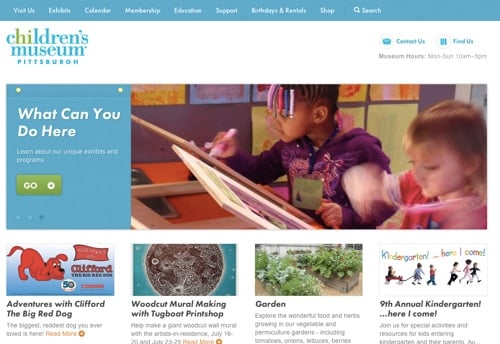
    • Children’s Museum of Pittsburgh: on mobile, they bubble up relevant content like how to get there, and they deprioritize that content on larger screens.
    • So you can still have one design, but use different priorities on mobile.

Smaller screens show important information about visiting like directions, hours, and contact details:

Museum mobile

On larger screens that information is deprioritized:

Museum desktop

It was a great high-level introduction to the conference, and I’m looking forward to the rest!

[Sponsor] Digg Reader: a Google Reader replacement

My thanks to Digg Reader for sponsoring Elezea’s RSS feed this week. If you haven’t settled on a Google Reader replacement (or even if you have), check it out!

Digg (yes, that Digg) has released a new RSS Reader for the web, iPhone, and iPad (Android coming soon). The design is sleek and clean, and the apps are speedy and efficient.

Whether you’re a hardcore RSS junky or simply want all your favorite online reading in one place, Digg Reader is for you. It’s free and available today!

Digg Reader

Sponsorship by The Syndicate.

The importance of Reddit

Ethan Zuckerman in Reddit: A Pre-Facebook Community in a Post-Facebook World:

Because Reddit connects strangers, it has certain advantages over Facebook, which connects friends. Ideas may spread more widely from Reddit than from Facebook despite a smaller pool of users. An idea shared between Facebook friends may peter out quickly as social networks reach saturation: an idea spread through friends who went to the same college may lose momentum when all alumni have heard about it.

Reddit users are connected to many different communities, and an idea spread on Reddit’s front page may go on to spread in thousands of different groups of friends on Facebook. This power to disseminate ideas to many different social subnets may explain why Reddit memes often go viral and why Reddit has emerged as a key node in online activism.

In social network theory terms, Reddit has figured out how to tap into “the strength of weak ties”1, whereas information on Facebook tends to keep getting recycled among people who already share strong ties offline.

Luke Kingma also touches on this strength in his interesting post The Next Great Social Network Will Not Put Relationships First:

The vast majority of us are not fortunate enough to have an incredibly diverse and interesting network of friends, family, and colleagues. Reddit works because the measure of a user is the content he shares, not the company he keeps. Moreover, visibility on Reddit is directly proportional to one’s utility in a given conversation. As a result, we are exposed to more interesting people, ideas, and perspectives.

This access to experts on any topic imaginable is what makes Reddit so powerful. The principle of content > relationships is probably also why Medium doesn’t have a follower model for its authors, but instead organizes content in topic collections. But Medium is a different topic altogether — I’ll post some thoughts on that platform soon.


  1. See my article How to increase the value you get out of social media for an extensive discussion of social network theory and weak ties. 

The mystery of Google+

Google Plus

I’ve been using Google+ a bit more frequently over the past few weeks. Of course, if you read this blog you wouldn’t have noticed. I know this because referral traffic to the site from Google+ is virtually non-existent. I find the whole narrative around Google+ extremely strange, so I’d like to get some of my random thoughts out in the open to see if anyone can add some insight.

First, viewed purely on its own merit Google+ is a fantastic social network. The interface manages to bring together all the best parts of Twitter (short updates, follow model), Facebook (pulling in short article summaries, good conversation mechanism), App.net (longer updates), and Flickr (beautiful photos). At the same time, it leaves out most of the annoying parts of those respective networks (like advertising, lack of context, and the inability to carry on a conversation). It’s my favorite social network to post links to, because I can add short commentaries or pull quotes from the article, and it automatically pulls in important metadata (sure, Twitter Cards also do this, but those aren’t supported by all sites and in all apps).

Second, Google+ feels like a parallel universe. As an active user of both Twitter and Google+, my experience has been that there is almost no overlap between the people who use those two networks on a daily basis. Further, users behave very, very differently depending on the platform. Twitter users comment more about Apple (well, the ones I follow anyway…), whereas Google+ content is much more slanted towards Google/Android news (not surprising, of course). Twitter users are more angry and combative, whereas Google+ is more like summer camp. Twitter feels frantic, Google+ feels relaxed.

And the weirdest thing — to keep beating a dead horse — is that the users on each network seem blissfully unaware of each other. It’s like going to a farmers market full of hipsters and young parents. Both are present, but it’s as if each group is invisible to the other1.

Getting actual numbers to compare the size of the networks is a fool’s errand. I don’t think we’ll ever really know how big each of the major networks are. But one widely reported statistic says that Google+ is now the #2 social network globally, behind Facebook but ahead of Twitter.

And this is why I’m confused. I think Google+ has a superior product in terms of its features. There appears to be lots of traffic on the network, and people are still reasonably nice to each other when they interact. And yet there’s no way I can even begin to think about moving off Twitter, because most of the people that I interact with and want to keep up with are on Twitter and not on Google+.

Does it mean that Google did too little, too late? Does it mean that the major social networks are all syphoning off their own unique customers that will never overlap? Is Google inflating the numbers artificially and it is, in fact, dying a slow death? Or, most disturbingly, does it mean that having a superior product doesn’t matter as much as strong network effects?

But then again, perhaps Google+ is not competing with who we assume they’re competing with. In line with Google’s vision to organize the world’s information, the focus on Google+ seems to be shifting to content more than relationships. And as Luke Kingma points out, the foundation of the next great social network will probably be the quality and relevance of the content, not the person who posted it. In that sense, I wonder if Google is more interested in being Reddit2 (the front page of the Internet), than it is in being a Facebook/Twitter clone (what your friends are up to).

I’d love to hear your thoughts on this… on Google+, of course.


  1. By the way, in this analogy Twitter would be the hipsters and Google+ would be the young parents. 

  2. Must-read article: Reddit: A Pre-Facebook Community in a Post-Facebook World 

[Sponsor] Backblaze: online backup & data dackup software

1 in 2 computer users lose data every year. Back up all your data with Backblaze online backup. It’s unlimited, unthrottled, uncomplicated, and unexpensive.

Don’t risk losing your music, photos, movies, and whatever else you’re working on or editing. Backblaze continuously and securely backs up all the data on your computer and external hard drives.

Need to restore or access your files? Download a single file or all your data from any web browser or have Backblaze FedEx you a flash key or USB hard drive. Even quicker - access your files right from your iPhone.


Whether it’s a broken hard drive, lost external, or a stolen computer, data loss happens all the time. For less than a cup of coffee, just $5/month, Backblaze can back up all the data on your computer.

It’s easy. Stop putting it off. Start your free trial, and get your backup started today.

Backblaze

Sponsorship by The Syndicate.

We can't blame the internet for our problems

By now most people have read Paul Miller’s I’m still here: back online after a year without the internet. The article is certainly deserving of all the attention it received back in May. I’m not sure what I expected — perhaps a gloating, holier-than-thou account of the virtues of going on an internet sabbatical to “find yourself”. But that’s not what this is. It’s a raw, often sad, always authentic account of a year that didn’t go at all as expected.

There is much to discuss and analyze in Paul’s experience, but I’d like to focus on this particular paragraph:

What I do know is that I can’t blame the internet, or any circumstance, for my problems. I have many of the same priorities I had before I left the internet: family, friends, work, learning. And I have no guarantee I’ll stick with them when I get back on the internet — I probably won’t, to be honest. But at least I’ll know that it’s not the internet’s fault. I’ll know who’s responsible, and who can fix it.

Paul touches on a really important point here. Over the past few years we’ve increasingly started to blame the internet or technology whenever we feel like we’re failing at being human beings. It all started with Nicholas Carr’s famous 2008 article Is Google Making Us Stupid?, a theme that is carried through in Kevin Kelly’s excellent book What Technology Wants.

These (and other) authors make great arguments, and I don’t doubt the validity of their assertions. But I do think the pendulum has swung too far away from the importance of personal responsibility. It has just become too easy to play the victim and blame technology for our own inability to resist it. Some people feel so powerless against the relentless pull of technology that they pay hundreds of dollars to go to what is essentially rehab for technology addicts. NPR tells the story in the article At Tech-Free Camps, People Pay Hundreds To Unplug:

Digital Detox co-founder Levi Felix attributes the high demand for tech-free retreats to a growing awareness of the pervasiveness of technology in our everyday lives. “People are feeling like something’s not right here,” he says.

With no iPhones or computers to distract them, campers at Camp Grounded participated in “playshops,” featuring yoga, laughing contests and writing sessions.

What the hell? “Laughing contests”? Isn’t that just called “going out to dinner with friends”? Sure, many of us find it hard to unplug, and we end up spending a lot of our time alone together1, but we can’t throw our hands in the air and blame inanimate objects for our woes. We have to take responsibility for our actions and realize that we have nothing to fear: our devices won’t become self-aware and attack us if we turn them off every once in a while.

I think Theodore Rooseveldt said it best:

If you could kick the person in the pants responsible for most of your trouble, you wouldn’t sit for a month.

Never alone

Image source: Jean Jullien


  1. This is a great book. Well worth your time. 

Sorting out messy online reputations

Graeme Wood takes a fascinating look at The World of Black-Ops Reputation Management for New York Magazine:

Whoever he was, it seemed that “Xander Fields” had built a whole Potemkin universe of positive-press websites that amplified made-up praise, often by made-up people, for a handful of rich folks with messy online reputations. I was now deep down in a ­rabbit hole but hadn’t yet landed with a ­satisfying thud. Who was “Xander Fields”?

I love reading stories like this. Consider this your required weekend reading.

Why the Steampunk movement is important

I’ve long been fascinated by the Steampunk movement, and Nick Harkaway’s The Steampunk Movement Is Good And Important is another great essay on the topic. Nick starts by explaining why Steampunk appeals to people (“it is premised on a technology which is visible and pleasing to the naked eye, and whose moving parts are comprehensible on a human scale,” and “it is an ethos of design and creativity which acknowledges the humanly physical, that which we can understand with our fingers”). He then goes on to explain how different this is from modern technologies like cell phones:

The ethos admits of failure: Steampunk devices almost are not working properly if they don’t have leaks, if they don’t require maintenance and the occasional thump. That’s where they get character and animation, identities of their own which reflect their owners, while every iPhone can be seen as Apple’s endlessly replicated identity given passage into your every waking moment, a tiny and instantly replaceable cloned shopfront: what role is conferred or imposed by such a device on the person carrying it? It’s not that Jonathan Ive’s designs are poor, it’s that they are profoundly truthful: an iPhone is a vector, not an object, valued by its creator for its purpose and interchangeability, not individuality.

Steampunk, on the other hand, repurposes, scavenges, remakes and embellishes in an arena where embellishment is seen as decadence, never mind the inherent decadence of creating the sheer amount of computing power our society now possesses in order that most of it should sit idle or be used for email and occasional games of Plants vs Zombies.

Steampunk appeals to the idea of uniqueness, to the one-off item, while every mainstream consumer technology of recent years is about putting human beings into ever more granular, packageable and mass-produced identities so that they can be sold or sold to, perfectly mapped and understood.

My Google Reader replacement setup

There have been quite a few posts over the past few months about what to do once Google Reader shuts down this weekend. I’ve been sticking my head in the sand, hoping that Silvio Rizzi will come to the rescue at the last minute and let me keep using my current setup, which is to use Reeder across all my devices (Mac, iPhone, and iPad). But alas, it looks like that’s not going to happen. So after much weeping and gnashing of teeth, here’s the setup I’ll go with for now.

  • Feedbin as RSS sync backend. I tried Feed Wrangler, but the lack of tags/folder structure is a deal breaker for me. I also set up Feedly, and it works nicely, but I’m just a bit worried about the service in general. There doesn’t appear to be a business model, and there’s currently no way to get your feeds out of the service. So, for now, $2/month for Feedbin is what I’m settling on. I really hope they add the ability to reorder and edit tags soon (come on, give the feature request some love!), but that’s the only major problem I currently have with it.
  • ReadKit on Mac. ReadKit just got a major update to support Feedbin, and it also lets me see and read all my Instapaper and Pinboard links in one place. This will be my desktop replacement for Reeder.
  • Reeder on iPhone. I don’t know how much longer Reeder will be around, but the iPhone client does support Feedbin, and it’s still my favorite RSS client ever, so I’ll stick with it for now.
  • Mr. Reader on iPad. Mr. Reader also just got a major update to support Feedbin. I used Mr. Reader before, but switched to Reeder when the iPad app became available. But since the Reeder iPad app is now very old (and still only supports Google Reader sync), I’ll move to Mr. Reader for the time being.

This is obviously quite a disjointed setup, and I’m not going to give up hope that there will be One Client To Rule Them All in the coming months. But this setup will hold me over until then. Like having to listen to Owl City while you wait for a new Death Cab for Cutie album to come out.

But I do feel like I now know way too much about the RSS reader landscape than I every wanted to. Thanks, Google.

Thanks, Google

Kids and their fascination with phones

James Fallows interviewed Linda Stone on Maintaining Focus in a Maddeningly Distractive World. This part, in particular, reminded me how destructive our technology use can be:

We may think that kids have a natural fascination with phones. Really, children have a fascination with whatever Mom and Dad find fascinating. If Mom and Dad can’t put down the device with the screen, the child is going to think, That’s where it’s all at, that’s where I need to be! I interviewed kids between the ages of 7 and 12 about this. They said things like “My mom should make eye contact with me when she talks to me” and “I used to watch TV with my dad, but now he has his iPad, and I watch by myself.”

There are many reasons why it’s important for kids to grow up around technology, but we should never forget how important it is for our kids to have our undivided attention when we’re with them.