Menu

Posts tagged “technology”

Cars as smartphones, and "No Fault Found" product returns

In Ford gives up on turning its cars into smartphones Zachary Seward shares a story on how adding seemingly cutting-edge features to everyday products can do more damage than good:

But it seems people have no patience for touchscreens when a simple knob will do. Raj Nair, head of global product development, tells the Wall Street Journal (paywall) that knobs and buttons will return to the dashboards of new Fords for functions like tuning the radio and changing the volume. The company said it would follow the model of its F-150 pickup truck, which currently sports a mix of touchscreen and more traditional controls on its dashboard panel.

This reminds me of a point Aylin Koca makes in her 2009 PhD study called Soft Reliability in New Product Development (PDF link):

Misalignments between product capabilities and user preferences damage the overall success of a product in the market. Especially in the past few years, these misalignments increasingly lead to users rejecting or returning products after purchase. However, technical analyses of such products show that these products fully meet their technical specifications. This is particularly the case with highly innovative products that bear considerable market uncertainty during their development.

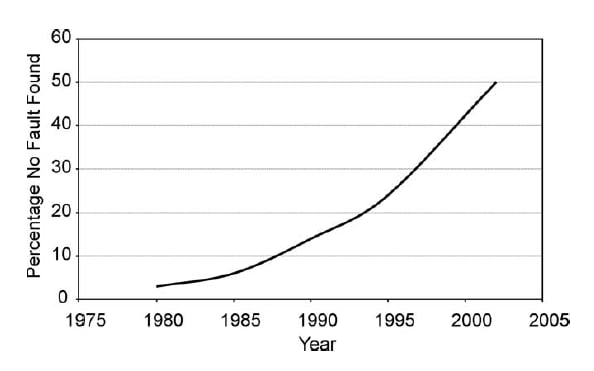
Have a look at this graph from Managing product reliability in business processes under pressure that shows the percentage of “No Fault Found” products that are being returned after purchase:

No Fault Found

More products than ever are being returned to shops because people think they are broken when they’re not — they’re just really difficult to use. And I guess that’s what Ford discovered as well: easy will beat fancy every time.

[Sponsor] MightyDeals.com: exclusive deals for web professionals

Ask anyone who’s ever tried to knock in a nail with a screwdriver: having the wrong tools is a major hindrance. Access to the right tools saves time, increases the quality of your work and adds to the pleasure of doing a job well.

The trouble for designers & developers is that there are so many tools out there, it’s hard to know what’s worthwhile, let alone being able to afford half of the resources we want.

That’s where MightyDeals.com comes in. We negotiate promotional deals with suppliers and often manage to agree up to 97% off regular pricing.

And what’s more, these aren’t just any tools, some of the best companies on the web promote their products through MightyDeals.com.

So if you’re looking for great deals, or just want to stay in touch with the latest fonts, applications, themes and resources, visit MightyDeals.com or sign up for our newsletter today.

Might Deals

Sponsorship by The Syndicate.

"I want an open, accessible, usable, free web"

I love this paragraph from Dave Rupert’s latest post on images in responsive design:

If the web cannot keep pace with a native experience in speed (rendering in under 1000ms), we’re all going to be out of a job. An uptick in native app usage means budget dollars would follow the trend and be poured into native apps. Meanwhile public facing websites will be left to rot because no one cared and we littered the web with bullshit. Native wins, the web dies, Zeldman hangs up his beanie, and Sir Tim Berners-Lee cries a single tear. That’s not the future I desire. I want an open, accessible, usable, free web available to anyone no matter the creed of their device.

Design and status

Nike+ Fuelband

William Kremer’s Why did men stop wearing high heels? is a fascinating look at history, gender inequality, and the peculiarities of seeking status. This part stuck with me:

In the muddy, rutted streets of 17th Century Europe, these new shoes had no utility value whatsoever — but that was the point.

“One of the best ways that status can be conveyed is through impracticality,” says [Elizabeth Semmelhack of the Bata Shoe Museum in Toronto], adding that the upper classes have always used impractical, uncomfortable and luxurious clothing to announce their privileged status.

“They aren’t in the fields working and they don’t have to walk far.”

So, people wore high heals because impractical clothes showed off one’s status. This seems very similar to how expensive sports cars are viewed in our current society. They’re highly impractical if you want to take anything with you where you’re going (or if you have kids), but having one certainly shows that you have a lot of money.

This got me thinking about technology products and their link to status. I remember that before the iPhone came out, during meetings people used to leave their cell phones in their pockets (well, on their belt clips…). Then, once the iPhone came along, pulling out your phone and placing it face up on the table became a status symbol. Suddenly the phone wasn’t meant to be hidden, but meant to be shown off. The iPhone is designed to be seen.

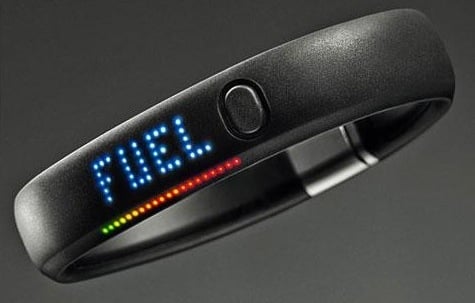
Companies like Nike tap into this sense of status by making the Fuelband extremely wearable. It’s not something you hide away, like the Fitbit. It’s something that’s meant to be shown off. From Dan Hon’s excellent article Fitness by design:

A few hours up the US west coast though, lies a company built upon not just sport performance, but also personal expression, fashion and style. Nike’s FuelBand is worn around your wrist. It looks and feels better, with its black rubber and distinctive pinpricked colour display inviting discussion. […] Though it is a silent device that constantly logs your activity, it is not out of sight — it is permanently visible, a wearable statement. You’re not given the choice of hiding it.

Of course, most technology products are very different from high heels in that they’re actually useful. So I guess some things have changed since the 1600s. Where impracticality used to be a sign of status, with technology we now associate that status with good design — a mix of utility, usability, and aesthetics.

[Sponsor] X WordPress Theme

My thanks to Themeco for sponsoring Elezea’s RSS feed this week to promote their brand new WordPress theme.

Themeco is proud to launch X, a first of its kind WordPress theme built in conjunction with leading business and marketing experts. To celebrate our release, we wanted to share a really powerful SEO technique that you can implement today.

Did you know there’s a little piece of code you can add to your popular posts or pages that will almost double or triple the amount of clicks you get? Google tracks on-site engagement closely, so anytime you can get your visitors to click through to multiple pages of your site it’s great for your SEO efforts. We’ll show you this one amazing trick and how we built it into our incredible new WordPress theme plus show you how to implement it even if you don’t use WordPress.

Get a free copy of our one-page report and learn how you can implement this strategy in the next 10 minutes.

X

Sponsorship by The Syndicate.

Smart cities and wealth creation

Rick Robinson wrote a really interesting article on the huge differences in life expectancy between the wealthiest and poorest areas of a city, and how the move to Smart Cities is trying to combat that. From Death, life, and place in great digital cities:

At the heart of the Smarter Cities movement is the belief that the use of engineering and IT technologies, including social media and information marketplaces, can create more efficient and resilient city systems. Might that idea offer a way to address the challenges of supporting wealth creation in cities at a sustainable rate of resource usage; and of providing city services to enable wellbeing, social mobility and economic growth at a reduced level of cost?

Rick goes on to explain some counter-intuitive dangers of this approach, and concludes:

We are opening Pandora’s box. These tremendously powerful technologies could indeed create more efficient, resilient city systems. But unless they are applied with real care, they could exacerbate our challenges. If they act simply to speed up transactions and the consumption of resources in city systems, then they will add to the damage that has already been done to urban environments, and that is one of the causes of the social inequality and differences in life expectancy that cities are seeking to address.

It’s a long, dense article, but it provides a much-needed realistic view of the power of technology to transform cities and the people who live there. The article also taught me this really good principle of urbanism:

Consider urban life before urban space; consider urban space before buildings.

That immediately jumped out at me as a good principle in software development as well: Consider user needs before applications; consider applications before individual pages.

On the topic of Smart Cities, also see Smart cities and smart citizens, a very interesting write-up about this year’s FutureEverything summit. It makes a similar point about the importance of life over buildings:

Perhaps part of the problem in current dialogues around smart cities is the failure to understand what a city actually is. The smart city vision has tended to focus on buildings and infrastructure or traffic management and how technology can increase efficiency. Catherine Mulligan of Imperial College London says the reverential tones with which some smart-city speculators talk about technology is worrying: “They say these systems and computers can now make better decisions than human beings. But if you take the human beings out, it’s just a bunch of buildings talking to each other… and that’s not a city. The city is what it is because of the people.”

More on algorithmic decision-making

Yesterday I posted The problem with letting algorithms make most of our decisions, discussing how removing all knowledge obstacles can make us less adept at dealing with challenges. As is often the case, within a few hours of posting that I came across two more articles that addresses the same issues. First, from Kyle Baxter’s very interesting essay On the Philosophy of Google Glass:

Page’s idea — that we would be fundamentally better off if we had immediate access to all of humanity’s information — ignores [how we develop knowledge]. It provides facts, but elides conclusions and connections. What’s worse, it starves us of opportunities to use our skill for critical thinking, and since it is a skill and is therefore something that must be developed and practiced, it starves us of the chance to develop it.

I find that troubling. Glass is not a technology that is designed to amplify our own innate abilities as humans or to make us better as humans, but rather one that acts as a crutch to lean on in place of exercising the very thing that makes us human. I don’t find that exciting. I find that disturbing.

And then, from Smart cities and smart citizens, an editorial in Sustain Magazine (which I’ll reference more over the coming days):

Furthermore, [Dan Hill, CEO of Fabrica] argues that current smart-systems thinking could lead us down a dangerous path towards passive citizens. As citizens — and city leaders — devolve their decision-making and responsibility to technology, their awareness of their environment diminishes in line with their ability to do something about it.

“If you automate too much stuff, people stop thinking about the issues. Yes, it might be more efficient to make the lights go off automatically, but it stops us thinking about it, we’re not engaged — and when we’re disengaged that’s not a good idea. We want people to think about something like carbon. Besides, we can turn the lights off on the way out — it’s entirely possible, we’re quite a smart species potentially!”

I find it fascinating how the Internet sometimes feel like one organism, always thinking and debating the same issues from many different angles. From Google Glass to Architecture to self-driving cars, it seems that currently we’re collectively worried about the impact of smart technologies on our lives.

The problem with letting algorithms make most of our decisions

Knight Rider Kitt

Image source: Knight Rider’s KITT - My finished replica!

Nicholas Carr asks some serious questions about things like self-driving cars and our increased reliance on algorithms for decision-making in Moral code:

As we begin to have computer-controlled cars, robots, and other machines operating autonomously out in the chaotic human world, situations will inevitably arise in which the software has to choose between a set of bad, even horrible, alternatives. How do you program a computer to choose the lesser of two evils? What are the criteria, and how do you weigh them?

Clive Thompson picks up the thread in a very interesting Wired article called Relying on Algorithms and Bots Can Be Really, Really Dangerous:

The truth is, our tools increasingly guide and shape our behavior or even make decisions on our behalf. A small but growing chorus of writers and scholars think we’re going too far. By taking human decision-making out of the equation, we’re slowly stripping away deliberation—moments where we reflect on the morality of our actions.

But even stepping away from the morality issues, there are some other undesirable side-effects to algorithmic decision-making:

Or as Evan Selinger, a philosopher at Rochester Institute of Technology, puts it, tools that make hard things easy can make us less likely to tolerate things that are hard. Outsourcing our self-control to “digital willpower” has consequences: Use Siri constantly to get instant information and you can erode your ability to be patient in the face of incomplete answers, a crucial civic virtue.

The argument is that smart technology has the potential to strip us of our grit. And that’s a big problem, particularly if you subscribe to what author Paul Tough calls “the character hypothesis”: the notion that noncognitive skills, like persistence, self-control, curiosity, conscientiousness, grit and self-confidence, are more crucial than sheer brainpower to achieving success.

The hypothesis is that character is created by encountering and overcoming difficult situations. Therefore one of the big dangers of algorithms making our decisions for us is that if it removes challenges from our lives, it reduces our ability to develop grit and build character. It’s like an Axiom for our brains.

Update: I came across a couple more articles about these issues. See More on algorithmic decision-making.

Instead of "intuitive", aim for UIs that are familiar, legible, and evident

John Pavlus wrote a great piece about the phrase “intuitive interfaces”, and comes to the following conclusion in I’m Boycotting “Intuitive” Interfaces:

I think what we all want from technology are interfaces and interactions that feel familiar, legible, and evident. They should teach us in ways we would like to learn, and speak to us in a way we can understand. This doesn’t mean that technology ought never to surprise or challenge us. But desperately seeking “intuitive” feels, to me, like a kind of techno-animism. Interfaces aren’t magic, and we don’t really want them to be. To borrow from Timo Arnall: interfaces are culture. And like any pieces of culture, what they ought to do is simple: they ought to connect.

For teens, Facebook is boring. Or a prison. Or something.

Cliff Watson in Teens aren’t abandoning “social.” They’re just using the word correctly:

What is Facebook to most people over the age of 25? It’s a never-ending class reunion mixed with an eternal late-night dorm room gossip session mixed with a nightly check-in on what coworkers are doing after leaving the office. In other words, it’s a place where you go to keep tabs on your friends and acquaintances.

You know what kids call that? School. For kids who still go to school, Facebook is boring. If one of their friends does something amazing or amazingly dumb, they’ll find out within five minutes. If they’re not friends with that person, it will take 15 minutes.

That’s interesting, but very different from the sentiment in two other recent articles on how teens use Facebook. First, from the fascinating and scary What Really Happens On A Teen Girl’s iPhone, in which a teenage girl describes Facebook more like a prison than anything else:

“I’ll wake up in the morning and go on Facebook just … because,” Casey says. “It’s not like I want to or I don’t. I just go on it. I’m, like, forced to. I don’t know why. I need to. Facebook takes up my whole life.” […]

“If you don’t get 100 ‘likes,’ you make other people share it so you get 100,” she explains. “Or else you just get upset. Everyone wants to get the most ‘likes.’ It’s like a popularity contest.”

And then from Slate’s Teenagers Hate Facebook, but They’re Not Logging Off, an article on a recent Pew study on social media usage among teens1:

“I think Facebook can be fun, but also it’s drama central,” one 14-year-old girl said. “On Facebook, people imply things and say things, even just by a ‘like,’ that they wouldn’t say in real life.” Said another, “It’s so competitive to get the most likes [on a Facebook picture]. It’s like your social position.” Ninety-four percent of American teenagers maintain a Facebook profile, but that doesn’t mean they have to like it. “Honestly,” one 15-year-old girl told Pew, “I’m on it constantly but I hate it so much.”

Whether Facebook is boring, a prison, or some bizarre combination of both, it seems that reports of its decline among teens have been a little premature. I don’t think “a trap you can’t escape” is a good way to ensure continued user growth and satisfaction, but that seems to be the position Facebook finds itself in at the moment.

I half-joked this morning (on Facebook, of course) that I’d like to start RealLifeBook, a site where you don’t leave out the ugly pictures and difficult parts of your life. I wonder if that’s part of the problem that makes Facebook feel like a place you hate but can’t leave — it looks like everyone else is always happy, so you can’t be yourself, and you get caught up in this endless cycle of trying to out-happy your friends to get the most likes.

Damn, do we have to rethink a few things about how the web works…


  1. danah boyd also posted some thoughts on the Pew report, and as always it’s very insightful.