Menu

Posts tagged “technology”

More on the hype, benefits, and dangers of Big Data

When I wrote The hype, benefits, and dangers of Big Data a few months ago I thought it would be my only post about Big Data, and then I’d move on. But 2013 appears to be the year of Big Data, so you can’t turn a corner on the web without bumping into an article about it. Looking at Google Trends, it’s clear that interest is at an all-time high:

So I wanted to point out just a few more articles that range from calling for a more tempered approach to Big Data to an all-out assault on its value and validity. Let’s start with the juicy one…

In A More Thoughtful but No More Convincing View of Big Data Stephen Few reviews the book Big Data: A Revolution That Will Transform How We Live, Work, and Think and uses it as a way to articulate his distaste with the whole thing:

Data exists in a potentially infinite supply. Given this fact, wouldn’t it be wise to determine with great care what we collect, store, retain, and mine for value? To the extent that more people are turning to data for help these days, learning to depend on evidence rather than intuition alone to inform their decisions, should we accept the Big Data campaign as helpful? We can turn people on to data without claiming that something miraculous has changed in the data landscape over the last few years. […]

As data continues to increase in volume, velocity, and variety as it has since the advent of the computer, its potential for wise use increases as well, but only if we refine our ability to separate the signals from the noise. More does not trump better. Without the right data and skills, more will only bury us.

It’s a long article, but very detailed and highly recommended as a well-reasoned counter-argument to the Big Data movement. Others are a little more pragmatic, suggesting that we improve on the promise of Big Data rather than destroy it. In Coffee & Empathy: Why data without a soul is meaningless1 Om Malik states:

What will it take to build emotive-and-empathic data experiences? Less data science and more data art — which, in other words, means that data wranglers have to develop correlations between data much like the human brain finds context. It is actually not about building the fanciest machine, but instead about the ability to ask the human questions. It is not about just being data informed, but being data aware and data intelligent.

It’s important to take this further and say the soul Om talks about needs to come from qualitative methods like ethnography. That’s why I like Dave McColgin’s point in his article How Will Big Data Change Design Research?:

In our field of designing products and experiences, the ‘why’ stays at the center of our process and creativity. Many designers work mostly on new products and services for which there may not yet be reliable data available. […] While Big Data can inform designers on how to improve once they put something out there, it is design research that provides principled guidance towards good solutions all along the way. Big Data can’t help us do that right now.

Tricia Wang’s Big Data Needs Thick Data is another excellent plea for ethnographers to get involved in the Big Data movement, to produce what she calls “Thick Data”:

Big Data produces so much information that it needs something more to bridge and/or reveal knowledge gaps. That’s why ethnographic work holds such enormous value in the era of Big Data. […]

Big Data reveals insights with a particular range of data points, while Thick Data reveals the social context of and connections between data points. Big Data delivers numbers; thick data delivers stories. Big data relies on machine learning; thick data relies on human learning.

And finally, Martin U. Müller and Marcel Rosenbach look at some of the scarier implications of Big Data in Living by the Numbers: Big Data Knows What Your Future Holds:

Is it truly desirable for cultural assets like TV series or music albums to be tailored to our predicted tastes by means of data-driven analyses? What happens to creativity, intuition and the element of surprise in this totally calculated world?

Internet philosopher Evgeny Morozov warns of an impending “tyranny of algorithms” and is fundamentally critical of the ideology behind many current Big Data applications. Morozov argues that because formulas are increasingly being used in finance and, as in the case of Predictive Policing, in police work, they should be regularly reviewed by independent, qualified auditors — if only to prevent discrimination and abuses of power.

I personally think there is the same value in data that there has always been, and that the Big Data movement isn’t so much about the size of the data sets, but the ability to extract more of that inherent value (signal) from the noise. But an algorithm will only take you so far. As always, knowing what and how much is not very useful without knowing why. And Big Data will never be able to tell us why…


  1. What’s that? You think I’ll just automatically link to any article with the word “coffee” in the headline? I resent that accusation, sir or madam! 

[Sponsor] Igloo: an intranet you'll actually like

My thanks to Igloo for sponsoring Elezea’s RSS feed this week.

Igloo has some funny new Sandwich videos to lighten your day (and maybe convince your boss and/or IT to upgrade your intranet to something more human). Check them out:

(You can also get a free 30-day trial and bring back Cake Fridays here.)

Igloo

Sponsorship by The Syndicate.

It's too early to write off Google Glass

Charles Miller starts his post On Google Glass with a story about the history of cell phones, and then makes a keen observation:

I’m pretty bad at predicting the success or failure of new technologies, but I just think it’s a little too early to write off something as potentially game-changing as Google Glass based on how it looks today, what it costs today, or based on the fact that we’re currently entrusting one of society’s most socially tone-deaf groups (nerds) with the question of when it’s appropriate to wear them.

My mom was one of the first people in our neighborhood to have a cell phone, but she was so embarrassed by the thing that she ran into a bathroom every time she received a call. So, yes, Google Glass sounds pretty creepy (now), and they look pretty silly (now), but it might not be like that 2 years from now.

The current limited usefulness of connected products

Liat Ben-Zur wrote a great post for AllThingsD called Connecting Things to the Internet Does Not an Internet of Things Make. His main issue with the current crop of connected devices is lack of cross-platform integration:

Each specific device seems to connect to its particular cloud service. There isn’t really one cloud. Every manufacturer has their own cloud service, and often these clouds are closed, proprietary environments. Devices that live in their own siloed cloud cannot speak to one another, meaning they cannot benefit from the data, context or control of nearby IoT devices. That is why we currently need a separate app to control — and interface with — each connected thing we buy. This may be acceptable in the near term, but it cannot scale.

This made me think of Ian Bach’s article Designing Connected Products:

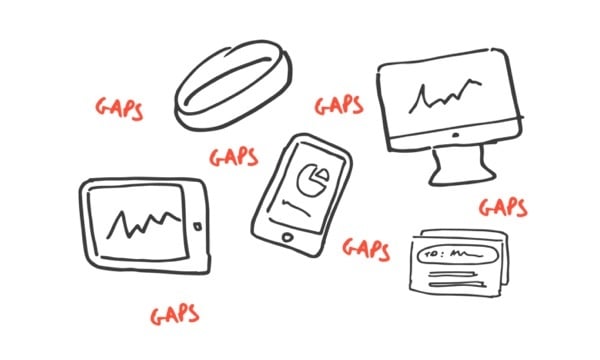
What’s more, when it comes to creating a smooth connected experience, focusing on the ‘things’ from the start can actually be somewhat of a decoy. Spend some time with any service or product that relies on data jumping from place to place and you’ll quickly realise it’s in the ‘gaps’ between things that design really matters. Problem is, gaps are easy to overlook, incredibly tough to design for and much less sexy than the ‘things’.

Gaps between things

Image source: Ian Bach

Ian comes from a different angle, but I think these points are related. Cloud services connect the ‘gaps’ between things, but it’s incredibly hard to fill the gaps well, so most companies keep their solutions proprietary since they see it as a competitive advantage. And that’s why we’re in the situation we’re in: great physical products with reasonably ok cloud services, but because the services don’t talk to each other the products aren’t nearly as useful as they could be.

(First link via @kbaxter)

Leaving gadgets on the table

Nick Bilton in Disruptions: Even the Tech Elites Leave Gadgets Behind, an article on the growing (not just hipster any more?) trend to step away from technology every once in a while:

As every aspect of our daily lives has become hyperconnected, some people on the cutting edge of tech are trying their best to push it back a few feet. Keeping their phone in their pocket. Turning off their home Wi-Fi at night or on weekends. And reading books on paper, rather than pixels.

The “phone stack” is becoming increasingly popular as a way to force people to talk to each other over dinner. Sad, but necessary.

Phone stack

Photo credit: Roo Reynolds on Flickr

[Sponsor] PDFpenPro 6 from Smile

PDFpenPro is the advanced version of PDFpen. PDFpenPro does everything that PDFpen does, such as add signatures, edit text and images, perform OCR on scanned documents and export Microsoft Word documents. It also has the ability to create a PDF form, build a table of contents, and convert HTML files to PDF.

The new PDFpenPro 6 adds document permission settings. When you share a PDF, you can restrict printing, copying, and editing of your PDFs. You can also use the new automatic form field creation tool to convert a non-interactive form into an interactive PDF form with text fields and checkboxes automatically added.

PDFpenPro 6 is available on the Smile Store and the Mac App Store for $100. A free demo can be downloaded on the Smile site. Find out why Macworld calls PDFpenPro “the crème de la crème of PDF editing and annotating applications.”

PDFpenPro 6

Thanks to Smile for sponsoring Elezea’s RSS feed this week! Sponsorship by The Syndicate.

Africa isn't really rising

Jumoke Balogun wrote a hard-hitting piece on uneven economic development in Africa Is Rising. Africans Are Not. The conclusion:

I understand that it is much easier to delight in articles and documentaries about a “rising Africa” than to examine personal class privilege. Economic inequality tasks those who have to consider the legitimacy of their wealth; it is an encompassing problem that we cannot donate, aid, or volunteer away. […]

We must all first admit that most Africans are not rising with Africa, and that wealth disparity is a major obstacle to overall development. Not doing so, and choosing to remain intentionally oblivious to the hardships of the majority of Africans who are losers in this new economic landscape is inane, and just downright cruel.

It’s quite chilling to read that article and then read Josh Ellis’s speech at Inspire Las Vegas a couple of months ago:

We call ourselves problem-solvers, but the evidence suggests the problems we want to solve are what are usually referred to as “First World” problems. […]

We are some of the smartest, most empowered humans who have ever lived. We have so much. Can we use our minds, our skills, our resources to make the world a better place for people who never had the opportunities we have? It would cost us so little, and we can accomplish so much.

This kind of thinking has become much more prevalent over the past couple of years, as smartphones and the app economy are reaching some level of maturity. As to why we tend to focus on solving “First World problems”, I like Paul Graham’s concept of “Schlep Blindness” — the inability to identify hard problems to solve:

The most dangerous thing about our dislike of schleps is that much of it is unconscious. Your unconscious won’t even let you see ideas that involve painful schleps. That’s schlep blindness.

But there is much value in identifying and solving the hard problems:

That scariness makes ambitious ideas doubly valuable. In addition to their intrinsic value, they’re like undervalued stocks in the sense that there’s less demand for them among founders. If you pick an ambitious idea, you’ll have less competition, because everyone else will have been frightened off by the challenges involved.

We don’t all have to stop what we’re doing and become social entrepreneurs. But if nothing else, these articles should nudge us to think about how we can move beyond the obvious problems. Instead of building another weather app, how about using weather information to send text messages to people when their area is in danger of flooding? Instead of focusing on providing people with nicer-looking information, what ways are there to help them do something with that information?

One organization that’s doing great work in this space is Praekelt Foundation. For example, TxtAlert sends automated, personalized SMS reminders to patients on chronic medication. MAMA uses mobile technologies to improve the health and lives of mothers in developing nations. Those are the kinds of solutions we need more of.

Twitter: better than flying cars

Bill Gates, pulling no punches in an interview with Wired:

Wired: Peter Thiel, expressing his dissatisfaction with technology’s progress, recently noted, “We wanted flying cars, instead we got 140 characters.” Do you agree with him?

Bill Gates: I feel sorry for Peter Thiel. Did he really want flying cars? Flying cars are not a very efficient way to move things from one point to another. On the other hand, 20 years ago we had the idea that information could become available at your fingertips. We got that done. Now everyone takes it for granted that you can look up movie reviews, track locations, and order stuff online. I wish there was a way we could take it away from people for a day so they could remember what it was like without it.

Gates’s point is well taken, but it’s also clear from his stance on the inefficiency of flying cars that he’s never been stuck in LA traffic.

(link via @ChrisFerdinandi)

What was shocking in 1995, we now call Facebook

I remember The Net as if it was yesterday. It’s a pretty laughable movie now, for sure, but back in 1995 it was an exciting and scary look at the future of the Internet. Chris Sims recently wrote a really funny and insightful retrospective of the movie, called What We Learned About Technology From 1995’s The Net. I especially like this part:

Really, though, the movie is more about how the rise of technology impacts our lives, and our changing ideas and concerns about privacy. Bennett was easily seduced by Devlin because he spied on her describing her ideal man in a chat room, and filled in the details by going through her records. As she says, our entire lives are recorded on computers, from our work to our taste in movies. In 1995, this was a shocking problem that people had to learn to deal with. In 2013, it’s basically how Facebook works.

Information that in 1995 required extensive sleuthing performed by clandestine government operations is now freely available to anyone who knows how to type a name into Google. It reminds me of this video (make sure you watch all the way to the end):

Steampunk and the future of Interaction Design

Joshua Tanenbaum, Audrey Desjardins, and Karen Tanenbaum take an in-depth look at Steampunk sub-culture, and specifically what it means for the future of Interaction Design, in their article Steampunking interaction design. It’s a dense piece, but really interesting. They discuss design fiction as a form of envisioning the future, and how Interaction Design could adjust to that possible future:

Steampunks have imagined a whimsical neo-Victorian fiction to frame their design practice: an optimistic lost age of adventure where invention, individuality, and innovation reign supreme. This fictional world reflects a set of values and relationships with technology, but that is not the most interesting or relevant thing that Steampunk has to offer the HCI (Human-Computer Interaction) community. Instead, it is in the practices of Steampunk makers that we can observe a possible future for interaction design: a future in which design is driven by aesthetics, grounded in a sustainable ethos, and aimed at serving the needs and preferences of distributed communities of engaged expert users.

Also see How steampunk culture offers clues to building a better future for another interesting viewpoint on this movement.