Menu

Posts tagged “technology”

On Google Buzz, online privacy, and where we go from here.

Google Buzz is really messing with my brain.  All my other social media activities fit nicely along the private-public continuum we all have to juggle.  But Buzz feels like an invasion of my personal space.  By infiltrating the most private of online communications (email), it’s also daring me to move that privacy line a little bit, and let people in on conversations that they really have no business in being a part of.  One of the few positive reviews I’ve read about Buzz so far is this tweet by my friend G-J:

Good point, but Tweetie for the iPhone already threads Twitter conversations, and I use Twitter lists to keep up with people in my closer network.  So I’m just not sure what to do with it, and that makes my brain hurt.

Privacy and the public persona

This issue, as well as the widely reported privacy gaps in Google Buzz, are just the latest in a growing conversation about privacy on the web.  Facebook’s recent updated privacy settings created quite a stir, and out of all the gazillion blog posts discussing it, none was more insightful than the brilliant Danah Boyd’s article Facebook’s move ain’t about changes in privacy norms.  It is a must-read for anyone interested in this topic.  In the article she says the following (my emphasis added):

There isn’t some radical shift in norms taking place. What’s changing is the opportunity to be public and the potential gain from doing so. Reality TV anyone? People are willing to put themselves out there when they can gain from it. But this doesn’t mean that everyone suddenly wants to be always in public. And it doesn’t mean that folks who live their lives in public don’t value privacy. The best way to maintain privacy as a public figure is to give folks the impression that everything about you is in public.

That last sentence really stuck with me.  It is so true.  Just because people divulge intimate details of their lives online, doesn’t mean everything they do is public.  Joshua Porter recently tweeted the following:

Ain’t that the truth…

But what if I want to maintain my privacy in public?

Another interesting story in this same vein — and a great example of the uncharted waters of online privacy — is that of designer Dustin Curtis.  I’ve been following his blog every since he blogged about the fascinating chain of events following his redesign of the American Airlines website.  That made him a bit of a celebrity in the world of web design, but it turned out to be nothing compared to what happened next.  On the day of the Apple iPad launch, he posted some very real-looking (but very fake) photos of the iPad.  It quickly sent the Internet into a frenzy and got him coverage on Mashable, TechCrunch and The Washington Post, among other places.

The next day he tweeted, simply:

Dustin Curtis: 1, Internet: 0.

Well played, sir.  Well played.  What’s interesting is what happened next, though.  He got a lot of attention from this stunt, and his Twitter follower count exploded.  He created an air of mystery leading a lot of people to wonder who he is.  It even led to a question on Quora with some amusing Chuck Norris-type answers: “Who is Dustin Curtis?”  The post on Quora prompted this tweet from him:

The answer is, of course, pretty straight-forward.  If you create a public and controversial persona, and in doing so amass over 13,000 followers on Twitter, people are going to want to find out more about you.  And, as a recent Times article pointed out:

When you make your private life public, when you seek attention in that broad a manner, you’re inviting not just the cool and the loving, but the angry and aggrieved.

And that is where online privacy get tricky.  We already talked about how public people value there privacy very much.  But at some point, people are going to assume that because you live a lot of your life in public, you have no need to be private, and won’t mind people digging around in your personal life (since there is no personal life any more).  But that’s clearly not the case, as Dustin points out in his tweet.

Facebook as theater

In a similar vein, I have to say that I have become increasingly uncomfortable with public conversations on Facebook.  And by that I mean girls who write “I miss you” on their boyfriends’ walls, people making coffee arrangements on each other’s walls, etc.  Once conversations that should be private are undertaken in a public forum, they become theater — meant for the onlookers more than the participants.  And that’s troubling.

Yes, there are legitimate cases (mostly for the sake humor) to have public conversations on Facebook.  But if you decide to write on someone’s wall and not send an email or a text, you are doing it so that other people can see it.  And that hurts the authenticity of the interaction.

So it’s not just that the lines between what is public and what is private are getting blurred.  It’s also that what is acceptable in the public realm is changing, as proven by those “I have to go to the bathroom” status updates I’m sure we all see occasionally in our news feeds.

Where do we go from here?

There are no universally agreed upon guidelines for what should be public and what should remain private online.  I’m pretty sure there will never be.  But I do believe that where that line is drawn should be a conscious decision by every person who goes online.  You can’t share every detail of your life online and then expect people to leave you alone.  You can’t go on Facebook, not change your privacy settings, and then complain if some of your photos leak out.  On the flipside, you can’t build a blog audience by writing articles that don’t expose your opinions in some way.

But wherever that line is drawn, it is extremely important that there is a point where your life stops being public.  The article Danger online: Perils of revealing every intimate moment puts it this way:

Concerns, though, are growing about the decline of the private self. Many people are questioning the wisdom particularly of blogs in which ordinary people write regular updates about their children and spouses, and they are asking whether we are surrendering our privacy too easily.

Or to put it another way, from another great article on the topic, Party On, but No Tweets:

We are fighting against this whole idea that everything people do has to be constantly chronicled. People think that every thought they have, every experience ”” if it is not captured it is lost.

When you let go of the pressure to chronicle, you are free to enjoy the moment for what it is, without the pressure of getting that picture up on Twitpic.

Don’t get me wrong — I think it is possible to build fantastic communities online by living public lives — both for business and personal purposes.  And I am definitely not going to stop blogging or shut down my Twitter account.  However, more and more I am finding myself agreeing with another sentence buried in that last article: There is something magical about a life less posted.

Netflix doesn't know me: How I lost faith in recommendation engines

When Netflix first came out with their movie recommendations, I thought it was a great idea. I started rating movies I’d seen — good and bad — confident that the brain behind it all will do its magic and recommend some hidden movie gems that will, you know, change my life. Well, I’m still waiting for those movies. And to be honest, I’ve become a little bit frustrated with the whole thing.

Describing the latest example I encountered will reveal how much I liked a movie that I probably have no business liking, but I’m willing to sacrifice a little bit of my reputation in the name of science, or whatever this is…

The first problem I encountered is a pure UI issue, and has to do with how Netflix shows the star movie ratings on their pages. As an example, this is what I see for the movie August Rush in my queue:

You would assume that the customer average rating is just over the 3-mark, right? Well, looking at it closer, it turns out that Netflix shows you a rating they call “Our best guess” (3.4 in this case), instead of showing you the customer average (4.1 in this case):

Here’s the problem. I loved this movie. I’m giving it 4 stars. But since Netflix doesn’t know that I have a soft spot for modern musicals (despite how highly I rated the movie “Once”), the “Netflix brain” didn’t think I would like this movie as much as the average customer.

This is a problem you see often on sites where the UI does not give proper user feedback about what it’s showing you.  It took me a few weeks to realize they’re showing me “Our best guess” in search results, and not the true customer average. Now I have to mouse over to see the true average every time. Why? Because I don’t trust the brain any more. (By the way, this is just one example, but as I’ve looked into it more, I realized it’s a systemic problem for me — Netflix’s best guess is rarely in line with my tastes).

Incidentally, on Amazon.com, the average user rating is 4.5 out of 5 stars. Pretty good. So this is the problem then. There is such a wide range of tastes out there that it’s hard to know who to trust. This is the problem Netflix is trying to solve — let’s look at “users like you” and then show you that average instead of the overall average. You’re therefore initially more inclined to believe the “best guess” rating provided by Netflix, than the average consensus provided by all users. It’s a good idea, but the implementation doesn’t seem to be there yet.  (The discussion about the validity of 5-star ratings in general is a separate and very interesting discussion).

I say all this to make a simple point — it appears that the collective wisdom of all users does a better job of predicting if I will like a movie than the recommendation engine provided by Netflix. The question is whether it would ever be possible for recommendation engines to get to know you well enough based on your preferences. Maybe if it takes into account not only your movie interests, but also music, books, online activity, etc.? Yes it sounds creepy, but how else would Netflix know how much I like strange modern musicals?

Email is dead. Long live email.

There has been growing discontent with email over the past year or so, but it appears that many people’s hatred for this particular form of communication has now finally started to boil over.  Several articles and blog posts over the past few weeks lamented the death and/or evilness of email in no uncertain terms.  In this post I go into a few highlights from said email hatemail, followed by some thoughts on why we shouldn’t be so fast to close down our email accounts.

The problem with email is…

First, a disclosure.  The excerpts below are just that: excerpts.  While I attempt to keep the context and the original intentions of the authors intact, I encourage you to read all these articles in their entirety.  They’re not only thoughtful and well-written, but they also lay a solid foundation for what I think is a very worthy and much-needed debate.

In the article Why Email No Longer Rules”¦, the Wall Street Journal announces that email is king no more:

But email was better suited to the way we used to use the Internet””logging off and on, checking our messages in bursts. Now, we are always connected, whether we are sitting at a desk or on a mobile phone. The always-on connection, in turn, has created a host of new ways to communicate that are much faster than email, and more fun.

Caught up in Google Wave frenzy, Techcrunch laments the following in Google Wave And The Dawn Of Passive-Aggressive Communication:

Google Wave is not just a service, it is perhaps the most complete example yet of a desire to shift the way we communicate once again.  For many of us, email is simply not cutting it the way that it used to. It’s a sedentary beast in a fast-moving web. It uses old principles for management, and this is leading to overload.

Sticking with Techcrunch, in Relevance Over Time, Nik Cubrilovic argues that email sacrifices relevance in order to present items in a chronological order:

Chronological order needs to be abandoned in favor of relevance. Without relevance, our ability to manage large sets of information is inefficient. The technology for relevance exist today, for eg. spam filters are able to tell us what we definitely don’t want to read. Real world information retrieval and organization is based on relevance, either what somebody else believes is relevant to us, or what we decide is relevant. Newspaper stories are not laid out in the order that events took place and libraries do not catalog their books in the order they were published.

Jeff Atwood, in a post entitled Email: The Variable Reinforcement Machine, explains why he think email kills productivity:

Oh, sure, we delude ourselves into thinking we’re being extra-productive by obsessively checking and responding to our email, but in reality we’re attending too frequently to our own desire for gratification and sabotaging our own productivity in the process.

Why email is essential in business communication

After reading each of these articles, the same question kept coming to mind: How do these authors use email? They certainly don’t use it the same way I do.  Because I simply cannot imagine replacing email with Twitter and Facebook - and even Google Wave.  As far as I can tell, here are the major complaints about email:

  1. Email is not real-time enough. I don’t understand this complaint at all.  How is Twitter more real-time than either sitting at your desk with your email client open, or checking your BlackBerry for new messages?  Yes, Google Wave lets you see people type in real-time, but do we really need that?
  2. Email is not dynamic enough. I don’t want email to be dynamic.  Email is a way to communicate static thoughts.  Tools like Google Docs, Dropbox, and Versionshelf are there for collaboration.  But email is a linear record of events and discussions, which is essential if we want to preserve any kind of sanity in business communication.
  3. Email is chronological, not relevant. This complaint perplexes me the most.  If email isn’t relevant, you may want to write different emails, or just spend a little time setting up a few filters to get rid of Hilton HHonors statements and other useless newsletters.  Chronology brings order.  Even though the most important things might not be at the top of your inbox,  timestamp is an important element in helping us separate the urgent from the important.
  4. Email reduces productivity. More than being on Twitter all day reduces productivity?  I’d like to see how productive people are who do business in 140 characters.

In short, I’m just not ready to give up email.  It serves as a very effective To Do list for me.  It allows for accurate and extensive documentation when needed, as well as quick decision-making with a variety of stakeholders.  Long live email.

How to increase the value you get out of social media

A common complaint about social networks is that they insulate us by only showing us information we’re already likely to agree with. This solidifies our existing confirmation biases and makes us less likely to see the value of other viewpoints. It’s a legitimate concern, but we only have ourselves to blame. The problem is that if we don’t follow enough people from different types of networks, we’re always going to see the same type of information over and over.  And in this fundamental point also lies the best way to get the biggest benefit from social media.  So stick with me as we discuss some sociology theory, which I promise will lead to some practical implications in the end.

First, a little background on Structural Hole Theory.

Structural Holes Defined

Ronald Burt’s theory of “structural holes’ is an important extension of social network theory, which argues that networks provide two types of benefits: information benefits and control benefits.

  • Information benefits refer to who knows about relevant information and how fast they find out about it. Actors with strong networks will generally know more about relevant subjects, and they will also know about it faster. According to Burt (1992), “players with a network optimally structured to provide these benefits enjoy higher rates of return to their investments, because such players know about, and have a hand in, more rewarding opportunities”.
  • Control benefits refer to the advantages of being an important player in a well-connected network. In a large network, central players have more bargaining power than other players, which also means that they can, to a large extent, control many of the information flows within the network.

People with a lot of followers on social media have a high degree of Control benefits — they are often extremely influential in their fields, and in unique positions to have control over certain conversations on the web. But being an influencer doesn’t guarantee that you will have strong Information benefits , because you tend to get the same news over and over again if you don’t do a bit of work on expanding your network in a very deliberate way.

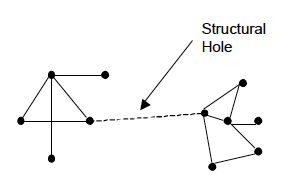
Burt’s theory of structural holes aims to enhance both these benefits to their full potential. A structural hole is “a separation between non-redundant contacts” (Burt, 1992). The holes between non-redundant contacts provide opportunities that can enhance both the control benefits and the information benefits of networks. The figure below shows a graphical representation of this definition.

The concept of non-redundant contacts is extremely important, and refers to contacts who give you access to networks you aren’t already part of. Now let’s look at how Mr. Scoble can increase the Information benefits he gets from Twitter.

Optimizing the benefits of networks

There are several ways to optimize structural holes in a network to ensure maximum information benefits:

  • The size of the network. The size of a network determines the amount of information that is shared within the network. A person has a much better chance to receive timely, relevant information in a big network than in a small one. The size of the network is, however, not dependant merely on the number of actors in the network, but the number of non-redundant actors. In other words, it’s not just about how many people you follow on Twitter, it’s also who you follow.  Pretty straight-forward, but let’s continue.
  • Efficient networks. Efficiency in a network is concerned with maximizing the number of non-redundant contacts in a network in order to maximize the number of structural holes per actor in the network. It is possible to eliminate redundant contacts by linking only with a primary actor in each redundant cluster. This saves time and effort that would normally have been spent on maintaining redundant contacts.  What this basically means is that if you follow people who all follow each other, your network isn’t very efficient and you need to get rid of some people.
  • Effective networks. Effectiveness in a network is concerned with “distinguishing primary from secondary contacts in order to focus resources on preserving primary contacts” (Burt, 1992:21). Building an effective network means building relationships with actors that lead to the maximum number of other secondary actors, while still being non-redundant.  This means that if 10 people give you access to the same network of information, only follow the most important one — their voice will be clearer and not drowned out by the others.
  • Weak ties. In his 1973 paper entitled “The strength of weak ties”, Mark Granovetter (Granovetter, 1973) developed his theory of weak ties. The theory states that because a person with strong ties in a network more or less knows what the other people in the network know (e.g. in close friendships or a board of directors), the effective spread of information relies on the weak ties between people in separate networks. “Weak ties are essential to the flow of information that integrates otherwise disconnected social clusters into a broader society” (Burt, 1992). This basically means that to get more out of Twitter, you need to figure out where your network is weak, and then follow those people who give you access to additional clusters. Building and maintaining weak ties over large structural holes enhances information benefits and creates even more efficient and effective networks.

So here’s the bottom line: to achieve networks rich in information benefits it is necessary to build large networks with non-redundant contacts and many weak ties over structural holes. Some of these information benefits are:

  • More contacts are included in the network, which implies that you have access to a larger volume of information.
  • Non-redundant contacts ensure that this vast amount of information is diverse and independent.
  • Linking with the primary actor in a cluster implies a connection with the central player in that cluster. This ensures that you will be one of the first people to be informed when new information becomes available.

How to get the most out of social media

If we apply these theories to Twitter and other social media networks, we quickly realize it is not the sheer number of “friends” in your network that count, it is the diversity of the people in your network that is most important. If you only have links to people in your immediate group of friends or colleagues, it will be difficult to get new information, since everyone will pretty much know the same things. This is not to say that you have to start following all those random spammers on Twitter, but it does mean that people with who you have “weak ties” will often provide you with new information and therefore more benefits than your “strong ties”.

So here’s how to make sure you get the most out of social media:

  • Identify the information networks you want to have access to (for me, it’s information about user experience design and product management).
  • Go through your following list and see where the overlap is — if there is a lot of resharing going on of the same people, follow the person who gets reshared the most.  This will reduce your Twitter stream but still get you the information you need (and faster than before).
  • Once you’ve reduced your following list, make your network as large as possible with the “weak ties” who will give you access to all the information you need.

These theories show that we can reduce the number of people we follow while actually getting more Information benefits from social media. We will get new information faster, we will get it only once or twice, and the information we get will be more diverse.

References

Burt, Ronald S. (1992). Structural Holes: The Social Structure of Competition. Cambridge: Harvard University Press. Granovetter, M. S. (1973). “The Strength of Weak Ties.” American Journal of Sociology 78: 1360-1380.

Using Twitter to value online information

I have recently noticed an interesting trend among the people I follow on Twitter. It appears that my network is dividing itself neatly into 2 camps: those who care deeply about the content they publish, and those who use it more casually. Let me explain…

Saying “good night” to everyone you know

Twitter users who casually update their status without thinking about it too much continuously say things like “Yep,” “Good night tweeple,” and “Banging my head against the desk.” Cryptic information that can be quite difficult to figure out. I’m not saying that this is necessarily a bad thing. It’s just clear that some people view Twitter as a broadcast medium mainly meant for people they know in the real world, and that’s fine (I tend to think that’s what Facebook is for, but let’s not split hairs about this).

I’m also not suggesting that all tweets should be serious — the odd random or exasperated update can be interesting, enlightening, and often very funny, and it also shows that there’s a real person at the other end. I do follow a lot of these casual users, but I know all of them personally so their updates are meaningful to me. And of course there is always the option to stop following someone, so you only have yourself to blame for the content you receive on Twitter.

But then there are those who care a lot about what they say…

Sharing content via Twitter

People who care see Twitter not just as an outlet for random thoughts, but also a valuable tool to learn and share and expand their knowledge about issues they care about. I follow a bunch of people who clearly care about the content they put on Twitter, and it adds enormous value to my work life and personal life (people like @jontyfisher, @adamnash, @SmithInAfrica, and @TheONECampain, just to name a small and diverse subset of folks).

Sharing interesting information on Twitter makes you a good citizen of the web for a very important reason. It allows the best content to rise to the top. What makes content sharing on Twitter powerful is that humans are involved, not just technology. The difference between going through your RSS feeds and learning about something through your Twitter network is that on Twitter, someone read the content and decided that it is good enough to share. And if you follow people with similar interests, chances are you will find it interesting too. As Justin Basini (@justinbasini) put it in a recent post: “Twitter users aggregate, edit, filter and share better than any technology.”

But what if the content isn’t interesting to anyone else? Well, then it will just die in the constant stream of tweets that go by every day. If the content is good, it will be retweeted, and spread rapidly not just through your own network but the networks of others.

In sociology the phenomenon of information spreading through multiple networks is known as The strength of weak ties. In a 1973 paper, Mark Granovetter developed his theory of weak ties. The theory states that because a person with strong ties in a network more or less knows what the other people in the network know (e.g. in close friendships or within your closely-guarded Facebook network), the effective spread of information relies on the weak ties between people in separate networks.

And this is of course one of the main strengths of Twitter — that not all connections have to be mutual (when you follow someone they don’t have to follow you back, like on Facebook). In other words, retweeting allows information to jump from one tightly-knit network to the next, allowing for the rapid spread of valuable information throughout the entire network, not just your own.

A new way to value information on the web

There are still a lot of people who feel that Twitter is a waste of time and adds no value. That might be true for them, but I think we are seeing a very interesting phenomenon here, and that is a new way to value information on the web and separate what’s worthy of reading from what’s not.

RSS feeds allow us to see content we might be interested in (but not every article will be good). Digg and similar services allow us to see what other people find interesting. But only Twitter puts those features together and lets us see content that people with similar interests than ours find valuable. And there is real power in that.

Oh, and you can follow me on Twitter if you’d like.