Menu

Posts tagged “content strategy”

Netflix's 76,897 micro-genres and the age of data-driven art

Alexis Madrigal — who is turning into one of the most interesting journalists of our time — goes deep on Netflix’s 76,897 (often bizarre) micro-genres in How Netflix Reverse Engineered Hollywood:

Netflix has meticulously analyzed and tagged every movie and TV show imaginable. They possess a stockpile of data about Hollywood entertainment that is absolutely unprecedented.

Netflix is putting in a staggering amount of effort on the structured data of their TV shows and movies. And of course, it’s all for one reason — to get to know you better:

They capture dozens of different movie attributes. They even rate the moral status of characters. When these tags are combined with millions of users’ viewing habits, they become Netflix’s competitive advantage. The company’s main goal as a business is to gain and retain subscribers. And the genres that it displays to people are a key part of that strategy. “Members connect with these [genre] rows so well that we measure an increase in member retention by placing the most tailored rows higher on the page instead of lower,” the company revealed in a 2012 blog post. The better Netflix shows that it knows you, the likelier you are to stick around.

And now, they have a terrific advantage in their efforts to produce their own content: Netflix has created a database of American cinematic predilections. The data can’t tell them how to make a TV show, but it can tell them what they should be making. When they create a show like House of Cards, they aren’t guessing at what people want.

What’s interesting is that similar things are happening in other forms of media as well. Spotify and Rdio’s knowledge of our listening data can be used to inform record labels what type of albums they should invest in. And as David Streitfeld reports in As New Services Track Habits, the E-Books Are Reading You, a new crop of companies are helping authors figure out what type of books they should write:

The move to exploit reading data is one aspect of how consumer analytics is making its way into every corner of the culture. Amazon and Barnes & Noble already collect vast amounts of information from their e-readers but keep it proprietary. Now the start-ups — which also include Entitle, a North Carolina-based company — are hoping to profit by telling all.

“We’re going to be pretty open about sharing this data so people can use it to publish better books,” said Trip Adler, Scribd’s chief executive. […]

Scribd is just beginning to analyze the data from its subscribers. Some general insights: The longer a mystery novel is, the more likely readers are to jump to the end to see who done it. People are more likely to finish biographies than business titles, but a chapter of a yoga book is all they need. They speed through romances faster than religious titles, and erotica fastest of all.

All of this raises familiar questions about the loss of serendipity — finding interesting things we’re not looking for. But I still think this is an unnecessary fear.

Paying for less information

Kontra explores a particularly egregious style of “content marketing”-style advertising on CNN’s website in his post “You Might Also Like”. He concludes:

Will these advertorial deceptions and misdirections move from the ad wells around the periphery of the page into the news delivery itself? Will there be product placements within news sentences? What follows that? Is the “mainstream media” management about to capitulate on long-held principles because it’s unable or unwilling to pursue any other strategy but the race to the bottom of the advertising barrel? Is there anything more precious than credibility to a news organization? If not, why is Time Inc. poisoning its own well so nonchalantly?

Contrast CNN’s approach with The Information, an online-only publication that just launched with a price tag of $400/year. Most people believe it won’t work, but I think Hunter Walk makes a good point in $400 for The Information Is About What’s Missing, Not What’s There:

For me the value in The Information is not solely in what they’re providing but what they’re leaving out. The ~two articles a day are both interesting. Because they’re not playing a page views game, they don’t need to overload me with 25+ posts every 24 hrs. The site is spartan because they don’t need to worry about IAB units. A small number of writers building their beats give me the chance to see each journalist’s style distinctly, not settle into some random byline slot machine of varying quality.

It’s sad that we have to pay not just to have a distraction-free reading environment, but also to reduce the amount of information we get to something more manageable (and focused on quality over quantity). But that appears to be the new world of publishing.

Weekend reading: online publishing's race to the bottom

Upworthy style

This week we saw quite a few articles on the rapidly changing online publishing scene. In particular, there is a lot of analysis going on about the sudden and unexpected traffic domination by sites like Buzzfeed and Upworthy, as readers (or rather, clicks…) move away from more established outfits like the Huffington Post.

To set the stage, Alexis Madrigal wonders if 2013 will be The Year ‘the Stream’ Crested. He refers to the endless updates on social networks, which are always presented in reverse chronological order — a design that inherently implies that new=good and old=bad:

When the half-life of a post is half a day or less, how much time can media makers put into something? When the time a reader spends on a story is (on the high end) two minutes, how much time should media makers put into something?

The necessity of nowness plus the professionalization of content production for the stream means that there are thousands and thousands of people churning out more crap than can possibly be imagined. 

In a story that proves Madrigal’s point about an inevitable, exasperated move away from this “nowness”, Robinson Meyer asks Why Are Upworthy Headlines Suddenly Everywhere? He explains that beyond the obvious reason — clickbait headlines work because, well, people click on them — lies a change in Facebook’s algorithm that rewards “viral” stories more than recent stories. In Facebook’s words, “stories that people did not scroll down far enough to see can reappear near the top […] if the stories are still getting lots of likes and comments.” Meyer continues:

Simultaneous to this traffic upheaval, an entire vocabulary and syntax for headlines that people click and share — and oh, boy, do they click and share — had presented itself on the social web. For publishers trying to grab more traffic from Facebook, the path became clear. Borrow, adapt, employ the Upworthy style post haste. Assure readers your content was nothing but wondtacular. And so began the wondtacularization.

So “nowness” is replaced by whatever can get the most clicks, regardless of its age. On the surface this move away from “the stream” sounds like a good thing, but we need to dig a little deeper. Another interesting tie-in to these stories is Farhad Manjoo’s Why Everyone Will Totally Read This Column. It’s a profile on Neetzan Zimmerman, who is in charge of posting “viral” content on Gawker (with remarkable success):

He posts only about a dozen items a day. Almost every one becomes a big traffic hit — an astonishing rate of success. I’ve worked on the Web for years, and I still have trouble predicting which of my stories will be hits and which will appeal only to my mom. Mr. Zimmerman has somehow cracked the code.

His secret, he says, is a deep connection to his audience’s evolving, irreducibly human, primal sensibilities. Usually within a few seconds of seeing an item, Mr. Zimmerman can sense whether it’s destined to become a viral story. “I guess you could call it intuition,” he says.

And now we get to the crux of it. What happens to the truth when all focus shifts to a story’s ability to go viral? That’s what Ravi Somaiya and Leslie Kaufman explore in their NYT piece If a Story Is Viral, Truth May Be Taking a Beating. They explain how this never-ending hunt for more clicks means that it doesn’t even matter if a story is true or not:

When the tales turned out to be phony, the modest hand-wringing that ensued was accompanied by an admission that viral trumps verified — and that little will be done about it as long as the clicks keep coming. “You are seeing news organizations say, ‘If it is happening on the Internet that’s our beat,’” said Joshua Benton, director of the Nieman Journalism Lab at Harvard. “The next step of figuring out whether it happened in real life is up to someone else.”

So this is the environment we find ourselves in right now:

Start with an entire industry built on the sandy foundation of ad revenue. Throw in a particular style of headline that feeds off people’s “primal sensibilities”. Add a Facebook traffic machine that is continuously tweaked to pick up these stories and recycle them endlessly on people’s news feeds. And what do you get? A race to the bottom where viral trumps verified, lowbrow beats intellectual, and cheap clicks beat in-depth reporting and considered opinion. Suddenly the Postliterate society doesn’t sound like such a crazy prediction any more.

No more FAQs

Lisa Maria Martin gives some advice on What To Do With Those Dreaded FAQs:

These all underscore FAQs’ fatal flaw: they are content without context, delivered without regard for the larger experience of the website. You can hear the absurdity in the name itself: if users are asking the same questions so frequently, then there is an obvious gulf between their needs and the site content. (And if not, then we have a labeling problem.) Instead of sending users to a jumble of maybe-it’s-here-maybe-it’s-not questions, the answers to FAQs should be found naturally throughout a website. They are not separated, not isolated, not other. They are the content.

We’re definitely in agreement about that. A while I go I wrote this:

Most users don’t know what FAQ stands for, and besides, it’s bad practice to answer questions outside the context people want to ask them in. Figure out where in the process each question in your FAQ might come up, and provide the answer right there within the flow. Don’t expect people to click to a different page to find the information they need.

By the way, 24 ways is a collection of fantastic design and development articles and tutorials for advent. If it’s not part of your daily reading yet, make it so!

Good writing and the death of plain language

I just read the following sentence in some digital strategy PDF thing:

As digital adds value to the customer experience there is an opportunity to amplify what the person experiences on the application.

I have no idea what that means, and I don’t think anyone does. The state of business writing is just abysmal right now. So many words that sound fancy but don’t mean a thing. Here’s another example from something I had to read last week:

Economic volatility plus consumer tech revolution is changing customers’ expectation of brands.

Uh, what?

Confused

Anyway, I just started reading William Zinsser’s On Writing Well, a book I should have read a long time ago. First published more than 30 years ago, it’s still engaging and fresh. Consider this passage, which I couldn’t get out of my head as I read through those “digital strategy” documents:

Still, we have become a society fearful of revealing who we are. The institutions that seek our support by sending us their brochures sound remarkably alike, though surely all of them — hospitals, schools, libraries, museums, zoos — were founded and are still sustained by men and women with different dreams and visions. Where are these people? It’s hard to glimpse them among all the impersonal passive sentences that say “initiatives were undertaken” and “priorities have been identified.”

We all need to heed Zinsser’s advice on simple writing:

Our national tendency is to inflate and thereby sound important. The airline pilot who announces that he is presently anticipating experiencing considerable precipitation wouldn’t think of saying it may rain. The sentence is too simple—there must be something wrong with it.

But the secret of good writing is to strip every sentence to its cleanest components. Every word that serves no function, every long word that could be a short word, every adverb that carries the same meaning that’s already in the verb, every passive construction that leaves the reader unsure of who is doing what — these are the thousand and one adulterants that weaken the strength of a sentence. And they usually occur in proportion to education and rank.

This is something I want to be a lot more cognisant of in my own writing going forward. So feel free to call me on it when I get too verbose.

Content modules for Responsive Web Design

Responsive gif

By now it’s been well drilled into our heads that web design starts with content, not with graphics. However, in practice, getting real content before the design process starts is challenging at the best of times, and it’s made even more difficult by the fact that we have to try to get to content parity across all types of devices.

So to deal with this complexity we come up with more pragmatic guidelines. Mark Boulton’s “Structure First. Content Always.” is certainly a more realistic approach:

You can create good experiences without knowing the content. What you can’t do is create good experiences without knowing your content structure. What is your content made from, not what your content is. An important distinction.

So you have to start with the structure not the words. […] How do we design around the fluidity? Well, we define structure; of our content, and the templates that content inhabits. We define the rules of the system to display the content in different ways (if we can) to help the reader understand the content better.

The problem with all these approaches has always been the same for me: It sounds awesome in theory, but I don’t know how to make it part of our workflow when we’re in the weeds with client work. So we tend to try to make physical things that help us get there1. First we created expanded customer journey maps to define a content plan based on user needs and personas.

That helped a lot, but on the next project we got stuck on content structure again — how do we create different page templates with different types of content, without getting into interaction design too soon? So we came up with the idea of Content Modules: diagrams that show the relative importance and length of different types of content, in a Mobile First context. Here’s an example:

Content Modules

This document has a few key components:

  • Each block outline represent a distinct content chunk that can be used on any other page.
  • The primary call to action is highlighted (in orange in the example above) so that we can easily check for consistency and impact across different pages.
  • Some pages will have optional modules — those are also highlighted (in yellow in the example above).
  • A gap in a column doesn’t mean there’s going to be empty space on the page. This is not a layout diagram. It just shows the relative importance of each chunk. It also allows one to easily compare which page templates have which types of content on the page. This lets you easily spot if there’s some missing content (or unneccesary duplication).
  • Each page template looks like a mobile view. That’s by design. It helps us to move straight into designing mobile views first, using the content hierarchy defined in the document, and then scale that up to larger views.

Creating content modules was the missing step we needed to bridge the gap between the content plan in our expanded customer journey maps, and starting the interaction design / prototyping phase. I was constantly worried that we’d start projects with content at the centre, but then gradually backslide into old ways as the project progresses. This document helps us to move seamlessly from content planning to interaction design, confident that we’re designing on the right content-led foundation.


  1. I’m really trying to avoid the word “deliverables”, but I’m struggling. 

How to build an audience in 743 difficult steps

Earlier today I delivered a talk called “How to build an audience in 743 difficult steps” at WordCamp Cape Town. This is a written version of the core points from the talk.

The biggest question every writer asks when they start publishing online is, “How do I get people to read my stuff?” There are many answers to this question, and these answers are usually now referred to as “content marketing”. Proposed methods run the gamut of SEO and Marketing advice, from back-linking and infographic making to the perfect way to write headlines (“People love lists!”).

This is a story about deciding to take a route that avoids most of these traditional content marketing methods. It’s a story of how a struggling blog with an insignificant number of readers has become not only a source of great joy and expression for me, but also a source of non-insignificant income. This is definitely not a story about how to get to 1 million page views a month. It’s a story about how to make your page views count.

Why write, anyway?

We should start at the beginning. Why write and publish online? It’s a lot of work and the payoff doesn’t always seem very clear. So why do it? I believe there are two main reasons for maintaining a personal site (and publishing there regularly).

First, it’s an excellent way to practice what Clive Thompson calls The art of public thinking:

The process of writing exposes your own ignorance and half-baked assumptions. I often don’t realize what I don’t know until I’ve started writing, at which point my unanswered questions and lazy, autofill thinking becomes obvious.

I’ve found this to be 100% true. Often, when I don’t understand a topic, I’ll just start writing about it, and in doing so the areas that need clarification start to crystalize. I also often start writing about something I think I understand well, but as I’m writing it becomes clear that I have huge knowledge/experience gaps somewhere. So I go away and figure it out before finishing the piece.

Second, your personal site is your resume. Many people have written about the importance of owning your identity, but I think Mitch Joel sums it up best in The New Resume:

Resumes have transformed from these static white pages into three dimensional, real-time personas that live, breathe, share and connect. Nothing will impress more than an individual who has taken the time to craft and share their perspectives about either the industry that they serve or what inspires them.

I’ve written quite a bit about the idea of work as platform, and owning your identity — separate from where you currently work — is a crucial component of that.

Let’s build an audience!

So those are the two main reasons I started this site. I wanted to get the benefits of public thinking, I wanted to have a record of my thoughts, and I wanted to do it in a way that’s hopefully interesting enough for others to enjoy as well. With those goals in mind, I was ready to go. I basically went off and did a whole lot of this:
Unfortunately, as anyone who has tried starting blog knows, “if you build it, they will come” is a big fat lie. Instead, this started happening with increasing frequency:
So, instead of happily “building an audience”, I started each day clearing out angry comments, and then walking around like this for the rest of the day:

Once that happens — once things suddenly don’t go according to plan — the lure of the easy can easily get you. Instead of focusing on providing quality content, the shortcuts that you’d vowed you’d never take suddenly become very attractive. Instead of automatically trashing those incessant emails about backlinking and infographic creation and paid content creation, you start reading them and before long you start considering all the ugly SEO tricks you’ve publicly scorned. And before you know it, your site looks like this:
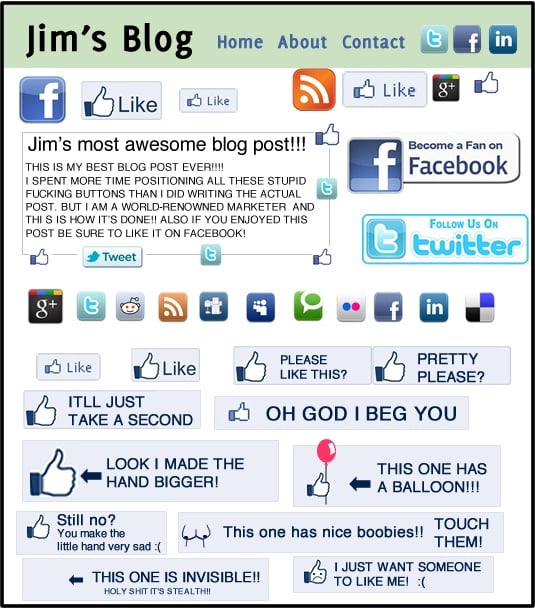
Like me!

Source: How to get more likes on Facebook

This is a dangerous place to be, and I’ve been there more than once. There have been many times where I’ve been on the verge of just stopping and shutting the site down, because I couldn’t see the use. Yet every time I came close to closing up shop, one question kept coming up in my mind: Why are we so unwilling to work hard for the things that we want? And then I saw someone articulate that thought perfectly…

The long, hard, stupid way (3 lessons)

I came across the idea of the long, hard, stupid way in a brilliant talk by Frank Chimero. He describes an episode of the TV show Treme where chef David Chang describes his cooking philosophy:

Just because we’re a casual restaurant, doesn’t mean we don’t hold ourselves to fine dining standards. We try to do things the right way. That usually means doing things the long, hard, stupid way.

Go ahead and think about a time when you learned to do something really difficult. Maybe it was learning to ride a skateboard, figuring out a new math equation, or debugging your first piece of code. Do you remember the strain, the frustration, and the countless failures? And do you also remember the enormous satisfaction you felt as you slowly mastered that task? Do you remember how doing it the hard way carried with it not only the benefits of learning that skill, but also many tangential thoughts or experiences that sparked new passions or interests?

When we do things the hard way, we invest in ourselves in the best possible way. We kick off an endless cycle of learning and mastery that helps us grow and lead fulfilling lives of purpose. When we take shortcuts, we become mere pretenders. We learn how to play the part, but there is no substance or continued growth. The instant gratification makes us build the house of cards ever higher, which brings anxiety about the whole thing coming tumbling down. Why would we shortchange ourselves like that?

Cal Newport nailed it when he said, “There is no avoiding the deliberate strain of real improvement.” If you want to become a better writer, read more and publish more. If you want to learn to design/code/fly, watch fewer episodes of Downton Abbey and practice the things that don’t come easy. And if you really want more Twitter followers, make and share things that are awesome, and be patient.

So what does this mean for online publishing? Over time I’ve learned 3 important lessons that have formed the foundation of how I write Elezea, and what I want this site to be.
Nobody wants to read your shit

The first lesson is Steven Pressfield’s timeless advice in The Most Important Writing Lesson I Ever Learned:

Nobody — not even your dog or your mother — has the slightest interest in your commercial for Rice Krispies or Delco batteries or Preparation H. Nor does anybody care about your one-act play, your Facebook page or your new sesame chicken joint at Canal and Tchopotoulis.

It isn’t that people are mean or cruel. They’re just busy.

Nobody wants to read your shit.

The thing is, once you realize that no one cares about the stuff you write, it’s actually quite liberating. It’s at that point that you realise that writing is a simple transaction between you and your readers. They have time and attentionwhich is more valuable than ever — and you have to provide content that is worthy of that time and attention. Otherwise we’re just wasting people’s time, and they certainly won’t stick around for that. No matter how many times I read it, I still love this Paul Ford quote from 10 Timeframes:

If we are going to ask people, in the form of our products, in the form of the things we make, to spend their heartbeats on us, on our ideas, how can we be sure, far more sure than we are now, that they spend those heartbeats wisely?

Remember the transaction between you and your readers, and make sure that when they pay you with their time and attention, they’re getting something worthy in return. But wait… how do I know if something is worthy…?
Some things aren't worthy

The second lesson I learned is that not everything is worthy of people’s attention. Content creation is becoming increasingly robotic and algorithmic, so instead of thinking about how people spend their heartbeats, we’re thinking about how to get them to click on things, regardless of what’s behind that click. We know that Yahoo tests more than 45,000 combinations of headlines and images every five minutes on its home page. We also know that The Huffington Post will serve different versions of a page to a couple of random groups and, after five minutes, the best headline will be selected. That sounds really smart, and they’ve obviously been extremely successful at generating traffic, but that approach is missing two key components. It’s missing what Merlin Mann refers to as Obsession times Voice.

Obsession is that thing that people want you to shut up about. The thing that wakes you up at night, the minuscule detail that you can’t stop thinking about. What is that thing that you just can’t let go of? That’s your obsession.

Voice is how you talk about that obsession. It’s the perspective that you bring on the topic, and the way you communicate why it’s your obsession.

So there’s a simple formula for what makes something worthy of people’s time. It’s Obsession times Voice. It’s a unique perspective on something you care deeply about, that no one else can copy. That’s the kind of thing I want to read on the web. Look at sites like The Loop, Daring Fireball, and The Brooks Review. They’re all successful because they’ve figured out the Obsession times Voice equation.
Don't just write, publish

The third lesson I learned is that writing is relatively easy when compared to actually publishing the stuff that you write. That’s where it gets real. I still feel like this every time I hover over the Send to Blog button:
I’m so scared

The thing is, publishing what you write is the only way you’re going to get better at it. Once your words are out there, it will be scrutinized. That is terrifying but also really exciting. People will correct you on things when you are wrong. That is a bonus benefit of thinking in public: you learn so much from feedback. But that only happens if you get things out of your drafts folder and onto your site.

How is that working out?

Building Elezea on these principles has worked pretty well for me so far. It has not only brought writing and advertising opportunities, but more importantly, it has brought me a great community of readers who communicate regularly via email and Twitter and other platforms.

If I can sum up what I’ve learned about online publishing in one sentence, it’s that who your readers are is more important than how many you have. Sure, I’d love for my traffic to grow a little bit faster. But I won’t do it if it comes at the cost of compromising the principles I’ve described above, because I know a click is empty until someone actually sticks around for more than a few minutes. That’s what makes this a meaningful and fulfilling experience, and that’s what makes me push on and keep writing here week after week.

So for those of you who keep coming back, THANK YOU. Not to get all mushy on you, but you make me happy.

For those interested, the full slide deck from the talk is here.
Where the hashtag really comes from

Keith Houston’s fascinating essay The Ancient Roots of Punctuation begins like this:

The story of the hashtag begins sometime around the fourteenth century, with the introduction of the Latin abbreviation “lb,” for the Roman term libra pondo, or “pound weight.” Like many standard abbreviations of that period, “lb” was written with the addition of a horizontal bar, known as a tittle, or tilde. And though printers commonly cast this barred abbreviation as a single character, it was the rushed pens of scribes that eventually produced the symbol’s modern form: hurriedly dashed off again and again, the barred “lb” mutated into the abstract #.

Which is why the hashtag is often referred to as the pound sign. Keith also explains the origins of the Pilcrow (¶), the Ampersand (&), the Manicule (☞), and the Diple (>). Great article.

Our obsession with meaningless data

Stijn Debrouwere’s Cargo cult analytics is a fantastic talk/essay on how we often get obsessed with meaningless data in the name of evidence-based decision-making. I don’t want to ruin it, because it’s one of those rare must-read pieces, but here’s a small taste:

Pageviews is a vanity metric: something that looks really important but that we can’t act on and that tell us nothing about how well we’re actually doing, financially or otherwise. […]

There’s nothing like a dashboard full of data and graphs and trend lines to make us feel like grown ups. Like people who know what they’re doing. So even though we’re not getting any real use out of it, it’s addictive and we can’t stop doing it.

Emoji and post-literacy

In The ‘Mood Graph’: How Our Emotions Are Taking Over the Web Evan Selinger writes about the rise if emoji and other emotional signals in social media:

But there are costs to a mood graph too. The more we rely on finishing ideas with the same limited words (feeling happy) and images (smiley face) available to everyone on a platform, the more those pre-fabricated symbols structure and limit the ideas we express. Such general symbols can also lead to even more confusion or misunderstanding due to cultural, generational, and other differences.

And finally, drop-down expression makes us one-dimensional, living caricatures of G-mail’s canned responses — a style of speech better suited to emotionless computers than flesh-and-blood humans.

It’s a great article well worth reading all the way through. This trend is a continuation of something I’ve discussed quite often here over the years: our move towards a post-literate society:

What is post-literacy? It is the condition of semi-literacy, where most people can read and write to some extent, but where the literate sensibility no longer occupies a central position in culture, society, and politics. Post-literacy occurs when the ability to comprehend the written word decays. If post-literacy is now the ground of society questions arise: what happens to the reader, the writer, and the book in post-literary environment? What happens to thinking, resistance, and dissent when the ground becomes wordless?

I find myself here in full agreement with Guy English from his post Learn to X:

But, let’s not kid ourselves, literacy is the new literacy. The ability to read, comprehend, digest and come to rational conclusions — that’s what we need more of.

Emoji are fine, and I’m as much a fan of the animated gif as anyone. But I do feel like we’re trying to create all these shortcuts to express our emotions because it’s hard to do it in words. The thing is, though, it should be hard to express our emotions. That’s how we understand them and work through them. So let’s go easy on the giphy.com searches every once in a while, and try to find the right words instead.

The Feels