Menu

Posts tagged “content strategy”

If software is eating the world, Medium is eating its content.

Medium

About two years ago Marc Andreessen proclaimed that software is eating the world (beware the WSJ paywall):

My own theory is that we are in the middle of a dramatic and broad technological and economic shift in which software companies are poised to take over large swathes of the economy.

We’ve seen this shift toward software in the content arena too, where it’s impossible to ignore the constant stream of stories about the struggles of print media. And lately, it seems that Medium is emerging as the first major successful content platform since the shift started. It feels like every second or third link on Twitter points to a Medium post, and somehow being on Medium gives content the perception of a certain level of prestige.

Why is that? Why is this platform so successful, and why does it have such a strong brand? I don’t agree with the direct comparison and the premise that Quora vs. Medium is an actual winner-takes-all situation, but AJ Juliani makes an interesting point about this in Why Medium May Succeed Where Quora Did Not:

Medium is about stories. Quora is about answers. And people love stories. Our favorite way to learn is through stories and narrative.

Medium is certainly a great platform for reading stories, and the tools available to writers make it a great creation experience as well. But there’s also been pushback recently on Medium’s apparent dominance in the individual writer domain. The biggest concern is that we don’t know what Medium’s plans are, and that authors are therefore giving up their words to an unknown entity. Here is Glenn Fleishman in Why You Should Be Your Own Platform:

I’ve written a few things on Medium (not paid) because I liked the experience of their writing tools, their statistics, and their reach. […] But it’s not mine. It’s theirs.

I can’t control the URL. I can’t embed. I have no idea about what their ultimate plans are. They could delete all non-owned/paid content in the future with no notice. They could rework the design and it would be ugly. My words’ persistence, both in appearance and permanent location, are dependent on factors beyond my control.

Marco Arment takes this argument further in Medium and Being Your Own Platform

Treat places like Medium the way you’d treat writing for someone else’s magazine, for free. It serves the same purpose: your writing gets to appear in a semi-upscale setting and you might temporarily get more readers than you would elsewhere, but you’re giving up ownership and a lot of control to get that.

As for me, I love the writing (and reading) experience on Medium. But I do have concerns that are big enough to make me take a step back:

  • Medium seems to be more about Medium than about authors. I don’t think we should move our personal blogs there — it’s already getting too crowded, and I still believe we should all own our own identities online.
  • Related to the last point: the idea of organizing content around topics (collections) is great, but there is no way to follow collections easily. RSS feeds are difficult to find, and it seems the only way to see what’s new in a collection is to go to its URL. This makes me worried about a walled garden approach to the content, similar to how Twitter and Google+ restrict how you can add and extract content.
  • There’s some great content being surfaced by the editorial team, but there are also a lot of duds when you dig a bit deeper into the collections. And by expanding the platform so quickly the noise is becoming louder. I’m worried Medium is quickly going to outgrow their initial focus on providing quality over quantity.

If we’ve learned anything over the past few years, it’s that we should be wary of platforms that offer large audiences at a price of admission that is not immediately apparent (See Facebook, Instagram, Twitter…).

The barrier to setting up your own site has never been lower (if you’re not into WordPress, try Scriptogr.am or Octopress). Yes, building an audience on your own platform is much harder than hoping to get picked by the Medium editorial team. But the longevity and the satisfaction you’ll get from maintaining your own voice is so much higher. Don’t give that away.
How to convince clients to think about content before they think about graphics

I recently had to convince a client to pause their redesign efforts and work on their content first. This is how I did it. I tried to stay away from UX jargon and overly technical arguments. There is obviously much more to say about Content Strategy and related disciplines, but this was an exercise in trying to make a succinct argument by only focusing on information that’s most relevant to the client. I’m posting it here in the event that it might be useful to those who have to make similar arguments to non-UX audiences.

Introduction

Since this is primarily an informational site with the goal of converting readers into customers, it is imperative that we start the design process by developing the core content first. This will ensure that we design a web site purposefully to help users find the information they need, and guide them towards desired actions, as opposed to designing the interface first without knowing what content will be displayed. For a more detailed overview of this strategy, see A Richer Canvas.

In this brief overview I will summarize the primary reasons for following this approach, and how I propose we go about it on a practical level.

What happens if we don’t follow a “content first” strategy?

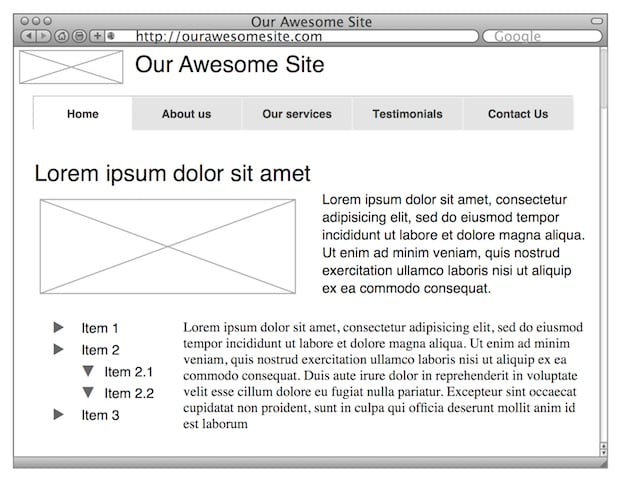
Let’s look at an example of starting the wireframe process before content is available. Let’s say we provide some wireframes of what the site might look like:

Content First

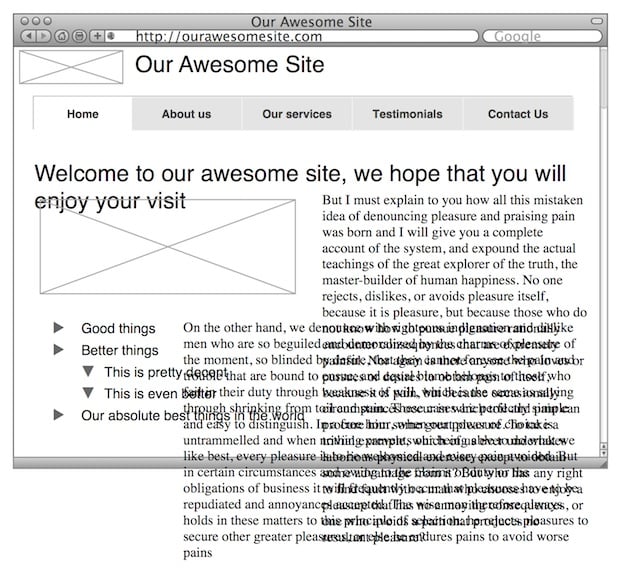
Now let’s say you love this approach and we proceed with graphic design, and eventually, towards the end, we finalize the content. We plug the content into the design, and then we discover we have a problem. Suddenly our design doesn’t work so well any more:

More Content First

If we design before we have content, we effectively create the packaging before we know what’s going to go in it. And if the content doesn’t fit the package, there are only two options: start from scratch, or try to jam the content into the existing package. We don’t want that.

But it’s not just about making the design work. Developing the content first allows us to be much more strategic about the words we put on the page. It gives us the opportunity to start with user and business goals, and make sure our content meets those goals. Ahava Leibtag puts it as follows:

We need to start urging our clients to think about their content not just as a commodity, but as the starting point, the building blocks of a website. It’s time to stop building the house without knowing how many bedrooms it may need. It’s a paradigm shift in the way we think about building websites. But, it has to be done. Because you know what they call things that are beautiful, but have no function? Useless.

So how do we design with a “content first” approach?

The basic process of putting content at the core of a design (specifically a redesign such as this) is as follows:

  • Audit. This is also referred to as a Content Inventory. We collect and document all our pages (like a site map), and we extract all the content from each page.
  • Analysis. In the next step we work on context and goals. We look at our audit and document how the content on each page relates to other pages. We look at the goals of our site, and figure out what type of content we need to ensure we meet those goals. We look at the process for writing content and if there are areas for improvement. We evaluate our brand promise and define exactly how we want to communicate to our visitors to deliver on that promise.
  • Content creation. Once we’ve laid down the guidelines for our content and agree on what we’re trying to achieve, we start writing. This involves rewriting existing content as well as writing new content if the audit and analysis showed us that we have some gaps.

For more on this process, see Getting to Grips with Content.

Who does this work?

The title of the person doing this type of work isn’t that important. The most important thing is that they have a thorough understanding of writing for the web, and how to connect users with the right content. In the web design industry this is often done by Information Architects or Content Strategists.

  • Information Architects “categorize information into a coherent structure, preferably one that most people can understand quickly, if not inherently” (see Wikipedia). Another way of saying it is that they build bridges between users and the content and services they need (see Information Architect).
  • Content Strategists “plan for the creation, publication, and governance of useful, usable content” (see The Discipline of Content Strategy).

So as I’ve said, the title isn’t important, only the outcome is. And the outcome is web content that meets user and business goals, and allows us to design an experience centred on guiding users along the desired path.

For the reasons outlined above, our strong recommendation is to engage a person with Information Architecture/Content Strategy skills to help us develop our core content before we proceed to the design stage.

End note: Of course, the argument is not always as simple as this. It is often impossible to have the majority of the content available before commencing design. That’s why I like the idea of Structure First. Content Always. But in this particular case, we needed content before we could do anything, so we had to put on the brakes until we had something useful to work with.

Expanded user journey maps: combining several UX deliverables into one useful document

UX deliverables had a rocky year so far. I feel particularly bad for the humble wireframe, which took some serious knocks over the past few months. There’s also a growing skepticism about the value of Personas. The Persona thing made me particularly uneasy because I’ve always been a huge fan, and we still start most of our projects with a workshop to define Personas and User Journeys.

That unease led me to introspection, which is a good thing, because it made me step back and revisit why we use Personas, and how we use them on a very practical level to design better products. The problem is, I came up short… I realized that though Personas are extremely useful to help clients figure out who their target market is, and understand those users better, they’re often not very useful once we go into the Interaction Design phase of the project1.

In contrast, the User Journey map that we create at the beginning of every project remains open in a tab until everything is done and dusted. I cannot overstate the usefulness of user journey mapping as a UX method. And then there’s the content plan — another essential part of the puzzle that we always create before the design phase starts. Once we’ve done a version of the Information Architecture, the content plan maps what kind of content needs to go on each page. But these are all separate documents, and you can only reference so many PDFs on any given day before it gets terribly distracting.

I realized that one of the problems with Personas is that it takes extra work to turn those user insights into artefacts that are useful for design. And that led me to the realization that there is probably a better way to group all these disparate UX deliverables together to help us create better products.

I decided to test my theory, so on a project we recently started, our User Journey map became more than just a journey with touchpoints, emotions, takeaways, etc. It also became a representation of the Information Architecture and the content plan, with our Personas (needs, goals, scenarios) serving as the starting point for everything — sort of like the glue that ties it all together.

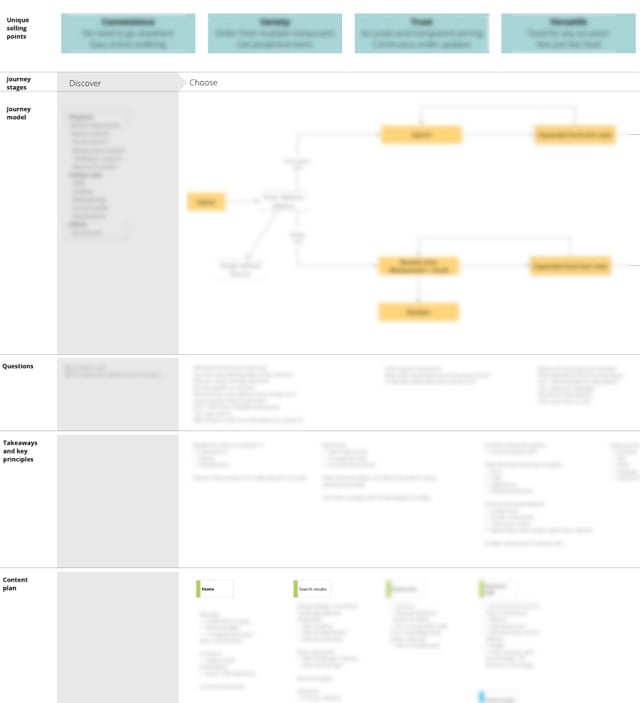
The project is still very much in progress, so I can’t show the full end result yet, but here’s a slightly blurry snapshot of one section of the journey:

Journey and content plan

This document is a summary of everything we need to know to design the best possible product for users. It has the following elements:

  • Unique selling points to keep us focused on what the site needs to communicate at all times. This comes straight from the Persona needs and goals.
  • Journey stages and model to remind us how the product fit into people’s lives, and what the primary calls to action need to be throughout the site.
  • Questions that our target Personas are likely to ask in each phase of the journey, to focus the type of content we serve on each page. In an e-commerce context, these are questions like, “Can I trust this retailer?” or “When will my stuff arrive?”
  • Takeaways and key principles to summarise the above sections (which primarily act as problem definitions/requirements) and document how that translates into the design decisions and solutions we need to keep in mind throughout the design process.
  • Content plan that maps each phase of the journey with the questions our Personas will ask during that phase, and what it means for the specific content that needs to go on each page. We get very specific here — nothing gets on the page unless it’s in the content plan. And if we can’t identify a Persona that would find the content useful, it just doesn’t go on the list.

Even though the Personas aren’t explicitly referenced on this document, we extract the key points from each and turn those into information that is actually useful for design — namely the content they are most likely to be interested in. The Persona step is essential to help us get to this point, so we can’t skip it, but we don’t need to show faces and names and stories on the User Journey map to make that information useful.

So, in the spirit of “getting out of the deliverables business”, this expanded User Journey map becomes the only document we use to guide us throughout the design process. You can think of this as the UX Strategy document. It incorporates Persona-based user needs and business goals with site structure and content planning in a way that really works for us. It also places content at the centre of the design process, which makes it easier to follow mobile first and responsive design strategies.

I’m sure it’s not perfect, but so far this has been an extremely useful artefact for us.


  1. Des Traynor wrote a good article about this

What the demise of online services means for the web

Ryan Holiday’s Our Regressive Web is the best thing I’ve read so far about the importance of services like Google Reader and Delicious. He starts off with this statement:

The collapse of these services, to me, represents an alarming reduction of key services designed to improve online information from the user’s perspective.

Ryan explains how RSS helps to reduce noise and clutter, and he provides a theory for why it never really took off beyond geek circles:

In an ad-impression and pageview-driven business, a service that allows users to opt out of the noise and get content delivered directly to them is dangerous.

Maybe I’m just suffering from confirmation bias because I’m still pretty bitter about Google Reader’s shutdown, but this is a really good analysis. Well worth reading the whole thing.

We're talking about hashtags again?

Hey, it’s time to argue about hashtags again! The Internet got all revved up about it this week when Daniel Victor published Hashtags considered #harmful:

In most searches, the quantity of tweets is overwhelming and the quality underwhelming. It’s worth questioning how many users find hashtag searches useful, but it’s hard to know, since Twitter doesn’t provide such data.

He goes on to make the argument that most blog posts and tweets about the article focused on:

I believe hashtags are aesthetically damaging. I believe a tweet free of hashtags is more pleasing to the eye, more easily consumed, and thus more likely to be retweeted (which is a proven way of growing your audience)

Sean Sperte followed up with On #hashtags1:

Hashtags actually do increase engagement. It may be tough to recognize through subjectivity, but the reality is, hashtags provide a mechanism for easier discovery, encourage brevity, promote a single key binding for disparate data, and even help inject tone/personality.

Whatever your personal thoughts on the use of hashtags2, it’s worth reminding ourselves that the American Dialect Society voted “hashtag” as the word of the year for 2012. So for a bit of history on our volatile relationship with the thing, have a look at these articles.


  1. Link via Kyle Baxter

  2. I agree with Daniel that they’re ugly, and I wonder if @beep is on to something

Data confusion is a failure of design, not an attribute of information

I just came across this great interview with Edward Tufte from 2011. I love his description of bad information design, and how it’s not the data’s fault:

Overload, clutter, and confusion are not attributes of information, they are failures of design. So if something is cluttered, fix your design, don’t throw out information. If something is confusing, don’t blame your victim — the audience — instead, fix the design. And if the numbers are boring, get better numbers. Chartoons can’t add interest, which is a content property. Chartoons are disinformation design, designed to distract rather than inform. Thus they reduce the credibility of your presentation. To distract, hire a magician instead of a chartoonist, for magicians are honest liars.

Chartoons. Heh.

Anyway, I find this particularly poignant in our current infographic age, where Mashable recently posted — without irony — an infographic on infographics. Here are some of my other favorite infographic takedowns:

(link via @ericatjader)

To carousel, or not to carousel

The use of carousels in web design has become quite the controversial topic. Brad Frost takes it on very well in his post Carousels. He starts by explaining that in most cases, it’s not a good idea to use carousels, because of reasons like this:

From universities to giant retailers, large organizations endure their fair share of politics. And boy does that homepage look like a juicy piece of prime real estate to a roomful of stakeholders. It’s hard to navigate these mini turf wars, so tools like carousels are used as appeasers to keep everyone from beating the shit out of each other.

It’s far harder to have an honest content strategy conversation and determine what truly deserves to be on the homepage.

Brad goes further to give some good tips for improving the UX of carousels — if you really need to use them. For more, also check out Peep Laja’s roundup of thoughts and research on carousel usage at Don’t Use Automatic Image Sliders or Carousels, Ignore the Fad.

Worthy aspirations for content makers

There are two articles I read in 2012 that will hopefully shape my writing here in the coming year. The first, and possibly the only post any aspiring writer needs to read before getting started, is The Most Important Writing Lesson I Ever Learned:

Nobody wants to read your shit.

When you understand that nobody wants to read your shit, your mind becomes powerfully concentrated. You begin to understand that writing/reading is, above all, a transaction. The reader donates his time and attention, which are supremely valuable commodities. In return, you the writer, must give him something worthy of his gift to you.

This ties in very well with Paul Ford’s plea in one of my favorite essays of 2012, 10 Timeframes:

If we are going to ask people, in the form of our products, in the form of the things we make, to spend their heartbeats on us, on our ideas, how can we be sure, far more sure than we are now, that they spend those heartbeats wisely?

So when we tweet, write, post, or whatever we call it when we create content, the first question we should ask ourselves is: “Is this thing I’m sharing worthy of attention?” If it’s a Foursquare checkin or a vaguebook update, it’s probably best left unsaid.

The second article that I hope will shape my writing more is this Steinbeck quote:

It is the duty of the writer to lift up, to extend, to encourage. If the written word has contributed anything at all to our developing species and our half developed culture, it is this: Great writing has been a staff to lean on, a mother to consult, a wisdom to pick up stumbling folly, a strength in weakness and a courage to support sick cowardice. And how any negative or despairing approach can pretend to be literature I do not know. It is true that we are weak and sick and ugly and quarrelsome but if that is all we ever were, we would milleniums ago have disappeared from the face of the earth, and a few remnants of fossilized jaw bones, a few teeth in strata of limestone would be the only mark our species would have left on the earth.

That is certainly an almost impossible standard to live up to. Consistently writing “wisdom to pick up stumbling folly” is something only the most talented writers can do — and even then there are stumbles along the way. Similarly, the Internet makes the thought of staying away from a “negative or despairing approach” sound ludicrous. What will be left of the Internet if we take away angry rants and YouTube comments?

And yet, as unreachable as they appear to be, I think these are good aspirations for anyone who publishes content on the Internet today:

  • Only share that which is worthy of your audience’s attention.
  • Strive to uplift and encourage, not to break down and destroy.

With that in mind, I’ll probably move away from straight-up link-blogging a little bit this year, and rather focus more on trying to connect dots where I think seemingly unrelated things on the web can come together to tell a good story. That’s what excites me, so it’s probably what Obsession Times Voice means for me1.

This isn’t a year-in-review post, but I’d still like to thank you for reading, for tweeting me your feedback, for emailing me. For correcting my spelling errors, for telling me when I’m full of crap, and for encouraging me when I feel like this is too much work for too little return.

I’d like to say a special thanks to those who subscribe to the site via RSS. When I subscribe to a feed, it feels like I’m inviting someone in from the porch to come have a seat inside and have a cup of coffee together. I know RSS space is limited, and that it’s a pretty big commitment to subscribe to someone’s feed. So please know that I take that seriously, and that you are a big part of the reason I aspire to become better at this.

Onward.


  1. For examples of what I mean by this, see The future of online publishing, The fetishization of the offline, and a new definition of real, and The unnecessary fear of digital perfection

The Internet and narrow horizons

Ian Leslie’s In search of serendipity is a very interesting article on how the Internet is narrowing our horizons by only giving us what we’re looking for, and nothing more:

Today’s world wide web has developed to organise, and make sense of, the exponential increase in information made available to everyone by the digital revolution, and it is amazingly good at doing so. If you are searching for something, you can find it online, and quickly. But a side-effect of this awesome efficiency may be a shrinking, rather than an expansion, of our horizons, because we are less likely to come across things we are not in quest of.

I especially like this metaphor for the Internet as modern city:

In 1952 a French sociologist called Paul-Henry Chombart de Lauwe asked a student to keep a journal of her daily movements. When he mapped her paths onto a map of Paris he saw the emergence of a triangle, with vertices at her apartment, her university and the home of her piano teacher. Her movements, he said, illustrated “the narrowness of the real Paris in which each individual lives”.

To some degree, the hopes of the internet’s pioneers have been fulfilled. You type “squid” into a search engine, you land on the Wikipedia page about squid, and in no time you are reading about Jules Verne and Pliny. But most of us use the web in the manner of that Parisian student. We have our paths, our bookmarks and our feeds, and we stick closely to them. We no longer “surf” the information superhighway, as it has become too vast to cruise without a map. And as it has evolved, it has become better and better at ensuring we need never stray from our virtual triangles.

As much as everyone seems to hate the word “curation”, it seems obvious to me that it’s important for all of us to seek out people who can lead us to things we didn’t know we’re interested in. As Callum J Hacket advises, make it a habit to follow reliable people rather than rigid topics.

E-commerce sites as editorial outlets

Marcelo Somers is in the process of writing a great series on e-commerce. Part 2 is called Sell the Hole, Not the Drill – A Guide to eCommerce Content Strategy:

The failure of eCommerce is that the functionality has been designed to sell, but sites have overlooked the opportunity to build relationships with their customers and genuinely make their lives better. Most online shopping engagements only make customers’ wallets lighter. […] eCommerce sites must start blurring the line between being an editorial site and a place for commerce.

I completely agree with this. I’ve written about it before, and called the approach context-based e-commerce:

[Where product-based e-commerce sees the product as the unit of measure], context-based e-commerce sees a customer’s unique situation as the unit of measure, and the user experience is built around delighting them based on who they are and how technology can help improve their lives. Quality, personal, context-based content serves as the bridge between product and customer.