Menu

Posts tagged “content strategy”

The future of online publishing

It’s an exciting time for publishing. After what feels like years of magazines and newspapers ignoring the Internet in the hope that it will go away, a new wave of innovation is happening. I wanted to share some of the content that I think provides some good context and thinking around this topic.

In one of the most important articles of 2012, Craig Mod defines a new way to deliver content called Subcompact Publishing. He starts off with an important observation:

In product design, the simplest thought exercise is to make additions. It’s the easiest way to make an Old Thing feel like a New Thing. The more difficult exercise is to reconsider the product in the context of now. A now which may be very different from the then in which the product was originally conceived.

Craig continues with a Subcompact Manifesto. The gist is that this new type of publication is small (both in issue and file sizes), HTML(ish) based, and completely focused on portability and reader needs. But it’s important to hear Craig talk about this, so if you haven’t read his brilliant article yet, it’s a good idea to do that first before continuing.

Craig’s post prompted quite a few responses. Jason Kottke followed up with a bunch of examples of Subcompact Publishing, including three of my favourites: Evening Edition, NextDraft, and The Magazine.

Jim Ray wrote a good summary called 29th Street Publishing and the Next Wave of Digital Publishing, in which he also points to some of the challenges that exist on the publishing side to make this a reality:

Adobe’s Digital Publishing Suite, which is what many traditional publishers have been using to quickly put together iPad versions of their magazines, is trying to solve an impossible problem. Publishers don’t have the resources to build digital native versions of their print magazines (which still manage to be quite lucrative, btw) so they bolted some tools onto their existing workflow and shipped it. This has all happened before, of course, when these same publishers were trying to figure out how to make workflows built for printing presses talk to an FTP server.

By starting fresh, 29th Street (and other upstarts, like The Magazine) can build proper apps that readers actually enjoy, instead of just pushing out a bloated PDF of a magazine into the Newsstand app.

I linked to this a while ago, but I want to mention Ben Brown’s concept of Reader Aware Design again, because it’s very relevant to this discussion:

Enormous piles of data are being collected about our browsing habits. When do we visit? What have we visited recently? This information is squirreled away in the cloud in order to better sell us things. Instead of just handing all that data over to Google and Facebook and Twitter, sites should leverage some of it to enhance the reading experience. In addition to becoming device aware through responsive design techniques, our sites should also strive to become reader aware.

Ben did more than just write about this — he has since released Aware.js, a jQuery plugin that implements many of the features he talked about. It’s definitely worth checking out. I’m keen to play with it on this site as well.

I also like Frank Chimero’s reflections on another emerging form of publishing he calls anthologies:

I think the web is heading toward an age of anthologies, where users gain new ways to select, sequence, recontextualize, and publish the content they consume. Anthologies are distinct from remix culture, because the source material is not modified. Some of these tools will be automated like Flipboard or Facebook’s timeline, but I’m interested in the opportunities of manual tools which require our attention to pass over what we’ve saved, bookmarked, liked, hearted, and favorited on the web. The chosen material is sorted, arranged, and given edges. An anthology flies in the face of the web as it exists, simply in that one may “finish” because it “ends.” I hope we are finally admitting to ourselves that we can’t stomach as much as we thought. We’ve realized that the way to make sense of this meal is to step away from the table for a while and come back later.

Frank mentions Readability’s Readlists as an example of this. I haven’t tried Readlists because I’m still a little uncomfortable with taking other people’s work and packaging it in a way that sends very little traffic back to the original source, but maybe I’m just being old school.

Finally, on this week’s episode of 5by5’s The Crossover, Gina Trapani and Jason Snell discuss the evolution of publishing, and it’s the perfect companion to what’s been written on the topic over the past week or so.

In short, we’re about to see an influx of great ideas in the publishing industry, and for the first time in a long time, it looks like readers like us will be the real winners.
Reimagining the traditional blog format

I’ve become increasingly dissatisfied with the reverse-chronological order on this site (and most blogs, for that matter). For me, the problem is that the latest few posts on the home page aren’t necessarily the most important posts I’d like readers to see. In addition to that, if a new reader visits an article through a link from elsewhere, and then checks out the home page, they won’t immediately get an idea of what the site is about.

That’s why I’m so excited about Ben Brown’s concept of Reader Aware Design. He begins with a question:

Presenting everything as a reverse chronological stream of posts made sense when we knew our readers were sitting at a desk, hitting reload on 30 tabs all day long at work. Does it still make sense when content arrives on an e-paper watch, an Xbox or a tiny slip of paper?

Ben says no, and he provides some recommendations as well as a proof-of-concept they’ve been working on. Read his post for the detail. Exciting stuff!

The user experience of printed publications

Craig Mod’s How magazines will be changed forever ties in really nicely with my previous post on embracing limitations in the digital world:

Like Newsweek, almost all magazines will eventually go purely electronic. […] Still, as I watch this shift, I can’t help but feel a twinge of nostalgia. Not for the paper, but for the boundaries.

I miss the edges — physical and psychological. I miss the start of reading a print magazine, but mostly, I miss the finish. I miss the satisfaction of putting the bundle down, knowing I have gotten through it all. Nothing left. On to the next thing. […]

One of the qualities most natural to the user experience of print is the sense of potential completion, defined by the physical edges. It is a quality that is wholly unnatural to digital formats. The digital reading experience makes one want to connect and expand outward. Print calls for limit and containment.

(link via @RobertSBoone)

New article on Smashing Magazine: The Immersive Web And Design Writing

My latest article for Smashing Magazine came out yesterday. The Immersive Web And Design Writing is about the resurgence we’re seeing in longform writing that’s done with much patience and care. I interviewed the publishers of three such examples: Andy McMillan of The Manual, Nick Disabato of Distance, and John Boardley of Codex. After all the editing was done, I came to the following conclusion:

So, maybe what I initially thought was an article about design publications is actually an article about all of us instead. The point is not just that we should have a balanced information diet, but that the real power of that balanced diet lies in the energy it gives us to get started on our own projects. Seek out these nutritious words. You won’t regret it.

I hope you like the article!

The future of e-commerce is storytelling

Marcelo Somers wrote a good article arguing that to compete with the likes of Amazon, e-commerce companies need to focus on telling stories through the products they sell. From Disrupting Amazon: Rethinking eCommerce:

An eCommerce site should be about more than just selling stuff. It should embody a set of values that are distilled in how the product looks, how it feels, and what it contains. It should have an opinion - the story is how we go about telling it through our interface, how we merchandise, the photography, and the products on the site.

He also provides some examples of companies that do this well.

Related post from the Elezea archive: The welcome shift to context-based e-commerce.

We need to talk about civility

Yesterday I read an opinion piece on a local news site that was just one long, scathing attack on the writer of another opinion piece on the site. No substance at all. You don’t have to go far on the web to see that kind of behavior. There is something about the false sense of anonymity provided by web sites, blogs, and comment sections that just bring out the worst in us.

Don’t get me wrong — I love disagreements. I believe that an essential quality of a good designer is the ability to balance his or her confidence in their proposed solution with an openness that they might be wrong. But we don’t disagree online any more, we just attack. I’ve often thought that new users of the Internet should be forced to read Paul Graham’s How to Disagree before they’re allowed to go any further. When it comes to online discourse we are, for all intents and purposes, locked in an Eternal September.

It is with these types of thoughts on my mind that I wrote a talk about how I think we can do better. I also turned the talk into an article for Smashing Magazine, which was published today under the title Making A Better Internet. The summary:

In this essay, I’ll weave together a story about the current state of Internet discourse. At the end, I’ll tell you how I think we can make it better. And then, we’ll most likely all go back to what we were doing and forget about it. Despite the probable futility of this exercise, I’ll carry it out anyway, because I love the Web and I really don’t want us to destroy it.

I don’t know what the reaction to this piece is going to be. I’m quite nervous about it, but we’ll see how it goes. If you’d like to see the slides from the talk, which I gave at a recent Cape Town Content Strategy Meetup, they are embedded below:

Read article on Smashing Magazine | View slides on Speaker Deck | Discuss on Google+

Facebook marketing: where community is more important than product

Craig Mod wrote a very interesting essay about community and content for Contents Magazine. In Our New Shrines he talks about building a community first, before deciding what you’re going to do with them. It’s a contentious topic, but it’s worth entertaining Craig’s argument:

There is a reality those of us long steeped in the web are reticent to admit: for many, Facebook is the internet. More than Tumblr. More than wordpress.com. More than Twitter. For a certain person, a very commonly found person, Facebook is a Yahoo! portal, personalized Google news, Gmail, Flickr, iPhoto, and Xbox. If you look closely, companies don’t post URLs to their home pages, they post URLs to their Facebook pages.

We facilitate lots of usability tests here at Flow. I’ve asked the question “So, what do you do when go online?” enough times to know exactly what the answer will be. It is always, without fail, a variation of “Well, I Facebook, of course… A little bit of email… Some Google… Umm, well, mostly Facebook.”

This might change, but I completely agree that for most people, Facebook is the Internet at the moment. I personally don’t like Craig’s proposal of building a community around something vapid before you decide what product/service you want to provide to them. I think it’s a dangerous game. But denying the short-term effectiveness of such a strategy would be naive. For better or worse, this is the attention economy we live in. For now.

NextDraft, and why email is still important

NextDraft is one of my favorite things on the Internet at the moment. It’s a daily newsletter with 10 interesting news stories, written by the brilliant Dave Pell. It also made me like email again, which I didn’t expect to be possible. But it makes sense now that I’ve read this great interview with Dave where he explains why email is still relevant:

Email has always been a great medium. It’s the content of most emails that’s problematic.

Email is still the killer app. It looks great on all your devices and the user experience is always exactly what you’ve come to expect. Look at the rise of Instapaper, Readability, and Pocket. People love plain, glorious, readable text. Email is also a technology that everyone understands, and it’s personal (if someone wants to respond to me, all they have to do is hit reply).

Tweets and status updates flow by and disappear into the black hole that is the Internet of five minutes ago. Interesting links and stories you find in an email newsletter are always right where you left them.

Also check out the NextDraft iPhone app. It’s fantastic.

BuzzFeed and the future of publishing

They’re not always great at citing sources, and it’s not exactly the height of intellectual journalism, but I’ll admit: BuzzFeed’s publishing strategy is commendable:

We don’t show crappy display ads and we make all our revenue from social advertising that users love and share.  We never launched one of those “frictionless sharing” apps on Facebook that automatically shares the stories you click because those apps are super annoying. We don’t post deceptive, manipulative headlines that trick people into reading a story.  We don’t focus on SEO or gaming search engines or filling our pages with millions of keywords and tags that only a robot will read. We avoid anything that is bad for our readers and can only be justified by short term business interests.

Instead, we focus on publishing content our readers love so much they think it is worth sharing. It sounds simple but it’s hard to do and it is the metric that aligns our company with our readers. In the long term it’s good for readers and good for business.

That’s from an email that BuzzFeed’s CEO sent to employees, and it’s worth reading in its entirety because it’s such a good description of the principles that good online publishing is built on.

A guide to good RSS feed citizenship for blog publishers

I do most of my online reading through RSS, and I don’t think I’m alone. For the most part this is a good reading experience, but there are a few things publishers can do to make it even better. So if you publish a blog, here are three proposed guidelines for RSS feeds:

  1. Have an RSS feed and make it easy to subscribe. Contrary to popular belief, Twitter did not kill RSS. It’s alive and well. So please don’t bury or hide the feed — it should be easy to find the link and subscribe. Also, do some work on your feed - use a service like Feedburner to customize it (and give you analytics on your subscribers).

  2. Unless it’s central to your revenue model, don’t provide article excerpts only. I understand that there are subscription sites that require payment to get access to full RSS feeds — that’s a conscious business decision, so if it works, great! But for the rest of us, RSS excerpts are a bad idea. It places the burden on anyone following your shared items to click through to see the article, and that slows people down. As a general rule (with the above stated exception), please provide a full feed - you’ll grow your audience and eventually get those click-throughs because of it.

  3. Remove the metadata from your feed URLs. If I do click through to an article to comment, share it on Twitter, etc., a URL like this looks bad and makes sharing harder to track: http://uxmag.com/design/debating-the-fundamentals?utm\_source=feedburner&utm\_medium=feed&utm\_campaign=Feed%3A+UXM
    +%28UX+Magazine%29.

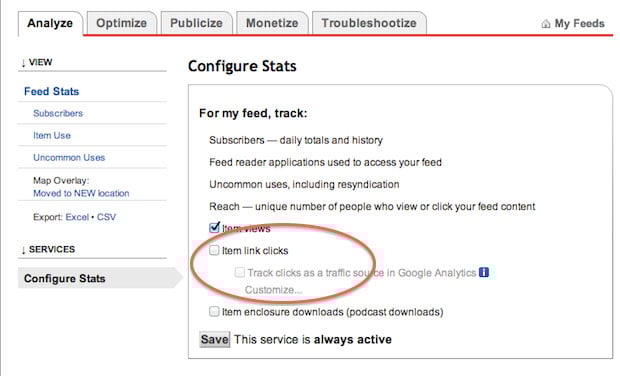
    The stuff after the ”?” is added by Feedburner so you can get detailed analytics on item link clicks. But unless you really want to see where your RSS feed clicks come from you don’t need this level of detail. All you need to know is the number of Item Views in your feed — the rest of your analytics can come from Google Analytics. It’s very easy to turn this tracking off to remove the metadata and make your URLs more friendly. In Feedburner, go to “Configure Stats” and uncheck the “Item link clicks” box. Here’s a screen shot:

feedburner URLs

In Luke Wroblewski’s new project Future Friendly, they discuss their thinking around universal content:

Well-structured content is now an essential part of art direction. Consider how it can flow into a variety of containers by being mindful of their constraints and capabilities. Be bold and explore new possibilities but know the future is likely to head in many directions.

If you publish content on the web it’s not future friendly to ignore and/or limit its use in RSS, which is one of the most important containers we have at our disposal.