Menu

Posts tagged “content strategy”

How to make “product principles” more useful

There’s an interesting discussion going on in the Elezea Community about “Product Principles”. What they are for, when you need them, how they can be made more useful, etc. A couple examples given are Intercom’s set of guidelines for making decisions, Dan Ritz’s interface design values and my own company’s values.

The biggest challenge I see with principles like these is figuring out how to make them specific enough to help us make decisions. The further I get into reading Good Strategy, Bad Strategy the more I realize how much we tend to hide behind nice words, when in most cases those nice words don’t actually change our behavior in any meaningful way. For example:

Bad strategy is not the same thing as no strategy or strategy that fails rather than succeeds. Rather, it is an identifiable way of thinking and writing about strategy that has, unfortunately, been gaining ground. Bad strategy is long on goals and short on policy or action. It assumes that goals are all you need. It puts forward strategic objectives that are incoherent and, sometimes, totally impracticable. It uses high-sounding words and phrases to hide these failings.

I fear that “product principles” are prone to be made up almost exclusively of “fluff”:

Fluff is superficial restatement of the obvious combined with a generous sprinkling of buzzwords. Fluff masquerades as expertise, thought, and analysis. A hallmark of true expertise and insight is making a complex subject understandable. A hallmark of mediocrity and bad strategy is unnecessary complexity—a flurry of fluff masking an absence of substance.

I think product principles, in particular, need to be detailed and specific enough so that they affect day-to-day decision making. This is similar to how we should use Personas (and why so many people hate Personas). If you just put a Persona’s face on a coffee mug, that’s not going to be very useful. But if you’re able to say, “this feature would be useful for a persona that’s not in our target market so we’re not going to build it”, that’s an entirely different story.

Which leads me to wonder if what we call “product principles” should rather just be the combination of a well-defined design system and content strategy. HelpScout’s Style Guide immediately comes to mind as a good example of this. Because what are “Product Principles” for if they don’t help us make product decisions?

Do you have thoughts to add on this topic? Join the community.
Companies have to get better at explaining the data behind personal recommendations

Ryan Bigge makes some very good points in his post about better personalized recommendations through transparency and content design:

Data-driven companies know something that the user doesn’t. Yet the language used to convince people to act on recommendations lacks variety and explanatory power.

Algorithms aren’t neutral — or as Ryan puts it:

Every facet of machine learning is fueled by human judgement, so it must be multi-disciplinary.

Users are getting more skeptical about where these magical recommendations for what to watch, listen to, and buy come from. To establish and build trust, companies have to get better at explaining exactly why they’re recommending a specific product or action.

Facebook as political platform

This NYT report on the massive political news force Facebook has become is quite something. From John Herrman’s article Inside Facebook’s (Totally Insane, Unintentionally Gigantic, Hyperpartisan) Political-Media Machine:

But truly Facebook-native political pages have begun to create and refine a new approach to political news: cherry-picking and reconstituting the most effective tactics and tropes from activism, advocacy and journalism into a potent new mixture. This strange new class of media organization slots seamlessly into the news feed and is especially notable in what it asks, or doesn’t ask, of its readers. The point is not to get them to click on more stories or to engage further with a brand. The point is to get them to share the post that’s right in front of them. Everything else is secondary.

This is the crux of the matter:

Such news exists primarily within users’ feeds, its authorship obscured, its provenance unclear, its veracity questionable. It exists so far outside the normal channels of news production and distribution that its claims will go unchallenged.

We need a renewed focus on Information Architecture

Abby Covert wrote a brilliant and passionate plea for a return to the basic principles of Information Architecture in our design work. From The Pain With No Name:

In too many cases, educational programs in design and technology have stopped teaching or even talking about IA. Professionals in the web industry have stopped teaching their clients about its importance. Reasons for this include “navigation is dead,” “the web is bottom up, not top down,” and “search overthrew structure”—but these all frame IA as a pattern or fad that went out with tree controls being used as navigation.

These misconceptions need to be addressed if we are going to deal with the reality of the impending “tsunami of information” approaching our shores. The need for clarity will never go out of style, and neither will the importance of language and structure. We will always need to have semantic and structural arguments to get good work done.

Effective onboarding through human connection

Jeremy Keith writes about the onboarding process of the site The Session in his post Words of welcome. He shows a series of screen shots of simple messages that teaches users how to be good citizens on the site. Keith closes with this:

No intricate JavaScript; no smooth animations; just some words on a screen encouraging a human connection.

Design words to live by.

Medium as RSS reader

Despite its ridiculous name I’ve become quite fond of the POSSE movement (Publish on your Own Site, Syndicate Everywhere). It’s pretty easy to hook up and automate, so I’ll just mention the basics (and then move on to the problem child):

I can add more things through IFTTT, but I think that’s all I need for now. Except for Medium. I really didn’t know what to do with Medium, especially considering this and this:

2015 was the year of Medium and Newsletters, but I feel like we should use 2016 to Make The Personal Blog Great Again™.

— Rian Van Der Merwe (@RianVDM) January 2, 2016

But then it dawned on me… Indie publishers have been thinking about Medium all wrong. We’ve been thinking about Medium as a thing that eats all the world’s content with zero regard for publishers. But Medium is, in fact, nothing more than a next-generation RSS reader. You can follow people and publications, and presumably things will then show up in your feed (it’s all a little confusing to me). That’s when I realized that I should treat Medium not as a publishing platform but as an RSS platform just like Google Reader (may it rest in peace) or Feedly.

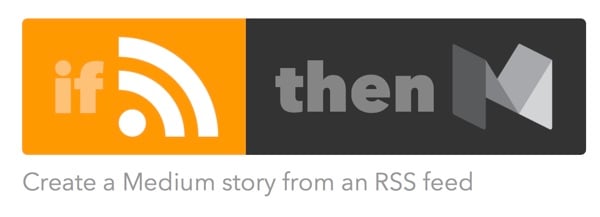
So back I went to IFTTT, and did this:

Medium RSS

Now every post on this site will automatically appear on Medium as well. So I guess my point is that if Medium is your RSS reader of choice, you can now subscribe to Elezea on Medium here.

Don't shame users into reading your stuff

No thanks

Katie Notopoulos writes about an extremely annoying marketing trend in Guilt And Shame As A UI Design Element—opt-out messages that make you feel bad about opting out:

The worst shame offender of all, however, is quickly becoming the mailing list opt-out guilt trip. When visiting a website, a pop-up implores you to sign up for their fantastic mailing list. The only way to get rid of this list is to click on the fine print at the bottom. But too often, this doesn’t merely say “Opt out” or “No thanks.”

No. It forces you to click a statement acknowledging you are a terrible, deplorable, disgusting human being.

It is not just enough that you don’t want to subscribe to the mailing list about political news. You must admit that “no, I DON’T care about being well-informed and reading great journalism.”

An invitation to bring back your personal site

Buried somewhere in the middle of Will Oremus’s article about Twitter’s decision to increase the 140-character limit we find this important paragraph:

What’s really changing here, then, is not the length of the tweet. It’s where that link at the bottom takes you when you click on it—or, rather, where it doesn’t take you. Instead of funneling traffic to blogs, news sites, and other sites around the Web, the “read more” button will keep you playing in Twitter’s own garden.

I’m nowhere near up to date or involved enough in the Open Web movement, but I’ve been writing this site since 2009 and since 6 years is a lot of time to invest in something, I do have Opinions on the matter. Hence one of the first things I tweeted this year:

2015 was the year of Medium and Newsletters, but I feel like we should use 2016 to Make The Personal Blog Great Again™.

— Rian Van Der Merwe (@RianVDM) January 2, 2016

The tweet prompted some interesting discussion, including links to a couple of excellent articles about Medium: Matthew Butterick’s The billionaire’s typewriter and Mandy Brown’s Ferengi (thanks for sending those, Chris!). There’s no need for me to reiterate their arguments here, except to say that this move to proprietary platforms—from Medium to Instant Articles to now Twitter’s entry to long-form publishing—seems to be a dangerous threat to the Open Web.

There are the political arguments around access and inequality that are all very valid, but I want to focus on another aspect here: content platforms as shortcuts. One of the main reasons for writing on a platform like Medium or Twitter or Facebook, as opposed to your own site, is that it’s supposed to give you easier access to a huge audience. And this is no small thing, because building an audience on your own site is, as far as I know, statistically impossible.

Okay, maybe that’s being a bit dramatic. But I’ll tell you that after 6 years of trying to do it I was exhausted and had to take a bit of a break recently. Now, you could argue that the reason I don’t have a huge following on this site is simply that my writing sucks, and you probably won’t be too far off track there. Yet I’d like to think that there’s more to it than that. Building an audience is just really hard because people have to seek out your content, and the truth is that most of the time nobody wants to read your shit.

But I digress. The point is that publishing on Medium and Twitter and Facebook gives you an immediate shortcut to a huge audience, but of course those companies’ interests are in themselves, not in building your audience, so it’s very easy for them to change things around in a way that totally screws you over (remember Zynga? Yeah, me either).

All this to say that I think it’s time we bring blogging and personal sites back. Some of my favorite sites are the ones that give me a glimpse into everything a person is interested in (I think my current favorite is Josh Ginter’s understated and eclectic The Newsprint). It’s a way to get to know someone through their interests, and to learn a bunch of things along the way. So I invite you not just to follow along here as I expand into topics beyond design and technology1, but to start your own personal blog up again if you’ve been neglecting it for a while. I’m really interested in the things you are passionate about. I want to learn from you. But don’t just do it for me, do it for you. Because it turns out there is an immense power in avoiding shortcuts and instead doing things the long, hard, stupid way.


  1. Fair warning: I’m a little rusty… 

Buzzfeed, Instagram, and the weirdness of present day journalism

Two recent articles made me think again about how weird journalism and publishing has become because of the internet and social media. In Instagram’s TMZ Jenna Wortham describes a very successful celebrity gossip “site” (what should we call these things now?) that exists primarily on Instagram:

Angie explained to me that Instagram perfectly suited her vision for The Shade Room: image-centric and interactive. For her purposes, Instagram was the equivalent of WordPress. When she started the feed a year ago, her goal was to accumulate 10,000 followers in the first year. She accomplished that in only two weeks. Angie started by posting about people at the bottom of the celebrity hierarchy (minor reality stars, mostly) and worked her way up to bigger names, building her loyalties slowly. Eventually, readers started sending her tips and videos via Instagram’s direct-messaging feature. Now, The Shade Room has more than half a million followers on Instagram alone.

Of course, this “business” is one decision by Instagram away from total collapse, but for now it’s an amazing success story.

The second article continues the media’s fascination with Buzzfeed. From Adrienne LaFrance and Robinson Meyer long and very interesting The Eternal Return of BuzzFeed:

BuzzFeed is a successful company. And it is not only that: BuzzFeed is the rare example of a news organization that changes the way the news industry works. While it may not turn the largest profits or get the biggest scoops, it is shaping how other organizations sell ads, hire employees, and approach their work. BuzzFeed is the most influential news organization in America today because the Internet is the most influential medium—and, in some crucial ways, BuzzFeed demonstrates an understanding of that medium better than anyone else.

And this:

Culturally, economically, even politically: BuzzFeed is so influential because it is still in ascendance. We don’t yet know how big this publication will get, how sweeping and lasting its effects on the American media sphere will be. “We’re still really small,” Peretti insists. “You have Disney and Viacom and Time Warner—the really big media companies are giant compared to us.” But BuzzFeed’s growth has been relentless in recent years. It shows no signs of slowing. Peretti is deliberately and aggressively building his company to be big. “The Internet isn’t for small companies,” he said last year.

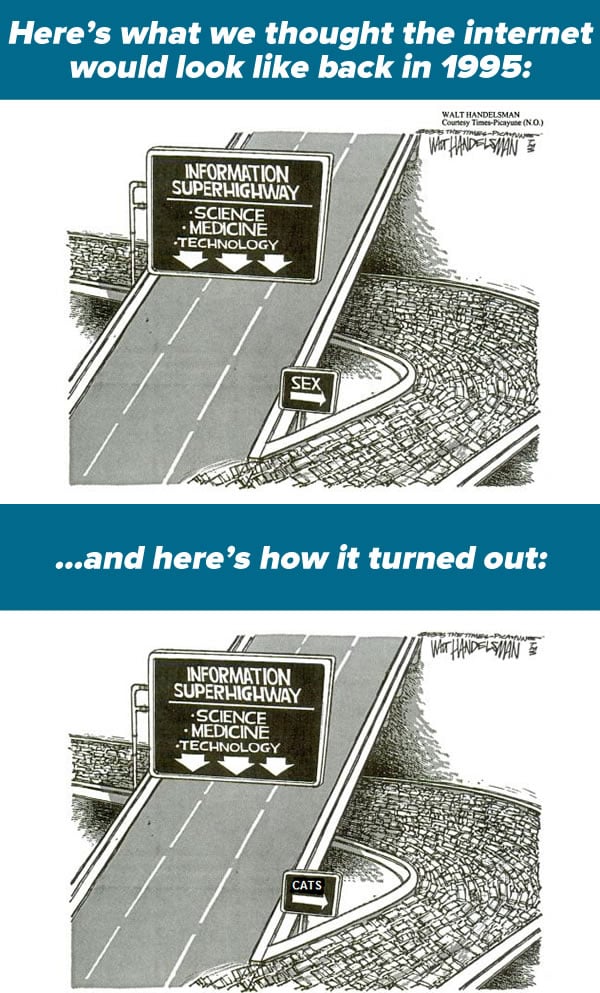
It’s hard not to admire the way Buzzfeed understands how the internet hive mind works. Let’s not forget that they were the first publication to figure out what the internet is really for:

A URL to call home

Robinson Meyer reflects on Medium and What Blogging Has Become:

And I too, a lowly twentysomething, pine for days of less centralization. As I wrote a few days ago, in a New Medium-style short post, “I still find the idea of a diverse blogosphere — arrayed across tens of thousands of URLs, with sites organized by author and shaped by distinctive interests — really, distinctively, unavoidably cool.”

But is there a place in the web ecosystem for this kind of writing anymore? And is the cost of using Medium, which will centralize writing and create a kind of publisher/publishee power inequality, worth the ease? What will happen when widespread abuse comes to Medium, the way it’s come to Twitter? And social media companies have proven tremendously malleable, product-wise, to the desires of other companies — will Medium be the same? What does a piece of advertising look like on Medium anyway, when the line between journalism and PR on it is already so thin?

I’ve been around long enough for Blogger to rise (and fall), for MySpace to be the best (and then the worst) place to write your thoughts, and for Posterous and Windows Live Spaces to disappear (along with all my posts there). So I will stubbornly hold on to writing on this here, my very own URL.

Posterous