Menu

Posts tagged “apple”

It's too early to write off Google Glass

Charles Miller starts his post On Google Glass with a story about the history of cell phones, and then makes a keen observation:

I’m pretty bad at predicting the success or failure of new technologies, but I just think it’s a little too early to write off something as potentially game-changing as Google Glass based on how it looks today, what it costs today, or based on the fact that we’re currently entrusting one of society’s most socially tone-deaf groups (nerds) with the question of when it’s appropriate to wear them.

My mom was one of the first people in our neighborhood to have a cell phone, but she was so embarrassed by the thing that she ran into a bathroom every time she received a call. So, yes, Google Glass sounds pretty creepy (now), and they look pretty silly (now), but it might not be like that 2 years from now.

Community and kindness

Matt Alexander wrote a guest post on 512pixels while Stephen Hackett is away on vacation with his family. It’s called Community, and it really hit home for me:

Perhaps we’re brought together by a foundational love of design or genuinely good products — often embodied by Apple — but I believe we remain, regardless of evolving opinions, because of a visceral sense of community.

I encourage you to read the whole post, as well as Stephen’s letter to his son, which Matt links to at the beginning.

I’ve had a bit of a rough month that gave me a lot of doubts about remaining active in the design industry. But Matt’s post reminded me again that for every bad experience, there are ten examples of people in our community being generous and supporting each other. And maybe it’s time for us to talk about that a bit more, even on our tech-centric sites.

Cap Watkins did it recently, and so did Anil Dash. We need those constant reminders of what Frank Chimero sums up so well in Issue #1 of The Manual:

The web is a technology, but more importantly, it is people all the way down. People constitute and maintain the network. It is widespread and distributed, but it is very delicate. Like a real web, it needs constant maintenance to keep from tearing.

The growing complexity creep in Apple's products

It’s a somewhat uneven article, but Dave Wiskus makes some good points in The secret of Apple’s design success: the humane interface. I did get a bit uneasy when I got to this part:

Where Apple differs from its competition isn’t in aesthetic beauty, it’s in the company’s ability and willingness to make decisions on behalf of its users. […] Apple’s take is to remove complexity and make choices long before the user sees the product.

It’s an argument that’s often used by Apple fans to defend the “Apple prison” accusations — I’ve used this line of reasoning myself. But here’s the thing — and I’m saying this as a die-hard Apple fan — even though this used to be true when the iPhone and iOS first came out, I don’t think our argument holds water any more. We’re starting to see more complexity sneaking into iOS and Mac OS X, and even though the veneer of simplicity is still highly visible, there be trouble beneath the surface.

And then I read Federico Viticci’s excellent interview with John Siracusa, in which John sums up the situation perfectly:

Simplicity is great, as iOS has shown. But there’s a difference between conceptual simplicity and visual simplicity. Just hiding controls does make things appear simpler, but it doesn’t actually make them any simpler. The complexity is now just hidden. Similarly, removing features that few people use is a good idea, but like any good idea, it can be taken too far. At a certain point, you’re just making your application worse for everyone, even new users.

You can’t always tweak or refactor an existing application into the beautiful thing you’re envisioning. Sometimes the only way to achieve true simplicity is to start over with a new concept for the whole app.

The first iterations of iOS and Mac OS X were great because they did just that — they started over with a new concept. But complexity creep is inevitable, and the big challenge for Apple now is how they’re going to manage that. Jonathan Ive’s influence will certainly help, but perhaps there’s even a case to be made for (gasp!) borrowing a page from Google’s playbook.

Apple innovates, Samsung follows fast

The Economist has a fascinating piece on what makes Samsung’s strategy so effective. From Samsung: The next big bet (my emphasis added):

Samsung’s successes come from spotting areas that are small but growing fast. Ideally the area should also be capital-intensive, making it harder for rivals to keep up. Samsung tiptoes into the technology to get familiar with it, then waits for its moment.

When it pounces, the company floods the sector with cash. Moving into very high volume production as fast as possible not only gives it a price advantage over established firms, but also makes it a key customer for equipment makers. Those relationships help it stay on the leading edge from then on.

The strategy is shrewd. By buying technology rather than building it, Samsung assumes execution risk not innovation risk. It wins as a ‘fast follower’, slipstreaming in the wake of pioneers at a much larger scale of production.

This is in direct contrast to Apple’s strategy, which is to look for a mature, stale market, and then innovate to deliver a solution that’s several orders of magnitude better than what incumbents are selling.

More on Android vs iOS mobile web browsing engagement

Anthony Wing Kosner wrote a very interesting analysis of Horace Dediu’s Android engagement paradox numbers, which show that although Android market share is surging, its share of mobile browsing is lagging way behind iOS. The Android vs iOS Engagement Paradox is full of insights like this:

In the U.S. and many other countries, inexpensive Android devices are the replacement for the feature phones most consumers have been using. A feature phone user carries their minimal expectations with them to their new device. It turns out that just giving someone a smartphone doesn’t make them a smartphone user. They need habits of use that take advantage of the new functionality they now possess. iOS users, in contrast, are much more interested from the get-go in what their device can do, though few of us really tap anything near the full computing capacity of what we carry in our pockets.

Read The Android vs iOS Engagement Paradox on Forbes.

The real problems with Apple's software

Kontra wrote a great post on the real problems Apple needs to address in their software and operating systems. Apple’s design problems aren’t skeuomorphic starts with a statement everyone needs to take to heart:

The current meme of Ive coming on a white horse to rescue geeks in distress from Scott Forstallian skeuomorphism is wishfully hilarious.

Exactly. As Gruber pointed out:

The speculation regarding skeuomorphism as a factor in Forstall’s ouster has gotten out of hand. That’s not what this was about. This is about Forstall’s relationship with the other senior executives at the company. Personalities and politics, not rich Corinthian leather.

Anyway, moving on. Kontra goes on to list some of Apple’s current software issues, and concludes:

In the end, what’s wrong with iOS isn’t the dark linen behind the app icons at the bottom of the screen, but the fact that iOS ought to have much better inter-application management and navigation than users fiddling with tiny icons. I’m fairly sure most Apple users would gladly continue to use what are supposed to be skeuomorphically challenged Calendar or Notebook apps for another thousand years if Apple could only solve the far more vexing software problems of AppleID unification when using iTunes and App Store, or the performance and reliability of the same. And yet these are the twin sides of the same systems design problem: the display layer surfacing or hiding the power within or, increasingly, lack thereof.

Read Apple’s design problems aren’t skeuomorphic.

Honesty and the rise of the flat design era

The Flat Design Era by Allan Grinshtein for the LayerVault Blog made the rounds a week or so ago, but I haven’t had a chance to read it until now. It’s a really good discussion about what they call “honest design”:

Designing honestly means recognizing that things you can do with screens and input devices can’t be done with physical objects — more importantly that we shouldn’t try copying them. It takes too much for granted. Can you imagine your pristine iPhone built into the body of an antique telephone handset? Is that beautiful design? […]

It is laziness to not continue to refine. Remove the unnecessary embellishments and keep stripping until you’ve almost gone too far. We believe that elegant interfaces are ones that have the most impact with the fewest elements.

Living inside our computers

In Living inside the Machine James Bridle writes about computers and data centres as aesthetic objects. It’s a very interesting idea and a great article. There’s one part in particular that stuck with me. James quotes William Gibson in an interview with the Paris Review from 2011, about his time in Vancouver in the late 70s/early 80s:

The only computers I’d ever seen in those days were things the size of the side of a barn. And then one day, I walked by a bus stop and there was an Apple poster. The poster was a photograph of a businessman’s jacketed, neatly cuffed arm holding a life-size representation of a real-life computer that was not much bigger than a laptop is today. Everyone is going to have one of these, I thought, and everyone is going to want to live inside them.

Everyone is going to have one of these, and everyone is going to want to live inside them. How prophetic…

James sums it up nicely in his article:

We used to posit this space, the network, the notional space, as being elsewhere, the other side of the screen. But increasingly we have these images of the machine as something that surrounds us, that we live inside, within. As something that enfolds us.

iPhone 5, the local maximum, and an important lesson for startups

Last week I used a product development theory called the Kano Model to explain why it’s wrong to be disappointed with the iPhone 5. I wrote the article just before the launch event, and lo and behold, it didn’t take long for the Internet to start yawning:

Um, it’s a little bit longer. Really Apple? You spent months in court fighting Samsung and portraying yourself as the world’s only truly innovative company and this is the best you can do? A phone that looks like what would happen if phones were capable of inbreeding?

Today I’d like to explore the fallacy of this kind of disappointment further using a mathematical theory I alluded to in my previous article, Maxima and Minima:

In mathematics, the maximum and minimum of a function are the largest and smallest value that the function takes at a point either within a given neighborhood (local or relative extremum) or on the function domain in its entirety (global or absolute extremum)

More specifically, I want to discuss the idea of the local maximum within the context of product development, and how that relates to innovation. For the purposes of product development, I liken the mathematical concept of neighborhood to product. For example, the iPhone (as a product) will hit a local maximum when the current design cannot be improved any more. This isn’t necessarily the best product you can make in the entire industry, but it is the best iteration of the current product1.
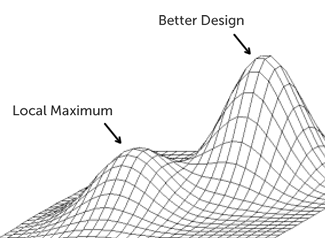
Local Maximum

(Image source: 52weeksofux)

To explore this further, we also have to differentiate between the concepts of iteration and variation. In product development, variation is a way to explore a bunch of alternative product solutions. In contrast, iteration solidifies the product idea that gets chosen. To quote Jon Kolko: “Where an iteration moves an idea forward (or backwards), a variation moves an idea left or right.” Or, to put it into the language of maxima and minima, variation surveys the landscape to help companies choose the right neighborhood (product) to move into. Iteration then helps them to find the local maximum in their chosen neighborhood.

Now, let’s look at the iPhone. Because of the Samsung trial we know that Apple did a great deal of variation work before they chose their neighborhood. See, for example, this sketch of different possible designs from a slide show on AllThingsD:
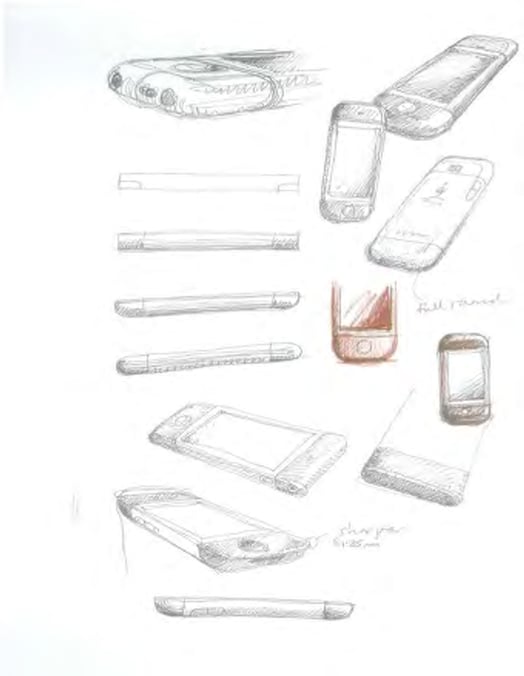
iPhone prototype

(Image source: AllThingsD)

If you dig deeper into the slide show you’ll see many variations they considered before settling on the basic design for the original iPhone.

It’s not just the hardware though, of course. There’s also iOS. As far as I’m aware there aren’t any early sketches for iOS publicly available, but I’m willing to bet a lot of money that they didn’t just sketch one thing and then designed it that way. It’s pretty safe to assume that the variation process on iOS was every bit as rigorous as for the iPhone hardware.

Once they’ve done a bunch of variation work on the hardware and software for the iPhone, Apple chose their neighborhood and started iterating. There were some major improvement jumps along the way (like iOS2, and iPhone 4), but it’s all still in the same neighborhood.

So let’s get to the crux of the matter. From an engineering perspective, variation is expensive, iteration is cheap. Especially if a product is already out there. Apple is able to give away the iPhone 4 for free because they have been iterating on the hardware for so long that they can manufacture the phones very cheaply. If the iPhone 5 was a drastically different phone (I’m talking about a completely different neighborhood), everything would have started from zero.

From a business perspective, why would Apple choose to make a very expensive move to a different neighborhood, when they know that they haven’t hit the local maximum on the current phone yet? Apple is iterating because they understand this concept, and because they know that the only thing that matters is if customers like it. As John Gruber said:

The collective yawn from the tech press was louder this year; the enthusiasm from consumers is stronger.

What does it mean for startups?

There are some important lessons for startups in the story of the iPhone evolution.

First, spend as much time and money as you can afford on variation upfront, because if you move into the wrong neighborhood, it’s really hard to change that later on. Some companies have done it successfully, like when Path completely redesigned their product from the ground up. Other companies are finding it really hard to move, as evidenced by the almost universal disdain for the new Twitter app for iPad2. And the jury is still out on whether Microsoft’s very expensive foray into the tablet OS world will be a success or not.

Second, don’t move to a new neighborhood until you’re absolutely sure that you’ve hit the local maximum right where you live. I’ll say it again - iteration is cheaper than variation. Instead of trying to rethink your product every few months/years, rather spend time to understand how you can make the current variation better. Apple is proof that this strategy pays off.

I have a feeling that Apple isn’t going to move out of their phone neighborhood any time soon. They might send some family members to buy a new house in the TV neighborhood. But when it comes to phones, they’re still on to a good thing, and they’re smart enough not to be tempted by the fake grass on the other side of the “change everything!” fence.


  1. In Is the iPhone good enough?, Horace Dediu speculates on whether the iPhone 5 has hit the local maximum yet. It’s a must-read piece. 

  2. I’m not as negative about the app as most people, because I understand where it’s coming from. The Twitter design team are most likely operating under some very specific business constraints, and they are doing everything they can to provide a good experience within those constraints. It’s a business, after all. 

Why you shouldn't be pre-disappointed with the next iPhone

The air of ‘meh’ surrounding Apple’s iPhone event this coming Wednesday is almost palpable. A wave of pre-disappointment is sweeping much of the tech blog world, with proclamations like this one from Andrew Couts:

As bored as I am by the new iPhone’s purported growth spurt, I’m not particularly interested in any of the other realistic features Apple might add to some “dream phone” either. NFC? Yawn. Quad-core processor? Psh. Wireless charging? Whatevs. All these features would be great, I suppose — but they have been done before, and will be done again and again and again by the time the iPhone 6 makes its way into the world around this time next year.

I’ve been wondering why so many people have gone all “Everything’s amazing and nobody’s happy” on Apple with this particular event. And I think the answer lies in an unlikely place: a product development theory called the Kano Model.

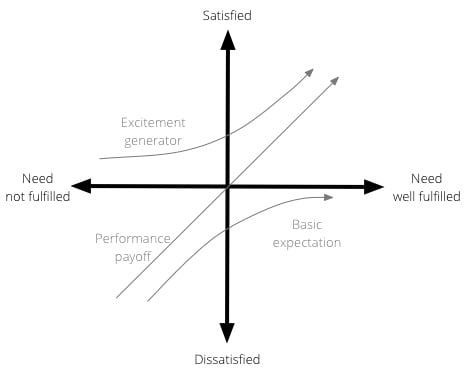
The Kano Model, developed in the 1980s by Professor Noriaki Kano for the Japanese automotive industry, is a helpful method to prioritise product features by plotting them on the following 2-dimensional scale:

  • How well a particular user need is being fulfilled by a feature
  • What level of satisfaction the feature will give users

The model is generally used to classify features into three groups:

  • Excitement generators. Delightful, unexpected features that make a product both useful and usable.
  • Performance payoffs. Features that continue to increase satisfaction as improvements are made.
  • Basic expectations. Features that users expect as a given — if these aren’t available in a product, you’re in trouble.

Here is a visual representation of the Kano model:

Kano model

Now, let’s look at the iPhone in this context. When it was first introduced it was all Excitement generators all the way. From the touch screen, to the scrolling, to the tiniest of UI details, the thing was just a joy to use from start to finish. And since no one had seen anything like it before, we thought it was a piece of magic that could do anything:

The iPhone can do anything

(Image source: Cyanide & Happiness)

Eventually the novelty wore off and the iPhone’s Excitement generators became Basic expectations since everyone started doing it (oh hi, Samsung!). But there were still plenty of Performance payoff features to work on. Continued UI refinements, 3rd party apps, enterprise support, push notifications… as those features were introduced and improved, we kept liking the device more.

This couldn’t go on forever, though. The natural evolution of most products is that the Excitement generators become harder to find, so you tend to spend more time on the Performance payoffs and Basic expectations1. For example, by the time cut-and-paste came to the iPhone, it was no longer an Excitement generator, but the most basic of expectations. All the features Andrew Couts talks about in the piece I quoted above are Basic expectations as well. John Gruber wrote about this back in May:

iOS is by no means feature-complete. But it’s getting harder to identify the low-hanging fruit — the things you just know Apple has to be working on, not just the stuff you hope they are.

There is nothing wrong with this. It’s a natural evolution of a product, and we should be happy with the incremental progress. But that’s just not good enough for us. We can’t move beyond the amazing 2007 keynote where we first saw the iPhone. That’s where Apple set the bar, and now it’s almost impossible to reach it again. So, even though every year the iPhone and iOS keep getting better and better, we become less and less impressed because we have an unrealistic expectation that everything Apple does has to fit into the Excitement generator category. It’s impossible. No one can do that ad infinitum.

We should stop hoping for an avalanche of Excitement generators in this week’s announcement of the new iPhone. Instead, we should realise that Apple is doing what any company should do with a mature product: focus on ways to increase customer satisfaction steadily with Performance payoff and Basic expectation features, without getting caught up in a wild goose chase to re-invent a product that already re-invented an industry.


  1. Also see the Local Maximum theory, which suggests that each design has a limit where it’s as effective as it’s ever going to be.