Menu

Posts tagged “apple”

Apple Music’s hi-res audio is *still* standing in its own light

Man. Standing ovation to this quote. I just want to know!!!

I’m not here to debate if the jump from lossy AAC to lossless ALAC is audible. Many people say they cannot hear the difference between the two (lucky them). Others say they can. Most importantly for any comments section, that second group is not seeking permission from the first group to stream losslessly. Apple Music supplies ‘Lossless’ and ‘Hi-Res Lossless’ streams at no extra cost to the subscriber, and some listeners just want to know that their audio hasn’t been lossy compressed along the way, even if they’re not 100% sure they can always hear the benefits. Many of these same people already know that an album’s mastering technique will impact its sound quality more than the delivery format.

Anyway. This article is your reminder that if you’re using AirPlay or Bluetooth with Apple Music you’re not getting lossless.

Source: Apple Music’s hi-res audio is *still* standing in its own light

Link roundup for February 9, 2023

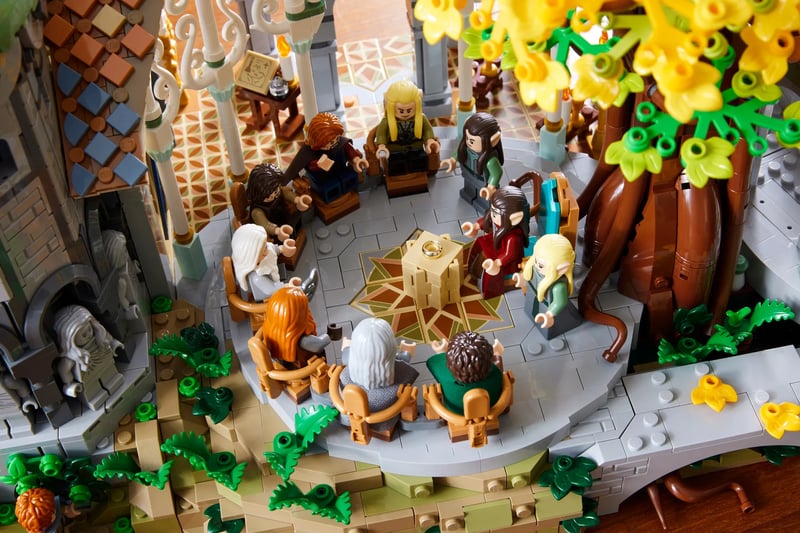
Lego reveals massively detailed Lord of the Rings Rivendell set. Take my money! [polygon.com]

The Window Trick of Las Vegas Hotels. “In order to make the buildings look smaller, less intimidating and messy, architects have come up with a ‘four or six windows in one’ solution. This means they grouped several windows (usually four or six) together and made them look like one window. This creates the visual effect of ‘shrinking’ the building, of making it more orderly and symmetrical.” [schedium.net]

You have to read this whole article for the full context, but this classification of the different ways we can choose to act online really got me thinking: “I see roughly three typical public stances: boring, lively, or outraged. Either you act boring, so the bandits will ignore you, you act lively, and invite bandit attacks, or you act outraged, and play a bandit yourself. Most big orgs and experts choose boring, and most everyone else who doesn’t pick boring picks bandit, especially on social media. It takes unusual art, allies, and energy, in a word “eliteness”, to survive while choosing lively. And that, my children, is why the world looks so boring.” [overcomingbias.com]

The Junkification of Amazon. Why Does It Feel Like Amazon Is Making Itself Worse? “If you understand Amazon as an aspiring megascale infrastructure company — a provider of systems, services, capacity, and labor — its junkification makes sense. Amazon hasn’t been acting like a store for a while. In its ideal future, selling things to people is everyone else’s problem.” [nymag.com]

People Can’t Stop ‘Spotify Snooping’ on Friends, Exes and Crushes (WSJ paywall, Archive.is link here). “When Ms. Ticoalu looked up what her ex-boyfriend was listening to in November, she saw ‘Glimpse of Us’ by Joji, a song about starting to date again after a relationship ended. Because he played the song so soon after their breakup, it led her to believe the two events were related. ‘It does lead me to overthink a lot,’ Ms. Ticoalu says.” [wsj.com]

New Form of Ice Discovered. “The newly discovered ice is amorphous — that is, its molecules are in a disorganized form, not neatly ordered as they are in ordinary, crystalline ice. Amorphous ice, although rare on Earth, is the main type of ice found in space. That is because, in the colder environment of space, ice does not have enough thermal energy to form crystals.” [scitechdaily.com]

This is such a fun and interesting story by Louie Mantia about his time working as an icon/UI designer at Apple in the early 2010s. [lmnt.me]

You have a machine voice

Tom Dart wrote a really interesting piece on how we change our accents when we talk to machines. From Y’all have a Texas accent? Siri (and the world) might be slowly killing it:

“Most people have what we would call a telephone voice, so they actually change away from their local family accent when they’re speaking on the telephone to somebody they don’t know,” said Alan Black, a Scottish computer scientist who is a professor at the Language Technologies Institute at Carnegie Mellon University in Pittsburgh.

They also have a “machine voice”, he said. “People speak to machines differently than how they speak to people. They move into a different register. If you’re standing next to somebody in an airport or at a bus stop or something, you can typically tell when they’re talking to a machine rather than talking to a person.”

This part on the design of Siri is really interesting:

Black speculated that “one of the reasons they designed Siri to be fundamentally a polite, helpful agent who isn’t your friend but works for you, is to encourage people to be somewhat polite and explicit to her, rather than being very colloquial. Because speech recognition is always hard when you drop into colloquialisms.”

The changing role of the record label

There are a couple of interesting articles about Frank Ocean’s new album and how it’s causing a lot of waves in the music industry. The short version is that Ocean found a clever way to get out of his agreement with his label Def Jam, and sign an exclusive deal with Apple Music instead. As Ben Sisario notes in Frank Ocean’s ‘Blonde’ Amplifies Discord in the Music Business, the labels aren’t happy:

“The unprecedented run of exclusives by digital music services has put a tremendous strain on the relationship between artists and their record companies,” said Larry Miller, an associate professor of music business at New York University’s Steinhardt School. “We are seeing that play out in public now.”

In Def Jam Can’t Compete With Apple Justin Charity explains further how Apple has become a giant player in the music industry:

Today, with Iovine’s connections and industry guile, Apple Music is becoming a de facto record label of its own. In just over a year, Apple has struck deals with Drake, Future, Chance the Rapper, and Travis Scott. […]

In response, Universal Music Group, which owns Def Jam, is quickly mobilizing against Apple Music’s exclusive streaming-rights model, which naturally limits the audience for new music. Without this model, Apple Music would be back to a prolonged competition to differentiate itself from its streaming competitors. With it, there’s a new, unprecedented competition: conventional record labels, which ideally develop artists into stars, versus Apple Music, which pays stars well.

I’m going to be in the minority here, but I don’t like Apple getting into the record label business. The entire idea of “exclusive” music releases rubs me the wrong way. And I’m just going to say it — this is the kind of stuff that happens when we get rid of physical media.

The benefits of prioritizing customer retention over revenues

Horace Dediu has a characteristically astute analysis of Apple’s business model in Priorities in a time of plenty. The part I’m particularly interested in is where he discusses how Apple prioritizes their product roadmap:

Conventionally, product development is filtered through a sieve of metrics, market sizing and impact on top/bottom income lines. These “financial” measures of success are considered prudent and optimized for return on equity (also known as the maximization of shareholder returns).

But this can be a toxic formula. The financial optimization algorithm always prioritizes the known over the unknown since the known can be measured and is assigned a quantum of value while the unknown is “discounted” with a steep hurdle rate, and assigned a near zero net present value. Thus the financial algorithm leads to promoting efficiency at the expense of creation. Efficiency may be the right priority when times are difficult and resources are scarce but creativity is the right priority in a time of plenty. And abundance is what being big is all about.

The difficulty is that creativity is hard to quantify, and therefore hard to measure, and therefore hard to prioritize—particularly in large enterprises. Horace speculates that “the creation and preservation of customers” is Apple’s primary focus (above revenues), which changes the way they prioritize:

Seen this way each centralized resource allocation question can be assumed to be prefaced with “In order to create/preserve customers should we…?”

This leads to answers quite different from questions that start with “In order to sell/profit more should we…?”

Much to digest here, particularly around the role of managers to identify the right balance for prioritization, and the right metrics to measure if your primary goal is, in fact, “the creation and preservation of customers”.

AAPL the stock vs. Apple the company

Neil Cybart has a very interesting analysis of AAPL, the stock, and Apple, the company. From The Two Apples:

While AAPL investors look at changing revenue sources and Apple entering new industries as risk factors, for Apple such characteristics are normal business and according to plan. It is this divide that will likely continue indefinitely, suggesting it is unwise to expect AAPL to one day begin to follow Apple. Just as a declining AAPL stock price is no indication of a struggling Apple, there will likely come a time when AAPL outperforms peers even though Apple, the company, may be struggling.

The whole article is worth reading if you’re interested in the disconnect between a company that seems to be doing really well, and a stock price that doesn’t reflect that.

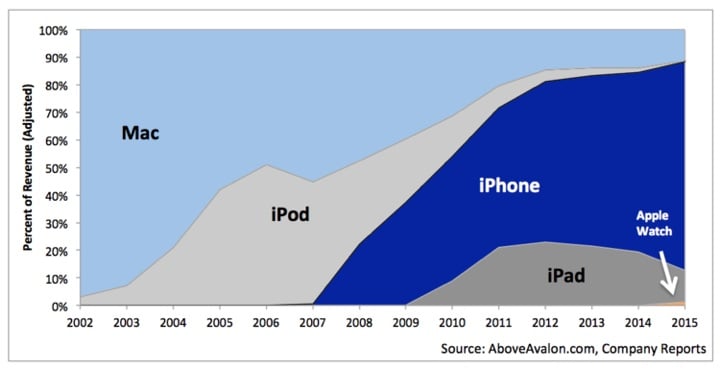
Apple Revenue

New article on UX Booth: The future of 3D Touch

I just published my first article on UX Booth. For The Next Step for 3D Touch I did some digging on where we might be headed with the 3D Touch feature in the new iPhones. I got particularly fixated on the idea of reducing an app’s UI to only the icon on the home screen:

So what would happen if 3D Touch became an app’s main UI? What could happen if we created apps solely comprised of shortcut actions and dynamic actions—and nothing else?

Read on for more…

Notifications everywhere, and not a drop to drink

Interesting thoughts from Steven Levy in What the Apple Watch Means for The Age of Notifications:

Done right, notifications are a wonderful Feed of Feeds, weeding out the stuff you really need to see from all the usual chaff in the stream.

But it’s hard to do this right when every single app wants to send you notifications. Even given that the system will limit itself to notices worthy of instant notice there are just too many notifications elbowing their way into what should be a narrow passage labeled, “Stuff I absolutely need to see.”

This decreases the value of all notifications.

Gmail has tried, but no one has really figured out the algorithms required to figure out what qualifies as “Stuff I absolutely need to see.” This is the holy grail of notifications at the moment.

The Watch and our attention

Jason Kottke wrote what I guess can be described as a review of Apple Watch reviews. He makes a particularly interesting point about the common assertion that we’ll start using our phones less because of the watch. From Apple Watch and the induced demand of communication:

In the entire history of the world, if you make it easier for people to do something compelling, people don’t do that thing less: they’ll do it more. If you give people more food, they eat it. If you make it easier to get credit, people will use it. If you add another two lanes to a traffic-clogged highway, you get a larger traffic-clogged highway. And if you put a device on their wrist that makes it easier to communicate with friends, guess what? They’re going to use the shit out of it, potentially way more than they ever used their phones.

He also quotes from the same article I had a visceral reaction to in The Apple Watch won’t save you time. In that article I made a similar point:

I’m not saying the Apple Watch won’t be wildly successful, or that I don’t want one — I definitely want one. I just don’t think we should fool ourselves into thinking it will somehow give us more time because we might look at our phones less. If history teaches us anything, it’s that we’ll find a way for the watch to fill up our “saved” time in other ways — and then some.

The Apple Watch won't save you time

Matthew Panzarino wrote something that historians will reference in thinkpieces on Medium 40 years from now. From The Apple Watch Is Time, Saved:

And that is the target market of the Apple Watch. Not “rich people” (though there’s a model specially for them), not “tech geeks” and not “Apple fanatics.” It’s people who want more time, and that is a very large target.

This, for some reason, is the thing that Apple has had a hard time articulating. This is the primary use case of the Watch. It’s not just that it’s a “notification center”; it’s that it allows you to act without any additional distraction.

The idea that some new technology will give us more time to do “other stuff” is as old as technological innovation itself. By now we should have learned that no, actually, this time isn’t different. But we’ll never learn. We approach every new technology with starry eyes and hopes and dreams of a life less time-consuming. When I read something like this, I always think about this classic scene from Arrested Development:
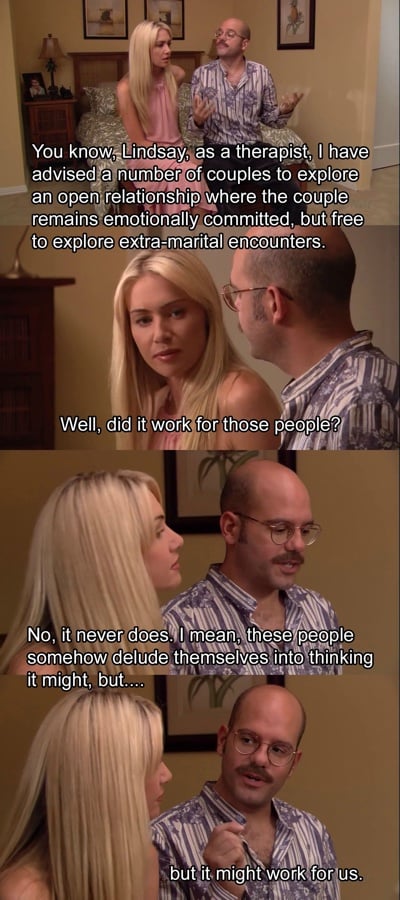
It might work for us

In just one of several historical examples of the time-saving delusion, John Maynard Keynes published an essay in 1930 called Economic Possibilities for our Grandchildren [PDF], in which he predicted that technological innovation will save people so much time that they won’t know what to do with themselves:

Thus for the first time since his creation man will be faced with his real, his permanent problem—how to use his freedom from pressing economic cares, how to occupy the leisure, which science and compound interest will have won for him, to live wisely and agreeably and well.

That, alas, has not happened. We are busier than ever these days. Instead of giving us more time, our technologies have instead given us more ways to be connected, to stay in touch with work, to never have to leave the office. I don’t see how one can argue that the Apple Watch will reverse this trend.

What the Apple Watch will do instead, I believe, is to accelerate a different trend, described by Douglas Rushkoff in Present Shock:

Our society has reoriented itself to the present moment. Everything is live, real time, and always-on. It’s not a mere speeding up, however much our lifestyles and technologies have accelerated the rate at which we attempt to do things. It’s more of a diminishment of anything that isn’t happening right now—and the onslaught of everything that supposedly is.

I’m not saying the Apple Watch won’t be wildly successful, or that I don’t want one — I definitely want one. I just don’t think we should fool ourselves into thinking it will somehow give us more time because we might look at our phones less. If history teaches us anything, it’s that we’ll find a way for the watch to fill up our “saved” time in other ways — and then some. And in doing so we’ll continue on the path Kevin Kelly lays out in his excellent book What Technology Wants:

Our lives today are strung with a profound and constant tension between the virtues of more technology and the personal necessity of less: Should I get my kid this gadget? Do I have time to master this labor-saving device? And more deeply: What is this technology taking over my life, anyway? What is this global force that elicits both our love and repulsion? How should we approach it? Can we resist it, or is each and every new technology inevitable? Does the relentless avalanche of new things deserve my support or my skepticism—and will my choice even matter?

That said, this post is only about the first version of the Apple Watch. The next watch is a different story. The next watch might be the one that finally saves us time. Just wait. You’ll see.