Menu

Posts tagged “writing”

Speed-reading and comprehension

In the excellent Reading to Have Read Ian Bogost sums up why I’m not a fan of Spritz, a speed-reading app that’s been making the rounds:

In today’s attention economy, reading materials (we call it “content” now) have ceased to be created and disseminated for understanding. Instead, they exist first (and primarily) for mere encounter. This condition doesn’t necessarily signal the degradation of reading; it also arises from the surplus of content we are invited and even expected to read. But it’s a Sisyphean1 task. We can no longer reasonably hope to read all our emails, let alone our friends’ Facebook updates or tweets or blog posts, let alone the hundreds of daily articles and listicles and quizzes and the like. Longreads may offer stories that are best enjoyed away from your desk, but what good are such moments when the #longreads queue is so full? Like books bought to be shelved, articles are saved for a later that never comes.

The core issue with Spritz (and speed-reading in general) as a way of dealing with this kind of overload is this:

But can you really read a novel in 90 minutes with full comprehension? Well, like most things that seem too good to be true, the answer unfortunately is no. The research in the 1970s showed convincingly that although people can read using rapid serial visual presentation (RSVP) at normal reading rates, comprehension and memory for text falls as RSVP speeds increase, and the problem gets worse for paragraphs compared to single sentences. One of the biggest problems is that there just isn’t enough time to put the meaning together and store it in memory (what psychologists call “consolidation”).


  1. That’s the dude who was punished for chronic deceitfulness by being compelled to roll an immense boulder up a hill, only to watch it roll back down, and to repeat this action forever. 

On moving to Portland, and how the internet is (still) awesome

Portland skyline

Take care of the people you love, and try to make yourself known and understood. Dial it down, work with your hands, keep it quiet, and share what you know.

— Frank Chimero, This One’s for Me

In 16 days our family will walk out of an empty house in Cape Town and get on a plane to Portland, OR. It will be a one-way journey. I’ve been searching for the words to write about it, but I haven’t quite found the right ones. So I guess these ones will have to do.

I started my first blog in 2004. It was hosted on Windows Live Spaces, and it was terrible. I called it Leave The Great Indoors (yes, because of the John Mayer song and we just moved countries and just roll with it ok?). I have no idea what I wrote about back then, but I must have felt that there was something to this writing thing, because a year later I moved it to Blogger (because more features!). It still exists, but please don’t tell anyone.

The writing thing kept growing on me, and a couple of months later I started a UX-focused blog called UX-SA (because User Experience, and I’m from South Africa, and yes it’s a stupid name for a blog). That one also still exists, but again, please don’t tell anyone.

It was only in late 2009 that I got serious about it, bought a domain name (I don’t know what I was thinking — no one can pronounce Elezea), installed WordPress, and got stuck in. I proceeded to go through several identity crises, which included a move from Silicon Valley to Cape Town, 2 kids, and realizing that I’ll never learn how to deal with angry comments so I should probably turn those off.

One day I wrote a post that got mildly popular, and Jim Dalrymple linked to it from The Loop. He also must have subscribed to my RSS feed, because he has linked to the site a few times since then — something I’m still surprised by and incredibly grateful for every time it happens.

Some time after that a guy I’d never met, who lives in Portland, started following me on Twitter. He’s a regular reader of The Loop, and he decided to check out this guy who has the same last name as he does (let’s call him Rudolph, because that’s his name). We started chatting a bit, and when he came to visit his extended family in Cape Town we caught up for coffee. We kept in touch, as like-minded people are prone to do.

Last August my wife and I went to San Diego for a family reunion. I also set up some interviews because we were strongly considering moving there. But we took one look at California and realized we won’t be able to live there again (Cape Town kind of gets you addicted to leafy mountain beauty, and well, California). On a whim I gave Rudolph a call, and asked him if he thinks we should move to Portland. I’d been following him on Instagram for a while, and it looked like a nice place.

So this random guy I met on the Internet went to work and helped us figure out if Portland might be the city for us. A few months later I started looking for jobs there. Since I’d never been to Oregon I took a one-week trip to check it out and speak to some people in person. Of course I stayed with Rudolph and his lovely family.

I talked to several companies in Portland, but the conversations that kept sticking in my mind were the ones I had with HealthSparq, a healthcare transparency company that’s part of Cambia Health Solutions. I never thought I’d work in the healthcare field, but the team’s passion and vision won me over. So on April 13th I’m starting at Healthsparq as a Director of Product. Healthsparq’s president, Scott Decker, wrote a post the other day that’s a pretty good summary of why I decided to join them. From Health Care Transparency: Opening Up the Market:

It’s important that these new transparency tools provide robust information that people want to know in a way they can make actionable. While more and more health care data is being generated and released — from personal tracking devices to government and payer data — the information won’t be useful unless it is understandable and easy to navigate. These new transparency tools should provide as complete a picture as possible of price and quality, from the moment a person begins receiving care for a specific condition to the time when they no longer require treatment.

That’s a tough UX problem, and a vision I can get behind. I’m excited about the move to a new city with new beginnings and new things to explore — and a product I can believe in.

Anyway, I’m telling you the strange story of how this all happened because I’m worried that we don’t always appreciate how cool the internet can be. My decision to start a crappy blog in 2004 eventually led to a bunch of connections with fantastic people who decided to give me a shot (remind me to tell you about the day that Francisco sent me a DM to ask if I’d like to write for Smashing Magazine). This move wouldn’t have happened if I hadn’t met Jim and Rudolph online, and if they weren’t such nice people, and I can’t quite get my brain around how great that is.

We give the internet a lot of crap, and yes, it can be a vile place sometimes. But we’re moving to Portland because of relationships that were started and cemented on the internet, so I’m going to remain in awe of this technology that has the power to help us make each other’s lives so much better.
What happens when placeholder text doesn't get replaced

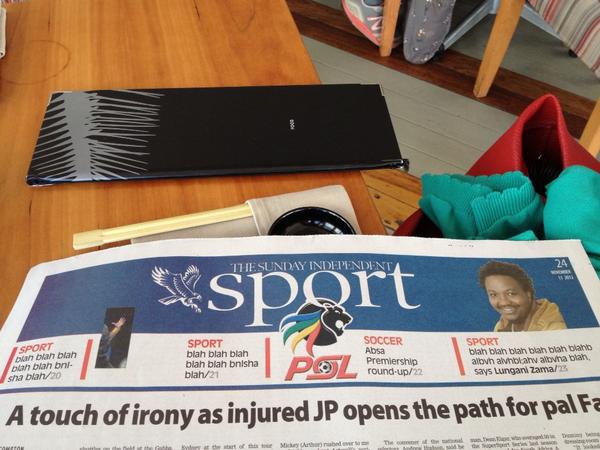
One of the many things I do that proves that I need to get out more is collect examples of placeholder text that ends up in a final interface. But I’ve also noticed that the issue happens more and more in the offline world as well. As I looked through my folder this morning I realized that, in the interest of science, I should post some of my favorites here. If you have any other good examples, please let me know!

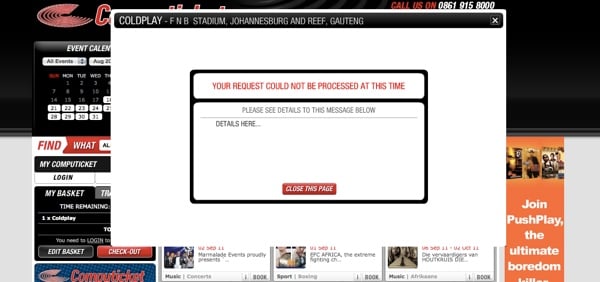
Let’s start with a very common one. Even though error messages are extremely important, they’re often forgotten about:

Computicket error message

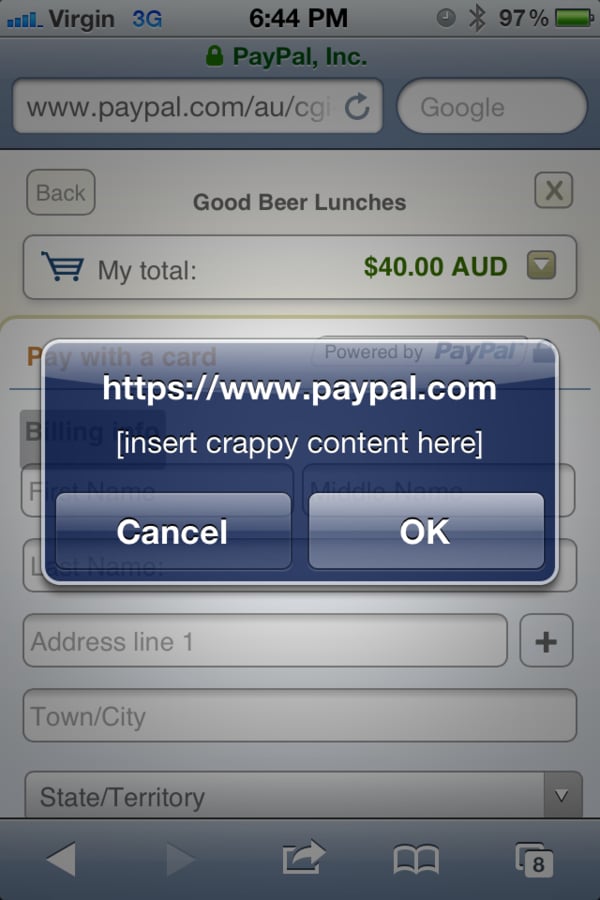
I have a feeling that this was done very late one night:

PayPal content

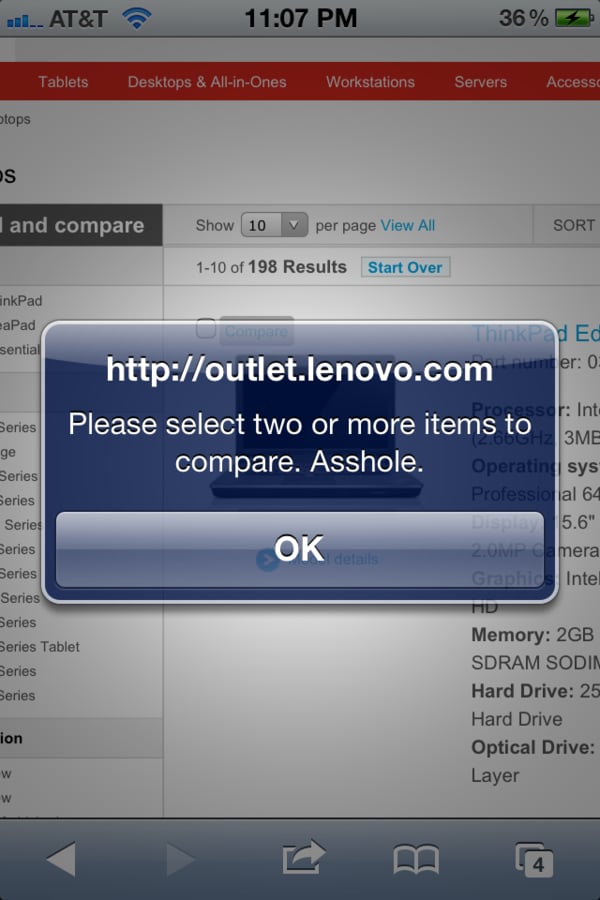
Speaking of disgruntled employees:

Lenovo

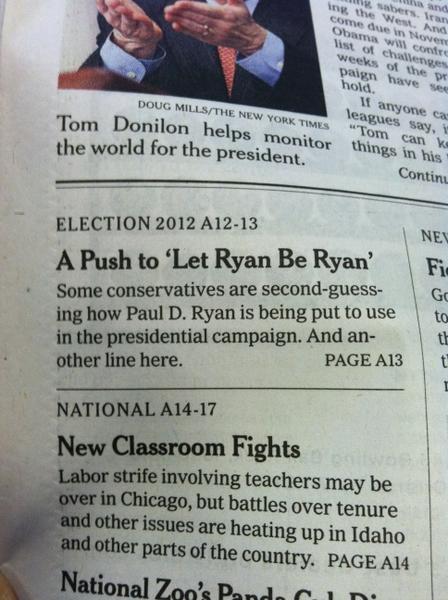
Placeholder text shows up surprisingly often in newspapers. And another line.

Another line here

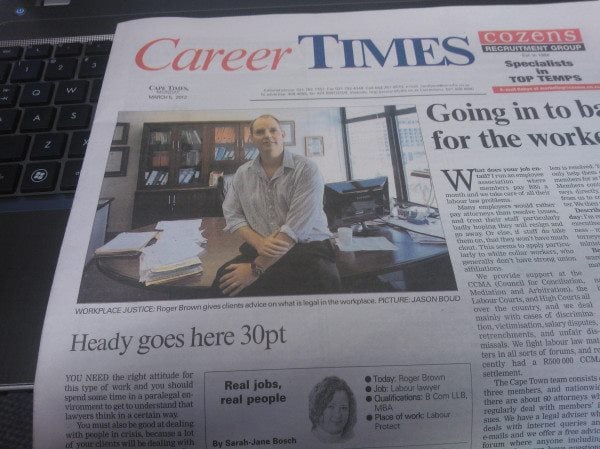
At least we know what the font size should be:

Cape Times headline

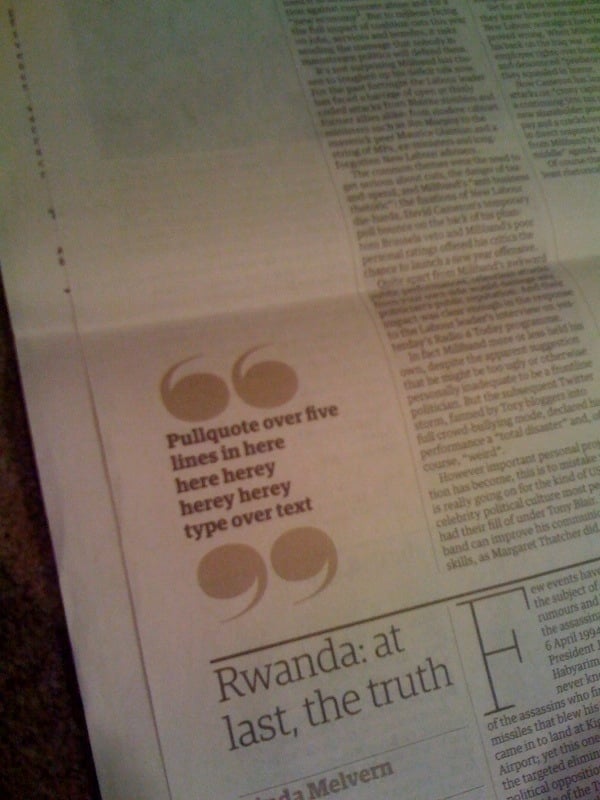
Pull quotes are optional:

Herey

I often feel the same way about sportsball:

Sportsball

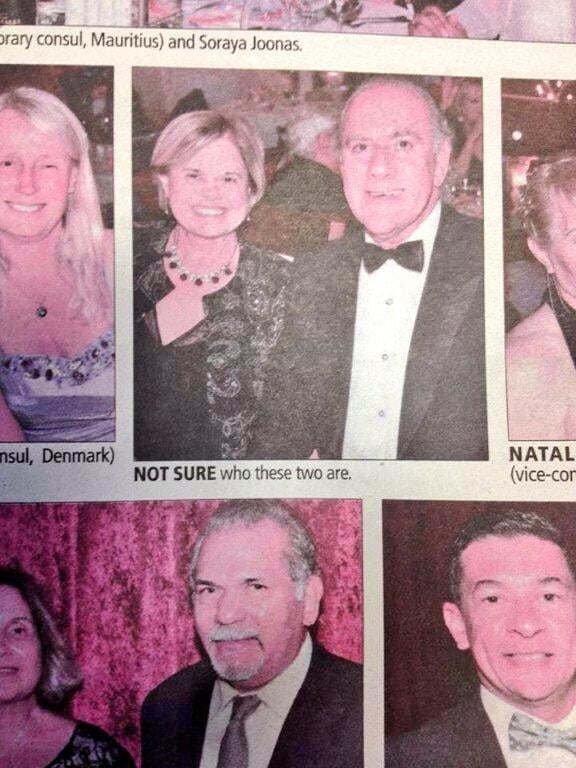
Who cares about these people:

Not sure

But I think my all-time favorite is still this teaser that went up all over Cape Town one morning:

3-deck headline

And finally: here you go, have a glass of Lorem Ipsum-inspired wine:

Lorem wine

Yes, it’s funny, but these examples also prove a very important point: the consequences of thinking about content after the design process is completed can be pretty embarrassing. Content-first design is where it’s at.

Always choose meaning over recognition

I’ve been thinking about this whole “being online” thing quite a bit over the past week or so, so James Shelley’s The Overinflated Currency of Personal Brands struck quite a chord:

What happens when the fame contagion infects an entire society? [American historian Daniel Boorstin] speculated that “The quest for celebrity, the pressure for well-knownness, everywhere makes the worker overshadow the work.” Increasingly we will go about our lives and work not actually concerned with the living and working itself, but with being known for our lives and work. Our lives and work become nothing but source material for the promotion of our personalities. Ultimately, achievement and accomplishment come to mean nothing, if they are not mechanisms for propagating our individual cult stories.

I see this more and more online, and it’s a worrisome trend — this tendency to measure the value of our work by the number of people who see it and comment on it. Our search for meaningful work should always outweigh our search for recognition. This idea of individual stories and meaning remind me of Donald Miller’s words in one of my favorite books, A Million Miles in a Thousand Years:

If [it’s true about] a good story being a condensed version of life — that is, if story is just life without the meaningless scenes — I wondered if life could be lived more like a good story in the first place. I wondered if a person could plan a story for his life and live it intentionally.

Planning a good story for our lives has nothing to do with “well-knownness” and everything to do with the amount of meaning we pack into each day. I know I’m being a bit sentimental today, but it’s because our family is on the verge of a very big change, and much of it is driven by a renewed appreciation for living life with greater intention. Over the past few years I’ve seen my decisions increasingly being influenced by a desire for my daughters to one day say to their friends, “My Dad wasn’t afraid to take risks.” So that’s what we’re doing…

The issue with @HistoryPics and lack of attribution

Internet

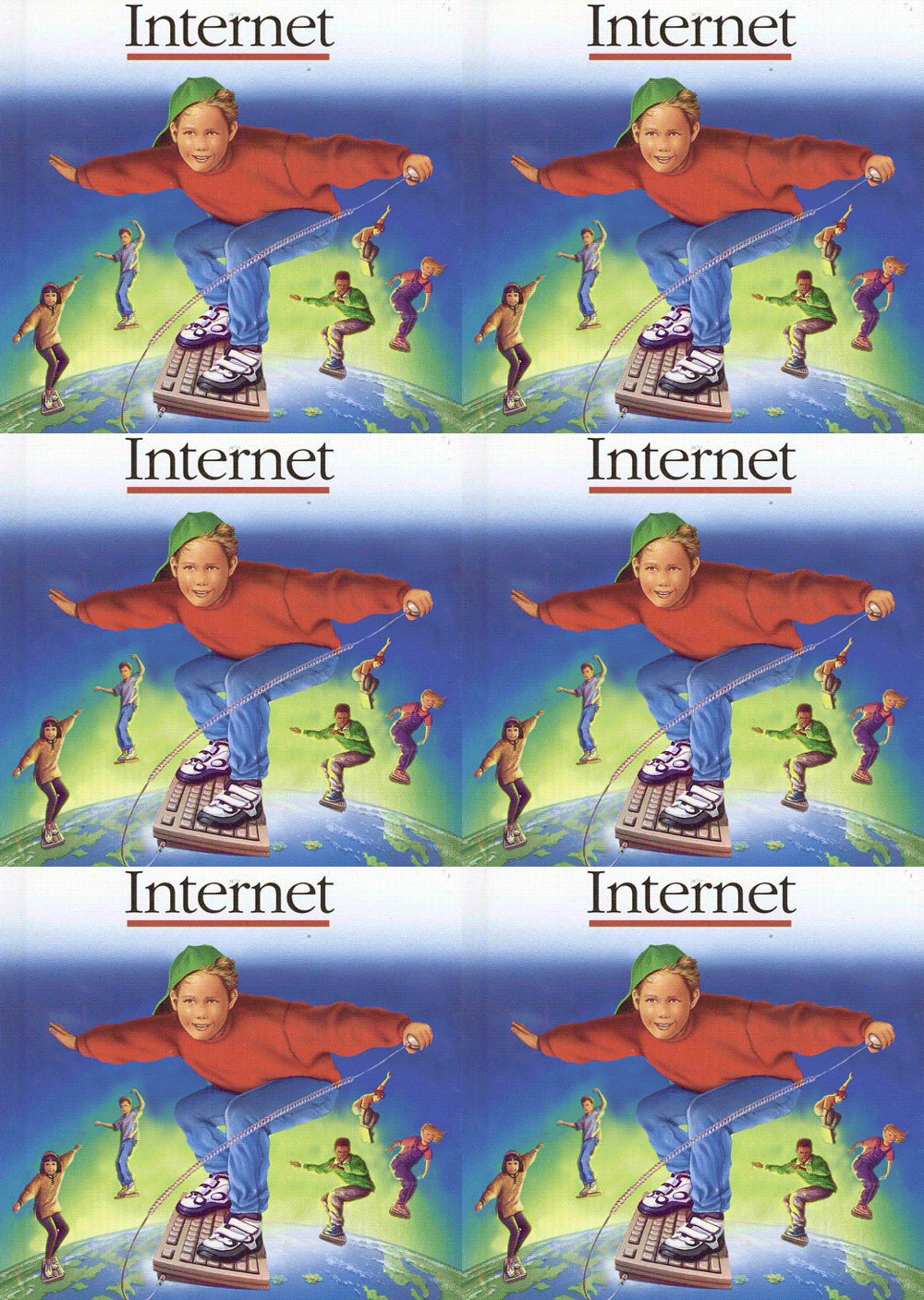
I rarely find myself in a position where I want to “engage” with the company who makes my toothpaste, so I generally don’t follow brands on Twitter (or any non-individual accounts, for that matter). But I recently indulged in a couple of guilty pleasure accounts. Faces in Things posts pictures of (wait for it) things that look like faces, and Behind the Scenes posts (wait for it) behind-the-scenes pictures from iconic movies.

I found the accounts interesting and funny for a while, but then I started noticing a few things that made me uncomfortable. Two things started bugging me:

  1. Photos are never attributed to their original sources, and
  2. These accounts (and several similar ones, most notably History In Pictures) seem to be run by the same people who just end up retweeting their own stuff to create some kind of snowball effect

I started suspecting that these accounts were created to amass hundreds of thousands of followers, only to then be sold to the highest bidder who wants to pimp their products to an unsuspecting audience. It’s a common practice on Facebook (I’ve written about that in The dirty world of Facebook EdgeRank Optimization), but I haven’t seen it on Twitter before.

Anyway, I unfollowed the accounts and didn’t think much more of it.

And then I read Wynken de Worde’s It’s history, not a viral feed1, in which he tears these Twitter accounts apart. He focuses quite a bit on the attribution issue, confirms that most of the accounts exist only for the bait-and-switch sale2, and then concludes:

Feeds like @HistoryinPics make it impossible for anyone interested in a picture to find out more about it, to better understand what it is showing, and to assess its accuracy. As a teacher and as someone who works in a cultural heritage institution, I am deeply invested in the value of studying the past and of recognizing that the past is never neutral or transparent. We see the past through our own perspective and often put it to use for our own purposes. We don’t always need to trace history’s contours in order to enjoy a letter or a photograph, but they are there to be traced. These accounts capitalize on a notion that history is nothing more than superficial glimpses of some vaguely defined time before ours, one that exists for us to look at and exclaim over and move on from without worrying about what it means and whether it happened. […]

And so @HistoryInPics makes me angry not for what it fails to do, but that it gets so many people to participate in it, including people who care about the same issues that I do. Attribution, citation, and accuracy are the basis of understanding history. @HistoryInPics might not care about those things, but I would like to think that you do. The next time you come across one of these pictures, ask yourself what it shows and what it doesn’t, and what message you’re conveying by spreading it.

The inaccuracy of these accounts (see, for example, 12 More Viral Photos That Are Totally Fake) is a huge deal, of course. But for some reason it’s still the lack of attribution that grates me the most. Back in 2009 I adopted Chris Messina’s use of slashtags on Twitter to attribute sources using the syntax “/via @name”. I’ve been using it ever since, and I saw many people who did the same. But it’s a practice that has slowly diminished over the past few years3.

Why is it a big deal to tell people where we found something? Isn’t the web free and open and we’re all one and blah blah blah? Sure, but the web is also fundamentally about hyperlinks. The ability to follow links back to their original sources — with plenty of pleasant detours along the way — is the core of what makes the internet such a wonderful place. Do you ever get happily lost on Wikipedia? Exactly. So if we stop caring about attribution, we rob others of the ability to find more people and topics that they might be interested in. I’ll say it again: It’s not about making the source feel important. It’s about helping others follow the breadcrumbs to places of interest.

So I guess the point of this post is to join in Wynken’s plea that we look at these new crop of Twitter accounts more critically, and call them what they are: get rich quick schemes. And to ask that we remember to take attribution seriously. It’s the right thing to do.


  1. Link via The Loop

  2. Also see Alexis Madrigal’s interesting reporting in The 2 Teenagers Who Run the Wildly Popular Twitter Feed @HistoryInPics

  3. There were other attempts at attribution syntax, of course — most notably the much-mocked curator’s ǝpoɔ

A service configuration to send Markdown-formatted excerpts from Mr. Reader to Notesy

I recently switched from Reeder to Mr. Reader as my default RSS app on my iPad1. The main reason is that I wanted an easier workflow to post article snippets to my text editor so that I can either post it to the site, or come back to it later and expand more before posting. Mr. Reader allows for the creation of custom workflows, which makes this possible.

The ultimate article on using Mr. Reader’s custom workflows is Federico Viticci’s characteristically insightful Mr. Reader And The Services Menu for iOS. He goes over several useful workflows, but the one he uses for Notesy doesn’t quite do what I want it to do, so I made my own and thought I might as well share in case anyone else is interested.

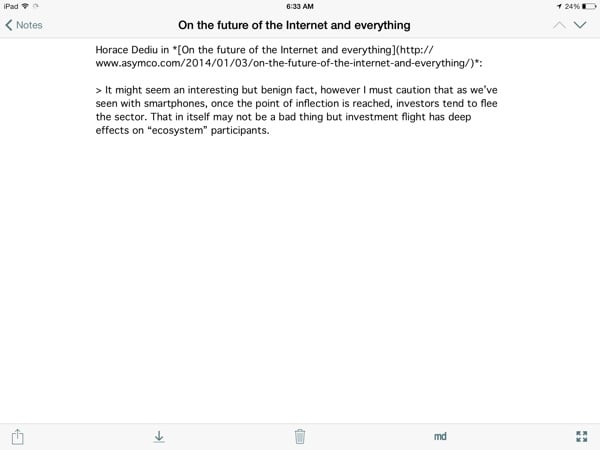
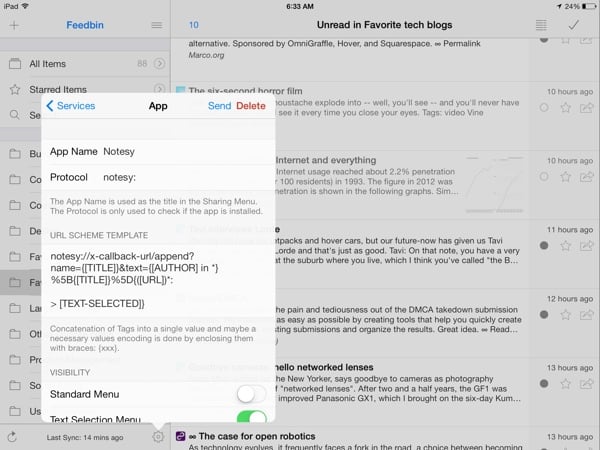
I want to have an action that lets me select some text in Mr. Reader, and then create a new note in Notesy with the article title as the note’s title, followed by a markdown-formatted excerpt that includes the author, the title/url, as well as the quoted text — like so:

Mr Reader Notesy

To set this up, go into the services menu in Mr. Reader, and configure it as follows:

Mr Reader Notesy

If you want to copy and paste the URL scheme text, here it is:

notesy://x-callback-url/append?name={[TITLE]}&text={[AUTHOR] in *}%5B{[TITLE]}%5D{([URL])*:

Make sure the “Text Selection Menu” toggle is on. Then, all you have to do is a select a piece of text, tap on “More actions”, and call the Notesy action. You can then either keep writing in Notesy, or come back to it later in nvALT on your Mac (see an overview of my plain text setup here).

And if you’re really lazy, just download this file on your iPad and select “Open In Mr. Reader” to set it up automatically: Notesy services configuration for Mr. Reader.


  1. The RSS Reader space is in dire need of an app name revolution 

The future of the personal site

‘Tis the time for introspection, and this year we all seem to wonder about the future of online publishing — and in particular, what role the personal blog will play going forward. Jason Kottke kicks us off with The blog is dead, long live the blog:

Instead of blogging, people are posting to Tumblr, tweeting, pinning things to their board, posting to Reddit, Snapchatting, updating Facebook statuses, Instagramming, and publishing on Medium. In 1997, wired teens created online diaries, and in 2004 the blog was king. Today, teens are about as likely to start a blog (over Instagramming or Snapchatting) as they are to buy a music CD. Blogs are for 40-somethings with kids. […]

The primary mode for the distribution of links has moved from the loosely connected network of blogs to tightly integrated services like Facebook and Twitter.

Even though I don’t want to believe Jason, his words ring true. And that bugs me, because I really like this site (which I haven’t called a blog for a long time, but hey, semantics). After a few days of overthinking things, Frank Chimero came to the rescue with Homesteading 2014, in which he explains his plans for his own site going forward. The whole thing is worth reading because it’s a great summary of the problem with endless content streams, but here’s the key part:

I’m returning to a personal site, which flips everything on its head. Rather than teasing things apart into silos, I can fuse together different kinds of content. Instead of having fewer sections to attend to distracted and busy individuals, I’ll add more (and hopefully introduce some friction, complexity, and depth) to reward those who want to invest their time. […]

So, I’m doubling down on my personal site in 2014. In light of the noisy, fragmented internet, I want a unified place for myself — the internet version of a quiet, cluttered cottage in the country. I’ll have you over for a visit when it’s finished.

Count me in. The strategy resonates with me, and besides, I don’t want to see the “blog” die.

From LOLcat to Doge

My fascination with how internet memes change language gets another healthy boost with Annalee Newitz’s excellent article We who spoke LOLcat now speak Doge:

In the internet meme war between cats and dogs, the dogs are currently winning. The “doge” meme features an image (often of an adorable shiba dog), annotated with distinctive phrases representing the thoughts of the dog — or the dragon, or whatever is being depicted. What has the internet gained in its move from LOLcats to doges?

I can’t decide which part to quote, so I just went for the opening paragraph and hope it will entice you to read the whole thing. Has there ever been a time like this, where language is changing so quickly and so completely?

Also, grammatical humor rocks.

Also, I love the internet.

No more FAQs

Lisa Maria Martin gives some advice on What To Do With Those Dreaded FAQs:

These all underscore FAQs’ fatal flaw: they are content without context, delivered without regard for the larger experience of the website. You can hear the absurdity in the name itself: if users are asking the same questions so frequently, then there is an obvious gulf between their needs and the site content. (And if not, then we have a labeling problem.) Instead of sending users to a jumble of maybe-it’s-here-maybe-it’s-not questions, the answers to FAQs should be found naturally throughout a website. They are not separated, not isolated, not other. They are the content.

We’re definitely in agreement about that. A while I go I wrote this:

Most users don’t know what FAQ stands for, and besides, it’s bad practice to answer questions outside the context people want to ask them in. Figure out where in the process each question in your FAQ might come up, and provide the answer right there within the flow. Don’t expect people to click to a different page to find the information they need.

By the way, 24 ways is a collection of fantastic design and development articles and tutorials for advent. If it’s not part of your daily reading yet, make it so!

[Sponsor] Pencils.com: Tools to unleash your creativity

Thanks to Pencils.com for sponsoring Elezea’s RSS feed this week!

At Pencils.com, we believe that creativity is the greatest of all virtues. And, with our selection of unique, high-quality pencils, notebooks, and creative tools, we’ve got everything you need to unleash yours.

Whether you’re a pencil nut who knows all the brands (Caran d’Ache, Blackwing, Faber-Castell, we stock them all), or a casual doodler looking for something to inspire you, there’s something for you on Pencils.com. Combine that with our legendary customer service and fast, reliable shipping, and you’ve got some serious creative potential.

So, go ahead and read the story of the $40 pencil, learn about the pencil company that has been around since the French Revolution, and find the perfect notebook to capture your ideas. If you’re in the giving mood, we also have gifts for artists, writers, musicians, and anyone else on your shopping list.

Above all else, stay creative.

Pencils.com

Sponsorship by The Syndicate.