Menu

Posts tagged “writing”

You should read these two zombie books

This isn’t a zombie blog1. Still, I’d be doing you a huge disservice if I didn’t tell you about two excellent zombie books I read recently. The books are great because yes, they have zombies in them, but they’re not actually about zombies. They’re about how humans treat each other when we turn on each other. How it’s easy to speak about our values but a bit harder to stick to those values when the going gets really tough. And that’s a topic worth exploring.
Great zombie books

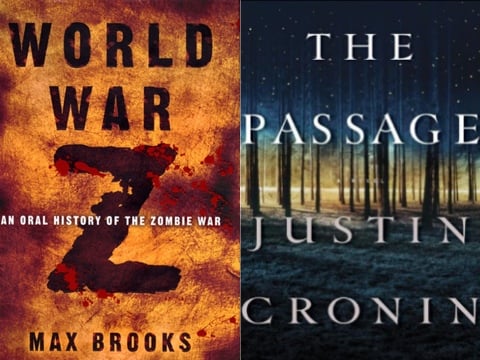
The first book I want to recommend is World War Z. The BOOK, not the movie! I saw the movie, and it’s fine, but it is not even remotely similar to the book. I don’t even know why they kept the title. It’s really strange. You should still see the movie, because it’s fun, but the book is something completely different. It is, as the subtitle promises, “an oral history of the zombie war”. The war happened. It’s over. This is a book about people reflecting on what went down. And it is fascinating.

There are commentaries about the media:

The only rule that ever made sense to me I learned from a history, not an economics, professor at Wharton. “Fear,” he used to say, “fear is the most valuable commodity in the universe.” That blew me away. “Turn on the TV,” he’d say. “What are you seeing? People selling their products? No. People selling the fear of you having to live without their products.” Fuckin’ A, was he right. Fear of aging, fear of loneliness, fear of poverty, fear of failure. Fear is the most basic emotion we have. Fear is primal. Fear sells. That was my mantra. “Fear sells.”

There are commentaries on what happens when “knowledge work” is not needed any more:

You’re a high-powered corporate attorney. You’ve spent most of your life reviewing contracts, brokering deals, talking on the phone. That’s what you’re good at, that’s what made you rich and what allowed you to hire a plumber to fix your toilet, which allowed you to keep talking on the phone. The more work you do, the more money you make, the more peons you hire to free you up to make more money. That’s the way the world works. But one day it doesn’t. No one needs a contract reviewed or a deal brokered. What it does need is toilets fixed. And suddenly that peon is your teacher, maybe even your boss. For some, this was scarier than the living dead.

And what happens when those workers relearn how to do stuff with their hands:

It gave people the opportunity to see the fruits of their labor, it gave them a sense of individual pride to know they were making a clear, concrete contribution to victory, and it gave me a wonderful feeling that I was part of that. I needed that feeling. It kept me sane for the other part of my job.

And finally, on freedom:

Freedom isn’t just something you have for the sake of having, you have to want something else first and then want the freedom to fight for it.

The deep thought that went into this book results in an engrossing story full of detail that makes you think about your everyday relationships, and what might happen if those relationships are strained beyond their limits. I loved it.

The second book is The Passage. First, the backstory is great. The author first began developing his ideas for the book when his daughter asked him to write a book about a “girl who saves the world.” Well, it’s about a girl, and she tries to save the world, but it’s like no hero story you’ve read before. It starts when the zombie apocalypse picks up steam, and then jumps ahead 100 years to focus on how one isolated community is dealing with the aftermath. In contrast to World War Z, the war is very much not over in The Passage. It’s gruesome at times, but again, beautifully written.

From interesting reflections on what zombies represent:

What were the living dead, Wolgast thought, but a metaphor for the misbegotten march of middle age?

To what it means to believe in the future:

A baby wasn’t an idea, as love was an idea. A baby was a fact. It was a being with a mind and a nature, and you could feel about it any way you liked, but a baby wouldn’t care. Just by existing, it demanded that you believe in a future: the future it would crawl in, walk in, live in. A baby was a piece of time; it was a promise you made that the world made back to you. A baby was the oldest deal there was, to go on living.

And the nature of hope:

Courage is easy, when the alternative is getting killed. It’s hope that’s hard.

The Passage is not just a great story (I couldn’t put it down), but also another interesting look at what happens when circumstances bring out the worst (and the best) in humans.

All this got me thinking again about an article I read recently about the Zombie Renaissance in literature. And I realised how true this part is about these two books:

We are living in a time when what counts as “life” is in significant scientific dispute, and in the heyday of zombie computers and zombie banks, zombie this and zombie that. Why wouldn’t we also be living in a time of zombie literary forms? Whatever their specific emphases and intricacies, all these zombies represent a plague of suspended agency, a sense that the human world is no longer (if it ever was) commanded by individuals making rational decisions. Instead we are witnessing a slow, compulsive, collective movement toward Malthusian self-destruction. Of course all monsters are projections of human fears, but only zombies make this fundamentally social and self-accusatory charge: we the people are the problem we cannot solve. We outnumber ourselves.

If this is an idea that interests you, I highly recommend these books. Even if you don’t like zombies, you’ll appreciate the thoughtful writing and gripping stories. Do it.


  1. Although, maybe a pivot is in order? I’ll think about it. 

Where the hashtag really comes from

Keith Houston’s fascinating essay The Ancient Roots of Punctuation begins like this:

The story of the hashtag begins sometime around the fourteenth century, with the introduction of the Latin abbreviation “lb,” for the Roman term libra pondo, or “pound weight.” Like many standard abbreviations of that period, “lb” was written with the addition of a horizontal bar, known as a tittle, or tilde. And though printers commonly cast this barred abbreviation as a single character, it was the rushed pens of scribes that eventually produced the symbol’s modern form: hurriedly dashed off again and again, the barred “lb” mutated into the abstract #.

Which is why the hashtag is often referred to as the pound sign. Keith also explains the origins of the Pilcrow (¶), the Ampersand (&), the Manicule (☞), and the Diple (>). Great article.

Emoji and post-literacy

In The ‘Mood Graph’: How Our Emotions Are Taking Over the Web Evan Selinger writes about the rise if emoji and other emotional signals in social media:

But there are costs to a mood graph too. The more we rely on finishing ideas with the same limited words (feeling happy) and images (smiley face) available to everyone on a platform, the more those pre-fabricated symbols structure and limit the ideas we express. Such general symbols can also lead to even more confusion or misunderstanding due to cultural, generational, and other differences.

And finally, drop-down expression makes us one-dimensional, living caricatures of G-mail’s canned responses — a style of speech better suited to emotionless computers than flesh-and-blood humans.

It’s a great article well worth reading all the way through. This trend is a continuation of something I’ve discussed quite often here over the years: our move towards a post-literate society:

What is post-literacy? It is the condition of semi-literacy, where most people can read and write to some extent, but where the literate sensibility no longer occupies a central position in culture, society, and politics. Post-literacy occurs when the ability to comprehend the written word decays. If post-literacy is now the ground of society questions arise: what happens to the reader, the writer, and the book in post-literary environment? What happens to thinking, resistance, and dissent when the ground becomes wordless?

I find myself here in full agreement with Guy English from his post Learn to X:

But, let’s not kid ourselves, literacy is the new literacy. The ability to read, comprehend, digest and come to rational conclusions — that’s what we need more of.

Emoji are fine, and I’m as much a fan of the animated gif as anyone. But I do feel like we’re trying to create all these shortcuts to express our emotions because it’s hard to do it in words. The thing is, though, it should be hard to express our emotions. That’s how we understand them and work through them. So let’s go easy on the giphy.com searches every once in a while, and try to find the right words instead.

The Feels

The perils of perfect recollection

Quentin Hardy has some interesting thoughts on what happens in a world of perfect recollection in his essay What’s Lost When Everything Is Recorded:

There is much to be gained from storage, of course. Who would not thrill to hear Lincoln at Gettysburg, or Shakespeare playing even a lesser role at the Globe? But Shakespeare’s plays were also reconstructions from the memories of diverse actors, some years after a performance. Our greatest literature was generated by an imperfect collective recollection, as much as it was written by one person.

I wrote about this issue before in The unnecessary fear of digital perfection.

If software is eating the world, Medium is eating its content.

Medium

About two years ago Marc Andreessen proclaimed that software is eating the world (beware the WSJ paywall):

My own theory is that we are in the middle of a dramatic and broad technological and economic shift in which software companies are poised to take over large swathes of the economy.

We’ve seen this shift toward software in the content arena too, where it’s impossible to ignore the constant stream of stories about the struggles of print media. And lately, it seems that Medium is emerging as the first major successful content platform since the shift started. It feels like every second or third link on Twitter points to a Medium post, and somehow being on Medium gives content the perception of a certain level of prestige.

Why is that? Why is this platform so successful, and why does it have such a strong brand? I don’t agree with the direct comparison and the premise that Quora vs. Medium is an actual winner-takes-all situation, but AJ Juliani makes an interesting point about this in Why Medium May Succeed Where Quora Did Not:

Medium is about stories. Quora is about answers. And people love stories. Our favorite way to learn is through stories and narrative.

Medium is certainly a great platform for reading stories, and the tools available to writers make it a great creation experience as well. But there’s also been pushback recently on Medium’s apparent dominance in the individual writer domain. The biggest concern is that we don’t know what Medium’s plans are, and that authors are therefore giving up their words to an unknown entity. Here is Glenn Fleishman in Why You Should Be Your Own Platform:

I’ve written a few things on Medium (not paid) because I liked the experience of their writing tools, their statistics, and their reach. […] But it’s not mine. It’s theirs.

I can’t control the URL. I can’t embed. I have no idea about what their ultimate plans are. They could delete all non-owned/paid content in the future with no notice. They could rework the design and it would be ugly. My words’ persistence, both in appearance and permanent location, are dependent on factors beyond my control.

Marco Arment takes this argument further in Medium and Being Your Own Platform

Treat places like Medium the way you’d treat writing for someone else’s magazine, for free. It serves the same purpose: your writing gets to appear in a semi-upscale setting and you might temporarily get more readers than you would elsewhere, but you’re giving up ownership and a lot of control to get that.

As for me, I love the writing (and reading) experience on Medium. But I do have concerns that are big enough to make me take a step back:

  • Medium seems to be more about Medium than about authors. I don’t think we should move our personal blogs there — it’s already getting too crowded, and I still believe we should all own our own identities online.
  • Related to the last point: the idea of organizing content around topics (collections) is great, but there is no way to follow collections easily. RSS feeds are difficult to find, and it seems the only way to see what’s new in a collection is to go to its URL. This makes me worried about a walled garden approach to the content, similar to how Twitter and Google+ restrict how you can add and extract content.
  • There’s some great content being surfaced by the editorial team, but there are also a lot of duds when you dig a bit deeper into the collections. And by expanding the platform so quickly the noise is becoming louder. I’m worried Medium is quickly going to outgrow their initial focus on providing quality over quantity.

If we’ve learned anything over the past few years, it’s that we should be wary of platforms that offer large audiences at a price of admission that is not immediately apparent (See Facebook, Instagram, Twitter…).

The barrier to setting up your own site has never been lower (if you’re not into WordPress, try Scriptogr.am or Octopress). Yes, building an audience on your own platform is much harder than hoping to get picked by the Medium editorial team. But the longevity and the satisfaction you’ll get from maintaining your own voice is so much higher. Don’t give that away.

How to convince clients to think about content before they think about graphics

I recently had to convince a client to pause their redesign efforts and work on their content first. This is how I did it. I tried to stay away from UX jargon and overly technical arguments. There is obviously much more to say about Content Strategy and related disciplines, but this was an exercise in trying to make a succinct argument by only focusing on information that’s most relevant to the client. I’m posting it here in the event that it might be useful to those who have to make similar arguments to non-UX audiences.

Introduction

Since this is primarily an informational site with the goal of converting readers into customers, it is imperative that we start the design process by developing the core content first. This will ensure that we design a web site purposefully to help users find the information they need, and guide them towards desired actions, as opposed to designing the interface first without knowing what content will be displayed. For a more detailed overview of this strategy, see A Richer Canvas.

In this brief overview I will summarize the primary reasons for following this approach, and how I propose we go about it on a practical level.

What happens if we don’t follow a “content first” strategy?

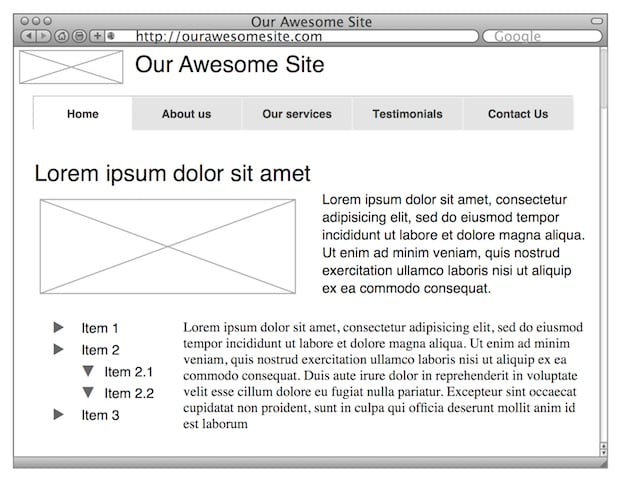
Let’s look at an example of starting the wireframe process before content is available. Let’s say we provide some wireframes of what the site might look like:

Content First

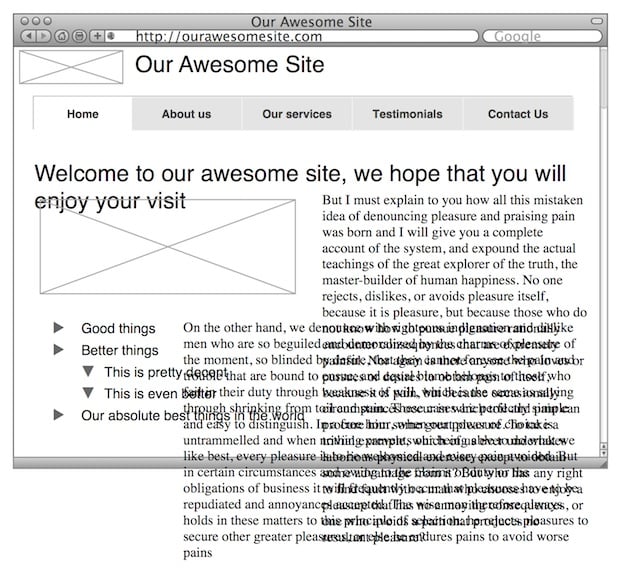
Now let’s say you love this approach and we proceed with graphic design, and eventually, towards the end, we finalize the content. We plug the content into the design, and then we discover we have a problem. Suddenly our design doesn’t work so well any more:

More Content First

If we design before we have content, we effectively create the packaging before we know what’s going to go in it. And if the content doesn’t fit the package, there are only two options: start from scratch, or try to jam the content into the existing package. We don’t want that.

But it’s not just about making the design work. Developing the content first allows us to be much more strategic about the words we put on the page. It gives us the opportunity to start with user and business goals, and make sure our content meets those goals. Ahava Leibtag puts it as follows:

We need to start urging our clients to think about their content not just as a commodity, but as the starting point, the building blocks of a website. It’s time to stop building the house without knowing how many bedrooms it may need. It’s a paradigm shift in the way we think about building websites. But, it has to be done. Because you know what they call things that are beautiful, but have no function? Useless.

So how do we design with a “content first” approach?

The basic process of putting content at the core of a design (specifically a redesign such as this) is as follows:

  • Audit. This is also referred to as a Content Inventory. We collect and document all our pages (like a site map), and we extract all the content from each page.
  • Analysis. In the next step we work on context and goals. We look at our audit and document how the content on each page relates to other pages. We look at the goals of our site, and figure out what type of content we need to ensure we meet those goals. We look at the process for writing content and if there are areas for improvement. We evaluate our brand promise and define exactly how we want to communicate to our visitors to deliver on that promise.
  • Content creation. Once we’ve laid down the guidelines for our content and agree on what we’re trying to achieve, we start writing. This involves rewriting existing content as well as writing new content if the audit and analysis showed us that we have some gaps.

For more on this process, see Getting to Grips with Content.

Who does this work?

The title of the person doing this type of work isn’t that important. The most important thing is that they have a thorough understanding of writing for the web, and how to connect users with the right content. In the web design industry this is often done by Information Architects or Content Strategists.

  • Information Architects “categorize information into a coherent structure, preferably one that most people can understand quickly, if not inherently” (see Wikipedia). Another way of saying it is that they build bridges between users and the content and services they need (see Information Architect).
  • Content Strategists “plan for the creation, publication, and governance of useful, usable content” (see The Discipline of Content Strategy).

So as I’ve said, the title isn’t important, only the outcome is. And the outcome is web content that meets user and business goals, and allows us to design an experience centred on guiding users along the desired path.

For the reasons outlined above, our strong recommendation is to engage a person with Information Architecture/Content Strategy skills to help us develop our core content before we proceed to the design stage.

End note: Of course, the argument is not always as simple as this. It is often impossible to have the majority of the content available before commencing design. That’s why I like the idea of Structure First. Content Always. But in this particular case, we needed content before we could do anything, so we had to put on the brakes until we had something useful to work with.

The significance of zombie literature

Mark McGurl wrote a fascinating essay on the recent Zombie Renaissance in literature:

We are living in a time when what counts as “life” is in significant scientific dispute, and in the heyday of zombie computers and zombie banks, zombie this and zombie that. Why wouldn’t we also be living in a time of zombie literary forms? Whatever their specific emphases and intricacies, all these zombies represent a plague of suspended agency, a sense that the human world is no longer (if it ever was) commanded by individuals making rational decisions. Instead we are witnessing a slow, compulsive, collective movement toward Malthusian self-destruction. Of course all monsters are projections of human fears, but only zombies make this fundamentally social and self-accusatory charge: we the people are the problem we cannot solve. We outnumber ourselves.

It really is a very thought-provoking piece. I just finished reading Justin Cronin’s The Passage and I kid you not — it is the best book I’ve read in a long time. Cronin is a literary author who takes on the zombie/post-apocalyptic genre in such a compelling and beautifully-written way. And as I read those words in McGurl’s article — “we the people are the problem we cannot solve” — I realised that’s exactly what makes The Passage so hard to put down. It is a story about surviving ourselves. If you’re looking for something to read this summer/winter, I highly recommend it.

The dying art of the small magazine ad

In Small Ads Dushko Petrovich turns our attention away from Facebook and Google to take a philosophical journey through those small, weird, completely non-targeted block-ads that appear in magazines:

At first you think these little rectangles are amusing because they offer monogrammed sweaters and self-publishing opportunities—things that are undoubtedly funny, in a sad, Skymall sort of way. But sometimes the funny sadness goes deeper than that, like the sadness of “unique diamond fish jewelry” for $15,000. And then sometimes you are plunged so deep into these ads, you wish there was a German word, or school of social thought, that could sufficiently describe the experience.

There might not be a German word for the experience, but Dushko’s troubled thoughts on the matter is entertainment enough.

Social media is turning us into better writers

Simon Kuper wrote a very interesting counter-argument to the common assertion that social media is making us a post-literate society. From his piece How social media improved writing:

Before the internet, only professional writers wrote. […] Email kicked off an unprecedented expansion in writing. We’re now in the most literate age in history. I remember in 2003 asking someone, “What’s a blog?” By 2006, the analysis firm NM Incite had identified 36 million blogs worldwide; five years later, there were 173 million. Use of online social media rises every month. In fact, writing is overtaking speech as the most common form of interaction.

The fact that we write to each other more than we talk to each other comes with its own set of problems, of course, but Simon argues that all this texting and IM’ing and status updating is turning us into better writers. And he makes a lot of sense.

On CNN, the circus is the point

Elliot Hannon nails it in CNN Gets It Wrong — Why We Don’t Really Mind:

If we cared more about journalism than news theater we’d all be watching PBS. But no one’s talking about NewsHour. There are no meltdowns. The circus, itself, becomes the point — the reason to watch. Youtube videos go viral precisely because they are unexpected, unvarnished — embarrassing. This is CNN.

I know I talk about it a lot, but here’s another paragraph from Neil Postman’s 1985 book Amusing Ourselves to Death that could have been written about 24-hour news networks:

Thus, we have here a great loop of impotence: The news elicits from you a variety of opinions about which you can do nothing except to offer them as more news, about which you can do nothing. […]

And a few chapters later:

Our culture’s adjustment to the epistemology of television is by now all but complete; we have so thoroughly accepted its definitions of truth, knowledge, and reality that irrelevance seems to us to be filled with import, and incoherence seems eminently sane. And if some of our institutions seem not to fit the template of the times, why it is they, and not the template, that seem to us disordered and strange.