Menu

Posts tagged “writing”

Language is changing, because Internet.

I read two really great articles this week about a couple of recent language shifts. The first is Megan Garber’s English Has a New Preposition, Because Internet, all about the “because-noun”:

However it originated, though, the usage of “because-noun” (and of “because-adjective” and “because-gerund”) is one of those distinctly of-the-Internet, by-the-Internet movements of language. It conveys focus (linguist Gretchen McCulloch: “It means something like ‘I’m so busy being totally absorbed by X that I don’t need to explain further, and you should know about this because it’s a completely valid incredibly important thing to be doing’”). It conveys brevity (Carey: “It has a snappy, jocular feel, with a syntactic jolt that allows long explanations to be forgone”).

But it also conveys a certain universality. When I say, for example, “The talks broke down because politics,” I’m not just describing a circumstance. I’m also describing a category. I’m making grand and yet ironized claims, announcing a situation and commenting on that situation at the same time. I’m offering an explanation and rolling my eyes — and I’m able to do it with one little word. Because variety. Because Internet. Because language. 

And then there’s Ben Crair’s exploration of SMS-speak in The Period Is Pissed — When did our plainest punctuation mark become so aggressive?:

The period was always the humblest of punctuation marks. Recently, however, it’s started getting angry. I’ve noticed it in my text messages and online chats, where people use the period not simply to conclude a sentence, but to announce “I am not happy about the sentence I just concluded.” […]

“In the world of texting and IMing … the default is to end just by stopping, with no punctuation mark at all,” Liberman wrote me. “In that situation, choosing to add a period also adds meaning because the reader(s) need to figure out why you did it. And what they infer, plausibly enough, is something like ‘This is final, this is the end of the discussion or at least the end of what I have to contribute to it.’”

If you have an interest in language, you’ll enjoy both articles very much.

Removing the Word shackles: getting started with plain text

Escape

I hate Microsoft Word. I want Microsoft Word to die. I hate Microsoft Word with a burning, fiery passion. I hate Microsoft Word the way Winston Smith hated Big Brother.

Charlie Stross

There is a growing uprising against word processors and WYSIWYG editors of late. This is partly because of how bad most of those products are, and partly because other alternatives — particularly plain text — have become so intriguing. In fact, please allow me a moment to declare my undying love for plain text.

I love that with plain text the focus is on the words, not the formatting. I love that it’s portable and can be used anywhere and everywhere, in any piece of software that edits or displays words. I love how easy it is to create beautifully formatted documents when needed. Most of all, I love how fast it is. I simply work more efficiently since switching to plain text.

And yet I haven’t been able to convince many people to join me in uninstalling Microsoft Word and moving most (if not all) of their writing to plain text. You wouldn’t believe how hard it is to find people at a party who are willing to listen to me rant about word processors. So, you know. To the internet!

This is a short post about the tools I use to do the vast majority of my writing (business as well as personal). I hope that it will convince at least some of you to take the plunge with me.

To move your note-taking and writing to plain text you need three things:

  • A format to write in
  • A place to write in
  • A central place to store it all

With those three things in place you’ll be all set to free yourself from the shackles of word processors and WYSIWYG editors. If you want more efficiency and clarity in your writing, this is the way to do it1.

A format to write in

I cannot sing the praises of Markdown enough. Markdown is an easy-to-learn, inconspicuous syntax that lets you focus on what you’re writing without getting bogged down in what it’s going to look like once you’re done. At the same time, it’s a powerful system for formatting documents automatically when you need to print them out, or send something to a colleague or client. The syntax remains easily readable without getting in the way of your words.

I write pretty much everything in Markdown now, and as more and more applications start to support it natively, I only see its popularity growing. The latest email app to take the Mac world by storm, Airmail, has native Markdown support. So does MarsEdit, the software I use to write and publish to this site. The PHP Markdown WordPress plugin further allows any WordPress site to publish with Markdown.

Trust me, it’s really easy to learn. Here’s another Markdown syntax guide to get you going.

A place to write in

Once you’ve settle on the Markdown format, you’re ready for the most difficult stage of the switch: figuring out which of the hundreds of great applications to write and edit plain text files works best for you. On the Mac I’ve tried iA Writer and Byword, but I now spend most of my time in Brett Terpstra’s nvALT. It is a fork of the original Notational Velocity text editor that adds some really great features. What makes it great? Nothing beats nvALT when it comes to speed and efficiency:

  • Modeless operation in which searching for notes and creating new notes happen in the same part of the interface. It’s highly efficient and there’s zero lag.
  • Powerful keyboard shortcuts for mouseless operation, which further speeds up your writing.
  • Native Markdown support, of course.

Even though nvALT has preview functionality built in, I prefer Marked 2 to view formatted text files. Yet another Brett Terpstra project, it’s a powerful previewer for Markdown files, and it works with any text editor. So even if you use something other than nvALT, or open a text file in another app, you can still use Marked. You can add custom CSS and export to a variety of file formats. So when you’re ready to move from words to formatting, this is the app to do it in.

On iOS I’ve gone through tons of text editor apps, but I currently use Notesy, and I’m really happy with it. It’s incredibly fast, which is, as I keep mentioning, one of the main reasons to switch to plain text. There are a few additional things about Notesy that make it one of the apps I use most on my iOS devices:

  • You can use it to quickly jot down some thoughts you don’t want to forget, and the file will be waiting for you on nvALT when you get back to your desk. So you can just keep going where you left off.
  • It has a URL structure and good support from other apps you may already be using. For example, if you read something in Instapaper that you want to reference in a blog post or an email, you can easily create a note with the selected text.

Send to Notesy

If you need a more comprehensive overview of iOS text editors, check out this extensive comparison (by — who else — Brett Terpstra).

A central place to store it all.

The last thing to figure out is how to make it all work together so your files are always synced and always available for use on any device. Of course, this is where Dropbox comes in. You’ll need to make a couple of simple settings changes in nvALT to accomplish this. In the Notes preference pane, do the following:

  • Change the “Read notes from folder” destination to a folder in Dropbox.
  • Change the “Store and read notes on disk as:” setting to Plain Text Files

nvALT storage

And just like that, you’re all set. Now you can access your text files from any computer that has internet access and an application that can read text files. Notesy on iOS works directly off Dropbox, so you just have to point it to the folder you set up for your plain text files in nvALT.

“But wait,” I hear you say, “what about folders and things?” Well, that’s what’s so great about using nvALT and Notesy. Everything is search-based. I’ve never had a problem finding a file/note I’m looking for. And since these applications are built for speed, even on a vast amount of text files, it’s much faster than trolling through folders looking for the right file. Getting out of the folders mindset is a bit uncomfortable at first, but it really does start to feel natural after a while.

If you really struggle with the idea, nvALT does support tagging (similar to Gmail’s tags), so you can use that as a crutch for a while. But a better option is to come up with a file naming system, and stick with it. See, for example, Michael Schechter’s excellent overview of the system he uses.

“But wait,” I hear you say again (you’re nothing if not persistent), “what about collaborating on documents?” Don’t worry, there’s an app for that. Once you’re at a point where you need to get feedback or collaborate on a document, you can just import your text file into the brilliant new service Editorially, and keep going from there. It supports Markdown (of course it does), version control, tracked changes, and comments. No sweat.

I won’t deny that there are still some circumstances where word processors are useful. I’m writing a book at the moment, and I’m using Pages for that (mainly because Editorially didn’t exist when I started writing it). But for the majority of everyday writing — meeting notes, emails, business documents — there is simply nothing better than plain text. Go ahead. Get rid of Word. You can do it.


  1. I’m making these recommendations from the perspective of an Apple user, but I’m sure there are good alternatives on other platforms. 

Good writing and the death of plain language

I just read the following sentence in some digital strategy PDF thing:

As digital adds value to the customer experience there is an opportunity to amplify what the person experiences on the application.

I have no idea what that means, and I don’t think anyone does. The state of business writing is just abysmal right now. So many words that sound fancy but don’t mean a thing. Here’s another example from something I had to read last week:

Economic volatility plus consumer tech revolution is changing customers’ expectation of brands.

Uh, what?

Confused

Anyway, I just started reading William Zinsser’s On Writing Well, a book I should have read a long time ago. First published more than 30 years ago, it’s still engaging and fresh. Consider this passage, which I couldn’t get out of my head as I read through those “digital strategy” documents:

Still, we have become a society fearful of revealing who we are. The institutions that seek our support by sending us their brochures sound remarkably alike, though surely all of them — hospitals, schools, libraries, museums, zoos — were founded and are still sustained by men and women with different dreams and visions. Where are these people? It’s hard to glimpse them among all the impersonal passive sentences that say “initiatives were undertaken” and “priorities have been identified.”

We all need to heed Zinsser’s advice on simple writing:

Our national tendency is to inflate and thereby sound important. The airline pilot who announces that he is presently anticipating experiencing considerable precipitation wouldn’t think of saying it may rain. The sentence is too simple—there must be something wrong with it.

But the secret of good writing is to strip every sentence to its cleanest components. Every word that serves no function, every long word that could be a short word, every adverb that carries the same meaning that’s already in the verb, every passive construction that leaves the reader unsure of who is doing what — these are the thousand and one adulterants that weaken the strength of a sentence. And they usually occur in proportion to education and rank.

This is something I want to be a lot more cognisant of in my own writing going forward. So feel free to call me on it when I get too verbose.

The power of thinking together

This Interview with Clive Thompson About Twitter, Ambient Awareness, Socrates, and Recency Bias is really interesting. Clive has a decidedly more positive take on technology than what we’ve come to expect recently:

There’s an idea, popular with many text-based folks—like myself, and many journalists and academics—that reading books is thinking; that if you’re not sitting for hours reading a tome, you’re not, in some essential way, thinking. This is completely false. A huge amount of our everyday thinking—powerful, creative, and resonant stuff—is done socially: talking to other people, arguing with them, relying on them to recall information for us. This has been true for aeons in the offline world. But now we have new ways to think socially online—and to do so with likeminded folks around the world, which is still insanely mind-blowing. It never stops being lovely for me.

The interview covers some of the material Clive talks about in his new book Smarter Than You Think: How Technology is Changing Our Minds for the Better, which is definitely next on my list (after On Writing Well, which is kicking my butt right now). Also, I don’t know if this will be interesting to anyone, but I share highlights from the ebooks I read on the Twitter account @rianisreading.

Resistance and digital design

The fifth and final Build Conf looks like it was, once again, a fantastic conference for web designers. The talks are still coming out, but so far there are two that really stood out for me. The first is Paul Soulellis’s Resistance — a fantastic essay on what an act of resistance looks like in design culture today:

I worry that this tendency to dismiss on the fly — as well as accumulating approval — might push us to make things for their ability to go viral. Designing for the showcase and rewarding smooth, easily digestible stories has become a kind of professional “code,” and I think this is where it gets dangerous.

Because some see it as permission to favor the quick fix of image-making over complex problem-solving. How many times have you been asked to build the site in a week. To design the logo in two days. To send files, right now. Somehow, we’re becoming a culture that values performance and instant product over presence.

Frank Chimero’s What Screens Want is another absolute must-read — one of the best essays of 2013. Frank goes on a journey to find the essence of digital design:

A designer’s work is not only about how the things look, but also their behaviors in response to interaction, and the adjustments they make between their fixed states. In fact, designing the way elements adapt and morph in the in-between moments is half of your work as a designer. You’re crafting the interstitials.

Both of these essays not only contain thought-provoking ideas, they’re also beautifully designed. Do yourself a favor and spend some time reading through both.

The Guardian's bogus claim about money, long commutes, and life satisfaction

Whenever I see an article that cites academic research in an oversimplified, generic way, one of my hobbies is to dig into the source papers to see if those glib statements are accurate1. For example, here’s a journey through an article that states that we supposedly get approximately the same type of pleasure from talking about ourselves on social media as we do from having sex.

Having said that, naturally this paragraph from The Guardian’s The secrets of the world’s happiest cities intrigued me:

Stutzer and Frey found that a person with a one-hour commute has to earn 40% more money to be as satisfied with life as someone who walks to the office.

This seemed exactly like the type of sweeping statement that every journalist thinks they can get away with because really, who’s going to read a 40-page academic paper to see if it’s true? Either that, or they don’t understand the research themselves. But let’s assume they’re cunning, not stupid.

New Study

Source: xkcd

Anyway, off I went to read the Stutzer and Frey paper Stress That Doesn’t Pay: The Commuting Paradox.

To understand what the paper actually says, we need to dig into the methodology just a little bit. The authors based their study on the principle of economic equilibrium, which is “a state where economic forces such as supply and demand are balanced and in the absence of external influences the (equilibrium) values of economic variables will not change.” They apply this to an underlying mathematical model that predicts that both the monetary and the mental costs of commuting are compensated for on the labor market (higher salaries) and the housing market (lower rent).

In short, what this means is that Utility (the authors use commuters’ reported satisfaction with life as a proxy measure for individual utility) is made up of three factors in this model:

  • The negative effect of spending more time commuting
  • The positive effect of earning a higher salary
  • The positive effect of paying less for rent

The important thing to understand is that it’s all about equilibrium. When people spend longer time commuting, they self-report lower life satisfaction (Utility in our model). So this lower satisfaction has to be offset by higher salaries and/or lower rent to keep the equation in a state of equilibrium.

Ok, now we’re ready to look at that statement again. The Guardian’s claim is derived from this section in the paper:

Before we discuss the potential explanations, we want to calculate how high the hurdle is. How far short of full compensation does the equilibrium prediction fall for people in the data set? In other words, how much additional income would a commuter have to earn in order to be as well off as somebody who does not commute?

The money quote is from this footnote:

Full compensation for commuting one hour (one way), compared with no commuting, is estimated to require an additional monthly income of approximately 515 Euro or 40 percent of the average monthly wage.

This shows us that there are two main issues with The Guardian’s quote:

  1. Earning more money doesn’t increase satisfaction with life. It just compensates for the lack of satisfaction (“Utility” in the formula) caused by longer commutes. Remember, this model is about economic equilibrium. You’re still less satisfied, the additional money just makes you ok with that. To put it another way: more money doesn’t increase satisfaction, it just makes up for the lack of satisfaction caused by the longer commute. You’re not happier, you just deal with the unhappiness because you’re getting paid more.
  2. It’s not “40% more money”, it’s 515 Euro, which equals 40% of the average monthly wage. For example, for commutes of 23 minutes (as opposed to one hour), that number is 242 Euros, which is equal to 18.86% of the average monthly wage.

A more accurate statement would therefore be this:

Stutzer and Frey found that a person with a one-hour commute has to earn 515 Euro more (or 40% of an average monthly wage in Germany) to compensate for the dissatisfaction caused by their long commute.

You might think that this is a storm in teacup. Why bother? So they printed a mildly inaccurate statement that most people will gloss over anyway, what’s the big deal? Well, the problem is that these things have a tendency to spread far and wide. Look at the number of retweets here:

A person w/ a 1hr commute has to earn 40% more money to be as satisfied with life as someone who walks to the office http://t.co/XZoOEKPs5H

— Charles Montgomery (@thehappycity) November 10, 2013

The statement is now even further out of context. Immediately we make the connection in our brains: more money = a more satisfied life. That’s not only not what the research says, we also know it’s just not true.

That’s why I think it’s important to call this kind of inaccuracy out, and why I want to encourage us to read the academic papers behind the easy percentages that get thrown around online. I learned a great deal about different economic and happiness models from this paper. It wasn’t boring at all, and I now understand what the research actually says. I think that’s time well spent.


  1. Yes, I need to get out more. Noted. 

How to build an audience in 743 difficult steps

Earlier today I delivered a talk called “How to build an audience in 743 difficult steps” at WordCamp Cape Town. This is a written version of the core points from the talk.

The biggest question every writer asks when they start publishing online is, “How do I get people to read my stuff?” There are many answers to this question, and these answers are usually now referred to as “content marketing”. Proposed methods run the gamut of SEO and Marketing advice, from back-linking and infographic making to the perfect way to write headlines (“People love lists!”).

This is a story about deciding to take a route that avoids most of these traditional content marketing methods. It’s a story of how a struggling blog with an insignificant number of readers has become not only a source of great joy and expression for me, but also a source of non-insignificant income. This is definitely not a story about how to get to 1 million page views a month. It’s a story about how to make your page views count.

Why write, anyway?

We should start at the beginning. Why write and publish online? It’s a lot of work and the payoff doesn’t always seem very clear. So why do it? I believe there are two main reasons for maintaining a personal site (and publishing there regularly).

First, it’s an excellent way to practice what Clive Thompson calls The art of public thinking:

The process of writing exposes your own ignorance and half-baked assumptions. I often don’t realize what I don’t know until I’ve started writing, at which point my unanswered questions and lazy, autofill thinking becomes obvious.

I’ve found this to be 100% true. Often, when I don’t understand a topic, I’ll just start writing about it, and in doing so the areas that need clarification start to crystalize. I also often start writing about something I think I understand well, but as I’m writing it becomes clear that I have huge knowledge/experience gaps somewhere. So I go away and figure it out before finishing the piece.

Second, your personal site is your resume. Many people have written about the importance of owning your identity, but I think Mitch Joel sums it up best in The New Resume:

Resumes have transformed from these static white pages into three dimensional, real-time personas that live, breathe, share and connect. Nothing will impress more than an individual who has taken the time to craft and share their perspectives about either the industry that they serve or what inspires them.

I’ve written quite a bit about the idea of work as platform, and owning your identity — separate from where you currently work — is a crucial component of that.

Let’s build an audience!

So those are the two main reasons I started this site. I wanted to get the benefits of public thinking, I wanted to have a record of my thoughts, and I wanted to do it in a way that’s hopefully interesting enough for others to enjoy as well. With those goals in mind, I was ready to go. I basically went off and did a whole lot of this:

Unfortunately, as anyone who has tried starting blog knows, “if you build it, they will come” is a big fat lie. Instead, this started happening with increasing frequency:
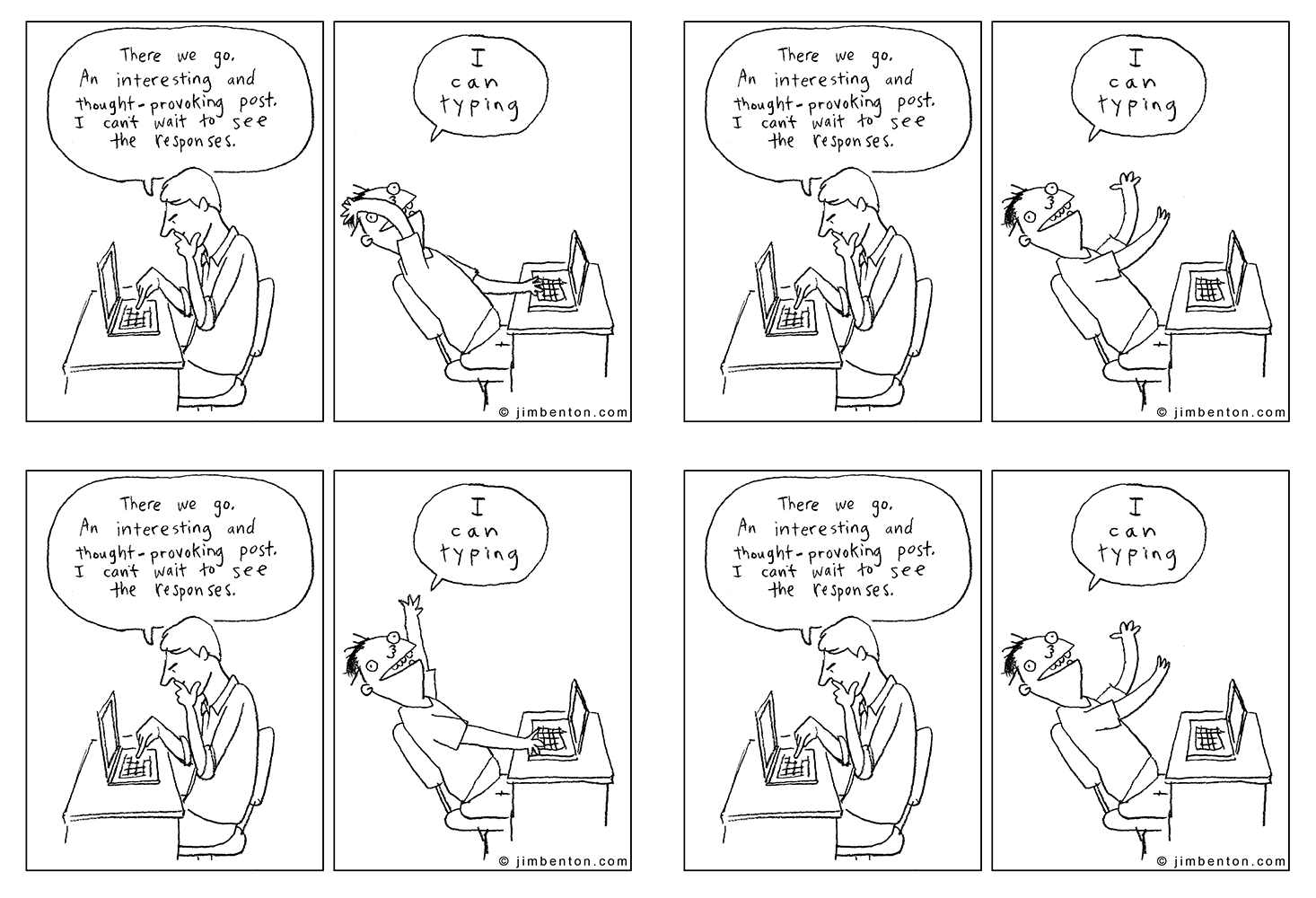
So, instead of happily “building an audience”, I started each day clearing out angry comments, and then walking around like this for the rest of the day:

Once that happens — once things suddenly don’t go according to plan — the lure of the easy can easily get you. Instead of focusing on providing quality content, the shortcuts that you’d vowed you’d never take suddenly become very attractive. Instead of automatically trashing those incessant emails about backlinking and infographic creation and paid content creation, you start reading them and before long you start considering all the ugly SEO tricks you’ve publicly scorned. And before you know it, your site looks like this:
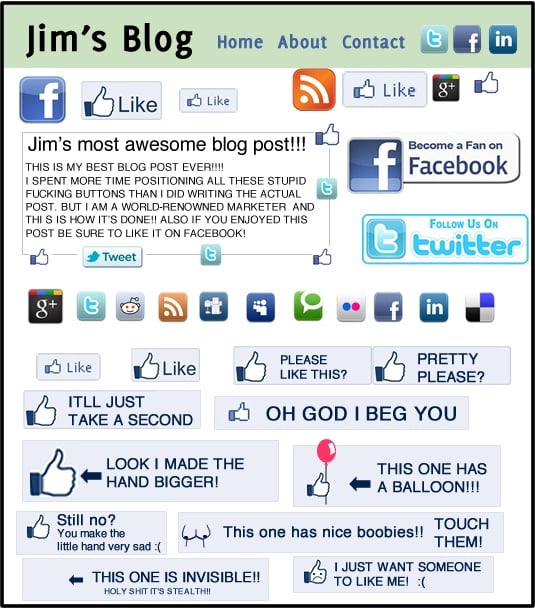
Like me!

Source: How to get more likes on Facebook

This is a dangerous place to be, and I’ve been there more than once. There have been many times where I’ve been on the verge of just stopping and shutting the site down, because I couldn’t see the use. Yet every time I came close to closing up shop, one question kept coming up in my mind: Why are we so unwilling to work hard for the things that we want? And then I saw someone articulate that thought perfectly…

The long, hard, stupid way (3 lessons)

I came across the idea of the long, hard, stupid way in a brilliant talk by Frank Chimero. He describes an episode of the TV show Treme where chef David Chang describes his cooking philosophy:

Just because we’re a casual restaurant, doesn’t mean we don’t hold ourselves to fine dining standards. We try to do things the right way. That usually means doing things the long, hard, stupid way.

Go ahead and think about a time when you learned to do something really difficult. Maybe it was learning to ride a skateboard, figuring out a new math equation, or debugging your first piece of code. Do you remember the strain, the frustration, and the countless failures? And do you also remember the enormous satisfaction you felt as you slowly mastered that task? Do you remember how doing it the hard way carried with it not only the benefits of learning that skill, but also many tangential thoughts or experiences that sparked new passions or interests?

When we do things the hard way, we invest in ourselves in the best possible way. We kick off an endless cycle of learning and mastery that helps us grow and lead fulfilling lives of purpose. When we take shortcuts, we become mere pretenders. We learn how to play the part, but there is no substance or continued growth. The instant gratification makes us build the house of cards ever higher, which brings anxiety about the whole thing coming tumbling down. Why would we shortchange ourselves like that?

Cal Newport nailed it when he said, “There is no avoiding the deliberate strain of real improvement.” If you want to become a better writer, read more and publish more. If you want to learn to design/code/fly, watch fewer episodes of Downton Abbey and practice the things that don’t come easy. And if you really want more Twitter followers, make and share things that are awesome, and be patient.

So what does this mean for online publishing? Over time I’ve learned 3 important lessons that have formed the foundation of how I write Elezea, and what I want this site to be.
Nobody wants to read your shit

The first lesson is Steven Pressfield’s timeless advice in The Most Important Writing Lesson I Ever Learned:

Nobody — not even your dog or your mother — has the slightest interest in your commercial for Rice Krispies or Delco batteries or Preparation H. Nor does anybody care about your one-act play, your Facebook page or your new sesame chicken joint at Canal and Tchopotoulis.

It isn’t that people are mean or cruel. They’re just busy.

Nobody wants to read your shit.

The thing is, once you realize that no one cares about the stuff you write, it’s actually quite liberating. It’s at that point that you realise that writing is a simple transaction between you and your readers. They have time and attentionwhich is more valuable than ever — and you have to provide content that is worthy of that time and attention. Otherwise we’re just wasting people’s time, and they certainly won’t stick around for that. No matter how many times I read it, I still love this Paul Ford quote from 10 Timeframes:

If we are going to ask people, in the form of our products, in the form of the things we make, to spend their heartbeats on us, on our ideas, how can we be sure, far more sure than we are now, that they spend those heartbeats wisely?

Remember the transaction between you and your readers, and make sure that when they pay you with their time and attention, they’re getting something worthy in return. But wait… how do I know if something is worthy…?
Some things aren't worthy

The second lesson I learned is that not everything is worthy of people’s attention. Content creation is becoming increasingly robotic and algorithmic, so instead of thinking about how people spend their heartbeats, we’re thinking about how to get them to click on things, regardless of what’s behind that click. We know that Yahoo tests more than 45,000 combinations of headlines and images every five minutes on its home page. We also know that The Huffington Post will serve different versions of a page to a couple of random groups and, after five minutes, the best headline will be selected. That sounds really smart, and they’ve obviously been extremely successful at generating traffic, but that approach is missing two key components. It’s missing what Merlin Mann refers to as Obsession times Voice.

Obsession is that thing that people want you to shut up about. The thing that wakes you up at night, the minuscule detail that you can’t stop thinking about. What is that thing that you just can’t let go of? That’s your obsession.

Voice is how you talk about that obsession. It’s the perspective that you bring on the topic, and the way you communicate why it’s your obsession.

So there’s a simple formula for what makes something worthy of people’s time. It’s Obsession times Voice. It’s a unique perspective on something you care deeply about, that no one else can copy. That’s the kind of thing I want to read on the web. Look at sites like The Loop, Daring Fireball, and The Brooks Review. They’re all successful because they’ve figured out the Obsession times Voice equation.
Don't just write, publish

The third lesson I learned is that writing is relatively easy when compared to actually publishing the stuff that you write. That’s where it gets real. I still feel like this every time I hover over the Send to Blog button:

I’m so scared

The thing is, publishing what you write is the only way you’re going to get better at it. Once your words are out there, it will be scrutinized. That is terrifying but also really exciting. People will correct you on things when you are wrong. That is a bonus benefit of thinking in public: you learn so much from feedback. But that only happens if you get things out of your drafts folder and onto your site.

How is that working out?

Building Elezea on these principles has worked pretty well for me so far. It has not only brought writing and advertising opportunities, but more importantly, it has brought me a great community of readers who communicate regularly via email and Twitter and other platforms.

If I can sum up what I’ve learned about online publishing in one sentence, it’s that who your readers are is more important than how many you have. Sure, I’d love for my traffic to grow a little bit faster. But I won’t do it if it comes at the cost of compromising the principles I’ve described above, because I know a click is empty until someone actually sticks around for more than a few minutes. That’s what makes this a meaningful and fulfilling experience, and that’s what makes me push on and keep writing here week after week.

So for those of you who keep coming back, THANK YOU. Not to get all mushy on you, but you make me happy.

For those interested, the full slide deck from the talk is here.

The decline of Wikipedia

Tom Simonite wrote a very interesting investigative piece called The Decline of Wikipedia: Even As More People Than Ever Rely on It, Fewer People Create It:

Wikipedia’s community built a system and resource unique in the history of civilization. It proved a worthy, perhaps fatal, match for conventional ways of building encyclopedias. But that community also constructed barriers that deter the newcomers needed to finish the job. Perhaps it was too much to expect that a crowd of Internet strangers would truly democratize knowledge. Today’s Wikipedia, even with its middling quality and poor representation of the world’s diversity, could be the best encyclopedia we will get.

The article also reminds me of one of the best episodes of Hypercritical ever, called Marked for Deletion. John Siracusa goes into a highly entertaining and informative tirade about the problems with Wikipedia, which is well worth the listen.

What's wrong with the modern world

Jonathan Franzen wrote a Guardian piece on what’s wrong with the modern world. It’s long and dense and sometimes requires multiple re-readings to figure out what’s going on, but he gives us much to think about. Let’s just say that he’s not a fan of what technology is doing to us:

One of the worst things about the internet is that it tempts everyone to be a sophisticate — to take positions on what is hip and to consider, under pain of being considered unhip, the positions that everyone else is taking.

He also has some harsh words for Amazon:

Amazon wants a world in which books are either self-published or published by Amazon itself, with readers dependent on Amazon reviews in choosing books, and with authors responsible for their own promotion. The work of yakkers and tweeters and braggers, and of people with the money to pay somebody to churn out hundreds of five-star reviews for them, will flourish in that world.

And that’s all I’ll quote from the article, in the hopes of piquing your interest to read the whole thing.

Slow down and refine

Slow coffee

I recently added a Hario Coffee Kettle to my favorite way to brew coffee at home (Chemex). And I realized that every tool I add to my coffee making routine makes it take a little longer, and taste a little better. I’ve been thinking about this for the past few days, wondering if there is a deeper lesson in there somewhere. And then Craig Mod published Pull back, which made it all fall into place:

I want them all to slow down. I want to whisper in their ears: pull back for a second. Just for a moment. Stop and refine. Refine and refine. […]

In refinement and iteration you finally get to know the thing you made. Really know it. Understand how bad it is. How great it could be. How much potential is still left unrealized. And within each iteration you move the thing forward; sometimes better, sometimes worse.

This is how it is with coffee, life, and yes — design. We can choose to make something and move on as soon as it’s done (Remember, The Biggest Lie in Corporate America Is Phase 2). Or we can choose to slow down, refine, and take the time to make things better. I think we should try to do more of the latter.