Menu

Posts tagged “technology”

How weather channels are turning no news into bad news

Gales Gone Wild, apart from being a great headline, is also a very interesting post by Timothy Egan on the changing role of weather sites and channels:

The scourge of 24-hour news, in which stuff that isn’t important gets its own countdown clock, is now doing to the weather what it did to public affairs and the stock market. It’s making us all a little jumpy and anxious, with a twisted view of the normal rhythms of the seasons.

Phrases like “meteorological thugs” and “cable television barker” makes this a delightful read, but Timothy also makes a scary observation:

The effect is to trivialize the real thing, to put breathless graphics and histrionics ahead of science and public safety.

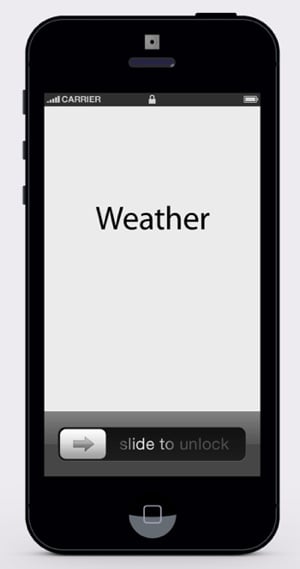
Maybe it’s time for us to tone down our love affair with weather apps. Or, just switch to Merlin Mann’s new app:

Merlin Mann minimalist weather app

What the demise of online services means for the web

Ryan Holiday’s Our Regressive Web is the best thing I’ve read so far about the importance of services like Google Reader and Delicious. He starts off with this statement:

The collapse of these services, to me, represents an alarming reduction of key services designed to improve online information from the user’s perspective.

Ryan explains how RSS helps to reduce noise and clutter, and he provides a theory for why it never really took off beyond geek circles:

In an ad-impression and pageview-driven business, a service that allows users to opt out of the noise and get content delivered directly to them is dangerous.

Maybe I’m just suffering from confirmation bias because I’m still pretty bitter about Google Reader’s shutdown, but this is a really good analysis. Well worth reading the whole thing.

Combining Big Data with Small Data for a more complete picture

Kate Crawford wrote a very good critique of Big Data methods in The Hidden Biases in Big Data:

Data and data sets are not objective; they are creations of human design. We give numbers their voice, draw inferences from them, and define their meaning through our interpretations. Hidden biases in both the collection and analysis stages present considerable risks, and are as important to the big-data equation as the numbers themselves.

Kate uses some interesting examples from Hurrican Sandy and the City of Boston to make her argument, and ends with the conclusion that is a common plea among qualitative researchers:

We know that data insights can be found at multiple levels of granularity, and by combining methods such as ethnography with analytics, or conducting semi-structured interviews paired with information retrieval techniques, we can add depth to the data we collect. We get a much richer sense of the world when we ask people the why and the how not just the “how many”.

Introducing two Flipboard magazines on UX and technology

Flipboard 2.0 was just released for iOS, and with it came a feature called Flipboard Magazines. From the blog post announcing the new version:

For the first time, you can collect and save articles, photos, audio and video by organizing them into beautiful magazines. These can be private, or if you want to connect with like-minded enthusiasts, you can make them public and share them on Flipboard and beyond. Now everyone can be a reader and an editor.

I’ve been playing around with this feature a bit, and I like it so far. It’s definitely an early release, so there are a few things missing. For example, you can’t edit the title of an article you’re adding to a Magazine, and you also can’t move articles around to be in a different order. But I’m sure those features will come. For now, it’s a great way to organize1 content — and the timing is particularly good with the impending demise of Google Reader.

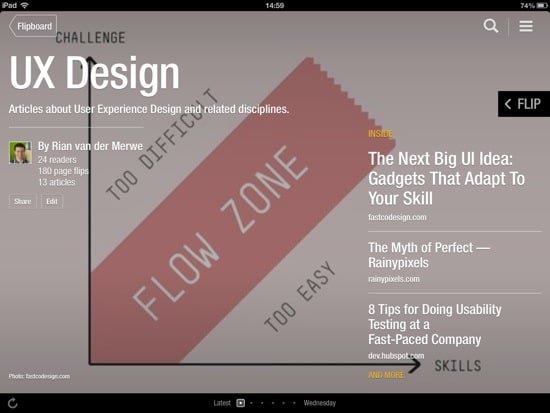
I’ve created two magazines so far, which you’re welcome to follow on Flipboard. UX Design is all about design and related disciplines. Technology and us desperately needs a less cheesy name, but it’s a collection of articles about the various ways technology impacts our lives.

Flipboard magazine

Enjoy!


  1. We’re all so desperately trying to avoid using the word “curate” since Matt and Marco spoke out about it, but that’s really what this is. Anyway, I’ll stick with “organize” so as not to offend anyone’s Internet sensibilities. 

Gadgets that adapt to our skill level

In The Next Big UI Idea: Gadgets That Adapt To Your Skill Philip Battin applies some existing ideas around progressive disclosure and Flow to tech gadgets:

User experiences are subjective and dynamic, but by and large, interactive products are not designed to take people’s changing capacity and experience into account. But they could. Here, I present a model for how designers can use the fundamentals of video games and the psychological principles of flow to design enhanced user experiences.

Philip proceeds with an example of how such a model could work for a Samsung E8005 SmartTV. We’ve applied these principles in traditional software design for a long time, but it’s interesting to think about how it could be used to improve the design of physical gadgets.

The gaming industry's move to digital goods

Mitch Lasky wrote a very interesting analysis of the gaming industry’s move from packaged goods to digital goods. From EA and the Future:

In my experience, the incumbent packaged goods companies clearly see mobile, digital distribution and free-to-play models as inevitable. They know what’s coming and have known for some time. But within the senior management ranks of these companies there is still a lingering perception that digital doesn’t, in their words, “move the needle” sufficiently — meaning that the revenue generated from existing console franchises still far exceeds the revenue that can be generated, even in aggregate, on new platforms and through new business models.

Mitch goes on to show how this thinking is wrong, and then explains how being caught between the promise of new consoles and the possibilities of digital revenue puts game manufacturers in a situation where they’ll have to make some very tough strategic decisions.

(link via @hunterwalk)

The future will have only two kinds of jobs

In How the internet is making us poor Christopher Mims asks a chilling question about what he calls the “hollowing out of the middle class” — the phenomenon where knowledge workers are being replaced by computers:

Like farming and factory work before it, the labors of the mind are being colonized by devices and systems. In the early 1800′s, nine out of ten Americans worked in agriculture—now it’s around 2%. At its peak, about a third of the US population was employed in manufacturing—now it’s less than 10%. How many decades until the figures are similar for the information-processing tasks that typify rich countries’ post-industrial economies?

The article also quotes this thought-provoking statement from Marc Andreessen:

The spread of computers and the Internet will put jobs in two categories: People who tell computers what to do, and people who are told by computers what to do.

It might seem like the usual doom-and-gloom “technology will kill as all” refrain, but the article reviews some very interesting historical (and current) data, so it’s worth checking out.

Binge-watching and the future of TV

Willa Paskin wrote a really interesting article for Wired about the future of television. The most interesting parts of Netflix Resurrected Arrested Development. Next Up: Television Itself are about the rise of “binge-watching” — the behavior of churning through multiple episodes at a time in one sitting. Netflix found that designing shows to allow for binge-watching is good business:

The more that ­people binge-watch, the more attached they become to the show. “Binge-watching is a behavior that really started for us back in the DVD days. The way ­people were returning the discs, they weren’t watching one a night or one a week,” Sarandos says. “As we got into the streaming business, it became more trackable. What we saw was that the ­people who did this were much more attached to the shows. And because they were more attached to the shows, they reported more value in watching them on Netflix.” In other words, the more you binge, the better for Netflix.

This is why Netflix released all 13 episodes of House of Cards at once, and why those who say it was a stupid decision will likely be proven wrong.

[Sponsor] Wufoo

I’d like to thank Wufoo for sponsoring the Elezea RSS feed this week. I use Wufoo as the contact form on Elezea, and it works great.

Wufoo? Who? It’s a web application that lets you build amazing online forms for your websites.

We host everything. We build the backend. You get an easy, fun and fast way to collect and analyze data, and it even integrates with many payment systems.

With Wufoo you get…

  • Over 200 pre-made templates & themes from our form gallery
  • Ability to customize branding with your own logo and themes to match
  • Integration with over 50 web apps including WordPress, MailChimp, Basecamp, Stripe, etc.
  • Support for beautiful typography with custom fonts and Typekit integration

Just because you’re working with forms and data doesn’t mean you have to do it without personality or style. Gathering information from your users is exciting, why shouldn’t your tools be exciting too?

Experience the difference. Sign up for Free and get started with Wufoo today.

Sponsorship by The Syndicate

More on kids and technology

I recently wrote about the value of exposing kids to technology, so I really enjoyed reading Hanna Rosin’s The touch-screen generation:

To date, no body of research has definitively proved that the iPad will make your preschooler smarter or teach her to speak Chinese, or alternatively that it will rust her neural circuitry—the device has been out for only three years, not much more than the time it takes some academics to find funding and gather research subjects. So what’s a parent to do?

Articles about how technology affects child development generally tend to take extreme views on the topic — it’s either horrible to let kids use iPads, or it doesn’t matter. In contrast, Hanna has a very thoughtful, measured approach to the topic. She discusses a bunch of research, looks at all the pros and cons, and ends with the conclusion that most parents have already realized: it depends, because no one knows your child as well as you do. It’s a long article, but well worth your time.

(link via Kottke)