Menu

Posts tagged “technology”

The dirty world of Facebook EdgeRank Optimization

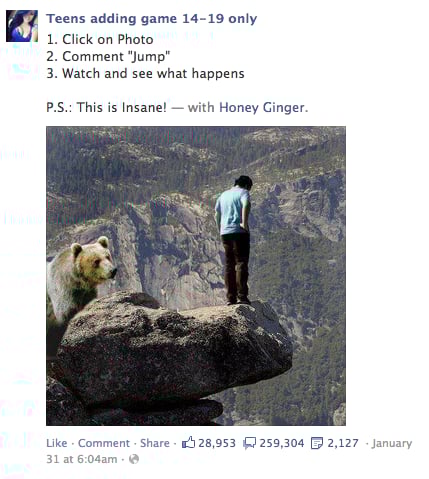
I’ve been seeing more and more scams like this one in my Facebook News Feed:

Dirty Facebook EdgeRank Optimization

You only have to think about it for 4 seconds to realize that making a comment on a photo on the web will result in you watching and seeing absolutely diddly-squat (“P.S.: This is not Insane after all!”). And yet, in this particular case, 259,304 people thought about it for 3 seconds or less, commented, waited and saw nothing, and then moved on to the next thing.

The question is, why do Page admins do this? What’s the use of tricking people into commenting on photos, especially when they’ll realize right away that they’ve been made to look like a fool? Well, because there’s money in it, of course.

This is a pretty transparent scam to beat Facebook’s EdgeRank system — the algorithm that Facebook uses to determine what articles should be displayed in a user’s News Feed. When someone comments on a picture it makes it more likely that the picture will show up in their friends’ News Feeds, so it’s an easy way for a Page to gain more exposure very quickly.

Once these Pages have built up hundreds of thousands of “Likes” using the scam, they usually do one of two things. They either start punting things they want to sell, or they sell the Page itself to a business that changes some of the details and uses it as their instantly enormously popular brand Page.

This is obviously pretty dirty, and also nothing new — we’ve had black hat SEO and dark patterns since the dawn of the web. But what I can never understand about the people who use these tactics is why they don’t long for the satisfaction and personal growth that comes from doing real work and reaping the rewards of that. Why create a community of people who couldn’t figure out that you’re scamming them, as opposed to a real community that values your company and what you do? I’ve written about this before in my defense of doing things the hard way:

When we do things the hard way, we invest in ourselves in the best possible way. We kick off an endless cycle of learning and mastery that helps us grow and lead fulfilling lives of purpose. When we take shortcuts, we become mere pretenders. We learn how to play the part, but there is no substance or continued growth. The instant gratification makes us build the house of cards ever higher, which brings anxiety about the whole thing coming tumbling down. Why would we shortchange ourselves like that?

So what can we do about these scams? Well, for one, obviously don’t comment on it. But I also recommend clicking on the little arrow on the right and hiding the post. That will tell EdgeRank that the person who commented on the photo is not worth paying attention to, so in time you’ll see less and less of those kinds of posts. Who says we can’t all be EdgeRank Optimization specialists?

Gestural interfaces and generational transition

Francisco Inchauste did a great interview with MIT Technology Review about the user experience challenges of gestural interfaces. From Does Gestural Computing Break Fitts’ Law?:

I think there are a lot of usability/UX rules and laws that will come into question as we move forward into more of these experimental kinds of interfaces. I know many of them already have been retested/validated by other researchers.

A lot of newer interaction paradigms aren’t naturally intuitive as we like to think. Tapping and swiping at “pictures under glass” (or in this case, content) is always going to be a learned thing, like when we were introduced to the desktop metaphor or icons.

I think we’re in a period of generational transition when it comes to fully gestural interfaces1. Despite living on the Internet, I still struggle to remember some of the newer gestures that are popping up in iOS apps. On the other hand, my 3½-year old daughter has zero problems figuring out (and remembering) gestures, because this is the world she’s growing up in. There is no major shift in mental model needed — to her, this is just how technology works. It reminds me of something Chuck Skoda said a while ago in The touchscreens are coming:

While I fully expect the future to have keyboards and mice (or some precision pointing device), touch is already precluding the ubiquity of both in the minds of children. When the upcoming generation is running the show, we will find another absurd idea, that a computer built for human interaction will have a screen that doesn’t respond to touch.

And when that generational transition is complete, what we once thought of as “newer interaction paradigms” will simply be “the way things are”.2


  1. By the way, check out Rise, a fantastic, fully gestural alarm clock app by Francisco and the team at Simplebots. 

  2. I think I deserve a special Internet high five for not making a “the future is already here…” reference here. 

The growing complexity creep in Apple's products

It’s a somewhat uneven article, but Dave Wiskus makes some good points in The secret of Apple’s design success: the humane interface. I did get a bit uneasy when I got to this part:

Where Apple differs from its competition isn’t in aesthetic beauty, it’s in the company’s ability and willingness to make decisions on behalf of its users. […] Apple’s take is to remove complexity and make choices long before the user sees the product.

It’s an argument that’s often used by Apple fans to defend the “Apple prison” accusations — I’ve used this line of reasoning myself. But here’s the thing — and I’m saying this as a die-hard Apple fan — even though this used to be true when the iPhone and iOS first came out, I don’t think our argument holds water any more. We’re starting to see more complexity sneaking into iOS and Mac OS X, and even though the veneer of simplicity is still highly visible, there be trouble beneath the surface.

And then I read Federico Viticci’s excellent interview with John Siracusa, in which John sums up the situation perfectly:

Simplicity is great, as iOS has shown. But there’s a difference between conceptual simplicity and visual simplicity. Just hiding controls does make things appear simpler, but it doesn’t actually make them any simpler. The complexity is now just hidden. Similarly, removing features that few people use is a good idea, but like any good idea, it can be taken too far. At a certain point, you’re just making your application worse for everyone, even new users.

You can’t always tweak or refactor an existing application into the beautiful thing you’re envisioning. Sometimes the only way to achieve true simplicity is to start over with a new concept for the whole app.

The first iterations of iOS and Mac OS X were great because they did just that — they started over with a new concept. But complexity creep is inevitable, and the big challenge for Apple now is how they’re going to manage that. Jonathan Ive’s influence will certainly help, but perhaps there’s even a case to be made for (gasp!) borrowing a page from Google’s playbook.

The impact of technology on kids and their development

I desperately wanted to dismiss Sherry Turkle’s answer to the question What should we be worried about? as alarmist, but she makes a terribly convincing argument about the impact that technology has on kids and their development. After discussing the issues in detail, she concludes:

Thus my worry for kindergarten-tech: the shiny objects of the digital world encourage a sensibility of constant connection, constant distraction, and never-aloneness. And if you give them to the youngest children, they will encourage that sensibility from the earliest days. This is a way of thinking that goes counter to what we currently believe is good for children: a capacity for independent play, the importance of cultivating the imagination, essentially, developing a love of solitude because it will nurture creativity and relationship.

The essay echoes Nicholas Carr’s thoughts:

We don’t like being bored because boredom is the absence of engaging stimulus, but boredom is valuable because it requires us to fill that absence out of our own resources, which is process of discovery, of doors opening. The pain of boredom is a spur to action, but because it’s pain we’re happy to avoid it. Gadgetry means never having to feel that pain, or that spur. The web expands to fill all boredom. That’s dangerous for everyone, but particularly so for kids, who, without boredom’s spur, may never discover what in themselves or in their surroundings is most deeply engaging to them.

But perhaps Stephen Hacket said it best — and most succinctly — in Why I Don’t Play Games on my iPhone:

Boredom isn’t a bad thing. But strangling it with Angry Birds probably is.

Movie UIs through the years

Preston de Guise wrote a very interesting post on how Sci-Fi interfaces have changed over the years. He concludes as follows in The changing face of computers on screen:

The shift was profound yet entirely subtle, something that a lot of people wouldn’t have really noticed at all – we shifted from portraying computer hardware to portraying computer software. […]

At some point, fiction and the future aligned, and the way in which computers were presented changed to being all about the interface – the software. This was of course just holding up a mirror to society in general: since computers have been around, their usage model has been undergoing a significantly powerful evolution from being a specific tool to being a general purpose piece of equipment; the logical continuance from a “piece of equipment” is an appliance, and that’s the era we’re starting to straddle into now, thanks in no small part to interfaces such as iOS.

Preston includes some great movie screenshots to make his case, so it’s definitely worth reading the whole article. For more, check out the collection of movie UIs in Ridiculous User Interfaces In Film, and the Man Who Designs Them. And here’s a highlight reel of Mark Coleran’s UI work in various movies:

Coleran Reel 2008.06 HD from Mark Coleran on Vimeo.

For bonus points (and if you don’t mind random pagination and small white text on a grey background), check out the Top 10 Worst Portrayals of Technology in Film.

Who has time for that?

Andy Budd’s most recent contribution to The Pastry Box Project got quite a bit of traction yesterday. This part, in particular, seems to have struck a chord in our corner of the Internet:

Good design takes time—more time than most of us are allowed. […] Sadly we see too many potentially amazing designers stuck by the glass ceiling of time. So they settle on the first solution that looks viable and are never allowed to sweat the details. They are forced to rely on 1% of inspiration without the benefit of perspiration.

So this is the dirty little secret in our industry. The best designers and developers rarely have more talent. They simply have more time.

This rings true, but I’d like to expand on that and say that it’s not just a problem in our industry. Things have become very, very fast all around us, and our impatience has reached remarkable levels. We pirate movies because we can’t wait 1 minute for the anti-piracy warnings on DVDs to play through (oh, the irony). We microwave pop tarts for 3 seconds because we can’t wait for them to finish toasting. Brian Regan has a pretty funny standup bit about this (the microwave thing starts at 2:35):

Frank Partnoy sums up the consequences of our addiction to speed very well in Wait: The Art and Science of Delay:

The essence of my case is this: given the fast pace of modern life, most of us tend to react too quickly. We don’t, or can’t, take enough time to think about the increasingly complex timing challenges we face. Technology surrounds us, speeding us up. We feel its crush every day, both at work and at home.

Yet the best time managers are comfortable pausing for as long as necessary before they act, even in the face of the most pressing decisions. Some seem to slow down time. For good decision-makers, time is more flexible than a metronome or atomic clock. As we will see over and over, in most situations we should take more time than we do.

We should take more time than we do, yes. But we don’t. Because business doesn’t work that way. Technology doesn’t work that way. And, most of all, release schedules don’t work that way.

We all know the saying Fast, good, and cheap — pick two. We live in an environment where everything has to be “fast”, so we’re inevitably left with choosing between “good” or “cheap”. And guess which one we end up having to choose most of the time…

Growing up on the social web

Hunter Walk wrote a great article about Facebook Connect and how difficult it is to own the social web, called Trying to be the one true social graph is like trying to hold water in your fist. One of the fascinating parts is his observation about how the next generation is using technology:

Each new group of kids come of age wanting a space they can discover together and call their own. This is DNA, not computer science. It’s not about tech changing (oh, this is Facebook if it was build only for tablets) - it’s about getting to a dry piece of land when you’re 13 years old and being able to plant your own flag. I don’t see how you get beyond the anthropology of this.

In light of that, Josh Miller’s Tenth Grade Tech Trends and Justin Hoenke’s follow-up Tenth Grade Tech Trends (Take Two) are important data points to know about. These are very anecdotal, sure, but Josh and Justin’s takeaways are definitely worth debating. Here, for example, is Josh’s insight based on his 15-year old sister’s comment that Tumblr is just for middle schoolers:

I can’t get over the “middle schoolers use it” comment, especially since they use Tumblr as an identity tool. That’s exactly how my friends and I used Myspace in middle school, and we too abandoned it (for Facebook) once we reached high school. So in middle school you care a lot about your personal presentation (themes and cultural images on your Myspace or Tumblr page), but once you reach high school you care more about the people you present yourself with (photos on Facebook and Instagram)?

If you’re interested in how teens use social media, it’s worth following danah boyd’s blog. She is a researcher on media and youth culture, and her insights are always interesting. Here’s a particularly relevant excerpt from her post Risk Reduction Strategies on Facebook:

Shamika deletes every wall message, status update, and Like shortly after it’s posted. She’ll post a status update and leave it there until she’s ready to post the next one or until she’s done with it. Then she’ll delete it from her profile. When she’s done reading a friend’s comment on her page, she’ll delete it. She’ll leave a Like up for a few days for her friends to see and then delete it. When I asked her why she was deleting this content, she looked at me incredulously and told me “too much drama.” Pushing further, she talked about how people were nosy and it was too easy to get into trouble for the things you wrote a while back that you couldn’t even remember posting let alone remember what it was all about. It was better to keep everything clean and in the moment. If it’s relevant now, it belongs on Facebook, but the old stuff is no longer relevant so it doesn’t belong on Facebook.

With behaviour like that, it’s no surprise that ephemeral apps like Snapchat and Poke are so successful.

Snapchat, Poke, and the backlash of the real

Jenna Wortham makes an interesting observation about apps like Snapchat and Poke in Facebook Poke and the Tedium of Success Theater. She starts off by talking about something I’ve written about quite a bit as well — that who we pretend to be online is not even close to who we really are:

We’ve become better at choreographing ourselves and showing our best sides to the screen, capturing the most flattering angle of our faces, our homes, our evenings out, our loved ones and our trips.

It’s success theater, and we’ve mastered it. We’ve gotten better at it because it matters more. You never know who is looking or how it might affect your relationships and career down the road, and as a result, we have become more cautious about the version of ourselves that we present to each other and the world.

The example most people immediately jump to when talking about this is Instagram filters — something I’ve written about before as well. It’s fascinating to think about apps like Snapchat and Poke as deliberate backlash against fake online versions of ourselves. By encouraging ephemeral, intimate, #nofilter snapshots, these apps give a more accurate reflection of “the real you”. In Wortham’s words:

These applications are the opposite of groomed; they practically require imperfection, a sloppiness and a grittiness that conveys a sense of realness, something I’ve been craving in my communication. They transform the screen of your phone into a window into the life of your friend, wherever they are at that exact moment. […]

It is an acknowledgement that the version of ourselves we share through other social media is not the truest one, and has not been for a long time.

The unnecessary fear of digital perfection

I’ve recently noticed a recurring theme in many articles that cover technology’s impact on our lives. It’s the idea that the move to digital technologies has taken away an essential part of being human: the accidental discovery of new things by getting lost. The fear is that what we might call “digital perfection” is removing the natural wayfinding mistakes that are essential for serendipitous discovery — like getting lost in a new city and then finding that perfect coffee shop. I’ll share a few examples first, and then comment on why I think this fear is unnecessary.

The example that’s cited most often is how Google search is enveloping each of us in the Internet’s “filter bubble” where we only find what we’re looking for, and nothing more. Here’s Maria Popova in Are We Becoming Cyborgs?:

The Web by and large is really well designed to help people find more of what they already know they’re looking for, and really poorly designed to help us discover that which we don’t yet know will interest us and hopefully even change the way we understand the world.

There are several industry-specific examples, like the lament that we don’t browse record stores just for the fun of it any more. From Spotify and the Problem of Endless Musical Choice:

We seem to have created an environment in which wonderful music, newly discovered, is difficult to treasure. For treasures, as the fugitive salesman in the flea market was implying, are hard to come by—you have to work to find them. And the function of fugitive salesmen is to slow the endless deluge, drawing our attention to one album at a time, creating demand not for what we need to survive but for what we yearn for. Because how else can you form a relationship with a record when you’re cursed with the knowledge that, just an easy click away, there might be something better, something crucial and cataclysmic? The tyranny of selection is the opposite of freedom. And the more you click, the more you enhance the disposability of your endeavor.

And then there is The End of the Map, a fascinating article about the history of cartographic errors, which includes this statement:

The uncertainty that was once an unavoidable part or our relationship with maps has been replaced by a false sense of Wi-Fi-enabled omnipotence. Digital maps are the enemies of wonder. They suppress our urge to experiment and (usually) steer us from error—but what could be more irrepressibly human than those very things?

This idea is echoed in No one likes a city that’s too smart:

A great deal of research during the last decade, in cities as different as Mumbai and Chicago, suggests that once basic services are in place people don’t value efficiency above all; they want quality of life. A hand-held GPS device won’t, for instance, provide a sense of community. More, the prospect of an orderly city has not been a lure for voluntary migration, neither to European cities in the past nor today to the sprawling cities of South America and Asia. If they have a choice, people want a more open, indeterminate city in which to make their way; this is how they can come to take ownership over their lives.

Now, I’ll admit that I largely agree with the consequences that are pointed out in these articles. I’ll even admit to feeling the same sense of loss that these authors do. But I don’t agree that accidental discovery is a thing of the past. I believe that digital perfection opens up amazing possibilities, and combined with the fact that humans will always be explorers and flâneur no matter what technology we use, we’re starting to see some great products to help us replace what we’ve lost in the analog world.

Here are some examples of the types of discovery products and services we now have access to.

  • Stellar.io collects tweets, articles, photos, and videos that the people you follow have favorited, and presents that in an aggregated stream. I always find something interesting and surprising in my Stellar feed, because it’s based not on explicit recommendations from the people I follow (i.e., what they think their followers might like), but on the things they really like themselves, without the social media personal brand/engagement filter.
  • This is my Jam has become my favorite way to discover new music. You choose one song that you really like, and this song becomes your “jam”. It then shows up in your followers’ streams. By only allowing users to choose one favorite song at a time the service doesn’t become overwhelming. I suspect we’re going to see many new social networks like this — sites that are focused on a specific vertical, that build on the trust we place in people we know in real life, and that are designed for quality of content, not quantity.
  • While the big guys are fighting over photo filters and who shouldn’t show up in whose stream, Foursquare is adding some amazing features with every release. We really shouldn’t underestimate this company’s potential. Foursquare has become an incredibly good way to discover not just new cities, but one’s own city as well. As users continue to add tips, lists, ratings, and photos of their favorite (and not so favorite) places, Foursquare will slowly resurface some of the “getting lost” moments that have been buried by digitally perfect maps.

My point is simply this. Sure, there are things we used to do in an analog era that we don’t do any more. We don’t get lost in encyclopedias, record stores, and cities any more. And that has some negative consequences. But we shouldn’t grieve about it too much.

Our insatiable spirit to discover new things haven’t gone away just because we’ve moved to a digital world. We just need to meet those needs in different ways — ways that better utilize the benefits of digital media. In fact, it’s not that we won’t get lost any more. It’s just that we need to invent ways to get lost differently.

How steampunk culture offers clues to building a better future

Being More Human is a fascinating article written by Brian David Johnson, Intel’s resident futurist. He explains how steampunk culture offers clues to building a better future:

Steampunk has emotion and passion; it has an opinion and a point of view. It is sassy and thoughtful and optimistic about what could be built. It is convinced we can build a better future by envisioning a different past. Steampunk shows us that people want the devices and the technology in their lives to have a sense of humor, history, and humanity. This desire has radical implications for the type of future we could build.

He then discusses how steampunk reveals three relationships that people want with their technology, and concludes as follows:

When I tell people I’m a futurist and an optimist, they seem surprised and amused. People expect all futurists to be pessimistic prophets of doom. I’m not like that. The future is going to be awesome because we are going to build it. The future is not some fixed point on the horizon that we are all helplessly hurtling toward. Quite the opposite: the future is made every day by people’s actions. We all, on some level, create the future. From the family we raise, to the community we live in, to the business we do, we build the future. We all need to be active participants in imagining the future: the one we want and the one we want to avoid. Then we need to do something about it.

I try hard to stay away from the word “must-read” in these posts, but I’m going to relax my guard on this one, being holiday and all. So, really — read it!