Menu

Posts tagged “technology”

How smartphones affect human thought

In How do Smartphones Affect Human Thought? Jenny Davis addresses the recent research behind the “Smartphones are Making Us Stupid” narrative:

[The research] hypothesis implies (though does not state) a research question: How does smartphone usage affect cognitive processes? This is an important question, but one the research was never prepared to answer thoughtfully. Rather, the authors recast this question as a prediction, embedded in a host of assumptions which privilege unmediated thought.

This approach is inherently flawed. It defines cognitive functioning (incorrectly) as a raw internal process, untouched by technology in its purest state. This approach pits the brain against the device, as though tools are foreign intruders upon the natural body. This is simply not the case. Humans [sic] defining characteristic is our need for tools. Our brains literally developed with and through technology. This continues to be true. Brains are highly plastic, and new technologies change how cognition works. Our thought processes are, and always have been, mediated.

The response echoes many of the points Clive Thompson brings up in Smarter Than You Think (my review) — namely that technology can be great augmentations to human thought. It’s not all bad.

The Apple Watch won't save you time

Matthew Panzarino wrote something that historians will reference in thinkpieces on Medium 40 years from now. From The Apple Watch Is Time, Saved:

And that is the target market of the Apple Watch. Not “rich people” (though there’s a model specially for them), not “tech geeks” and not “Apple fanatics.” It’s people who want more time, and that is a very large target.

This, for some reason, is the thing that Apple has had a hard time articulating. This is the primary use case of the Watch. It’s not just that it’s a “notification center”; it’s that it allows you to act without any additional distraction.

The idea that some new technology will give us more time to do “other stuff” is as old as technological innovation itself. By now we should have learned that no, actually, this time isn’t different. But we’ll never learn. We approach every new technology with starry eyes and hopes and dreams of a life less time-consuming. When I read something like this, I always think about this classic scene from Arrested Development:
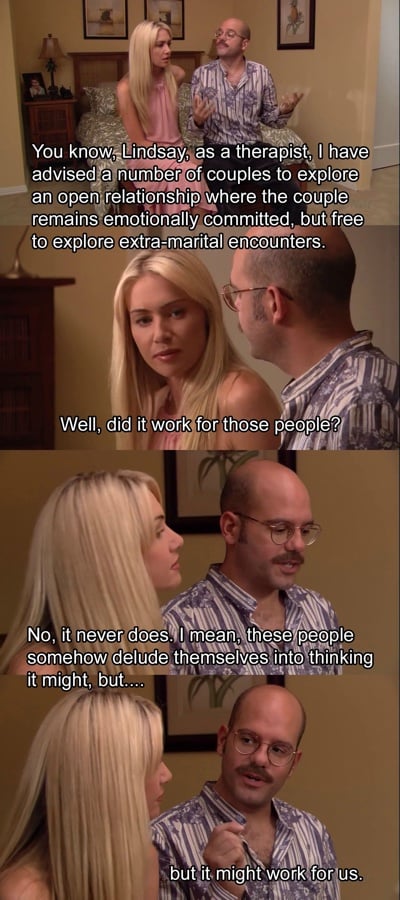
It might work for us

In just one of several historical examples of the time-saving delusion, John Maynard Keynes published an essay in 1930 called Economic Possibilities for our Grandchildren [PDF], in which he predicted that technological innovation will save people so much time that they won’t know what to do with themselves:

Thus for the first time since his creation man will be faced with his real, his permanent problem—how to use his freedom from pressing economic cares, how to occupy the leisure, which science and compound interest will have won for him, to live wisely and agreeably and well.

That, alas, has not happened. We are busier than ever these days. Instead of giving us more time, our technologies have instead given us more ways to be connected, to stay in touch with work, to never have to leave the office. I don’t see how one can argue that the Apple Watch will reverse this trend.

What the Apple Watch will do instead, I believe, is to accelerate a different trend, described by Douglas Rushkoff in Present Shock:

Our society has reoriented itself to the present moment. Everything is live, real time, and always-on. It’s not a mere speeding up, however much our lifestyles and technologies have accelerated the rate at which we attempt to do things. It’s more of a diminishment of anything that isn’t happening right now—and the onslaught of everything that supposedly is.

I’m not saying the Apple Watch won’t be wildly successful, or that I don’t want one — I definitely want one. I just don’t think we should fool ourselves into thinking it will somehow give us more time because we might look at our phones less. If history teaches us anything, it’s that we’ll find a way for the watch to fill up our “saved” time in other ways — and then some. And in doing so we’ll continue on the path Kevin Kelly lays out in his excellent book What Technology Wants:

Our lives today are strung with a profound and constant tension between the virtues of more technology and the personal necessity of less: Should I get my kid this gadget? Do I have time to master this labor-saving device? And more deeply: What is this technology taking over my life, anyway? What is this global force that elicits both our love and repulsion? How should we approach it? Can we resist it, or is each and every new technology inevitable? Does the relentless avalanche of new things deserve my support or my skepticism—and will my choice even matter?

That said, this post is only about the first version of the Apple Watch. The next watch is a different story. The next watch might be the one that finally saves us time. Just wait. You’ll see.

A technical guide to mobile usability testing

I wrote a guest post on mobile usability testing for my friends at Unboxed Consulting. It’s something I’ve mentioned briefly here on Elezea before, but in this post I go quite deep on the ins and outs of setting up a mobile usability lab. From A technical guide to mobile usability testing:

Setting aside the details of recruiting, script writing, and interviewing, from a technical perspective doing usability testing on desktop web applications is pretty simple, thanks to software like Morae and Silverback. There is, however, no straight-forward, single solution for doing usability testing on mobile devices. I recently went through the process of setting up our own mobile usability testing process at Jive, so I thought I’d share some of what we learned about the components of a good setup.

Bots and the law

Kashmir Hill asks an interesting question: Who do we blame when a robot threatens to kill people?

Last week, police showed up at the home of Amsterdam Web developer Jeffry van der Goot because a Twitter account under van der Goot’s control had tweeted, according to the Guardian, “I seriously want to kill people.” But the menacing tweet wasn’t written by van der Goot; it was written by a robot.

He goes on:

Bots will be bots. They won’t know if they’re doing something wrong unless we program them to realize it, and it’s impossible to program them to recognize all possible wrong and illegal behavior. So we’ve got challenges ahead. In the short term, [Clément Hertling, a Paris-based university student who wrote the software that powered the bot] suggested Twitter — and any other platforms bots might live on — could solve the offensive speech problem by allowing bots to self-identify in an obvious way as bots. “That would allow people (law enforcement included) to ignore what they say when it becomes problematic.”

This issue only gets scarier as the question expands to wondering what happens when we put self-driving cars in morally ambiguous situations.

The inmates are running the tablets

Kevin Roose and Pendarvis Harshaw wrote a fascinating 3-part series for Fusion on technology in prisons. I was particularly drawn to the part about allowing inmates to use tablets: Can technology and prisons get along?

He can’t just hand out iPads, of course. The tablets being used in the Napa jail are manufactured by a Chicago start-up called Jail Education Solutions, which runs them on a secure, proprietary software platform called Edovo. The tablets can’t be used to connect to the Internet; instead, inmates can connect to a local intranet administered by the correctional facility itself. Using the tablets, they can stream Khan Academy lectures, run cognitive behavioral therapy apps, study for a GED, or take courses from Narcotics Anonymous and Alcoholics Anonymous. They can also opt for lighter fare – games and movies, which can be “purchased” with points they earn by completing more educational tasks.

I’m intrigued by stories like this because it shows how designing under severe constraints can result in big innovations.

(I know it’s bad form to explain a joke, but I’m pretty happy with the title of this post)

The importance of non-makers

Debbie Chachra wrote a great essay on our current obsession with the word “Maker”, and how that devalues other professions like educators and caregivers. From Why I Am Not a Maker:

When new products are made, we hear about exciting technological innovation, which are widely seen as worth paying (more) for. In contrast, policy and public discourse around caregiving—besides education, healthcare comes immediately to mind—are rarely about paying more to do better, and are instead mostly about figuring out ways to lower the cost.

Big data and human intervention

In Netflix’s Secret Special Algorithm Is a Human Tim Wu writes about the importance of human intervention in data-driven decision making:

Of course, there is a big difference between using data in combination with intuition and relying entirely on an algorithm—the decision-making equivalent of Siri finding gas stations near you. I don’t think anyone—Netflix, Mitt Romney—makes big decisions that way. As Chris Kelly, the C.E.O. of Fandor, an indie-film Internet channel told me, “It just isn’t true that you can rely on data completely.” Even Google, the champion of algorithms, employs substantial human adjustments to make its search engines perform just right. (It cares so much about this that Google claims First Amendment protection for its tweaks.) I do not doubt that companies rely more on data every day, but the best human curators still maintain their supremacy.

It’s a good reminder that following data blindly is a pretty bad idea. Joshua Porter’s Metrics Driven Design is stil the best presentation I’ve seen on this topic and how it relates to design.

Algorithms aren't gods

In The Cathedral of Computation Ian Bogost makes the argument that algorithms have replaced religion for many people:

Here’s an exercise: The next time you hear someone talking about algorithms, replace the term with “God” and ask yourself if the meaning changes. Our supposedly algorithmic culture is not a material phenomenon so much as a devotional one, a supplication made to the computers people have allowed to replace gods in their minds, even as they simultaneously claim that science has made us impervious to religion.

It’s a long article but very much worth reading, especially for the conclusion:

Algorithms aren’t gods. We need not believe that they rule the world in order to admit that they influence it, sometimes profoundly. Let’s bring algorithms down to earth again. Let’s keep the computer around without fetishizing it, without bowing down to it or shrugging away its inevitable power over us, without melting everything down into it as a new name for fate. I don’t want an algorithmic culture, especially if that phrase just euphemizes a corporate, computational theocracy.

But a culture with computers in it? That might be all right.

New Sonos logo pulses when you scroll

New Sonos logo

This is pretty fantastic. The new Sonos logo pulses like sound waves when you scroll up and down. Brand New comments:

There is no doubt this is a party.

Indeed.

Designed by Bruce Mau Design.

My favorite indie web services

I recently realized that the web services I love and use the most are all run by indie developers or small companies. While I ponder what that means, I thought I’d do my little part to tell you about them in case you’re in the market for one of these things.

These are all services I’ve used for a while and have no intention of leaving. Unless they shut down. PLEASE SUPPORT THEM SO THEY DON’T SHUT DOWN.

  • I use Feedbin as my back-end for RSS reading. It’s solid. It always updates fast, it never goes down, and it works with a pretty much any RSS reader you can think of. I tried Feedly, but it’s not for me. Too many gimmicks I don’t need.
  • Speaking of which, I use Reeder as my front end for RSS reading. Beautiful UI, great integration with services.
  • Anyone who’s paying attention knows that Feedburner is on its way out. So a while ago I moved my site’s RSS feed hosting to Feedblitz. It’s not worth linking to them — it was a terrible mistake. Shady “growth hacking” marketing techniques, impossible to work with on support issues, etc. Don’t do it. I have since switched to FeedPress and I’m really happy with it. I do think there’s still a gap in the market for a really good Feedburner replacement, but Feedpress does an admirable job for now.
  • Pinboard is still the backbone of everything I do online. It’s basically my external memory. I don’t know how I would internet without it.
  • Instapaper is not a one-person band any more, but it’s still my “read later” service of choice. I dabbled in Pocket for a while, but I keep coming back to Instapaper for the no-nonsense UI and focus on typography.
  • When it comes to writing, my favorite tools remain MarsEdit (blog writing and editing), nvALT (text editor), and Marked 2 (Markdown viewer).

I really hope these developers continue to make enough money to focus on these fantastic projects. I also hope they know how many people they’re helping every day with the things they dream up. Thank you, to all of you.