Menu

Posts tagged “publishing”

Paper textbooks help students learn better

In Students to e-textbooks: no thanks Nicholas Carr reflects on a recent study (PDF link) out of Ryerson University in Toronto which shows that students still prefer paper textbooks over electronic textbooks:

What’s most revealing about this study is that, like earlier research, it suggests that students’ preference for printed textbooks reflects the real pedagogical advantages they experience in using the format: fewer distractions, deeper engagement, better comprehension and retention, and greater flexibility to accommodating idiosyncratic study habits. Electronic textbooks will certainly get better, and will certainly have advantages of their own, but they won’t replicate the particular advantages inherent to the tangible form of the printed book.

What makes this interesting is that it’s not the usual “I want to smell the pages” argument we see in most stories about the yearning for paper books. This study shows that paper textbooks help students learn better. That’s not to say that electronic textbooks won’t eventually catch up — they will — but it’s a reminder that in some spaces, e-books still have a long way to go.

Worthy aspirations for content makers

There are two articles I read in 2012 that will hopefully shape my writing here in the coming year. The first, and possibly the only post any aspiring writer needs to read before getting started, is The Most Important Writing Lesson I Ever Learned:

Nobody wants to read your shit.

When you understand that nobody wants to read your shit, your mind becomes powerfully concentrated. You begin to understand that writing/reading is, above all, a transaction. The reader donates his time and attention, which are supremely valuable commodities. In return, you the writer, must give him something worthy of his gift to you.

This ties in very well with Paul Ford’s plea in one of my favorite essays of 2012, 10 Timeframes:

If we are going to ask people, in the form of our products, in the form of the things we make, to spend their heartbeats on us, on our ideas, how can we be sure, far more sure than we are now, that they spend those heartbeats wisely?

So when we tweet, write, post, or whatever we call it when we create content, the first question we should ask ourselves is: “Is this thing I’m sharing worthy of attention?” If it’s a Foursquare checkin or a vaguebook update, it’s probably best left unsaid.

The second article that I hope will shape my writing more is this Steinbeck quote:

It is the duty of the writer to lift up, to extend, to encourage. If the written word has contributed anything at all to our developing species and our half developed culture, it is this: Great writing has been a staff to lean on, a mother to consult, a wisdom to pick up stumbling folly, a strength in weakness and a courage to support sick cowardice. And how any negative or despairing approach can pretend to be literature I do not know. It is true that we are weak and sick and ugly and quarrelsome but if that is all we ever were, we would milleniums ago have disappeared from the face of the earth, and a few remnants of fossilized jaw bones, a few teeth in strata of limestone would be the only mark our species would have left on the earth.

That is certainly an almost impossible standard to live up to. Consistently writing “wisdom to pick up stumbling folly” is something only the most talented writers can do — and even then there are stumbles along the way. Similarly, the Internet makes the thought of staying away from a “negative or despairing approach” sound ludicrous. What will be left of the Internet if we take away angry rants and YouTube comments?

And yet, as unreachable as they appear to be, I think these are good aspirations for anyone who publishes content on the Internet today:

  • Only share that which is worthy of your audience’s attention.
  • Strive to uplift and encourage, not to break down and destroy.

With that in mind, I’ll probably move away from straight-up link-blogging a little bit this year, and rather focus more on trying to connect dots where I think seemingly unrelated things on the web can come together to tell a good story. That’s what excites me, so it’s probably what Obsession Times Voice means for me1.

This isn’t a year-in-review post, but I’d still like to thank you for reading, for tweeting me your feedback, for emailing me. For correcting my spelling errors, for telling me when I’m full of crap, and for encouraging me when I feel like this is too much work for too little return.

I’d like to say a special thanks to those who subscribe to the site via RSS. When I subscribe to a feed, it feels like I’m inviting someone in from the porch to come have a seat inside and have a cup of coffee together. I know RSS space is limited, and that it’s a pretty big commitment to subscribe to someone’s feed. So please know that I take that seriously, and that you are a big part of the reason I aspire to become better at this.

Onward.


  1. For examples of what I mean by this, see The future of online publishing, The fetishization of the offline, and a new definition of real, and The unnecessary fear of digital perfection

The future of the amateur web

Robin Sloan laments that because there are so many different browsers and devices to support these days, it’s no fun to make personal websites any more. He proceeds to make the case that maybe we don’t need to do it ourselves, and that it’s more practical to rely instead on near-perfect “machines” created by professionals (such as Medium, Svbtle, etc.). From The end of history and the last website:

Today, I don’t think—and I’m almost afraid to write this, because it’s like the tolling of some great bell—today I don’t think the amateur’s best effort is good enough. We as internet users have less patience and less charity for janky, half-broken experiences. (Which is quite an evolution, because the whole internet used to be a janky, half-broken experience.) That’s unfortunate for me, and other amateurs of my approximate skill level, because that’s really the only kind we can muster. […]

Don’t get me wrong; the amateur web isn’t going anywhere. It’s just that, if it used to be the internet’s Main Street, it’s starting to feel more like the forest on the edge of town. I don’t mean that in a bad way. Sure, it’s a little spooky out there, but it’s also where all the adventures start, obviously. You know, like: I hear there’s an old guy out there who makes robots out of car parts. Let’s go find him. The amateur web will always have that: the old guy, the robots, the car parts.

I get what he’s saying, and it’s a logical argument to make. But personal websites are rarely based on logic, they’re based on a fairly impractical but passionate desire to “own your corner of the web.” This site might not render perfectly on all devices, and having your own domain is a very difficult way to build an audience these days. But damn, it’s gratifying to play around in a sandpit of your own.

The perfect espresso

I loved Marco Tabini’s essay in The Magazine about his experiences growing up in his Mother’s coffee shop in Italy. From Majestic Espresso:

A professional espresso machine — in my mind, always the Machine — is intimidating in function and involved to use. I used to liken the Machine to the star beast of a mythical circus of the kind you would find in the pages of a fantasy book by Hickman and Weis. Manhandled, it would defend itself by spewing dangerously hot liquid, billowing clouds of steam rising from it like smoke from the mouth of a fire-breathing dragon; but it could also be capable of extreme gentleness, pushing out a shot of espresso one drop at a time while growling quietly in the background.

This bit about Starbucks made me laugh out loud:

A good espresso blend has been processed to a medium roast; the beans should have the color of bittersweet chocolate, with a slight sheen of essential oils on their surface. Dark-roasted beans produce a bitter taste because of the excessive caramelization of the sugars in them; contrary to popular opinion, a dark coffee doesn’t produce a “stronger” espresso, but only one that tastes like burnt earth. As my mom once exclaimed after trying Starbucks for the first time, you might as well grab a handful of dirt from your garden, drop it in a cup of hot water, and save some money.

The Magazine just gets better and better with every issue. And since you’re probably looking for some quality holiday reading this week, now is a great time to subscribe.

The future of online publishing

It’s an exciting time for publishing. After what feels like years of magazines and newspapers ignoring the Internet in the hope that it will go away, a new wave of innovation is happening. I wanted to share some of the content that I think provides some good context and thinking around this topic.

In one of the most important articles of 2012, Craig Mod defines a new way to deliver content called Subcompact Publishing. He starts off with an important observation:

In product design, the simplest thought exercise is to make additions. It’s the easiest way to make an Old Thing feel like a New Thing. The more difficult exercise is to reconsider the product in the context of now. A now which may be very different from the then in which the product was originally conceived.

Craig continues with a Subcompact Manifesto. The gist is that this new type of publication is small (both in issue and file sizes), HTML(ish) based, and completely focused on portability and reader needs. But it’s important to hear Craig talk about this, so if you haven’t read his brilliant article yet, it’s a good idea to do that first before continuing.

Craig’s post prompted quite a few responses. Jason Kottke followed up with a bunch of examples of Subcompact Publishing, including three of my favourites: Evening Edition, NextDraft, and The Magazine.

Jim Ray wrote a good summary called 29th Street Publishing and the Next Wave of Digital Publishing, in which he also points to some of the challenges that exist on the publishing side to make this a reality:

Adobe’s Digital Publishing Suite, which is what many traditional publishers have been using to quickly put together iPad versions of their magazines, is trying to solve an impossible problem. Publishers don’t have the resources to build digital native versions of their print magazines (which still manage to be quite lucrative, btw) so they bolted some tools onto their existing workflow and shipped it. This has all happened before, of course, when these same publishers were trying to figure out how to make workflows built for printing presses talk to an FTP server.

By starting fresh, 29th Street (and other upstarts, like The Magazine) can build proper apps that readers actually enjoy, instead of just pushing out a bloated PDF of a magazine into the Newsstand app.

I linked to this a while ago, but I want to mention Ben Brown’s concept of Reader Aware Design again, because it’s very relevant to this discussion:

Enormous piles of data are being collected about our browsing habits. When do we visit? What have we visited recently? This information is squirreled away in the cloud in order to better sell us things. Instead of just handing all that data over to Google and Facebook and Twitter, sites should leverage some of it to enhance the reading experience. In addition to becoming device aware through responsive design techniques, our sites should also strive to become reader aware.

Ben did more than just write about this — he has since released Aware.js, a jQuery plugin that implements many of the features he talked about. It’s definitely worth checking out. I’m keen to play with it on this site as well.

I also like Frank Chimero’s reflections on another emerging form of publishing he calls anthologies:

I think the web is heading toward an age of anthologies, where users gain new ways to select, sequence, recontextualize, and publish the content they consume. Anthologies are distinct from remix culture, because the source material is not modified. Some of these tools will be automated like Flipboard or Facebook’s timeline, but I’m interested in the opportunities of manual tools which require our attention to pass over what we’ve saved, bookmarked, liked, hearted, and favorited on the web. The chosen material is sorted, arranged, and given edges. An anthology flies in the face of the web as it exists, simply in that one may “finish” because it “ends.” I hope we are finally admitting to ourselves that we can’t stomach as much as we thought. We’ve realized that the way to make sense of this meal is to step away from the table for a while and come back later.

Frank mentions Readability’s Readlists as an example of this. I haven’t tried Readlists because I’m still a little uncomfortable with taking other people’s work and packaging it in a way that sends very little traffic back to the original source, but maybe I’m just being old school.

Finally, on this week’s episode of 5by5’s The Crossover, Gina Trapani and Jason Snell discuss the evolution of publishing, and it’s the perfect companion to what’s been written on the topic over the past week or so.

In short, we’re about to see an influx of great ideas in the publishing industry, and for the first time in a long time, it looks like readers like us will be the real winners.
Reimagining the traditional blog format

I’ve become increasingly dissatisfied with the reverse-chronological order on this site (and most blogs, for that matter). For me, the problem is that the latest few posts on the home page aren’t necessarily the most important posts I’d like readers to see. In addition to that, if a new reader visits an article through a link from elsewhere, and then checks out the home page, they won’t immediately get an idea of what the site is about.

That’s why I’m so excited about Ben Brown’s concept of Reader Aware Design. He begins with a question:

Presenting everything as a reverse chronological stream of posts made sense when we knew our readers were sitting at a desk, hitting reload on 30 tabs all day long at work. Does it still make sense when content arrives on an e-paper watch, an Xbox or a tiny slip of paper?

Ben says no, and he provides some recommendations as well as a proof-of-concept they’ve been working on. Read his post for the detail. Exciting stuff!

Fewer ads for a better world

In The Banner Blindness Cure: How Fewer Ads Can Equal More Revenue Dave Zinman points out something all readers know already, and publishers will hopefully take note of:

It’s no wonder, looking at these stats, that banner blindness is such a glaring issue. Talk about losing sight of the forest for the trees: We’re so busy looking after our bottom line, we’re not paying attention to the user experience. We hit our visitors over the heads with ads like sledgehammers, then wonder why our ads aren’t “performing.” It’s absurd. Clearly, we’re doing it wrong. […]

Wouldn’t a publisher be far better off serving fewer ads, and taking top dollar for one or two premium placements? With highly relevant ads that aren’t forced to compete against several other ads on the page, odds of interaction and possible conversion are tremendously improved. And when ads perform better, publishers, advertisers and consumers win.

Somewhat related, here’s what’s happening over on the far end of the creepiness scale:

The odds are that access to you — or at least the online you — is being bought and sold in less than the blink of an eye. On the Web, powerful algorithms are sizing you up, based on myriad data points: what you Google, the sites you visit, the ads you click. Then, in real time, the chance to show you an ad is auctioned to the highest bidder.

Not that you’d know it. These days in the hyperkinetic world of digital advertising, all of this happens automatically, and imperceptibly, to most consumers.

If I may use a John Gruberism: Gross.

A call for "tempered pessimism" about the Internet as distractor

The Atlantic printed an interesting interview with Clay Shirky, covering a wide range of topics like privacy, publishing, and the Internet as a distractor. Shirky argues for tempered pessimism about the oft-lamented distracting role of the Internet. Here’s why:

The other case for tempered pessimism is that the examples we have of group creation don’t rely on wholesale change — whether you are looking at examples of amateur collaboration (digitizing old ship logs, figuring out how proteins fold), sites of cultural production (Pinterest, YouTube), collaborative consumption (Freecycle, CouchSurfing) or new kinds of conversational value (Quora, Reddit). Each of these initiatives requires only a small percentage of the population to donate a small percentage of time to making or sharing to have an outsized effect.

This is, for me, the biggest driving force in our use of the cognitive surplus: considering that by the end of the 20th century, the total time spent in media consumption, with no accompanying production or sharing and even precious little annotation or discussion, is a situation so different from ours in the early 21st century.

His point is that even though we’re much more connected to media (which definitely has its drawbacks), it’s a much less passive connection than it used to be. Now we comment, like, share, and in the best case scenario, further discussions in a meaningful way. And that’s a good thing.

Poster: a great iOS WordPress app

Back in May I posted my wish list for a mobile WordPress publishing platform. Since then nothing official has come out of Wordpress to help with that list. But I’ve been using Tom Witkin’s Poster app for a while now, and it’s close enough to what I need that it has significantly increased the amount of writing and publishing I do from my iPhone and iPad.

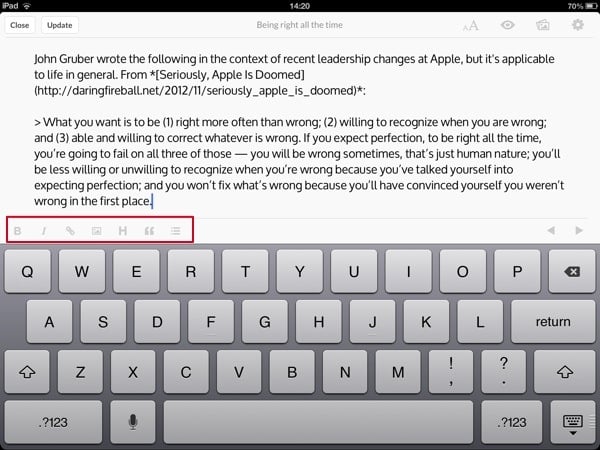
Poster’s interface is clean and focused on what’s most important: writing. It has full support for Markdown and TextExpander touch — including some custom keyboard commands to insert commonly used Markdown attributes:

Poster edit screen

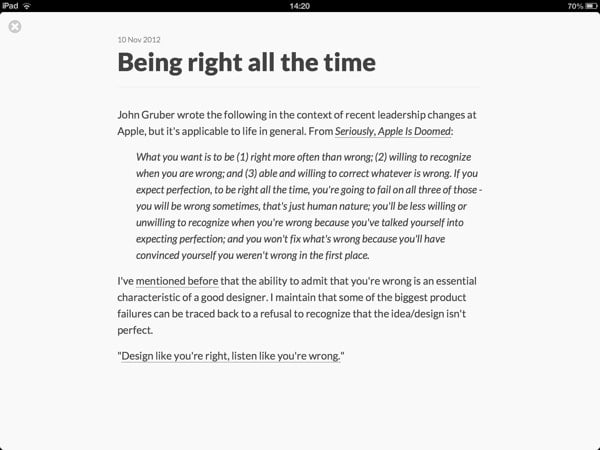
The built-in preview screen makes it easy to proofread and make sure you didn’t miss anything:

Poster preview screen

The only thing that is still missing for me is a mobile Safari bookmarklet that lets me send a piece of selected web page text — along with the page title and URL — to Poster as a new post that’s ready for editing. It would also be great to see Poster integration with apps like Instapaper and Reeder.

If you run WordPress and have stayed away from mobile blogging because it seemed like too much of a hassle, give Poster a try.

Links for Poster: Official site | On iTunes

More on eBook pagination vs. scrolling

In a response to a series of posts on eBook pagination vs. scrolling (including mine), Dr. Drang presents the strongest argument against pagination that I’ve seen so far. From Scrolling or paging?:

Authors don’t write in pages, they write in sentences and paragraphs, neither of which are honored in a paged interface.

That’s a really good point. Pages artificially break up authors’ thoughts. Pagination is the hurdle-race to scrolling’s 400-meter dash. Everything is a trade-off though, so for the time being I will stubbornly stick to my preference for pagination, because as I said, I just find it easier to deal with.

I want to challenge Dr. Drang on one point, though. He says:

As for the sense of accomplishment, I am, if anything, even more dubious. Flipping a page, whether in a physical book or an ebook, has never charged me with a feeling of achievement. In fact, in paged ebooks I seldom have any sense of how far along I am—in physical books there is, at least, the thickness of what’s in your left hand compared to what’s in your right.

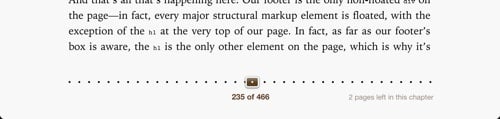
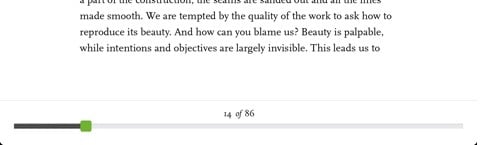
I don’t agree with that. Most eBook readers have sorted out the “sense of place” problem, and now provide both visual and text indicators to help you figure out how far along you are in the book you’re reading. Below are the interfaces for iBooks and Readmill:

iBooks pagination

Readmill pagination

Note the text-based information about the number of pages that have been read, and how many pages there are in total. The visual indicators, in turn, give you a sense of the “weight” of the number of pages you’ve already read — Readmill does a particularly good job of this. And iBooks even tells you how many pages you have left in any given chapter. Those indicators combined serve as a worthy replacement for “the thickness of what’s in your left hand compared to what’s in your right”.