Menu

Posts tagged “publishing”

Ideas of March 2012

This is my contribution to Chris Shiflett’s Ideas of March initiative, which encourages people to write about why they like blogs.

My love of writing comes from a love of problem-solving. There is a sense of pride and accomplishment in finding the right words to say something. And yet, great writing has an inherent unattainability to it that keeps me ever searching. There are good ways and bad ways to communicate something, but there is never a best way. It’s like a video game in the sense that you can level up by writing often, but it’s not a game you can ever beat. There is no big boss fight at the end that proves that you are now the best writer you can be. What keeps me going is the nagging sense that the last thing I wrote could have been written much better, so I’d better keep trying.

There are many benefits to writing, of course. Most importantly, it’s a problem solving technique in itself. By taking the time to structure your thoughts and your words in a way that other people need to understand, you tend to get a better understanding of what’s going on in your head. Clive Thompson addresses this well in The art of public thinking:

The process of writing exposes your own ignorance and half-baked assumptions: When I’m writing a Wired article, I often don’t realize what I don’t know until I’ve started writing, at which point my unanswered questions and lazy, autofill thinking becomes obvious. Then I freak out and panic and push myself way harder, because the article is soon going before two publics: First my editors, then eventually my readers. Blogging forces a similar clarity of mental purpose for me. As with Wired, I’m going before a public. I’m no longer just muttering to myself in a quiet room. It scarcely matters whether two or ten or a thousand people are going to read the blog post; the transition from nonpublic and public is nonlinear and powerful.

Writing in public continues to help me gain clarity about my thoughts and problems. That I expected. But I didn’t expect it to give me such a sense of community. The past few months have been especially gratifying, ever since I’ve been invited to become a contributor to Smashing Magazine. Through that process I’ve met amazing people, and through them, I think I’ve become a better writer. Which in turn helps me to solve problems better. It hardly seems fair that I gain so much from this community. If you’ll allow me the use of a ridiculous phrase, the ROI on my writing seems preposterously high.

I started my first blog on Windows Live Spaces in 2003. I’d just moved to the US and needed a way to feel connected to friends and family in South Africa. It’s 2012 now, and I don’t write on Windows Live Spaces any more. I also don’t live in the US any more. I’ve moved homes and countries and blogging platforms way too many times over the past 9 years. But looking back over many false starts and wrong turns in life and in blogging, I’m grateful for the thread of words that runs from my beginnings on Spaces, through the detour on Blogger, and now my own home on this domain. Somehow, those words anchor me.

So maybe writing this has once again shown me the error in my original thinking, just as it’s done so many times before. I was wrong in my opening paragraph. I don’t write because I love problem-solving. I write to know that I am here.
Smashing Magazine, and the community that sustains me

In what still feels like a dream that I’ll someday wake up from, I’ve been extremely privileged to become a contributor to Smashing Magazine. I haven’t written about it here before because I’m not really a fan of meta posts, and like I said, I’m still waiting to wake up and discover that it’s not real. But I do want to express a few thoughts on the experience so far, and acknowledge some of the people who make the magazine happen behind the scenes.

The opportunity to write for Smashing Magazine fell in my lap out of nowhere. One of my favorite designers and writers, Francisco Inchauste, contacted me out of the blue after reading some of my articles here on Elezea, and asked if I’d be interested in contributing to a new UX area on Smashing that he was starting up. I tried to play it cool, but really, how is that even a question? Of course I jumped on the opportunity, and so far it’s been a fantastic learning experience.

I am extremely impressed by the editing process at Smashing Magazine. It not only results in great content on the site, but it provides extremely valuable feedback to writers to help us get better at it. The first step is usually a discussion between Francisco and I about the idea for the article, followed by 2-3 drafts that he gives feedback on. Once Francisco is happy with the draft, each article goes through two blind reviews by people in the industry who are usually experts in the topic you’re writing about.

The feedback that comes from Francisco and the team of reviewers is always smart and constructive, and results in better articles across the board. To be honest, I feel like I get more out of the process than Smashing does. I get to hone my writing skills - all they’re getting is an article! But hey, as long as they’re ok with that deal, I’ll take it.

So, on to a brief summary of what I’ve written about so far, and some of the things I’ve been thinking about for the future. In my first two articles (part 1, part 2) I talked about the organizational challenges of doing user experience in large organizations, and how we can work better together. In The Data-Pixel Approach To Improving User Experience I shifted gears and applied some of Edward Tufte’s data visualization principles to web design.

I am currently very interested in the connection between architecture and web design. I’m trying to read up on architecture as much as I can, and I continue to be struck by the similarities between the history of architecture and the current arc of web design. In Designer Myopia: How To Stop Designing For Ourselves I tried to scratch the surface of that, but there’s still so much more to be said. I really believe that the history of architecture can tell us a lot about the future of web design, and I hope to explore some of that in upcoming articles.

My next article cued for publishing is also the first one inspired by my 2-year old daughter, so I’m particularly excited about seeing that one come out. I want to thank Francisco, Vitaly, and the entire Smashing Magazine team for giving me the opportunity to write for such a great publication, and making me feel part of the Design community that sustains me every day.

It's time to find your voice

I’ve been following the recent back-and-forth about blog comments closely, since I have the same question about this blog: should comments be turned on or off? I even mentioned recently that I’m going to turn comments off for a while and see how it goes.

Matt Gemmell is driving/documenting the debate in the most articulate way, and his recent post on pseudonyms is another example of that. Even though the conversation now mostly appears to have run its course, it occurred to me that the root of this debate is related to what Paul Ford calls the fundamental question of the web:

“Why wasn’t I consulted,” which I abbreviate as WWIC, is the fundamental question of the web. It is the rule from which other rules are derived. Humans have a fundamental need to be consulted, engaged, to exercise their knowledge (and thus power), and no other medium that came before has been able to tap into that as effectively.

The Internet gives people this idea that if they can’t respond directly to something someone else said on a web site, their fundamental right to be consulted is violated. And that’s just not true - we don’t have a right to be consulted on everything that happens around us. What is true, however, is that we all have a voice, and that finding that voice is extremely important for our own development.

So the thing is, we’re having the wrong discussion. We shouldn’t be arguing about whether comments should be turned on or off on a blog. What we should be talking about is how all of us can spend more time finding our own obsession and voice, and how we can share that with the world. Tom Standage argues that writing is the greatest invention:

It is not just one of the foundations of civilisation: it underpins the steady accumulation of intellectual achievement. By capturing ideas in physical form, it allows them to travel across space and time without distortion, and thus slip the bonds of human memory and oral transmission, not to mention the whims of tyrants and the vicissitudes of history.

So forget about comments - it doesn’t matter whether you have them turned on or not. The real question is which one of the many available options you’re going to choose to start writing and owning your voice.


Update: Reader Greg Mathes asks in an email, “What’s so important about finding our own voice?” To answer, I’d like to quote Clive Thompson in The Art of Public Thinking:

The process of writing exposes your own ignorance and half-baked assumptions: When I’m writing a Wired article, I often don’t realize what I don’t know until I’ve started writing, at which point my unanswered questions and lazy, autofill thinking becomes obvious. Then I freak out and panic and push myself way harder, because the article is soon going before two publics: First my editors, then eventually my readers. Blogging (or tumbling or posterousing or even, in a smaller way, tweeting) forces a similar clarity of mental purpose for me. As with Wired, I’m going before a public. I’m no longer just muttering to myself in a quiet room. It scarcely matters whether two or ten or a thousand people are going to read the blog post; the transition from nonpublic and public is nonlinear and powerful.

Creepy content

“Content” Creep is an important article by Drew Breunig. I try to shy away from the word “must-read”, but this is probably as close as it gets. Breunig takes a step back to analyze the constant stream of web content we see every day, and he draws some interesting macro conclusions about the current state and future of publishing on the web.

He starts off by explaining the problems with the word “content” itself, and goes on to use the content farm “company” Demand Media as an example of the problem with measuring quality in web publishing:

Unfortunately, even if we assume page views are capable of measuring quality Demand’s business model prevents them from doing so. Because Demand’s “approach is driven by consumers’ desire to search for and discover increasingly specific information across the Internet”, page views are only capable of reflecting how well Demand’s “content” has been optimized for search engines. If a piece appears in search results, is clicked by a user, and closed because the writing is shoddy, Demand is only able to measure everything before the click. At best the page views metric can measure the quality of the headline. At worst they reflect the SEO tricks employed by a site.

Or to put it more succinctly:

Demand has created an environment which incentivizes SEO hacks more than good writing.

This is so true, and results in the type of ad-infested web sites I’ve written about before as well. Breunig goes on to explain what he calls the impending “content crunch”, and the need to adjust business models to account for quality. His conclusion is spot on:

It’s hard to believe a single word could slate an entire industry for failure. On its own, the word “content” is merely awkward. But as a unit of measurement, “content” affects business is real ways. Ignoring the variables audiences care about in order to populate Excel spreadsheets incentivizes weak writing short on substance and attention spans. All this would be tremendously depressing if it wasn’t creating an enormous opportunity for people with the courage to look beyond the numbers, where it’s too messy to measure, and invest in journalism, videos, photography, and art people might actually enjoy.

A site that immediately comes to mind as an example of the kind of courage Breunig speaks of is the brilliant Brainpickings - “a human-powered discovery engine for interestingness, culling and curating cross-disciplinary curiosity-quenchers, and separating the signal from the noise to bring you things you didn’t know you were interested in until you are.”

The article and Breunig’s main conclusions remind me of one of Clay Johnson’s points in his book The Information Diet:

Just as food companies learned that if they want to sell a lot of cheap calories, they should pack them with salt, fat, and sugar””the stuff that people crave””media companies learned that affirmation sells a lot better than information. Who wants to hear the truth when they can hear that they’re right?

The problem lies not just with the content farms, but also with us - the people who click on the links because it gives us more of what we want (even if it’s not good for us). The only solution to this problem is something that sounds like a pipe dream - expecting readers to be more conscious about the information they allow into their lives so that content farming ceases to be effective. In Johnson’s words:

The first step is realizing that there is a choice involved. As much as our televisions, radios, and movie theaters would have us believe otherwise, information consumption is as active an experience as eating, and in order for us to live healthy lives, we must move our information consumption habits from the passive background of channel surfing into the foreground of conscious selection.

For bonus points, read A long sentence is worth the read - it’s also a really good related discussion on the topic:

Enter (I hope) the long sentence: the collection of clauses that is so many-chambered and lavish and abundant in tones and suggestions, that has so much room for near-contradiction and ambiguity and those places in memory or imagination that can’t be simplified, or put into easy words, that it allows the reader to keep many things in her head and heart at the same time, and to descend, as by a spiral staircase, deeper into herself and those things that won’t be squeezed into an either/or.

Beautiful.

No more unedited first drafts

Mandy Brown in Babies and the Bathwater, a great article for the first edition of Contents Magazine:

Something about the nature of digital content seems to give us permission to slack off editorially. Digital formats are routinely marked by slapdash editing and nonexistent proofreading””a sign of how little anyone cares. Many online publications rearrange content based on the needs of machines rather than people. As the web forces us to speed up our publishing process, editing is often the first thing to be thrown out.

This is one of my pet peeves as well. Publishing is cheap, but that doesn’t mean we don’t have to do it right. I like how Merlin Mann puts it in Better:

What worries me are the consequences of a diet comprised mostly of fake-connectedness, makebelieve insight, and unedited first drafts of everything.

Words continue to matter more and more. Let’s not forget to edit them.

Please let this not be the future of reading on the web

In The Pummeling Pages, Brent Simmons sums up the experience of reading on the web, which is something I’ve become increasingly frustrated with as well:

I was there because I just wanted to read something. Words. Black text on a white background, more-or-less. And what I saw ”” at a professional publication, a site with the purpose of giving people something good to read ”” was just about the farthest thing from readable.

The site has good writing. But the pages do everything possible to convince people not to try. “Don’t bother,” the pages say. “It’s hopeless. Oh ”” and good luck not having a seizure!”

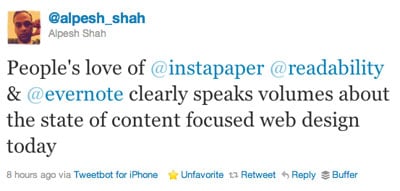
I see the sentiment echoed everywhere, including tweets like this one by Alpesh Shah:

alpesh.jpg

Just to be clear about what we’re talking about, here are a few examples that illustrate why there is such a growing frustration with reading on the web.

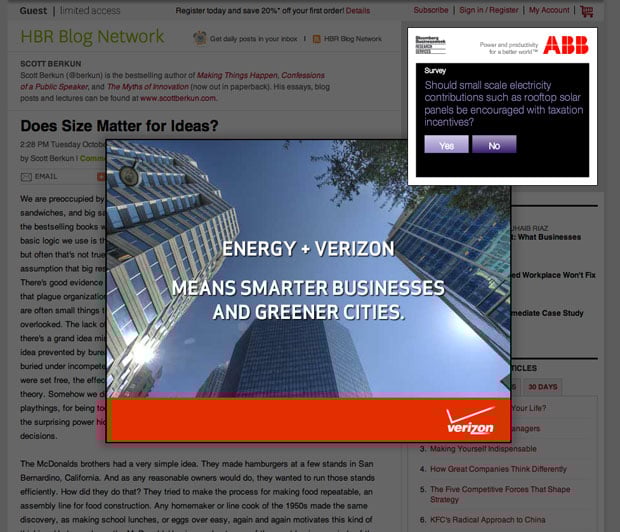
First, here is an article on Harvard Business Review that not only blocks me from reading anything until I click to dismiss the ad, it also messes with the other ads on the page:

HBR.jpg

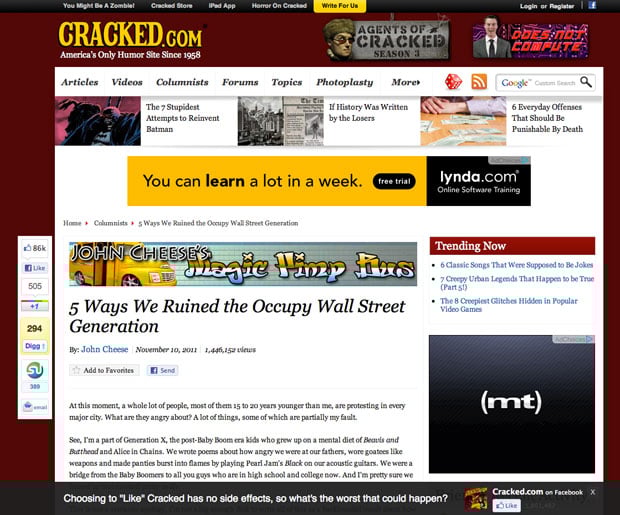
Here’s a story from Cracked.com, where in my unscientific estimation about 15% of the page above the fold is devoted to the actual text of the article:

cracked.jpg

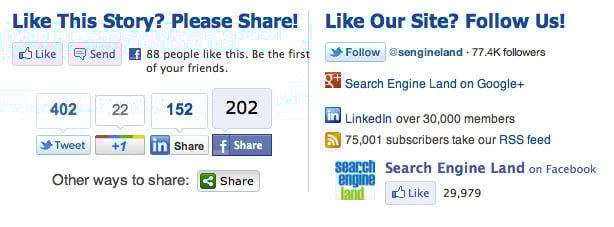
And finally, an example from Search Engine Land that illustrates the following sentiment in Brent’s article:

They’re filled with ads and social-media sharing buttons ”” and more ads. And Google plus-onesies and Facebook likeys. And also more ads. Plus tweet-this-es. Plus ads. (And, under-the-hood, a whole cruise-ship-full of analytics. The page required well-more than 100 http calls.)

sel.jpg

Is this the future of reading on the web? I sincerely hope not. I keep reminding myself of these words by Jeffery Zeldman:

Most of all, I worry about web users. Because, after ten-plus years of commercial web development, they still have a tough time finding what they’re looking for, and they still wonder why it’s so damned unpleasant to read text on the web ”” which is what most of them do when they’re online.

The scary thing is that Zeldman wrote that in 1999 (he revised the post slightly in 2005). And many years later the experience of reading text on the web seems to be getting worse, not better. As I wrote in The demise of quality content on the web, I’m worried that the wells of attention are being drilled to depletion by linkbait headlines, ad-infested pages, “jumps” and random pagination, and content that is engineered to be “consumed” in 1 minute or less of quick scanning ”“ just enough time to capture those almighty eyeballs.

As advertising clickthrough rates continue to drop, the ads become more desperate and invasive, and readers are starting to notice and do something about it. I’m doing the majority of my reading in RSS and Instapaper where I can read in peace without being pummeled by distractions.

The thing is, there are better ways to make money from writing - ways that are more respectful of readers. Ad networks like The Deck come to mind, as well as the growing number of sites that offer memberships (like The Loop and Daring Fireball).

It’s time for publishers to think different.

The demise of quality content on the web

I remember exactly when I decided to stop reading Mashable. I saw the headline Facebook Users Beware: Facebook’s New Feature Could Embarrass You on Twitter, clicked through, hunted for the words of the article among the sea of ads and social sharing icons, and then closed the tab after realizing it’s just another rehash of Facebook frictionless sharing (albeit in a tantalizing way). I went back to my Twitter feed and unfollowed them.

I’m sure the article was great for traffic, though. It is the perfect linkbait title backed up by a perfect SEO-ified URL (/new-facebook-feature). Here’s a screen shot of what’s visible above the fold:

mashable-fold.jpg

You can’t see a single word from the actual article without scrolling. It reminded me of a comment that Merlin Mann recently made in his typically funny and obnoxious style:

merlin-mann.jpg

I think I’ve finally hit the limit of my tolerance for web content that’s designed to make advertisers happy. I have no problem with working hard to build an audience - I have a blog, after all. But we seem to be in this bizarre race to the intellectual bottom to write the most generic article in the world so that everyone with an Internet connection will click through. And the only purpose seems to be to keep the advertising monster fed, fat, and happy.

I’m worried that all the noise makes it increasingly difficult for quality content[1] to be seen. Worse, I’m worried that it’s discouraging the creation of quality content because what’s successful (i.e. what gets the most clicks) is mostly lowest-common-denominator blog post titles that either start with a number or end with a question mark. James Bridle sums up this problem so well in The New Value of Text:

Like over-stuffed attendees at a dull banquet, the mind wanders. We are terrified that people are dumbing down, and so we provide them with ever dumber entertainment. We sell them ever greater distractions, hoping to dazzle them further.

Or as Marco Arment put it: “Anti-intellectualism is one of my biggest fears for our society.”

Yet despite all the evidence to the contrary there is still a common refrain on the Internet that quality content will always find its way out of the depths of obscurity. Kristina Halvorson recently complained about the fact that computer-generated articles are gaining traction. Joshua Porter responded: “Re: quality content…there is always room at the top.” My response to that was cynical, but borne out of the type of regurgitation you see everywhere:

to-bokardo.jpg

I used to believe that if you write with passion and clarity about a topic you know well (or want to know more about), you will find and build an audience. I believed that maybe, if you’re smart about it, you could find a way for some part of that audience to pay you money to sustain whatever obsession drove you to self-publishing (and to do it without selling your soul in the process). There are certainly examples of that out there (Daring Fireball, Shawn Blanc, Ben Brooks, etc.), but I’m not convinced any more that such an option exists for anyone who works hard and gives it a solid go.

The problem is not that people don’t have enough time, it’s that people don’t have enough attention. Like an oil well there’s only so much there, and once the well runs dry you don’t have a lot of options:

So one effect of Peak Attention is that every human mind has been mined to capacity using attention-oil drilling technologies. To get to Clay Shirky’s hypothetical notion of cognitive surplus, we need Alternative Attention sources.

The wells of attention are being drilled to depletion by linkbait headlines, ad-infested pages, “jumps” and random pagination, and content that is engineered to be “consumed” in 1 minute or less of quick scanning - just enough time to capture those almighty eyeballs[2]. And the reality is that “Alternative Attention sources” simply don’t exist.

I don’t know where we go from here. I just know that I’ve stopped reading sites that cater more for advertisers than for me as a reader. It won’t make much of a difference, but it will hopefully help me sleep better.


  1. Of course, we’re never going to agree on what “quality content” means. It’s one of those “you know it when you see it” things, and everyone’s definition will be different. Still, my personal view is that quality content presents two or more of the following components: (1) new information, (2) interpretation of information, and/or (3) a well considered personal opinion about what the information means.  â†©
  2. Wait, who am I to decide what people should and shouldn’t read? You’re absolutely right, I can’t do that so I should get off my high horse and let people read whatever they want to read. This is an opinion piece.  â†©

The inventions that prevent information from vanishing

James Gleick provides a very interesting excerpt from his book The Information in the article How Information Became a Thing, and All Things Became Information. In the excerpt he discusses the inventions that allow us to record and preserve information (like the transistor and the “bit” as unit of measure), and how this fundamentally changed society:

The information produced and consumed by humankind used to vanish””that was the norm, the default. The sights, the sounds, the songs, the spoken word just melted away. Marks on stone, parchment, and paper were the special case. It did not occur to Sophocles’[1] audiences that it would be sad for his plays to be lost; they enjoyed the show[2].

Now expectations have inverted. Everything may be recorded and preserved, at least potentially: every musical performance; every crime in a shop, elevator, or city street; every volcano or tsunami on the remotest shore; every card played or piece moved in an online game; every rugby scrum and cricket match.

It looks like a great book. James, if you’re out there, when will the Kindle edition be available?


  1. The Wikipedia entry on Sophocles is fascinating.↩
  2. Speaking of enjoying the show↩

Deluge of Content on the Web Swamps Yahoo (and puts content creators in a tough spot)

The Wall Street Journal in Deluge of Content on the Web Swamps Yahoo:

As Web traffic explodes, Internet companies are struggling to profit off ads shown next to the articles, videos and other content offered to viewers.

It’s a simple rule of any market. The more information that is created, the more the value is reduced. And despite attempts to woo spending with bigger, bolder and more targeted ads, services that help consumers navigate that content, namely search, remain the big money makers online.

As I (and many others) have written before, it doesn’t look like display advertising is a sustainable business model for media sites going forward (and I think we can agree that it makes for a pretty bad user experience). This puts content creators in quite a predicament: how do you make money from producing content? The WSJ piece points to the central problem here:

“People tell me that content is king, but that is not true at all,” says Rishad Tobaccowala, chief strategy and innovation officer at Vivaki, the digital-media unit of Publicis Groupe SA. “Most people make money pointing to content, not creating, curating or collecting content.”

Although the value of pointing to content is indisputable, we need a better way than display ads for content creators and curators to make a living. And I don’t think we quite know what that looks like yet.

No More Banner Ads: Alternatives to Ad-Supported Media Sites

This morning I read an article about something that’s been on my mind for a while: Banner ads on media sites/blogs. In The Truth About Display Advertising, Mitch Joel writes:

Go to the website for your local newspaper. How many display ads, banners, buttons, text links, etc… do you see that are ads? Mine has over 15. That’s not in consecutive order… that’s all at once. It’s hard enough to get consumers to sit through four TV ads in a row, so what did you expect to have happen when you blast them with 15 ads on one page, all at once? Foregoing the aesthetics and the basic Marketing lesson that an ad will experience diminishing returns based on how cluttered the environment that it’s placed in is, does anyone really believe that this is the best way to advertise to consumers in the digital spaces?

No. I don’t think this is the best way to advertise to consumers. In fact, I don’t even think advertising is the best way to monetize media sites either. But are there viable alternatives? I think there are at least two business models that could work.

Distraction-Free Reading

One of my favorite services on the web is Readability. Users sign up for at a low monthly fee (minimum $5), and it then allows them to read articles in a beautiful distraction-free environment with all the ads stripped out. But here’s the best part: publishers also get something out of it:

70% of all Readability membership fees go directly to writers and publishers. Every time a subscriber uses Readability on your site, a portion of that subscriber’s fees are allocated to you. Whether in a web browser, iPhone, or just about any mobile or tablet device, Readability puts reading ”” and your content ”” at the center of the experience.

Here’s a 1-minute video that summarizes the experience:

You’ll also see that the Readability buttons are the only content sharing buttons I have on my blog apart from the Tweet button. There are many reasons for only choosing those two, but with Readability it’s simple - I think they have a fair business model where both reader and publisher win.

How would this work as a replacement for ads? Sites could integrate the “Read Later” functionality in some innovative ways. Sites that publish a lot of content could provide an ad-free home page with content snippets and “Read now/later” buttons to get to the full article. Users without a Readability (or an equivalent) account could view ad-supported full articles if they prefer. My hope is that content would win and readers would start to prefer paying small amounts of money for ad-free reading environments.

This is by no means a well-explored alternative for ad-supported sites, but it could be the beginning of something great that rewards both readers and publishers.

Business Class Subscriptions

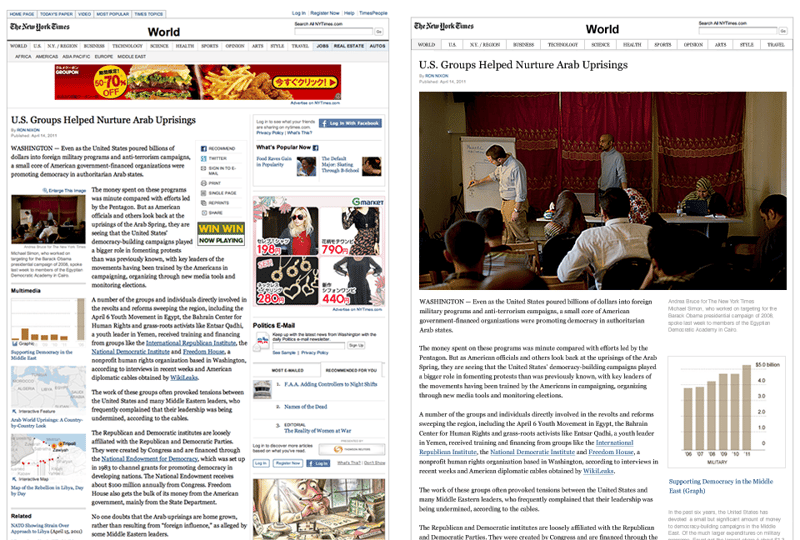
Oliver Reichenstein recently posted another very interesting alternative to traditional paywalls on sites like the New York Times. He refers to it as Freemium for News, and the idea is that instead of paying for additional content like with traditional paywalls, you pay to get a better experience (just like paying for Business Class still gets you to the same destination, but in a much more comfortable way). Think of it as a Readability season ticket for a specific site. Here is one example he shows:

Now, think about how this might work for ad-supported sites. I would certainly pay $0.99/month to access a Business Class version of TechCrunch. Would you?

But Can Any Of This work?

Realistically, could either of these ideas provide viable alternatives to the traditional ad model for media sites and blogs? Probably not yet. But I don’t think we’re seeing enough discussion about alternatives, particularly those that focus on user experience as opposed to “monetizing traffic”. I also don’t think these ideas would ever replace ads completely (just being realistic), but at the very least it could provide an additional revenue stream that’s actually based on what users want, not on what advertisers want to push down our throats.

Let me end with something I probably should have begun with. I am no expert in the area of publishing, so it’s easy for me to back-seat-drive media sites out of their biggest source of revenue - after all, it’s not my car. I am in the lucky position where I don’t need to monetize this blog, so I don’t really have to make tough decisions about these things.

But I do hope that if I ever need to make money here, there would be a viable alternative to putting ads all over the page. I just don’t think an ad-supported User Experience Design blog is a good idea. So from the back seat I just ask those who make a living in the publishing industry: Can you please figure out how to do this so I don’t have to?