Menu

Posts tagged “publishing”

eBook pagination: to scroll or not to scroll

Dmitri Fadeyev makes an argument in favor of continuous scrolling in eBooks (as opposed to traditional pagination) in The Return of the Scroll:

The scroll interface suits the variable nature of the digital content that it holds, but more so, it gives the user more fine-grained control over the reading experience. It feels more natural to scroll the page on a tablet because it creates the illusion of the physical medium, of a page sliding under your fingers. A scrolling interface also stops unwanted page turns if you happen to accidentally touch the screen. I’ve been trying out the new iBooks and while I think it’s too early to tell which mode is better, so far I really like it.

Even though his argument is solid, I still prefer the page metaphor when I’m reading an eBook, and I’m trying to figure out why. The closest I can get to a reason is the idea of “edges” that Craig Mod talks about in How magazines will be changed forever:

I miss the edges — physical and psychological. I miss the start of reading a print magazine, but mostly, I miss the finish. I miss the satisfaction of putting the bundle down, knowing I have gotten through it all. Nothing left. On to the next thing.

Scrolling is exhausting — it never ends. There is no sense of accomplishment. I once heard someone refer to infinite scrolling on websites as “a game you can never win.”

In contrast, pages allow us to hang on to some sense of beginning and end. They communicate a solid sense of progress. They serve as signposts to help us figure out where to stop reading until the next time. Where scrolling is an endless blob of text, pagination fits into the idea of memory chunking because it’s a more manageable unit to deal with cognitively.

In short, pagination lets you know that you’re getting somewhere, and not just running on a treadmill. Or maybe I’m just old and need to get with the times…

Update: @jbruwer pointed me to @simuari’s concept of flick scrolling as a possible solution. Video below, but also check out the post for more details.

Update 2: I wrote a quick follow-up to address some feedback on this post.
The user experience of printed publications

Craig Mod’s How magazines will be changed forever ties in really nicely with my previous post on embracing limitations in the digital world:

Like Newsweek, almost all magazines will eventually go purely electronic. […] Still, as I watch this shift, I can’t help but feel a twinge of nostalgia. Not for the paper, but for the boundaries.

I miss the edges — physical and psychological. I miss the start of reading a print magazine, but mostly, I miss the finish. I miss the satisfaction of putting the bundle down, knowing I have gotten through it all. Nothing left. On to the next thing. […]

One of the qualities most natural to the user experience of print is the sense of potential completion, defined by the physical edges. It is a quality that is wholly unnatural to digital formats. The digital reading experience makes one want to connect and expand outward. Print calls for limit and containment.

(link via @RobertSBoone)

New article on Smashing Magazine: The Immersive Web And Design Writing

My latest article for Smashing Magazine came out yesterday. The Immersive Web And Design Writing is about the resurgence we’re seeing in longform writing that’s done with much patience and care. I interviewed the publishers of three such examples: Andy McMillan of The Manual, Nick Disabato of Distance, and John Boardley of Codex. After all the editing was done, I came to the following conclusion:

So, maybe what I initially thought was an article about design publications is actually an article about all of us instead. The point is not just that we should have a balanced information diet, but that the real power of that balanced diet lies in the energy it gives us to get started on our own projects. Seek out these nutritious words. You won’t regret it.

I hope you like the article!

The power of words to defy the laws of nature

Adam Kirsch’s Neverending stories is a very interesting exploration of fairy tales, and why they’ve had such longevity in our culture. The essay struggles to find its way in the first half, but it picks up steam when Adam starts to speculate about why these ancient stories continue to be so popular. I especially like this theory:

Rather, what fairy tales obsessively conjure up is a world of mutability, in which things and people are not immured in their nature. The frog becomes a prince, the wolf becomes a grandmother, the little mermaid becomes a woman, the beast becomes a handsome man, the 12 brothers become a flock of ravens. So much of the appeal of these stories, in a preliterate, premodern culture, must have been simply in their demonstration of the power of words to defy the laws of nature. In this way, the storyteller enacts the magic powers he describes and possesses the wealth he fantasises about.

All good writing conjures up thoughts and images that go beyond the immediate realities of the story that is being told.

I recently finished reading Paul Soulellis’s essay in Issue #3 of The Manual called “Design Humility”. I’ll write about it more at some point, but for now, phrases like “walking slow, but looking hard” and “amplified vulnerability” are racing through my mind at such speed that I don’t know what to do with it all yet. I love writing like that. Writing that makes you dizzy with sudden understanding and new ideas. Writing that defies the laws of nature.

Embrace your mediocrity

An Elite for Everyone is another thought-provoking piece from Callum J Hackett, whose excellent blog I just recently discovered. He makes the case that maybe we should let go of this idea that everyone can be creative if they just try hard enough:

While monetary elites are deceptive and damaging, a creative elite is arguably essential to artistic culture. For art, literature and music to have any significant purpose in our lives, they depend on the relationship between a handful of creators and a much larger, consuming audience. I think this should be an argument against the incessant drive to democratise creative talent, and the trope that everyone has a novel in them, because not only is it likely biologically impossible (again shifting the blame from lack of possibility to individual failure), it’s also undesirable. I think there comes a time when we have to embrace our own mediocrity, and instead recognise our important place as part of the audience. This might seem bleak and self-defeating, but it sits more comfortably with the real world, and wouldn’t feel like such a bum deal if we weren’t continually titillated with the distant, unlikely prize of publication and fame.

Birth of a Book, and tangible craftsmanship

Birth of a Book is a beautiful video of a book being created using traditional printing methods. Watch it before you continue reading:

Birth of a Book from Glen Milner on Vimeo.

Merlin Mann often defines a priority as an activity you both care about, and are willing to sacrifice something for. That phrase — care and sacrifice — immediately sprung to mind as I watched this video. You can sense the care that goes into the book’s creation, and you can easily imagine the time sacrifice needed to make sure it comes out perfect.

I am not on some kind of crusade against ebooks. I read way more ebooks than traditional books. But there is still something exciting about opening and reading physical copies of books like The Shape of Design or The Manual. The level of care and sacrifice becomes tangible, and transfers from creator to consumer. It’s why I still buy vinyl, and prefer a manual coffee making process.

As much as I live online, I recognise that there is a level of tangible craftsmanship to certain physical things that can inspire us in ways that an Instagram filter just can’t do.

(video via Daily Exhaust)

NextDraft, and why email is still important

NextDraft is one of my favorite things on the Internet at the moment. It’s a daily newsletter with 10 interesting news stories, written by the brilliant Dave Pell. It also made me like email again, which I didn’t expect to be possible. But it makes sense now that I’ve read this great interview with Dave where he explains why email is still relevant:

Email has always been a great medium. It’s the content of most emails that’s problematic.

Email is still the killer app. It looks great on all your devices and the user experience is always exactly what you’ve come to expect. Look at the rise of Instapaper, Readability, and Pocket. People love plain, glorious, readable text. Email is also a technology that everyone understands, and it’s personal (if someone wants to respond to me, all they have to do is hit reply).

Tweets and status updates flow by and disappear into the black hole that is the Internet of five minutes ago. Interesting links and stories you find in an email newsletter are always right where you left them.

Also check out the NextDraft iPhone app. It’s fantastic.

RSS FTW

I recently tweeted that I’m fairly convinced that the most valuable (and most difficult) metric to grow in online publishing is RSS subscribers. I’d like to explore that idea a bit further.

The RSS publishing experience

Over the past few days I’ve done quite a bit of investigation to see if my hunch about the value of RSS subscribers is correct — at least on my own site. Apart from just typing in the URL, there are currently three ways to subscribe to updates on my blog: Twitter, a weekly email, and RSS. I’d like to share some metrics on each of those methods.

Since Twitter doesn’t have analytics on t.co links yet, I had to look at the bitly links on my main Twitter account as a proxy. On average, the clickthrough rate on links I post on bitly is between 2% and 3%. That’s really low. It’s also worth noting that bitly did some analysis that showed that the mean half life of a link on Twitter is 2.8 hours. That is an extremely short time before whatever you tweet pretty much disappears forever.

The weekly email performs a bit better. The open rate on that email hovers just under 20%, on average. That’s pretty decent, I think — certainly much better than posting links on Twitter.

On the RSS feed, the average reach (the total number of people who have viewed or clicked on the content in the feed) is 28%. This is by far the most engaged group of the three methods I provide to get updates on the site’s content.

From a publishing perspective, RSS subscribers are like magazine subscribers. When they invite you into their reader it means that they place some value on the content you create. They are also the people who share your content, and care enough to give constructive feedback when you suck. So if you have to look at metrics for your site or online publication, that’s where I think you should look for a reflection of its quality.

The RSS reading experience

I also want to make a few points about the RSS reading experience, and why I think it’s superior to other methods. There’s no way to keep up with all the links that come across my Twitter feed every day. But whenever I read something I like, I always go to the site’s home page to read some other posts. If I like the general theme I subscribe to the RSS feed and relax, because I don’t have to worry about accidentally missing a new post. RSS is a very “Slow Web” way of keeping up with content you don’t want to miss.

The other reason I’m such a fan of RSS is that it is a completely open platform (not Android “open” — real open). There are a multitude of ways to publish and consume feeds, and there is no lock-in whatsoever. This is why RSS has remained so strong. Dave Winer sums it up best, of course, in Protocols don’t mean much:

RSS won not because of its great design, but because there was a significant amount of valuable content flowing through it. Formats and protocols by themselves are meaningless. That’s what I say about specs. Show me content I can get at through the protocol, and I’ll say something.

Towards on open social network

I do see one big problem with RSS: there is no way to build a community around the people who subscribe to your feed. Feedburner tells me how many people are subscribed, and there is some basic aggregated demographic information, but that’s it. I’d love for RSS to give users the option to reveal their names and/or email addresses when they subscribe to a feed. This might sound creepy, but if it’s an optional setting (with an ethical default as private), I think this could be really powerful.

There are many sites that I subscribe to that I won’t mind if they know who I am. Publishers could use this information to kick off forums or email discussions around certain topics, organise local meetups, or any number of community interaction initiatives. For all this talk about “open” social networks, the idea of loose connections around an open protocol seems pretty appealing to me.

Or am I crazy?

Writing shortcuts

David Carr wrote a great post about journalism and plagiarism called Journalists on the Edge of Truth. There’s one part in particular that stood out for me:

The now ancient routes to credibility at small magazines and newspapers — toiling in menial jobs while learning the business — have been wiped out, replaced by an algorithm of social media heat and blog traction. Every reporter who came up in legacy media can tell you about a come-to-Jesus moment, when an editor put them up against a wall and tattooed a message deep into their skull: show respect for the fundamentals of the craft, or you would soon not be part of it.

Social media has levelled the playing field somewhat by enabling writers to become popular without the need for a newspaper/magazine platform. But shortcuts are always fraught with hidden traps and potholes, like letting the pressures of publishing drive you over the “remix” line to straight-up plagiarism.

Why Twitter's restrictions won't usher in a resurgence in blogging

Daniel Jalkut1 tweeted a very interesting response to the news that Twitter has revoked Tumblr’s friend-finding privileges:

All this rage against Twitter will ultimately bolster blogging: the distributed, DNS-backed social network Twitter was allegedly displacing.

— Daniel Jalkut (@danielpunkass) August 23, 2012

I would love nothing more than for more people to write on their own domains. I’m fully on board with the “own your data” movement, and I’m obviously a fan of blogging in general. The problem is that Twitter and traditional blogging are at complete opposite ends of what I’ll call the “publishing barrier” spectrum.

The web is a battlefield of dead blogs. So many people start one up with the best of intentions, only to realize that “If you build it, they will come” does not apply at all. Once they figure out that it’s exceptionally hard work to post frequently and build an audience, since nobody wants to read your sh*t, they abandon their efforts.

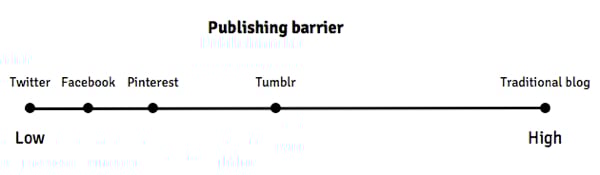
And where do they go? Twitter. Facebook. Pinterest. Tumblr. Where there is no pressure to write coherent paragraphs and then convince people that they should try to remember a URL they can’t pronounce2. The expectations for content on these sites are low, so the barrier to publishing is all but removed. Here’s how I’d plot some different publishing platforms on the spectrum:

Publishing barrier scale

We could probably argue about where to put the dots, but the basic point remains the same. The reason we won’t suddenly see a mass resurgence of “distributed, DNS-backed” blogging is that people are lazy, and we’re all looking for the path of least resistance that will make us feel like “content creators”. If Twitter does end up losing its way, we’ll find somewhere else to fill that need. We are, after all, becoming a post-literate society.


  1. The owner of MarsEdit, which I’m using to write this post (meta!) 

  2. Yes, I know. I chose badly. Too late now…