Menu

Posts tagged “publishing”

Book culture everywhere

Hugh Howey is the author of WOOL, one of my favorite sci fi series. His essay Your Fear is My Opportunity is a rant on Amazon and self-publishing, and I really appreciate his perspective as someone who has gone through the hard process of self-publishing:

The things I advocate for: Reasonably priced e-books, for publishers to take risks and do exciting things, for us to embrace the future of storytelling and allow it to coexist with the past, to release all editions of a work at once, to get rid of DRM, to mix up genres and do something fresh and new … these are all things I’ve wanted as a reader for longer than I’ve been writing.

And this:

I am a reader first. And I want more readers. Selfishly, as a reader, I want more readers. I want to see airports full of people staring at books, e-readers, and tablets laced with text. Not people staring at cell phones, Candy Crush, Facebook, or authors’ blogs. I want book culture everywhere. I want interactions with strangers to be about what they’ve read lately. I want my social media feed to be all about books. I’m an addict, and I want to get other people hooked. Maybe that’s a bad thing. I don’t care.

If you haven’t read WOOL you should give it a try. Great storytelling whether you’re a sci fi fan or not.

An automated image upload workflow for Amazon S3

I have no idea if anyone else will find this helpful, but I’m so excited about it that I have to share it1. One of the most time-consuming and repetitive tasks in blogging is uploading images to my Amazon S3 account, generating the CDN link, and inserting it into the post. But I’ve now cobbled together a recipe that makes this really easy, and I’d like to tell you about it. First, here are the ingredients you’ll need:

  1. An Amazon S3 account for image storage (optional: Cloudfront CDN)
  2. TextExpander to handle the repetitive typing
  3. Hazel to automate the upload to S3
  4. Dropbox isn’t technically necessary, but it makes everything just a little bit smoother.

With that said, here are the steps in the recipe:

Step 1: Set up a Hazel workflow to upload new files to S3

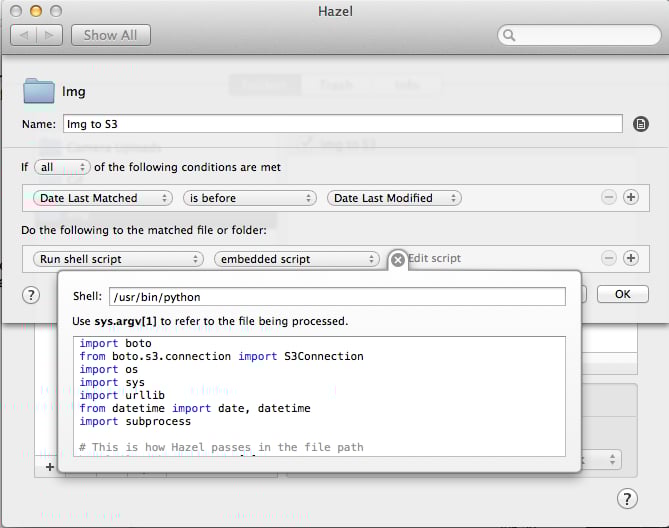
First, we need to set up Hazel to watch a folder and upload any new files to your S3 bucket. The Macdrifter article Upload to Amazon S3 from Dropbox using Hazel is extremely helpful for this. I basically copied that script with some minor adjustments. Here’s what it looks like:

Hazel upload to Amazon S3

Note that you have to change the type of shell script you run to /usr/bin/python. The script I use looks as follows (again, see the Macdrifter article for the whole story):

import boto
from boto.s3.connection import S3Connection
import os
import sys
import urllib
from datetime import date, datetime
import subprocess

# This is how Hazel passes in the file path
hazelFilePath = sys.argv[1]

# Obviously, you'll need your own keys
aws_key = 'YOUR_KEY'
aws_secret = 'YOUR_SECRET'

# This is where I store my log file for these links. It's a Dropbox file in my NVAlt notes folder
logFilePath = "/Users/~YOUR_COMPUTER_NAME/Dropbox/Notational/Link_Log.txt"
nowTime = str(datetime.now())

# Method to add to clipboard
def setClipboardData(data):
    p = subprocess.Popen(['pbcopy'], stdin=subprocess.PIPE)
    p.stdin.write(data)
    p.stdin.close()
    retcode = p.wait()

# This is the method that does all of the uploading and writing to the log file.
# The method is generic enough to work with any S3 bucket that is passed.
def uploadToS3(localFilePath, S3Bucket):
  fileName = os.path.basename(localFilePath)

# Determine the current month and year to create the upload path
    today = date.today()
    datePath = today.strftime("/%Y/%m/")

# Create the URL for the image (Add your own path here)
    imageLink = 'https://cdn.elezea.com/images/'+urllib.quote(fileName)

# Connect to S3
    s3 = S3Connection(aws_key, aws_secret)
   bucket = s3.get_bucket(S3Bucket)
   key = bucket.new_key('images/'+fileName)
   key.set_contents_from_filename(localFilePath)
   key.set_acl('public-read')
   logfile = open(logFilePath, "a")

try:
       # %% encode the file name and append the URL to the log file
       logfile.write(nowTime+'  '+imageLink+'n')
      setClipboardData(imageLink)
   finally:
      logfile.close()

Here’s what the script does in my case: Whenever I add a new file to the Img folder in Dropbox, it uploads the file to S3, copies the URL to the clipboard, and also adds that URL to a Link_Log text file in my nvALT folder for later access if needed (or if I add multiple images in one go).

Step 2: Set up TextExpander shortcuts

Once the image is added to S3, the rest is handled with TextExpander. When I want to add an image to a blog post I type:

,img

That expands to:

<p><img style="display: block; margin-left: auto; margin-right: auto;" title="%fill:image title%" src="%|%fill:image source%" border="0" alt="%fill:image title%" /></p>

It asks me to give the image an alt tag, and then it places the cursor where I’m going to add the source file. Since the source URL is already in my clipboard, I then just ⌘-V and I’m all set.

They call it magic

That’s it. It might seem like a lot of work, but now that everything is set up my workflow is extremely simple:

  1. Add new image to the Img folder
  2. Type the TextExpander shortcut and paste the Image URL where I want the image to appear

I think it’s going to save me at least as much time this year as it took to write this blog post.

Oh. Wait.


  1. It also gives me an opportunity to pretend I’m Dr. Drang, but I digress. 

Typos arent taht bad

In A Corrected History of the Typo Adrienne LaFrance argues that maybe print errors aren’t such a bad thing:

What we’ve lost, in many cases, online, isn’t the integrity of print, but the traceability of its weaknesses. Centuries ago, “errata lists became, paradoxically, markers of well-made books.” The made in “well-made” is a key word here. Mistakes can serve as reminders that books are made at all—the physicality of the process, the “connection between the book going wrong, momentarily, and a sense of the process of production being briefly revealed, or implied,” as Smyth put it in a recent paper about print in Early Modern England. It’s why readers relish newspaper typos—they represent the lifting of a veil, and hint at the human (and that human’s fallibility) on the other end of the object. 

If this kind of thing is of interest to you, it reminds me of post I wrote a couple of years ago called The unnecessary fear of digital perfection. It cites a bunch of articles that lament the fact that we don’t let ourselves make mistakes any more.

Newsletters: not dead yet

David Carr in For Email Newsletters, a Death Greatly Exaggerated:

Email newsletters, an old-school artifact of the web that was supposed to die along with dial-up connections, are not only still around, but very much on the march. […]

And:

Email is a 40-year-old technology that is not going away for very good reasons — it’s the cockroach of the Internet.

Well, I confess that I have also succumbed to the lure of this particular cockroach, and have been experimenting with a revamped newsletter. If you’re keen, join in…

The web's Eternal September

Jason Kottke in The revenge of the nerds:

On the very public stage of the web, the nerds of the world finally had something to offer the world that was cool and useful and even lucrative. The web has since been overrun by marketers, money, and big business, but for a brief time, the nerds of the world had millions of people gathered around them, boggling at their skill with this seemingly infinite medium.

There’s been a lot of talk about the web we lost in recent months. It’s now gone mainstream with TechCrunch calling the phenomenon The Fourth Internet:

If the first Internet was “Getting information online,” the second was “Getting the information organized” and the third was “Getting everyone connected” the fourth is definitely “Get mine.” Which is a trap.

I certainly understand where everyone is coming from with this. I also go on about the importance of self-publishing on your own domain (or as Jeremy Keith calls it, “selfish publishing”). And I also miss the old Twitter, back when it was about discussions and sharing knowledge, and not about big brands taking over our feeds with promoted photos.

But we also have to remember that the web is always going to be an Eternal September. So many new people are coming online every day, and they don’t know our “rules”, so they make up their own. And as much as we might long for earlier days, that’s how progress happens — through the actions of people who don’t know what they’re supposed to do.

So, sure. Let’s continue to publish on our own sites, and shout loudly about the virtues of doing so. But let’s not make people feel like unwanted newbies when they dream up a different web. We need them as much as they need us.

The future of the personal site

‘Tis the time for introspection, and this year we all seem to wonder about the future of online publishing — and in particular, what role the personal blog will play going forward. Jason Kottke kicks us off with The blog is dead, long live the blog:

Instead of blogging, people are posting to Tumblr, tweeting, pinning things to their board, posting to Reddit, Snapchatting, updating Facebook statuses, Instagramming, and publishing on Medium. In 1997, wired teens created online diaries, and in 2004 the blog was king. Today, teens are about as likely to start a blog (over Instagramming or Snapchatting) as they are to buy a music CD. Blogs are for 40-somethings with kids. […]

The primary mode for the distribution of links has moved from the loosely connected network of blogs to tightly integrated services like Facebook and Twitter.

Even though I don’t want to believe Jason, his words ring true. And that bugs me, because I really like this site (which I haven’t called a blog for a long time, but hey, semantics). After a few days of overthinking things, Frank Chimero came to the rescue with Homesteading 2014, in which he explains his plans for his own site going forward. The whole thing is worth reading because it’s a great summary of the problem with endless content streams, but here’s the key part:

I’m returning to a personal site, which flips everything on its head. Rather than teasing things apart into silos, I can fuse together different kinds of content. Instead of having fewer sections to attend to distracted and busy individuals, I’ll add more (and hopefully introduce some friction, complexity, and depth) to reward those who want to invest their time. […]

So, I’m doubling down on my personal site in 2014. In light of the noisy, fragmented internet, I want a unified place for myself — the internet version of a quiet, cluttered cottage in the country. I’ll have you over for a visit when it’s finished.

Count me in. The strategy resonates with me, and besides, I don’t want to see the “blog” die.

Paying for less information

Kontra explores a particularly egregious style of “content marketing”-style advertising on CNN’s website in his post “You Might Also Like”. He concludes:

Will these advertorial deceptions and misdirections move from the ad wells around the periphery of the page into the news delivery itself? Will there be product placements within news sentences? What follows that? Is the “mainstream media” management about to capitulate on long-held principles because it’s unable or unwilling to pursue any other strategy but the race to the bottom of the advertising barrel? Is there anything more precious than credibility to a news organization? If not, why is Time Inc. poisoning its own well so nonchalantly?

Contrast CNN’s approach with The Information, an online-only publication that just launched with a price tag of $400/year. Most people believe it won’t work, but I think Hunter Walk makes a good point in $400 for The Information Is About What’s Missing, Not What’s There:

For me the value in The Information is not solely in what they’re providing but what they’re leaving out. The ~two articles a day are both interesting. Because they’re not playing a page views game, they don’t need to overload me with 25+ posts every 24 hrs. The site is spartan because they don’t need to worry about IAB units. A small number of writers building their beats give me the chance to see each journalist’s style distinctly, not settle into some random byline slot machine of varying quality.

It’s sad that we have to pay not just to have a distraction-free reading environment, but also to reduce the amount of information we get to something more manageable (and focused on quality over quantity). But that appears to be the new world of publishing.

Weekend reading: online publishing's race to the bottom

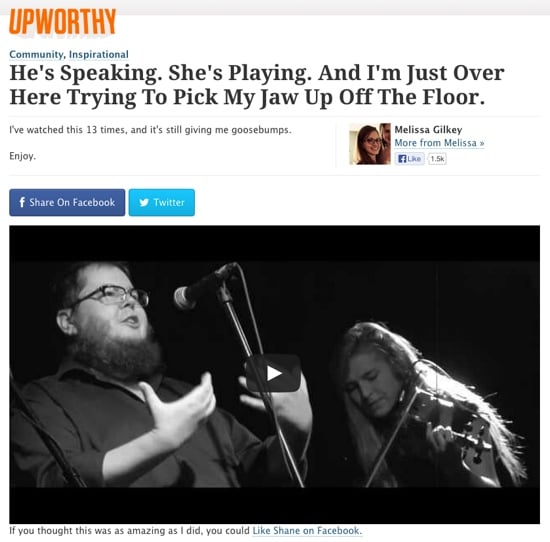
Upworthy style

This week we saw quite a few articles on the rapidly changing online publishing scene. In particular, there is a lot of analysis going on about the sudden and unexpected traffic domination by sites like Buzzfeed and Upworthy, as readers (or rather, clicks…) move away from more established outfits like the Huffington Post.

To set the stage, Alexis Madrigal wonders if 2013 will be The Year ‘the Stream’ Crested. He refers to the endless updates on social networks, which are always presented in reverse chronological order — a design that inherently implies that new=good and old=bad:

When the half-life of a post is half a day or less, how much time can media makers put into something? When the time a reader spends on a story is (on the high end) two minutes, how much time should media makers put into something?

The necessity of nowness plus the professionalization of content production for the stream means that there are thousands and thousands of people churning out more crap than can possibly be imagined. 

In a story that proves Madrigal’s point about an inevitable, exasperated move away from this “nowness”, Robinson Meyer asks Why Are Upworthy Headlines Suddenly Everywhere? He explains that beyond the obvious reason — clickbait headlines work because, well, people click on them — lies a change in Facebook’s algorithm that rewards “viral” stories more than recent stories. In Facebook’s words, “stories that people did not scroll down far enough to see can reappear near the top […] if the stories are still getting lots of likes and comments.” Meyer continues:

Simultaneous to this traffic upheaval, an entire vocabulary and syntax for headlines that people click and share — and oh, boy, do they click and share — had presented itself on the social web. For publishers trying to grab more traffic from Facebook, the path became clear. Borrow, adapt, employ the Upworthy style post haste. Assure readers your content was nothing but wondtacular. And so began the wondtacularization.

So “nowness” is replaced by whatever can get the most clicks, regardless of its age. On the surface this move away from “the stream” sounds like a good thing, but we need to dig a little deeper. Another interesting tie-in to these stories is Farhad Manjoo’s Why Everyone Will Totally Read This Column. It’s a profile on Neetzan Zimmerman, who is in charge of posting “viral” content on Gawker (with remarkable success):

He posts only about a dozen items a day. Almost every one becomes a big traffic hit — an astonishing rate of success. I’ve worked on the Web for years, and I still have trouble predicting which of my stories will be hits and which will appeal only to my mom. Mr. Zimmerman has somehow cracked the code.

His secret, he says, is a deep connection to his audience’s evolving, irreducibly human, primal sensibilities. Usually within a few seconds of seeing an item, Mr. Zimmerman can sense whether it’s destined to become a viral story. “I guess you could call it intuition,” he says.

And now we get to the crux of it. What happens to the truth when all focus shifts to a story’s ability to go viral? That’s what Ravi Somaiya and Leslie Kaufman explore in their NYT piece If a Story Is Viral, Truth May Be Taking a Beating. They explain how this never-ending hunt for more clicks means that it doesn’t even matter if a story is true or not:

When the tales turned out to be phony, the modest hand-wringing that ensued was accompanied by an admission that viral trumps verified — and that little will be done about it as long as the clicks keep coming. “You are seeing news organizations say, ‘If it is happening on the Internet that’s our beat,’” said Joshua Benton, director of the Nieman Journalism Lab at Harvard. “The next step of figuring out whether it happened in real life is up to someone else.”

So this is the environment we find ourselves in right now:

Start with an entire industry built on the sandy foundation of ad revenue. Throw in a particular style of headline that feeds off people’s “primal sensibilities”. Add a Facebook traffic machine that is continuously tweaked to pick up these stories and recycle them endlessly on people’s news feeds. And what do you get? A race to the bottom where viral trumps verified, lowbrow beats intellectual, and cheap clicks beat in-depth reporting and considered opinion. Suddenly the Postliterate society doesn’t sound like such a crazy prediction any more.
[Housekeeping] A new design, and some other things

I don’t write meta-posts often, but enough has happened this year that I wanted to give you a quick update on what’s going on. In an effort to make sure I don’t get too verbose, I’ll stick to a few short bullet points.

  • We recently made some slight updates to Elezea’s design. We removed the texture, cleaned up some things, switched to Droid Sans, and made the primary color a bit more orange. Most importantly, the site is now mobile-first and sports a fancy new off-canvas menu. Once again, I’m indebted to Alex Maughan for his amazing design and development work. High five, Alex.
  • This year I joined The Syndicate and AdPacks.com. I was quite worried about the response, but you guys have been awesome. It’s a testament to the quality of the audience (and the ads) that they are quite happy with the return they’re getting from advertising on Elezea. I have a love/hate relationship with ads, but I like the tasteful way these companies approach things, so it’s been a very good fit.
  • I’m currently finishing up a book on Product Management that will hopefully be published around March/April next year. If you’d like to get updates on what’s going on with that, you can sign up for the newsletter.
  • I’m quite impressed by Flipboard Magazines, and have recently started posting a lot of the articles that Elezea is based on (and things that don’t make it on here) to a companion magazine I imaginatively call Elezea Magazine. Please check it out, and share if you like it. It’s a really great platform.

I think that’s it. This has been a really cool year for Elezea, and I look forward to 2014. I feel privileged that you have chosen to take this hike with me. Thank you.

P.S. While we’re talking about other things, allow me to brag a little bit about where I live. I took this last week on an early morning run. If you haven’t been to Cape Town, you should definitely put it on your list.

Running in Stellenbosch

When product enhancements are actually distractions

David Streitfeld takes an interesting look at the complicated relationship between digital and physical books in Out of Print, Maybe, but Not Out of Mind. This part jumped out at me, because it points to a mistake companies often make:

“A lot of these solutions were born out of a programmer’s ability to do something rather than the reader’s enthusiasm for things they need,” said Peter Meyers, author of “Breaking the Page,” a forthcoming look at the digital transformation of books. “We pursued distractions and called them enhancements.”

As Barbara Nelson points out in Who Needs Product Management?:

It is vastly easier to identify market problems and solve them with technology than it is to find buyers for your existing technology.

That’s the mistake that many ebook companies made. They let technology lead, where the better solution is to be led by user needs.