Menu

Posts tagged “publishing”

Daring Fireball, App.net, and admitting who our heroes are

It’s not fashionable any more to have heroes. In fact, I’m scared to admit that I like anything, because I just never know if maybe, for some reason, we’re supposed to complain about that thing instead. Look at the response to App.net, for example. Much of it has been positive, but there is also an awful lot of snark and sarcasm out there — much of it from people I like and admire. So I’ve resisted the urge to confess that I backed the project, and that I like the Alpha product so far.

It’s become really hard to know what we’re allowed to like online.


I don’t remember exactly when I started to read John Gruber’s Daring Fireball, but I do remember that it had an immediate and profound effect on my view of online publishing. His efficiency with words gave me an appreciation for what web writing could be, and I started to dissect every post to try to learn as much as I could. Gruber and Merlin Mann did a talk about blogging at SXSW 2009 where they discussed the idea of Obsession times Voice:

Topic times voice. Or, if you’re a little bit more of a maverick, obsession times voice. So what does that mean? I think all of the best nonfiction that has ever been made comes from the result of someone who can’t stop thinking about a certain topic — a very specific aspect of a certain topic in some cases. And second, they got really good at figuring out what they had to say about it.

That talk — along with Gruber’s site — got me thinking: I wonder if I could do something like that? I have so many Obsessions. Could I maybe find a hidden Voice somewhere in those obsessions? It’s after hearing that talk that I decided to start taking this site more seriously. And even though Daring Fireball probably gets the equivalent of my monthly traffic in about an hour, this has still been one of the most rewarding experiences of my life. It has opened so many doors and enabled me to meet some wonderful people.


Why is it that we reach for the comforts of collective cynicism whenever someone who is not in our inner circle of coolness tries to do something new or different? In the case of App.net, someone just raised more than $500,000 from end users to build a product that’s trying to compete with Twitter. Why can’t we just, for a few moments, look past everything that might be wrong with the idea, and appreciate what an enormous accomplishment that is?

You don’t have to like Dalton Caldwell or App.net. You don’t even have to be quiet about not liking them. Really — it’s ok to not like things. But don’t be a dick about it.


Gruber linked to me once on Daring Fireball. Hey, so what if I printed out his post and framed it? I still remember opening my RSS reader on the morning of Thanksgiving 2011, and falling out of bed when I saw my name on Daring Fireball. I was floating on air for weeks. It wasn’t about the traffic — it was Thanksgiving so there was pretty much no one online. The reason I was so happy is that John Gruber — someone I decided I want to impress with my writing — noticed something I wrote, and put it on his site. Since I really want to make this thing work long term, that was the biggest encouragement I could have received.

I took the opportunity to write to John to thank him not just for the link, but for the impact he has on my writing. Here’s one part of what I said:

I appreciate and learn so much from your approach to writing — you’re authentic and to the point, which is in such contrast to much of the web. Thank you for showing so many of us aspiring writers that we don’t have to sell our souls to have an audience.

He emailed back:

Great note. Thanks!

—J.G.

The response couldn’t have been more Gruber. Even in a short email, a regular dash just isn’t good enough. It’s em dashes all the way for the guy whose Obsession times Voice is about the quest for perfection in everything we do.


I know it’s not fashionable any more to have heroes. But this week App.net got funded, and Daring Fireball turned 10 years old. So roll your eyes if you must, but I’m just going to say it.

I backed App.net, and John Gruber is one of my heroes.
Meaningful writing

Dmitry Fadeyev reflects on the purpose of writing in Give Sight:

Meaningful writing has a purpose beyond that of simple entertainment or of generating conversation. Its purpose is to improve society, to improve our life, by teaching us certain truths that the author has learned. John Ruskin puts it well in his essay on books, Of Kings’ Treasuries, by saying that good books give us sight. By teaching us what to look for, and the value of those things, we learn to tell apart the good from the bad, to pass better judgements using our sharpened vision. We grow and become wiser. And that is the only sort of writing that ever improves us as people because all the rest, information and entertainment, it just passes by and leaves us in the same state that we are when we first come into contact with it.

I completely agree with this viewpoint, and that results in a constant struggle as I try to weigh the demands of long-form writing with the demands of, you know, having a day job. The compromise that many of us in this situation goes for, to keep the much-needed momentum of writing going (what Alex Charchar calls “act the pro”), is to share links and quick thoughts, interspersed with some long-form writing when inspiration and a brief excess of time collide.

I’m particularly self-conscious about the dangers of this approach after reading Marcelo Somers’s piece The Linkblog Cancer:

Our job as independent writers isn’t to be first or even to get the most pageviews. It’s to answer the question of “so what?”. Taken as a whole, our sites should tell a unique story that no one else can, with storylines that develop over time that help bring order to the chaos of what we cover.

That’s what I want to happen here, but I know I often fall short. I’ll keep doing it though, because I have hope that, taken as a whole, there is a thread running through the links I post and the essays I write, and that when I look back at it in a few years, that thread will spark some new and interesting ideas. We’ll see.

BuzzFeed and the future of publishing

They’re not always great at citing sources, and it’s not exactly the height of intellectual journalism, but I’ll admit: BuzzFeed’s publishing strategy is commendable:

We don’t show crappy display ads and we make all our revenue from social advertising that users love and share.  We never launched one of those “frictionless sharing” apps on Facebook that automatically shares the stories you click because those apps are super annoying. We don’t post deceptive, manipulative headlines that trick people into reading a story.  We don’t focus on SEO or gaming search engines or filling our pages with millions of keywords and tags that only a robot will read. We avoid anything that is bad for our readers and can only be justified by short term business interests.

Instead, we focus on publishing content our readers love so much they think it is worth sharing. It sounds simple but it’s hard to do and it is the metric that aligns our company with our readers. In the long term it’s good for readers and good for business.

That’s from an email that BuzzFeed’s CEO sent to employees, and it’s worth reading in its entirety because it’s such a good description of the principles that good online publishing is built on.

The complexity of designing books for print as well as e-readers

I love Frank Chimero’s explanation of the book design decisions he made for The Shape of Design. From an interview with FontFont:

Many of the design decisions were also influenced by the affordances of ebooks and their readers. The cover was designed to be very iconic so I had a design system which could transition to each reading environment. The page size of the printed book was chosen to be similar in size to what would be experienced on an iPad or Kindle. The illustrations are two-color, because I knew I could make them look good on a Kindle, iPad, and in print.

Basically, I wanted to design a system that was flexible enough to keep its identity intact as the words went from place to place. I think it is possible to craft books in a way so that no reading environment is obviously inferior to another, whether printed book or ebook. Each piece has to shine on all the other parts to make a better whole.

Typography, invisible design, and windows to words

In 1955 Beatrice Warde wrote an essay on typography, book publishing, and advertising called The Crystal Goblet, or Printing Should Be Invisible. It is one of the best descriptions of the concept of invisible design I’ve ever read. I pretty much want to quote the whole thing, but I’ll stick with this gorgeous paragraph, and let you click through for the rest:

The book typographer has the job of erecting a window between the reader inside the room and that landscape which is the author’s words. He may put up a stained-glass window of marvelous beauty, but a failure as a window; that is, he may use some rich superb type like text gothic that is something to be looked at, not through. Or he may work in what I call transparent or invisible typography. I have a book at home, of which I have no visual recollection whatever as far as its typography goes; when I think of it, all I see is the Three Musketeers and their comrades swaggering up and down the streets of Paris. The third type of window is one in which the glass is broken into relatively small leaded panes; and this corresponds to what is called “˜fine printing’ today, in that you are at least conscious that there is a window there, and that someone has enjoyed building it. That is not objectionable, because of a very important fact which has to do with the psychology of the subconscious mind. That is that the mental eye focuses through type and not upon it. The type which, through any arbitrary warping of design or excess of “˜colour’, gets in the way of the mental picture to be conveyed, is a bad type. Our subconsciousness is always afraid of blunders (which illogical setting, tight spacing and too-wide unleaded lines can trick us into), of boredom, and of officiousness. The running headline that keeps shouting at us, the line that looks like one long word, the capitals jammed together without hair-spaces — these mean subconscious squinting and loss of mental focus.

(link via Retinart)

A guide to good RSS feed citizenship for blog publishers

I do most of my online reading through RSS, and I don’t think I’m alone. For the most part this is a good reading experience, but there are a few things publishers can do to make it even better. So if you publish a blog, here are three proposed guidelines for RSS feeds:

  1. Have an RSS feed and make it easy to subscribe. Contrary to popular belief, Twitter did not kill RSS. It’s alive and well. So please don’t bury or hide the feed — it should be easy to find the link and subscribe. Also, do some work on your feed - use a service like Feedburner to customize it (and give you analytics on your subscribers).

  2. Unless it’s central to your revenue model, don’t provide article excerpts only. I understand that there are subscription sites that require payment to get access to full RSS feeds — that’s a conscious business decision, so if it works, great! But for the rest of us, RSS excerpts are a bad idea. It places the burden on anyone following your shared items to click through to see the article, and that slows people down. As a general rule (with the above stated exception), please provide a full feed - you’ll grow your audience and eventually get those click-throughs because of it.

  3. Remove the metadata from your feed URLs. If I do click through to an article to comment, share it on Twitter, etc., a URL like this looks bad and makes sharing harder to track: http://uxmag.com/design/debating-the-fundamentals?utm\_source=feedburner&utm\_medium=feed&utm\_campaign=Feed%3A+UXM
    +%28UX+Magazine%29.

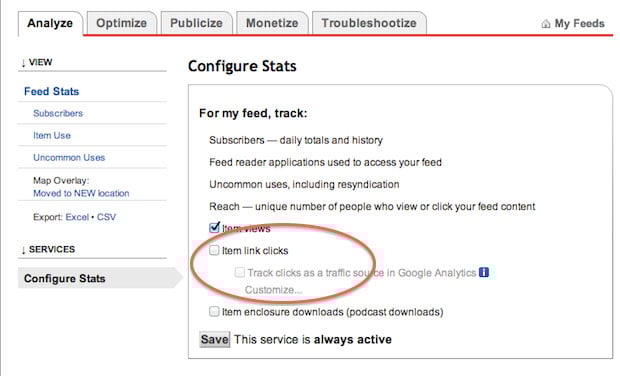
    The stuff after the ”?” is added by Feedburner so you can get detailed analytics on item link clicks. But unless you really want to see where your RSS feed clicks come from you don’t need this level of detail. All you need to know is the number of Item Views in your feed — the rest of your analytics can come from Google Analytics. It’s very easy to turn this tracking off to remove the metadata and make your URLs more friendly. In Feedburner, go to “Configure Stats” and uncheck the “Item link clicks” box. Here’s a screen shot:

feedburner URLs

In Luke Wroblewski’s new project Future Friendly, they discuss their thinking around universal content:

Well-structured content is now an essential part of art direction. Consider how it can flow into a variety of containers by being mindful of their constraints and capabilities. Be bold and explore new possibilities but know the future is likely to head in many directions.

If you publish content on the web it’s not future friendly to ignore and/or limit its use in RSS, which is one of the most important containers we have at our disposal.

The popular news is not the best news

Scott Berkun in The idiot theory of news:

Non-news, news without context, is easy to generate. It takes less skill as a journalist to write these stories. Often these stories are more popular than better written stories about important things. The popular news is not the best news. The popular anything is rarely the best anything. The way we see the world is shaped by what sells best as news, rather than what will give us a realistic perspective on the world and our place in it.

(link via @iamFinch)

Data-driven book publishing and the possible decline of risky writing

The Wall Street Journal has an interesting piece on the data mining of e-book reading habits. In Your E-Book Is Reading You they discuss, for example, what Barnes & Noble has learned from Nook data:

Barnes & Noble has determined, through analyzing Nook data, that nonfiction books tend to be read in fits and starts, while novels are generally read straight through, and that nonfiction books, particularly long ones, tend to get dropped earlier. Science-fiction, romance and crime-fiction fans often read more books more quickly than readers of literary fiction do, and finish most of the books they start. Readers of literary fiction quit books more often and tend skip around between books.

The article goes on to discuss how publishers are now using this kind of data to guide everything from the subject matter to the length of future publications. The whole thing makes me a little uncomfortable — I think I agree with Mr. Galassi here:

Others worry that a data-driven approach could hinder the kinds of creative risks that produce great literature. “The thing about a book is that it can be eccentric, it can be the length it needs to be, and that is something the reader shouldn’t have anything to do with,” says Jonathan Galassi, president and publisher of Farrar, Straus & Giroux. “We’re not going to shorten ‘War and Peace’ because someone didn’t finish it.”

I realize there is a hint of hypocrisy in my feelings about data-driven book publishing. As a practitioner of user-centered design I am a big proponent of data-driven decisions (this presentation by Joshua Porter is a constant companion). But this feels different. I guess I’m worried that publishing books with the explicit purpose of satisfying some imaginary, averaged-out reader drone will pull us all towards a safe middle ground where no risk is allowed.

In my version of a nightmare scenario, my 2-year old daughter will be awash in Dora the Explorer books with no access to dangerous, crazy stories like Oh, The Places You’ll Go or Where The Wild Things Are. I don’t think a data-driven approach to publishing would have let those books see the light, and that would have been a tragedy.

Here’s to writers who take risks.

Flipboard v Magazines

Nat Ives quotes “an executive at a magazine company” in his piece Wired and The New Yorker Pull Back on Flipboard:

“Nobody will deny that Flipboard is a beautiful product, but the question is, is it too beautiful?” the executive said. “What people want out of a magazine is exactly what they’re delivering. So if people feel like they’re getting that already, even if it’s not the same depth of content that would be in a print or monthly publication, then are they less likely to want to find it in the magazine itself?”

Wait, what? The executive acknowledges that Flipboard gives people what they want out of a magazine, so he/she is advocating that they should respond by pulling their content from Flipboard instead of, I don’t know, giving people what they want out of a magazine.

(link via @iamFinch)

Making Meaning: a review of Distance 02

Towards the end of Finding Meaning in the Technium CaveFrancisco Inchauste’s essay for Distance 02 — he urges us to be more cognizant of the lasting impact of our work:

What we create today will become the baseline for future generations. In the future, explorers will find our technium cave, filled with the artifacts of our present. What will they find in there? What will our creations tell them about what was meaningful to us? I can only hope it’s not what I see today. I know it can change, and I hope you see it too.

This is the theme that echoes through Distance 02, a collection of three essays on the topic of “Extracurriculars” — how to take ourselves out of the daily grind and think more clearly about how the things we make impact the world around us. It’s a topic that I see more and more designers touch on, starting with Wilson Miner’s excellent When We Build talk, all the way through Frank Chimero’s The Shape of Design, parts of Mike Monteiro’s Design is a Job, and smaller essays like Dmitry Fadeyev’s Moral Design. I’ve also touched on this before:

I wonder what would happen if we felt the weight of responsibility a little more when w’re designing. What if we go into each project as if the design will be around for 100 years or more? Would we make it fit into the web environment better, aim to give it a timeless aesthetic, and spend more time considering the consequences of our design decisions? Would we try to design something that “makes life worth living”?

The cynic in me worries that this vitally important topic is getting a bit too trendy, which brings with it lots of attention but also hoards of Internet critics. But before the possible backlash gets into full swing there is still time to read Distance 02 and be challenged to be better designers, not just people who design things better. For example, Sharlene King urges us to do more side projects in Do Your Homework:

I believe success comes through homework: the projects we do separate from our day-to-day work, that help us live design rather than simply work in design, allow passionate designers to break through.

And in The Embedded Designer, Cassie McDaniel talks about designers’ ability to influence adjacent industries in a positive way:

While design processes are available to anyone, regular experience with the creative process makes the designer particularly adaptable to new environments. An eagerness to understand the nature of our design challenges is part of our mandate. We ask tough questions of our clients and their industries. We need to know: Why are things done this way? What problem is it solving? What can we get rid of to make this simpler? Designers are receptive to new input by definition, and that makes us inherently more malleable than other kinds of workers.

What I found pleasantly surprising about Distance 02 is that it doesn’t stick to the philosophical. There is plenty of practical advice on how to make these ideas real in our everyday design work. Francisco’s framework for measuring meaning will come in particularly handy in all my projects.

Like any publication, Distance 02 is not perfect. It buckles under the weight of its 100+ citations, which sometimes makes it hard to follow the authors’ own story threads through the essays. Either that, or I’m just very easily distracted.

But that is a small complaint, and certainly not enough to make me discourage you from reading the book in any format your heart desires. In fact, at $5 for a digital copy and $15 for print & digital, it’s pretty much a no-brainer. You can buy Distance here.