Menu

Posts tagged “publishing”

Why some people prefer physical books over ebooks

I’m a little hesitant to believe these kinds of stats without seeing the actual research (and you have to pay for this report, which makes it even harder to verify), but Voxburner claims that 62% of 16-24s prefer books as physical products. That’s interesting in itself, but even more interesting is the reasons they cite:

There is less affection towards electronic versions of books. Whereas age is shown in the spine of each book — and commitment by the size of one’s bookshelf — digital files have no distinguishing characteristic. Most books adhere to the same fonts, as defined by the standards of ebook readers, and e-ink displays are void of any images besides the cover due to the lack of colour.

One of the things we sometimes miss in the ebook vs. physical book debate is that some of the inherent benefits of physical books have nothing to do with the act of reading. The experience of reading an ebook might be very similar to reading a physical book, but your Kindle doesn’t give you bragging rights. No one can walk into your house and see what kind of person you are just by looking at your Kindle — but they can learn a great deal by walking past bookshelves filled with the words that represent how you want the world to perceive you.

We often forget that physical products speak to a predisposition that digital products simply cannot counter: our own vanity.

How to build an audience in 743 difficult steps

Earlier today I delivered a talk called “How to build an audience in 743 difficult steps” at WordCamp Cape Town. This is a written version of the core points from the talk.

The biggest question every writer asks when they start publishing online is, “How do I get people to read my stuff?” There are many answers to this question, and these answers are usually now referred to as “content marketing”. Proposed methods run the gamut of SEO and Marketing advice, from back-linking and infographic making to the perfect way to write headlines (“People love lists!”).

This is a story about deciding to take a route that avoids most of these traditional content marketing methods. It’s a story of how a struggling blog with an insignificant number of readers has become not only a source of great joy and expression for me, but also a source of non-insignificant income. This is definitely not a story about how to get to 1 million page views a month. It’s a story about how to make your page views count.

Why write, anyway?

We should start at the beginning. Why write and publish online? It’s a lot of work and the payoff doesn’t always seem very clear. So why do it? I believe there are two main reasons for maintaining a personal site (and publishing there regularly).

First, it’s an excellent way to practice what Clive Thompson calls The art of public thinking:

The process of writing exposes your own ignorance and half-baked assumptions. I often don’t realize what I don’t know until I’ve started writing, at which point my unanswered questions and lazy, autofill thinking becomes obvious.

I’ve found this to be 100% true. Often, when I don’t understand a topic, I’ll just start writing about it, and in doing so the areas that need clarification start to crystalize. I also often start writing about something I think I understand well, but as I’m writing it becomes clear that I have huge knowledge/experience gaps somewhere. So I go away and figure it out before finishing the piece.

Second, your personal site is your resume. Many people have written about the importance of owning your identity, but I think Mitch Joel sums it up best in The New Resume:

Resumes have transformed from these static white pages into three dimensional, real-time personas that live, breathe, share and connect. Nothing will impress more than an individual who has taken the time to craft and share their perspectives about either the industry that they serve or what inspires them.

I’ve written quite a bit about the idea of work as platform, and owning your identity — separate from where you currently work — is a crucial component of that.

Let’s build an audience!

So those are the two main reasons I started this site. I wanted to get the benefits of public thinking, I wanted to have a record of my thoughts, and I wanted to do it in a way that’s hopefully interesting enough for others to enjoy as well. With those goals in mind, I was ready to go. I basically went off and did a whole lot of this:
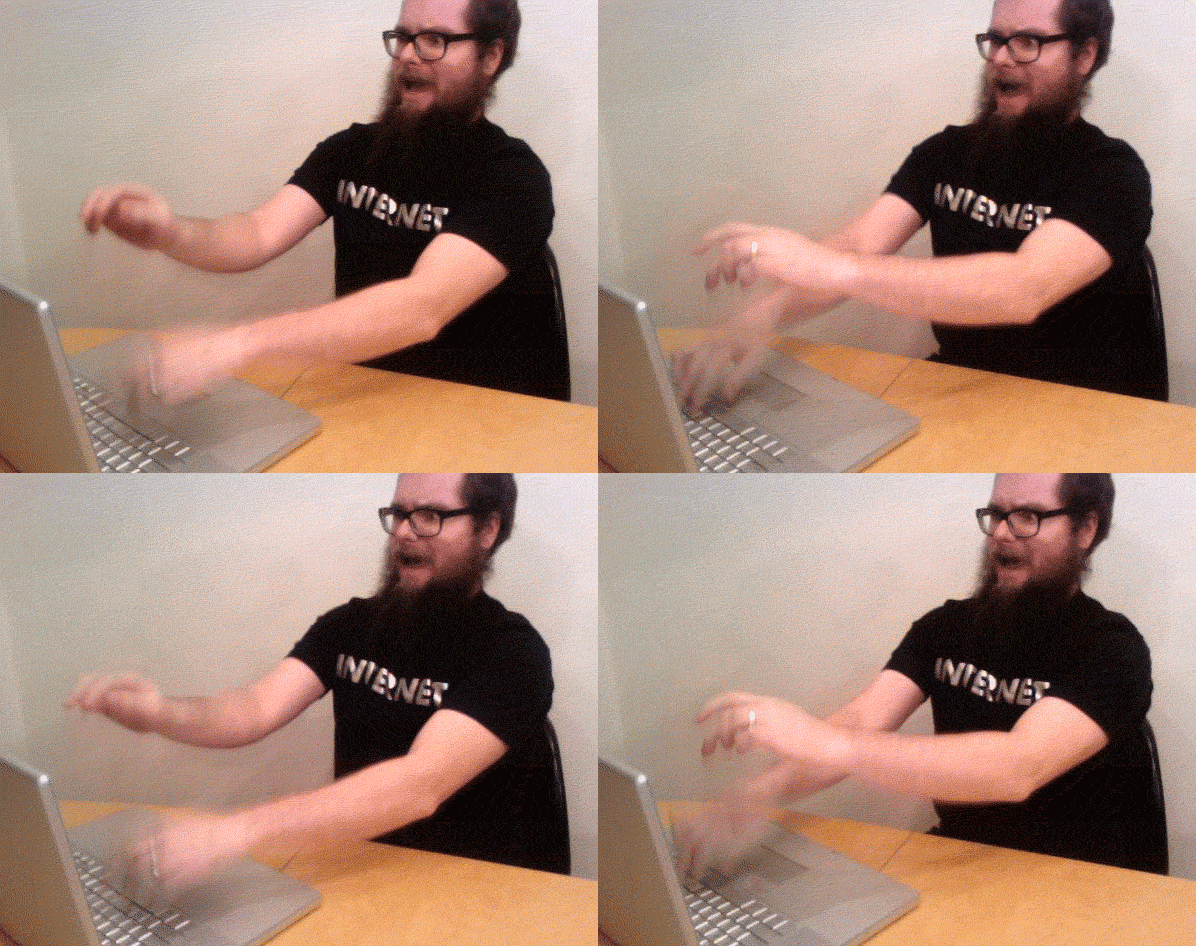
Unfortunately, as anyone who has tried starting blog knows, “if you build it, they will come” is a big fat lie. Instead, this started happening with increasing frequency:
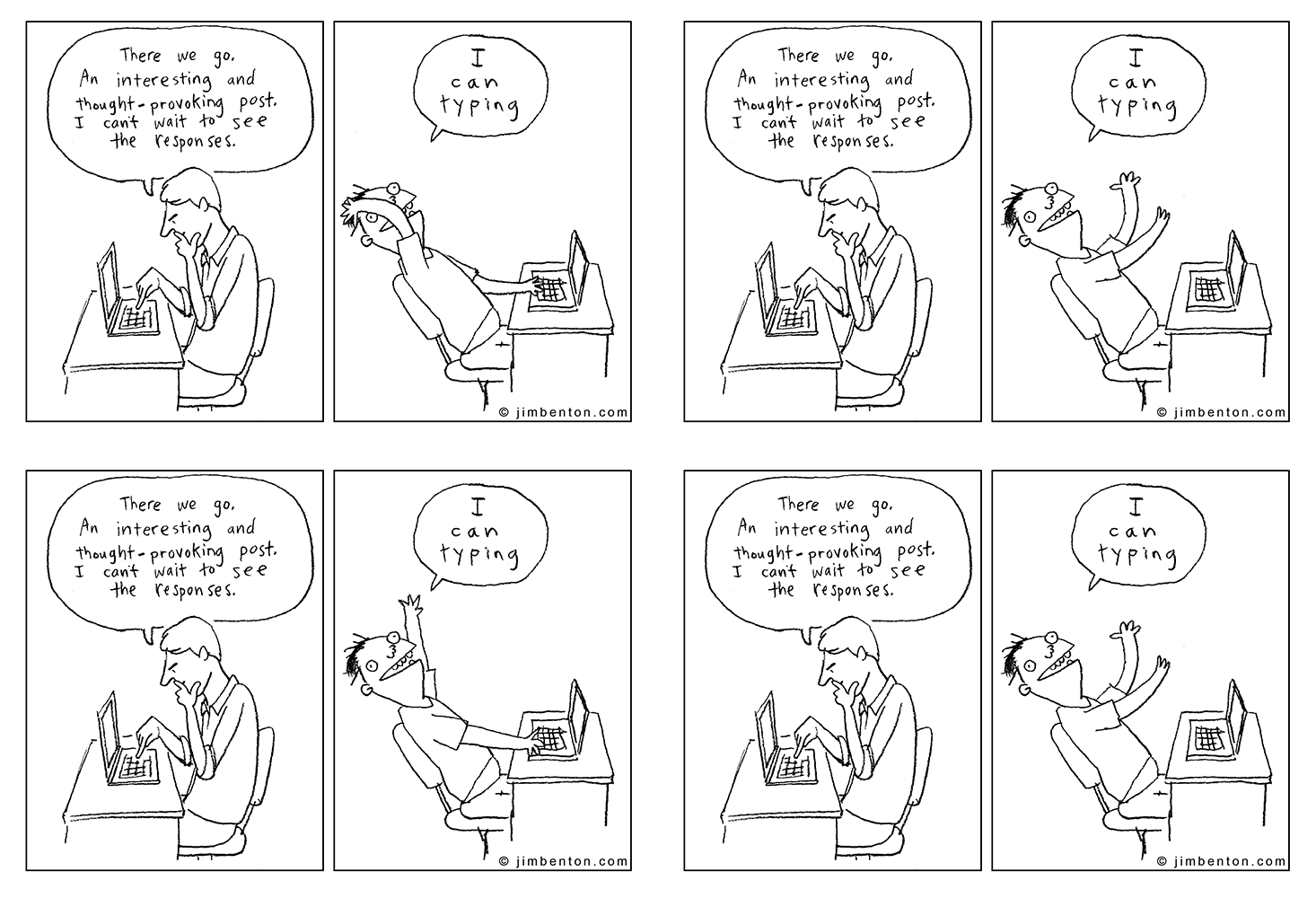
So, instead of happily “building an audience”, I started each day clearing out angry comments, and then walking around like this for the rest of the day:

Once that happens — once things suddenly don’t go according to plan — the lure of the easy can easily get you. Instead of focusing on providing quality content, the shortcuts that you’d vowed you’d never take suddenly become very attractive. Instead of automatically trashing those incessant emails about backlinking and infographic creation and paid content creation, you start reading them and before long you start considering all the ugly SEO tricks you’ve publicly scorned. And before you know it, your site looks like this:
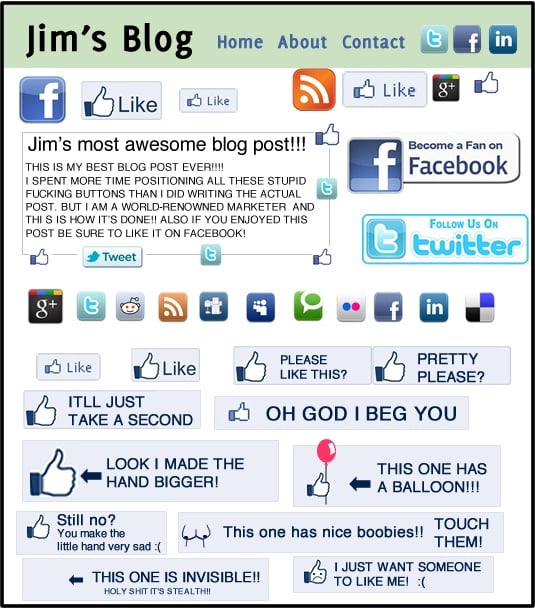
Like me!

Source: How to get more likes on Facebook

This is a dangerous place to be, and I’ve been there more than once. There have been many times where I’ve been on the verge of just stopping and shutting the site down, because I couldn’t see the use. Yet every time I came close to closing up shop, one question kept coming up in my mind: Why are we so unwilling to work hard for the things that we want? And then I saw someone articulate that thought perfectly…

The long, hard, stupid way (3 lessons)

I came across the idea of the long, hard, stupid way in a brilliant talk by Frank Chimero. He describes an episode of the TV show Treme where chef David Chang describes his cooking philosophy:

Just because we’re a casual restaurant, doesn’t mean we don’t hold ourselves to fine dining standards. We try to do things the right way. That usually means doing things the long, hard, stupid way.

Go ahead and think about a time when you learned to do something really difficult. Maybe it was learning to ride a skateboard, figuring out a new math equation, or debugging your first piece of code. Do you remember the strain, the frustration, and the countless failures? And do you also remember the enormous satisfaction you felt as you slowly mastered that task? Do you remember how doing it the hard way carried with it not only the benefits of learning that skill, but also many tangential thoughts or experiences that sparked new passions or interests?

When we do things the hard way, we invest in ourselves in the best possible way. We kick off an endless cycle of learning and mastery that helps us grow and lead fulfilling lives of purpose. When we take shortcuts, we become mere pretenders. We learn how to play the part, but there is no substance or continued growth. The instant gratification makes us build the house of cards ever higher, which brings anxiety about the whole thing coming tumbling down. Why would we shortchange ourselves like that?

Cal Newport nailed it when he said, “There is no avoiding the deliberate strain of real improvement.” If you want to become a better writer, read more and publish more. If you want to learn to design/code/fly, watch fewer episodes of Downton Abbey and practice the things that don’t come easy. And if you really want more Twitter followers, make and share things that are awesome, and be patient.

So what does this mean for online publishing? Over time I’ve learned 3 important lessons that have formed the foundation of how I write Elezea, and what I want this site to be.
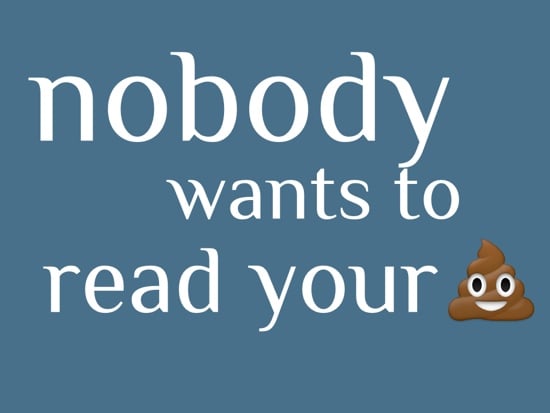
Nobody wants to read your shit

The first lesson is Steven Pressfield’s timeless advice in The Most Important Writing Lesson I Ever Learned:

Nobody — not even your dog or your mother — has the slightest interest in your commercial for Rice Krispies or Delco batteries or Preparation H. Nor does anybody care about your one-act play, your Facebook page or your new sesame chicken joint at Canal and Tchopotoulis.

It isn’t that people are mean or cruel. They’re just busy.

Nobody wants to read your shit.

The thing is, once you realize that no one cares about the stuff you write, it’s actually quite liberating. It’s at that point that you realise that writing is a simple transaction between you and your readers. They have time and attentionwhich is more valuable than ever — and you have to provide content that is worthy of that time and attention. Otherwise we’re just wasting people’s time, and they certainly won’t stick around for that. No matter how many times I read it, I still love this Paul Ford quote from 10 Timeframes:

If we are going to ask people, in the form of our products, in the form of the things we make, to spend their heartbeats on us, on our ideas, how can we be sure, far more sure than we are now, that they spend those heartbeats wisely?

Remember the transaction between you and your readers, and make sure that when they pay you with their time and attention, they’re getting something worthy in return. But wait… how do I know if something is worthy…?
Some things aren't worthy

The second lesson I learned is that not everything is worthy of people’s attention. Content creation is becoming increasingly robotic and algorithmic, so instead of thinking about how people spend their heartbeats, we’re thinking about how to get them to click on things, regardless of what’s behind that click. We know that Yahoo tests more than 45,000 combinations of headlines and images every five minutes on its home page. We also know that The Huffington Post will serve different versions of a page to a couple of random groups and, after five minutes, the best headline will be selected. That sounds really smart, and they’ve obviously been extremely successful at generating traffic, but that approach is missing two key components. It’s missing what Merlin Mann refers to as Obsession times Voice.

Obsession is that thing that people want you to shut up about. The thing that wakes you up at night, the minuscule detail that you can’t stop thinking about. What is that thing that you just can’t let go of? That’s your obsession.

Voice is how you talk about that obsession. It’s the perspective that you bring on the topic, and the way you communicate why it’s your obsession.

So there’s a simple formula for what makes something worthy of people’s time. It’s Obsession times Voice. It’s a unique perspective on something you care deeply about, that no one else can copy. That’s the kind of thing I want to read on the web. Look at sites like The Loop, Daring Fireball, and The Brooks Review. They’re all successful because they’ve figured out the Obsession times Voice equation.
Don't just write, publish

The third lesson I learned is that writing is relatively easy when compared to actually publishing the stuff that you write. That’s where it gets real. I still feel like this every time I hover over the Send to Blog button:

I’m so scared

The thing is, publishing what you write is the only way you’re going to get better at it. Once your words are out there, it will be scrutinized. That is terrifying but also really exciting. People will correct you on things when you are wrong. That is a bonus benefit of thinking in public: you learn so much from feedback. But that only happens if you get things out of your drafts folder and onto your site.

How is that working out?

Building Elezea on these principles has worked pretty well for me so far. It has not only brought writing and advertising opportunities, but more importantly, it has brought me a great community of readers who communicate regularly via email and Twitter and other platforms.

If I can sum up what I’ve learned about online publishing in one sentence, it’s that who your readers are is more important than how many you have. Sure, I’d love for my traffic to grow a little bit faster. But I won’t do it if it comes at the cost of compromising the principles I’ve described above, because I know a click is empty until someone actually sticks around for more than a few minutes. That’s what makes this a meaningful and fulfilling experience, and that’s what makes me push on and keep writing here week after week.

So for those of you who keep coming back, THANK YOU. Not to get all mushy on you, but you make me happy.

For those interested, the full slide deck from the talk is here.
What's wrong with the modern world

Jonathan Franzen wrote a Guardian piece on what’s wrong with the modern world. It’s long and dense and sometimes requires multiple re-readings to figure out what’s going on, but he gives us much to think about. Let’s just say that he’s not a fan of what technology is doing to us:

One of the worst things about the internet is that it tempts everyone to be a sophisticate — to take positions on what is hip and to consider, under pain of being considered unhip, the positions that everyone else is taking.

He also has some harsh words for Amazon:

Amazon wants a world in which books are either self-published or published by Amazon itself, with readers dependent on Amazon reviews in choosing books, and with authors responsible for their own promotion. The work of yakkers and tweeters and braggers, and of people with the money to pay somebody to churn out hundreds of five-star reviews for them, will flourish in that world.

And that’s all I’ll quote from the article, in the hopes of piquing your interest to read the whole thing.

[Sponsor] The Theme Foundry

Thanks to The Theme Foundry for sponsoring Elezea’s RSS feed this week! As a reminder, I am traveling this week so there won’t be much activity, but all should be back to normal on Monday.

The Theme Foundry has been building premium WordPress themes since 2008. They recently released Collections — a unique and beautiful WordPress theme for sharing, designed by Veerle Pieters. Visit the live demo of Collections to see it in action, or purchase it now for $79.

What makes The Theme Foundry special?

  • A focus on quality over quantity. You won’t find a huge assortment on their site — they keep a small, curated collection of premium WordPress themes.
  • Exclusive partner with WordPress.com (the official hosted WordPress provider). Each and every theme goes through a stringent audit process from some of the best WordPress coders in the world.
  • Whole team support. You get fast and friendly support from the team that actually built your theme, not a part time support rep.

Sponsorship by The Syndicate.

If software is eating the world, Medium is eating its content.

Medium

About two years ago Marc Andreessen proclaimed that software is eating the world (beware the WSJ paywall):

My own theory is that we are in the middle of a dramatic and broad technological and economic shift in which software companies are poised to take over large swathes of the economy.

We’ve seen this shift toward software in the content arena too, where it’s impossible to ignore the constant stream of stories about the struggles of print media. And lately, it seems that Medium is emerging as the first major successful content platform since the shift started. It feels like every second or third link on Twitter points to a Medium post, and somehow being on Medium gives content the perception of a certain level of prestige.

Why is that? Why is this platform so successful, and why does it have such a strong brand? I don’t agree with the direct comparison and the premise that Quora vs. Medium is an actual winner-takes-all situation, but AJ Juliani makes an interesting point about this in Why Medium May Succeed Where Quora Did Not:

Medium is about stories. Quora is about answers. And people love stories. Our favorite way to learn is through stories and narrative.

Medium is certainly a great platform for reading stories, and the tools available to writers make it a great creation experience as well. But there’s also been pushback recently on Medium’s apparent dominance in the individual writer domain. The biggest concern is that we don’t know what Medium’s plans are, and that authors are therefore giving up their words to an unknown entity. Here is Glenn Fleishman in Why You Should Be Your Own Platform:

I’ve written a few things on Medium (not paid) because I liked the experience of their writing tools, their statistics, and their reach. […] But it’s not mine. It’s theirs.

I can’t control the URL. I can’t embed. I have no idea about what their ultimate plans are. They could delete all non-owned/paid content in the future with no notice. They could rework the design and it would be ugly. My words’ persistence, both in appearance and permanent location, are dependent on factors beyond my control.

Marco Arment takes this argument further in Medium and Being Your Own Platform

Treat places like Medium the way you’d treat writing for someone else’s magazine, for free. It serves the same purpose: your writing gets to appear in a semi-upscale setting and you might temporarily get more readers than you would elsewhere, but you’re giving up ownership and a lot of control to get that.

As for me, I love the writing (and reading) experience on Medium. But I do have concerns that are big enough to make me take a step back:

  • Medium seems to be more about Medium than about authors. I don’t think we should move our personal blogs there — it’s already getting too crowded, and I still believe we should all own our own identities online.
  • Related to the last point: the idea of organizing content around topics (collections) is great, but there is no way to follow collections easily. RSS feeds are difficult to find, and it seems the only way to see what’s new in a collection is to go to its URL. This makes me worried about a walled garden approach to the content, similar to how Twitter and Google+ restrict how you can add and extract content.
  • There’s some great content being surfaced by the editorial team, but there are also a lot of duds when you dig a bit deeper into the collections. And by expanding the platform so quickly the noise is becoming louder. I’m worried Medium is quickly going to outgrow their initial focus on providing quality over quantity.

If we’ve learned anything over the past few years, it’s that we should be wary of platforms that offer large audiences at a price of admission that is not immediately apparent (See Facebook, Instagram, Twitter…).

The barrier to setting up your own site has never been lower (if you’re not into WordPress, try Scriptogr.am or Octopress). Yes, building an audience on your own platform is much harder than hoping to get picked by the Medium editorial team. But the longevity and the satisfaction you’ll get from maintaining your own voice is so much higher. Don’t give that away.

[Sponsor] X WordPress Theme

My thanks to Themeco for sponsoring Elezea’s RSS feed this week to promote their brand new WordPress theme.

Themeco is proud to launch X, a first of its kind WordPress theme built in conjunction with leading business and marketing experts. To celebrate our release, we wanted to share a really powerful SEO technique that you can implement today.

Did you know there’s a little piece of code you can add to your popular posts or pages that will almost double or triple the amount of clicks you get? Google tracks on-site engagement closely, so anytime you can get your visitors to click through to multiple pages of your site it’s great for your SEO efforts. We’ll show you this one amazing trick and how we built it into our incredible new WordPress theme plus show you how to implement it even if you don’t use WordPress.

Get a free copy of our one-page report and learn how you can implement this strategy in the next 10 minutes.

X

Sponsorship by The Syndicate.

The dying art of the small magazine ad

In Small Ads Dushko Petrovich turns our attention away from Facebook and Google to take a philosophical journey through those small, weird, completely non-targeted block-ads that appear in magazines:

At first you think these little rectangles are amusing because they offer monogrammed sweaters and self-publishing opportunities—things that are undoubtedly funny, in a sad, Skymall sort of way. But sometimes the funny sadness goes deeper than that, like the sadness of “unique diamond fish jewelry” for $15,000. And then sometimes you are plunged so deep into these ads, you wish there was a German word, or school of social thought, that could sufficiently describe the experience.

There might not be a German word for the experience, but Dushko’s troubled thoughts on the matter is entertainment enough.

Give it a minute

Since I’m currently knee-deep in the sheer undiluted slog of writing a book, wondering what I was thinking, Ben Yu’s There are no shortcuts really resonated with me:

Take the time to do things right — a shortcut will end up costing much more time in the long run as things come crashing to the ground.

Also, optimize for the long run. Constantly aiming for the short term, particularly in the frantic and ever-changing startup world (hoping to build a lot of hype, raise a lot of money, and get acquired in two years), tends to encourage the taking of illusory shortcuts which have the fate of failure stamped on them from the very outset.

This follows hot on the heels of something Louis C.K. said in an excellent interview:

There’s people that say: “It’s not fair. You have all that stuff.” I wasn’t born with it. It was a horrible process to get to this. It took me my whole life. If you’re new at this — and by “new at it,” I mean 15 years in, or even 20 — you’re just starting to get traction. Young musicians believe they should be able to throw a band together and be famous, and anything that’s in their way is unfair and evil. What are you, in your 20s, you picked up a guitar? Give it a minute.

So I’m learning to stop complaining, do the necessary hard work, and just give it a minute.

(“No shortcuts” link via @mobivangelist)

[Announcement] Elezea is joining The Syndicate

You may have seen a sponsored post here last Monday, and wondered what’s going on… Well, that was a test we ran with the good folks at The Syndicate ad network. And I can now announce that as of this week I’m officially joining the network, which includes many sites I read every day — like Shawn Blanc, TightWind, and Behind Companies.

What this means is that you’ll see one sponsored post per week, usually on a Tuesday. These posts will be clearly marked with the [Sponsor] signifier so you can tell ad content from other articles. They are high quality ads, so I also hope that you’ll find the sponsored posts useful, and visit their sites when you find something that interests you. For example, the sponsor this coming week is Wufoo — the company that I already happen to use as the contact form on Elezea.

I’m happy to answer any questions or comments you might have about this. I can assure you that being part of this network will push me to work even harder to produce good content throughout the week, to make it all worth your while.

As always, thank you for reading, and enabling my writing habit.

Why the Google Reader shutdown matters

I was going to write about the Google Reader shutdown but Brent Simmons beat me to the argument I was going to make. In Why I love RSS and You Do Too he sums up why we should all care about Google Reader’s demise:

Even if you don’t use an RSS reader, you still use RSS. If you subscribe to any podcasts, you use RSS. Flipboard and Twitter are RSS readers, even if it’s not obvious and they do other things besides. Lots of apps on the various app stores use RSS in at least some way. […] And those people you follow on Twitter who post interesting links? They often get those links from their RSS reader. One way or another, directly or indirectly, you use RSS. Without RSS all we’d have is pictures of cats and breakfast.

Killing Google Reader doesn’t kill RSS, for sure, but it’s such a big part of the ecosystem that we should be concerned about the health of the platform. From the perspective of a guy with a blog this is pretty depressing news. RSS subscribers are extremely difficult to grow, but they are, by far, the best kind of readers. I’ve written about this before, but to reiterate: they’re loyal, they read almost everything, and they share your stuff. It’s the best way to build an audience. Hunter Walk makes this point succinctly:

Google Reader impact also undercounted if you strictly look at # users bec many power-curators/sharers use it as a discovery system

— Hunter Walk (@hunterwalk) March 14, 2013

But Scott Stein has perhaps the best TL;DR version of the whole debacle:

Google Reader is to Twitter as a well-labeled filing cabinet is to a bag of insane cats.

— Scott Stein (@jetscott) March 14, 2013

So, what now? For a bit of nostalgia, Buzzfeed has a great history of Google Reader. It’s a fascinating story, worth reading. And then, Om Malik has an interview with the original creator of Google Reader. Once you’re done grieving and ready to move on, Lifehacker has a very comprehensive post on the alternatives.