Menu

Posts tagged “product strategy”

Taking down Facebook, piece by piece

About a year ago Chris Dixon wrote a great post called Some problems are so hard they need to be solved piece by piece. It was based on an old Andrew Parker post The Spawn of craigslist about how Craigslist is getting beaten not by another similar company, but by niche startups going after their business piece by piece. Chris writes:

Startups that have tried to go head-to-head against the entirety of Craigslist (the “horizontal approach”) have struggled. Startups that have tried to go up against pieces of Craigslist (the “vertical approach”) have been much more successful (e.g. StubHub, AirBnB).

Andrew’s chart got me thinking about Facebook, and it looks like something similar is happening in the social media space. There are, of course, many ways to cut this, but here’s a possible view of some of the startups and companies that are going after different pieces of Facebook:

Taking down Facebook

A few thoughts on this:

  • Messaging apps like WhatsApp, WeChat, and Viber are not just replacing 1:1 messaging, but group messaging as well. In fact, I keep hearing stories of people saying that WhatsApp has replaced Facebook entirely for them. They just create specific interest groups on WhatsApp and share photos and updates that way.
  • Private social networks like EveryMe and Path might appear to be dead, but they’re sleeping giants. For those who want a little bit more than what WhatsApp can offer, Path is the perfect replacement to cut down on cruft while maintaining a small, meaningful network in an environment that’s designed to share everyday experiences. There’s no pressure to only share smart/funny/happy things, like there is on Facebook. Sharing what you’re eating for lunch is ok, because on Path you only connect with people who care about that stuff. It’s more about growing real-life relationships than maintaining virtual ones.
  • Photos are moving to Instagram more and more (and don’t count out products like Flickr and VSCOcam’s grid). Of course, Facebook now owns Instagram, which looks like a great decision more and more every day.
  • Glassboard remains small, but appears to be the preferred business version of Path, especially at industry conferences.
  • The spread of links is more difficult to pin down, since they’re shared in so many different ways. I put a Twitter logo on the chart above, but I think what we’re seeing is more of a trickle down from one network to the next, something like this:

The Facebook funnel

Things worth knowing about start on sites like imgur and 4chan (and others that I’m not brave enough to visit), as well as RSS feeds (yep, not dead yet). From there it spreads to reddit and 9gag, where the best stuff goes on to Twitter. Eventually — usually about 2 weeks later — a few of the best memes find their way all the way to Facebook.

The question is, what happens when people start moving up this funnel, away from Facebook to Twitter, to reddit, or even further? Then they won’t need Facebook to find interesting links any more, because Facebook is basically just a filter for links you can find sooner elsewhere.

But that’s not the only scary part. Here’s the other interesting thing. When you take away all the things on Facebook that can possibly replaced by niche products, you’re left with this:

Facebook ads

Apps, and ads.

How long can a company sustain itself with that type of content?

Facebook is in a classic position where, as a dominant provider of horizontal social services, it is in danger of being taken down piece by piece by several vertical players who provide specific, narrow experiences very well. Facebook has become a social media firehose. It won’t be replaced by another firehose, but by a bunch of different cocktails that users can customize as they please.

Why even Lean startups need functional specs

Ian McAllister states a common rallying cry of the Lean movement in his answer to the Quora question What should a lean startup functional spec / product requirements doc look like?:

Functional specs or product requirements documents invite scope creep and are walking dead documents.

I’d like to start my rebuttal with something Joel Spolsky wrote in Painless Functional Specifications - Part 1, back in 2000:

Failing to write a spec is the single biggest unnecessary risk you take in a software project. It’s as stupid as setting off to cross the Mojave desert with just the clothes on your back, hoping to “wing it.” Programmers and software engineers who dive into code without writing a spec tend to think they’re cool gunslingers, shooting from the hip. They’re not. They are terribly unproductive. They write bad code and produce shoddy software, and they threaten their projects by taking giant risks which are completely uncalled for.

Having said that, I’ll admit that the majority of specification documents are bad. Meaning they are long, they are boring, they are done just to check a box to say they were done, they are written once and never updated, and most importantly, they don’t get used during development. That is a situation Product Managers desperately need to avoid. If a spec isn’t being used actively during development, it’s not the developer’s fault, it’s the Product Manager’s fault. It’s up to the Product Manager to understand what kind of document would be useful to developers, and then provide such a document — one that is much, much better than winging it.

The Functional Spec describes how a product works from a user’s perspective. It’s not focused on how it will be implemented (that’s covered in the Technical Spec), but on defining flows and screens, and how users will experience the product. This might sound a bit academic to some, and against the spirit of the Lean movement that’s all about “getting out of the deliverables business”, but we have to remember that documentation isn’t bad. Bad documentation is bad. Good functional specs help teams communicate, save time, and build better products. But to make sure your functional specs fall into the “good documentation” category, there are a few important points to remember:

  • Specs should be dynamic. They are not written once and forgotten about. This is why specs shouldn’t be written in Microsoft Word (no more “v27_FINAL4.docx” filenames). Instead, use collaborative tools like a Wiki or Google Docs to make it easier to edit and access the most recent version.
  • Specs should be accessible. The spec document isn’t something that the PM writes in isolation before coming down the mountain to hand over their “Ten Commandments” to the development team to implement. Anyone in the organization should be able to access the specs at any time, and team members should be able to ask questions and contribute to the spec. That’s another reason why Word is out, and online collaborative tools are in. Seriously, uninstall Microsoft Word.
  • Specs should be flexible. The biggest and most valid criticism of most functional spec documents is that they are too rigid. Most are merely a list of requirements that were written by people far away from actual implementation, and once their job is done, they are unable to adapt in the face of reality. That’s not how it should work. The last 20% (or more) of a spec is always going to happen during development. That’s not only normal, it’s healthy. It means that teams can adapt to the needs of the products and users, and that they are willing to remove, change, or add features if needed (i.e. if the user evidence or business need is there).

The spec isn’t a document that the PM writes the day before development starts. This is a document that is started as soon as a new project kicks off. Create a template in your wiki (or wherever the plan is to store specs), and open it up as soon you start working on a new project. The best way to write a spec is to add information to it as it becomes available. Add the customer journey map as soon as you have it. Add sketches as soon as you move into the prototyping phase. This reinforces that idea that it’s a living document that is open to collaboration, and it also breaks up the workload so that it doesn’t feel like a huge effort to create the spec.

It’s essential to only add relevant content to the spec — nothing more. For some smaller projects it might be ok to skip the customer journey and prototyping phase, and move straight from sketching to graphic design and/or development. That’s ok. Don’t think of the different sections that make up a spec as above the law, think of them as an a la carte menu that you can pick and choose from based on the needs of the project.

Many people roll their eyes at functional specifications, believing it’s part of an old school way of doing Product Management that isn’t relevant any more. But I’ll repeat what I said earlier: specs aren’t bad. Bad specs are bad. If you create documentation that people actually use to build the product and understand why certain decisions were made, how can you argue that it’s not useful? So my advice is, don’t stop writing specs. Just start writing really good ones.

I’m currently working on a Product Management book, to be published by Smashing Magazine early next year. In the book I go into much more detail on the ingredients of a good functional spec. If you’re interested in getting notified when the book comes up, you can sign up here.

Why Apple introduced new processors in the iPhone 5s

Horace Dediu makes an interesting point about some of the new iPhone 5s features in M is for Mystery:

Perhaps this is why Apple chose to describe the iPhone 5s as “forward-thinking”. The M7 and the Touch ID are like research projects whose actual value will be realized at some future time, in probably different contexts.

Sisir Koppaka takes this idea further in The Most Forward-Thinking Apple Yet. On going 64-bit:

I don’t believe Apple added 64-bit support to iOS 7 and all their apps just to prepare for an eventual transition to 4GB+ memory capacities in future iPhones. I think this was to do with something more impending. Do we know any product category that Apple would be interested in, that would require the use of both iOS and an A-series chip that is 64-bit capable in order to address 4GB+ memory? Apple TV (the one that is yet to come, not the one that exists).

And on the M7 processor:

The new CoreMotion Framework for iOS 7 adds a step counter and a motion activity detector (stationary, walking, running, vehicle or unknown). We know that Apple has been hiring experts in noninvasive blood component measurements. We know they have a patent on a wrist watch. The iWatch must not be far away.

This is a pretty daring thing for Apple to do. Instead of focusing on what is hot now, they are releasing a product that reveals their vision for the future without it having the capabilities needed to deliver fully on that future. It’s a long game, it’s a gamble, it’s gutsy, and it’s probably going to work once developers start experimenting.

Apple and emerging markets

iPhone 5C

More than a few people seem to be confused about the pricing strategy for the iPhone 5C. There are probably only two articles you need to read about that: John Gruber’s Thoughts and Observations on Today’s iPhone 5C and 5S Introduction, and Ben Thompson’s The iPhone is Apple Doubling-Down On What It Does Best.

But even those articles don’t address a complaint that I’ve seen quite a bit of over the past couple of days: that Apple is trying (and failing) to expand into emerging markets. Here’s an example from a bizarre Memeburn article called Dear Apple, don’t try to be Nokia:

…the iPhone 5C — supposedly targeted at the emerging markets and presented as a low-cost device…

And tweets like this are everywhere:

@RianVDM @bokardo - and our customers can’t afford ( well the billion potential customers in emerging markets)

— Kirstin Horton (@KirstinHorton) September 11, 2013

It’s important to point out a few things here.

First, everything flows from the pricing strategy, and the only people calling the 5C a “cheap iPhone” are tech bloggers. It’s not a cheap iPhone. It’s an iPhone that replaces the previous strategy of selling last year’s model at a slightly cheaper price. As Gruber points out:

The prices of the iPhone tiers remain the same as last year. What changes with the 5C is that the middle tier is suddenly more appealing, and has a brand of its own that Apple can promote apart from the flagship 5S.

Second, the vast majority of mobile connections in emerging markets are pre-paid, not contract-based. For example, in Africa 96% of connections are pre-paid (source). This means that in emerging markets people buy phones that aren’t subsidized. The cheapest iPhone 5C costs $549 off-contract. This makes it a virtually unattainable phone in the pre-paid emerging market.

Here’s the thing though: does anyone think Apple doesn’t know this? Is the assumption that Apple is trying to break into the emerging market with a $549 phone? That would be insane, right? But that’s not what Apple is doing at all, and they never said that they are.

The iPhone 5C is not about expanding Apple’s share in emerging markets. It’s about increasing their share of the high-end phone market, while simultaneously increasing their profit margins on those phones because of cheaper manufacturing costs.

So, yes. The iPhone is still too expensive for most of the emerging market. But Apple doesn’t need the emerging market to be insanely successful. They just need to keep selling a ton of phones in subsidized markets at a healthy profit margin. And that’s exactly what the iPhone 5C will accomplish.

We're only loyal to ourselves

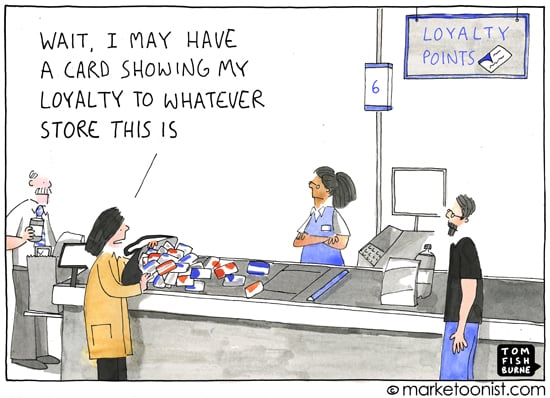
Kathy Sierra wrote a brilliant post about loyalty called Your customer won’t take a bullet for you. She makes the point that to understand loyalty, we have to realize that we aren’t loyal to products, we’re loyal to ourselves:

If you want to benefit from a customer’s loyalty to himself, you can’t bribe it, you must earn it. Deserve it. Focus not on upgrading your product but upgrading your user’s capabilities. If you can’t enhance your product, enhance the context in which your product is used. Provide better and more inspiring documentation. Make YouTube tutorials. Join forums and offer expert help where it’s most needed. Use every nanosecond of your social media time to help people become better at something for themselves. Relentlessly ask, “How are we helping our users kick ass? What can we inspire, amplify, teach, enable, empower?”

This reminds me of Tom Fishburne’s “loyalty fatigue” cartoon:

Loyalty fatique

Amazon: caught between a rock and a local maximum

Joshua Porter makes a good point about Amazon’s product pages:

The reality is that Amazon has designed themselves into a Local Maximum. They’ve tested and tweaked the same product page over and over and they’ve optimized it as much as possible. They can’t improve it significantly at this point without making a big change. But they can’t make a big change because the only changes they can make must increase revenue (or some closely related KPI). So any big change is a very, very scary thing when that page is driving billions of dollars in revenue. So it makes sense that Amazon only makes small changes to their product page design.

Amazon’s design is often held up as a gold standard in e-commerce, but at some point we have to realize that maybe the emperor has no clothes - and we need to start calling it out so clients can stop asking us to “just make it like Amazon”.

Facebook's brilliant mobile advertising strategy

Ben Thompson’s stratēchery has become one of my favorite sites. His insight into the tech world gives me a new perspective with every post. Recently he discussed what makes the Facebook app so compelling in Mobile Makes Facebook Just an App; That’s Great News:

Brand advertising on Facebook’s app shares the screen with no one. Thanks to the constraints of mobile, Facebook may be cracking the display and brand advertising nut that has frustrated online advertisers for years. […]

[Facebook] is the most indispensable tech product in most people’s lives, and every time one of those billion people use the mobile app, they see an advertisement that completely owns their device’s screen, if only for a moment.

“Ads in users’ faces” is certainly a great sell to advertisers, but I do wonder how far they can push it before people feel like their entire feed is taken over by advertising, and there’s just not enough content from their friends any more.

The benefits of product mistakes

John Ciancutti explains how Netflix uses data to make product decisions in How We Determine Product Success:

It can be frustrating to be in a product development environment where force of personality or hierarchy determines product outcomes. At Netflix the focus on customer value makes a teachable moment of those times one guesses wrong. My product intuition is vastly better today for the benefit of my mistakes.

It’s a great read on the importance of listening like you’re wrong when you develop products.

The mystery of Google+

Google Plus

I’ve been using Google+ a bit more frequently over the past few weeks. Of course, if you read this blog you wouldn’t have noticed. I know this because referral traffic to the site from Google+ is virtually non-existent. I find the whole narrative around Google+ extremely strange, so I’d like to get some of my random thoughts out in the open to see if anyone can add some insight.

First, viewed purely on its own merit Google+ is a fantastic social network. The interface manages to bring together all the best parts of Twitter (short updates, follow model), Facebook (pulling in short article summaries, good conversation mechanism), App.net (longer updates), and Flickr (beautiful photos). At the same time, it leaves out most of the annoying parts of those respective networks (like advertising, lack of context, and the inability to carry on a conversation). It’s my favorite social network to post links to, because I can add short commentaries or pull quotes from the article, and it automatically pulls in important metadata (sure, Twitter Cards also do this, but those aren’t supported by all sites and in all apps).

Second, Google+ feels like a parallel universe. As an active user of both Twitter and Google+, my experience has been that there is almost no overlap between the people who use those two networks on a daily basis. Further, users behave very, very differently depending on the platform. Twitter users comment more about Apple (well, the ones I follow anyway…), whereas Google+ content is much more slanted towards Google/Android news (not surprising, of course). Twitter users are more angry and combative, whereas Google+ is more like summer camp. Twitter feels frantic, Google+ feels relaxed.

And the weirdest thing — to keep beating a dead horse — is that the users on each network seem blissfully unaware of each other. It’s like going to a farmers market full of hipsters and young parents. Both are present, but it’s as if each group is invisible to the other1.

Getting actual numbers to compare the size of the networks is a fool’s errand. I don’t think we’ll ever really know how big each of the major networks are. But one widely reported statistic says that Google+ is now the #2 social network globally, behind Facebook but ahead of Twitter.

And this is why I’m confused. I think Google+ has a superior product in terms of its features. There appears to be lots of traffic on the network, and people are still reasonably nice to each other when they interact. And yet there’s no way I can even begin to think about moving off Twitter, because most of the people that I interact with and want to keep up with are on Twitter and not on Google+.

Does it mean that Google did too little, too late? Does it mean that the major social networks are all syphoning off their own unique customers that will never overlap? Is Google inflating the numbers artificially and it is, in fact, dying a slow death? Or, most disturbingly, does it mean that having a superior product doesn’t matter as much as strong network effects?

But then again, perhaps Google+ is not competing with who we assume they’re competing with. In line with Google’s vision to organize the world’s information, the focus on Google+ seems to be shifting to content more than relationships. And as Luke Kingma points out, the foundation of the next great social network will probably be the quality and relevance of the content, not the person who posted it. In that sense, I wonder if Google is more interested in being Reddit2 (the front page of the Internet), than it is in being a Facebook/Twitter clone (what your friends are up to).

I’d love to hear your thoughts on this… on Google+, of course.


  1. By the way, in this analogy Twitter would be the hipsters and Google+ would be the young parents. 

  2. Must-read article: Reddit: A Pre-Facebook Community in a Post-Facebook World 

The 9x effect in product development

This widely linked post from Benedict Evens definitely deserves all the attention it’s been getting. In Glass, Home and solipsism Benedict talks about the fallacy of thinking that customers care as much about your product as you do1:

You can think of people as users or customers — but they’re not yours. They don’t belong to you, and they may barely even care that you exist.

A little bit earlier he discusses Google Glass and says this:

If everyone you know owns a Tesla and is deeply engrossed in new technology, then the idea that there might be social problems with Glass doesn’t come up — everyone’s too busy saying ‘AWESOME!’

This reminded me of what John T. Gourville calls “The 9x Effect” in Eager Sellers and Stony Buyers: Understanding the Psychology of New-Product Adoption (you have to register for a free HBR account to view the article):

There’s a fundamental problem for companies that want consumers to embrace innovations: While developers are already sold on their products and see them as essential, consumers are reluctant to part with what they have. This conflict results in a mismatch of nine to one between what innovators believe consumers want and what consumers truly desire.

This image from the article explains the concept well:

The 9x effect

This might explain why products like Color, Facebook Home, and Google Glass appear destined not to do very well in the general market.


  1. I’ve written about the same thing before in What users really care about