Menu

Posts tagged “product strategy”

Forget about ads and privacy, Facebook Home is about identity

There’s certainly a lot of hand-wringing going on about Facebook Home. And although there is some truth to articles like Facebook Home — My Personal Hell and Why Facebook Home bothers me: It destroys any notion of privacy, I feel like making this story’s headlines about how boring Facebook is and how it’s just another step towards evil corporations owning all our data is missing out on what’s really important about this announcement. The much more interesting question is this: How does Facebook Home impact identity?

Perhaps the best analysis I’ve seen about Facebook Home is a tweet written by Rebekah Cox back in January 2011:

The first company to fully execute on embedding your identity into your phone (making a truly first class experience) wins the next decade.

— R. Marie Cox (@artypapers) January 29, 2011

Rebekah expands on this in her post Mobile Identity, in which she concludes:

A mobile experience that truly represents your identity — in a way that both resembles and enhances an in-person conversation but still affords you control over how you portion out your attention and provides context — could tie the knot for the myriad communication channels available.

That certainly sounds like an accurate description of what Facebook is trying to do with this new product. Now add to that Dan Frommer’s analysis in Who’s Going To Buy The Facebook Phone?:

What about those millions of people who have bought Android phones who don’t really care that they’re Android phones, or even smartphones? […] My guess is that many — most? — of these people are Facebook users, and could easily see some utility in having Facebook features highlighted on their phones. And — bonus — Facebook’s software looks good. Much better than the junk that ships with typical low-end Android devices.

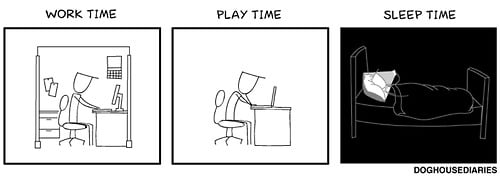
Put these two things together — identity and easy access — and Facebook’s strategy starts to become clear. For the majority of people life increasingly revolves around the Internet and their phones. This cartoon pretty much sums it up:

Work, play, sleep

Image source: DOGHOUSE

It’s also clear that many people’s identities are getting tied up in Facebook. And Facebook is really good at accelerating the pace at which that is happening. Much has been written about Edgerank — the algorithm Facebook uses to decide what stories to show in people’s News feeds — and how it ends up promoting confirmation bias by only showing users stories that they are likely to agree with. Facebook knows the truth behind Clay A. Johnson’s words in The Information Diet:

Just as food companies learned that if they want to sell a lot of cheap calories, they should pack them with salt, fat, and sugar — the stuff that people crave — media companies learned that affirmation sells a lot better than information. Who wants to hear the truth when they can hear that they’re right?

What’s even more interesting about this is that Facebook is in the process of reversing a media trend that started with telegraphy. Before the introduction of the telegraph all news was local, and had a high “information-action ratio” — meaning that you could do something about what you read or heard about. But as Neil Postman points out in Amusing Ourselves to Death:

The telegraph made a three-pronged attack on typography’s definition of discourse, introducing on a large scale irrelevance, impotence, and incoherence. These demons of discourse were aroused by the fact that telegraphy gave a form of legitimacy to the idea of context-free information; that is, to the idea that the value of information need not be tied to any function it might serve in social and political decision-making and action, but may attach merely to its novelty, interest, and curiosity. […] Most of our daily news is inert, consisting of information that gives us something to talk about but cannot lead to any meaningful action.

Television and the Internet kept this trend going. All I have to do is say the word “Kardashian” and you’ll know what I mean. But Facebook — and particularly Facebook Home — is a return to “news that’s relevant”. Because it’s news about the people you have let into your life, and therefore news you can do something with (even if it’s just liking a status). Whatever your thoughts are on the privacy and sociological implications of Facebook as a service, you have to admit that it increases “information-action ratio” by (1) giving you information that’s relevant and (2) reducing the effort required to take some kind of action on that information1. That’s pretty powerful stuff.

What Facebook Home is really about

So, let’s tie all of this together. What Home allows Facebook to do is put Edgerank and people’s “social graphs”2 on steroids by giving them easy access to their identities. A Facebook-centric phone that constantly tells you what you want to hear about yourself and your friends means that you’ll find less and less use for the rest of the Internet. And that’s very, very good for Facebook since engagement is everything for an ad-based business.

Where does this leave us? I’m trying to reserve judgment about where this road that Facebook is paving will lead us. All I know is that they are doing some very smart things from a strategic business perspective. They are making news relevant again. They are shaping people’s identities (with a lot of help from Edgerank). And now they have found a way to go beyond apps and do a complete takeover of the device that most people never leave out of their sight.

Tech journalists can write about privacy and the virtues of quitting Facebook all day long. The rest of the world won’t even hear about it, because they’ll be too busy getting immersed in the lives and identities of the friends they agree with.


  1. See Like, the Post-Literate Society 

  2. Just remember, The Social Graph is Neither 

How to compete with Starbucks (or, how to develop a successful product)

I’ve long been fascinated by the links between coffee, craft, and product design. Peter Baskerville’s answer on Quora to the question How do you compete with Starbucks in the coffee industry? is another great example of that. His answer can very easily be applied to building an online product (my emphasis added):

I concluded very quickly that Starbucks was good for tourists and those folk looking for brand association, but their appeal to the quality espresso seeking locals was limited to just one curious trial. I also saw that they were in fact following the age-old successful chain formula of adequate product + brilliant marketing rather than the other way around. So they were not actually targeting my niche unique coffee/service market, which is where I believe the independents fit in.

This is so true for the current state of software development. We used to swim in a sea of adequate products that employed brilliant marketing to convince us they’re better than they really are. Now, the products and services we gravitate towards are increasingly brilliant niche products that don’t have to rely on an overdose of traditional marketing to gain traction. From Dropbox to Clear to Instapaper, people are flocking to quality products after their “one curious trial” of the do-it-all marketing-driven alternative doesn’t quite meet their needs.

Peter goes on to list 8 specific strategies that Australian coffee shops have used to beat Starbucks. With advice like “Quality above all” and “Let your customers own you”, his answer gives product designers plenty to think about.

Some of my previous posts on this topic include Coffee, design, and the nature of craft, and How to get buy-in on your design process.

Everything doesn't need to be automated

In Human Intervention as a Competitive Advantage Derek Sivers makes the case that automation isn’t always the best option:

When everyone else is trying to automate everything, using a little human intervention can be a competitive advantage. The problem is when business owners see it as a cost, instead of an opportunity. Trying to minimize costs, instead of maximize income, quality, loyalty, happiness, connection, and all those other wonderful things that come from real human attention.

You can buy a fancy phone routing system, so people have to listen to 9 options, choose option 5, then listen to 6 more options, or you can hire a charming person to pick up the phone on the first ring, and make a great impression. Which one do you think will win you new fans? […]

I know what you’re thinking — how does this scale? Derek explains that in the post as well…

Accuracy vs. precision in the context of product decisions

Kenton Kivestu defines the difference between accuracy and precision, and then discusses what it means in the context of product decisions:

There is a significant opportunity cost in consistently prioritizing precision over accuracy. Accuracy is about launching what the market needs, precision is about optimizing and delivering relentlessly on it. Unless you’ve nailed the former, material effort on the latter is going to be wasted because you’re optimizing something too far from the true north (the accurate goal) you should be pursuing.

This is an important point. Any call for data-driven design (in the quantitative, 41 shades of blue sense of the word) needs to come with a disclaimer that it’s an extremely useful approach to get closer to the middle of a target (precision), but it’s useless if you’re shooting at the wrong thing (accuracy).

(link via @ixhd)

The gaming industry's move to digital goods

Mitch Lasky wrote a very interesting analysis of the gaming industry’s move from packaged goods to digital goods. From EA and the Future:

In my experience, the incumbent packaged goods companies clearly see mobile, digital distribution and free-to-play models as inevitable. They know what’s coming and have known for some time. But within the senior management ranks of these companies there is still a lingering perception that digital doesn’t, in their words, “move the needle” sufficiently — meaning that the revenue generated from existing console franchises still far exceeds the revenue that can be generated, even in aggregate, on new platforms and through new business models.

Mitch goes on to show how this thinking is wrong, and then explains how being caught between the promise of new consoles and the possibilities of digital revenue puts game manufacturers in a situation where they’ll have to make some very tough strategic decisions.

(link via @hunterwalk)

Redesigning with patience

Jared Spool looks at different redesign strategies in Extraordinarily Radical Redesign Strategies. Whenever time and budget allow it, I believe the “realign” strategy — what Jared calls “The Glacial-Speed Approach” — works best. This strategy relies on continuous, incremental change to reach your site goals:

The beauty of making small changes means that you never have high risk. A menu item here, a new form field there. Slowly the interface morphs, and if you make a mistake, well, you change it back.

But here’s the kicker — the reality that makes most product teams opt for a different strategy:

This type of redesign takes patience. It also takes humility, especially from those organizations who think people want to hear that they’ve made it better. Unfortunately, to most people, those proclamations sound like the web equivalent of “Our menus have changed so please listen carefully.”

To pull this off, the team needs a solid vision of where the design should eventually go. Then, one small change at a time, they start. Make the change and watch what happens, proceeding slowly to the next. The team will know it’s succeeded when they hear a user insist that a new addition has been in the design all along.

Patience isn’t a word most people would use to describe their leadership teams when it comes to site redesigns. But the reality is that most other strategies involve much higher risks than the internal frustration of waiting a few extra months using the realignment approach. Risks like losing the majority of your customer base to a competitor (as Digg found out the hard way).

Read Jared’s article for a good overview of the pros and cons of different redesign strategies.

Complexity and technology-driven innovation

In The Guardian Tom Meltzer asks, Are our household appliances getting too complicated? Despite violating Betteridge’s law of headlines he makes some good points:

“The innovation is obviously being driven by manufacturers’ desire to add value and to differentiate themselves,” says analyst Neil Mason, head of retail research at market research company Mintel. “But from a consumer’s point of view, what they want is convenience and simplicity. When you run into trouble is when you add all these extra functions and consumers just get perplexed as to how to actually use them.”

He cites some classic examples of technology-driven innovation — asking “What more can we do with this technology?” as opposed to “What goals do our customers want to accomplish with our product?”

The hype, benefits, and dangers of Big Data

A Readlist of all the articles referenced in this post is available here. Readlists allow you to send all the articles to your Kindle, read them on your iOS device, or download it as an e-book.

Despite the overly alarmist title, Andrew Leonard’s How Netflix is turning viewers into puppets1 is a fascinating article on how Netflix uses Big Data in their programming decisions:

“House of Cards” is one of the first major test cases of this Big Data-driven creative strategy. For almost a year, Netflix executives have told us that their detailed knowledge of Netflix subscriber viewing preferences clinched their decision to license a remake of the popular and critically well regarded 1990 BBC miniseries. Netflix’s data indicated that the same subscribers who loved the original BBC production also gobbled down movies starring Kevin Spacey or directed by David Fincher. Therefore, concluded Netflix executives, a remake of the BBC drama with Spacey and Fincher attached was a no-brainer, to the point that the company committed $100 million for two 13-episode seasons.

The article also asks what this approach means for the creative process, something I’ve written about before in The unnecessary fear of digital perfection, so I won’t rehash that argument here.

What’s interesting to me about the rise in Big Data approaches to decision-making is the high levels of inaccuracy inherent to the analysis process. Of course, this is something we don’t hear about often, but Nassim N. Taleb recently wrote a great opinion piece about it for Wired called Beware the Big Errors of ‘Big Data’, in which he states:

Big-data researchers have the option to stop doing their research once they have the right result. In options language: The researcher gets the “upside” and truth gets the “downside.” It makes him antifragile, that is, capable of benefiting from complexity and uncertainty — and at the expense of others.

But beyond that, big data means anyone can find fake statistical relationships, since the spurious rises to the surface. This is because in large data sets, large deviations are vastly more attributable to variance (or noise) than to information (or signal). It’s a property of sampling: In real life there is no cherry-picking, but on the researcher’s computer, there is. Large deviations are likely to be bogus.

He gets into more detail on the statistical problems with Big Data in the article, and his book Antifragile looks really interesting too.

Since I haven’t written about Big Data before, I also want to reference a few articles on the topic that I enjoyed. Sean Madden gives some interesting real world examples in How Companies Like Amazon Use Big Data To Make You Love Them2. But over on the skeptical side, Stephen Few argues in Big Data, Big Deal that “interest in big data today is a direct result of vendor marketing; it didn’t emerge naturally from the needs of users.” He also makes the point that data has always been big, and that by focusing on the “bigness” of it, we’re missing the point:

A little more and a little faster have always been on our wish list. While information technology has struggled to catch up, mostly by pumping itself up with steroids, it has lost sight of the objective: to better understand the world—at least one’s little part of it (e.g., one’s business)—so we can make it better. Our current fascination with big data has us looking for better steroids to increase our brawn rather than better skills to develop our brains. In the world of analytics, brawn will only get us so far; it is better thinking that will open the door to greater insight.

Alan Mitchell makes a similar point in Big Data, Big Dead End, a case for what he calls Small Data:

But if we look at the really big value gap faced by society nowadays, it’s not the ability to crunch together vast amounts of data, but quite the opposite. It’s the challenge of information logistics: of how to get exactly the right information to, and from, the right people in the right formats at the right time. This is about Very Small Data: discarding or leaving aside the 99.99% of information I don’t need right now so that I can use the 0.01% of information that I do need as quickly and efficiently as possible.

What I think we should take from all of this is that our ability to collect vast amounts of data comes with enormous predictive and analytical upside. But we’d be foolish to think that it makes decision-making easier. Because Big Data does not take away the biggest challenge of data analysis: figuring how to turn data into information, and information into knowledge. In fact, Big Data makes this harder. To quote Nassim again:

I am not saying here that there is no information in big data. There is plenty of information. The problem — the central issue — is that the needle comes in an increasingly larger haystack.

In other words: proceed with caution.


  1. Link via @mobivangelist 

  2. It’s interesting that the phrasing of both this headline and the Netflix one implies that companies are using Big Data to persuade us to do things against our will. But I can’t figure out if that’s a real fear, or just clever linkbait. 

What a Product Manager should focus on in the first 90 days

Arriving at a company as a new (or sometimes, the first) Product Manager can be daunting. Product Management is usually introduced in an organization once there is a such a high level of internal enthusiasm and chaos that the leaders aren’t sure how to handle it any more. And then everyone looks to the Product Manager — you — to “manage stuff”.

It’s easy to get overwhelmed by how much there is to do when you step into a stressful role like Product Management. So here are some recommendations on how to spend your first 3 months at a new company.

First 30 days: Understand the product, the market, and the company culture

The goal of the Product Manager is “to deliver measurable business results through product solutions that meet both market needs and company goals”. With that in mind, spend the first 30 days learning and understanding:

  • The product. What does the company sell? What does the product do? How does it work? What is the value proposition? What problems does it solve for customers? What features does it have? What kind of bugs does it have? What are the main usability issues?
  • The market. Who currently uses the product? What are they like? What are their characteristics? What do they like and not like about the product? Who is the target market? Are there personas for each different type of person in the target market? What are macro and micro market needs addressed by the product? Who are the competitors?
  • The current product/market fit. Are you in a good market with a product that can satisfy the market? What are the gaps that you need to close between what the product does, and what the market needs, to ensure a better fit?
  • The company culture. Talk to as many people as possible in the organization — from marketing to finance to design to engineering — to understand how things work. What do people like about the product development process? What do they hate? Do designers feel like they have enough time to do their work? Do developers have what they need to program effectively?
  • Ensure the PM role is properly understood. For a Product Manager to be effective, the organization needs to understand that PMs should have autonomy over the products they manage. Executive buy-in is a prerequisite for success, so make sure that it’s well understood that even though everyone gets a voice, not everyone gets to decide. As Seth Godin once said, “Nothing is what happens when everyone has to agree.”

Next 30 days: Develop a strategic product plan

Based on what you learn in the first 30 days, start the product planning phase:

  • Run a Product Discovery workshop to start identifying user needs, business needs, and technical needs, and to create a problem frame diagram.
  • Develop personas and user journeys, and start brainstorming ideas for product development with the team.
  • Work with the team to prioritise ideas and start building a roadmap for development. Consider methods like the KJ-technique or the Kano model as a way to formalize prioritization efforts.
  • Identify success measures — define how you’ll know if what you’re doing is having the desired impact. The 3 A’s (Acquisition, Activation, Activity) are always a good start.
  • Put the appropriate processes in place to ensure effective product development lifecycles. This means knowing what kind of requirements and specifications developers need to start working, how research and design fits into the process, where marketing becomes involved, how QA should work, etc. You can only do this once you understand the current culture, and what the strategic plan will be going forward.

All of the above goes into a document called the strategic product plan. Among other things, this plan includes statements about the product’s value proposition, who the market is (customer profiles), how you plan to achieve product/market fit (the business opportunity, pricing, distribution), what the priorities are, a first stab at the roadmap, and proposed success measures.

Next 30 days: Start executing on the strategic product plan

Now that the plan and the initial roadmap are in place, start the product execution phase:

  • Start with a reasonably small requirement with clear and easily measurable success metrics. Work with the team to get it done right.
  • Measure, and show the success of the process. Use this to build trust and continue to ship improvements (and even better products).
  • Assess the situation, and use customer and business feedback to adjust priorities (and the roadmap) as needed. Flexibility is key.
  • Keep going. Repeat any of the initial steps as needed.
  • Have fun while you’re doing all of this.

The life of a Product Manager has an exhausting, exhilarating rhythm that is beyond the scope of this article. But spending your first 3 months systematically moving from product planning to product execution will not only give you a solid foundation from which to improve the product, but also ensure that you hit the ground running by shipping the right improvements as early as possible.

I posted an earlier version of this article as an answer on Quora.

Startups, failure, and focusing on customer problems

Peter Matthaei wrote down some thoughts on failure, startups, and product development in ALL THE USE CASES. He makes some good points, like this one:

Every great company started by being great at solving just a single problem. Quite often, a very humble one. But they solved that one problem incredibly well, picked up momentum, and with large doses of relentless ambition, good timing, vision and luck kept on going.

Dropbox is, of course, the poster child for this line of thinking. One of my favorite Quora answers is still Michael Wolfe’s response to Why is Dropbox more popular than other programs with similar functionality?:

“But,” you may ask, “so much more you could do! What about task management, calendaring, customized dashboards, virtual white boarding. More than just folders and files!”

No, shut up. People don’t use that crap. They just want a folder. A folder that syncs.

I would add that I think the problem with most startups is not necessarily that they’re trying to solve too many problems; it’s that they’re trying to provide solutions to problems that don’t exist. I love this quote from Pragmatic Marketing in their post Who Needs Product Management?:

It is vastly easier to identify market problems and solve them with technology than it is to find buyers for your existing technology.

My thesis continues to be that the single biggest cause of startup failure is focusing on finding buyers for cool technology, as opposed to identifying (and fully understanding) market problems first.