Menu

Posts tagged “product strategy”

The difficulty of expanding jobs-to-be-done

MG Siegler in Going Against The Grain:

We’re seeing over and over again now that the behemoths can’t simply add a startup’s funtionality into their own app as a feature and kill said startup. But it’s equally important to note that if you are able to establish your startup, especially those in apps form, it may be hard to get your users to do anything other than what they originally came to do. Especially if the new funtionality is against the grain in any way.

This comes back to understanding what job users hire your product to do for them, and realizing that it’s very difficult to convince them to use the product for a different job.

Product strategy doesn't start with a technology choice

James Stout explains how Responsive Design won’t fix your usability issues for you. If your site is bad before the redesign, those problems won’t just magically go away once you’ve gone responsive. It’s a good article, and I especially like this bit:

But in the face of all this great technology, it’s more important than ever to avoid the “features for features’ sake” pitfall. Maintain that ever-present purpose and goal and be deterministic concerning whether these technologies help drive that goal, or whether they’re being included simply because they’re new. Use only those features you need and make them truly spectacular when you do.

The mobile revolution is nothing new, yet the battle to bring it about rages on. Understand that success on the web is not defined by the tools in your arsenal, which any web-MacGyver can use, but by the strategy you employ, including the very manner in which you approach the field.

It reminds me of one of my favorite Product Management quotes, from Barbara Nelson’s Who Needs Product Management?:

It is vastly easier to identify market problems and solve them with technology than it is to find buyers for your existing technology.

Des Traynor’s Product Strategy Means Saying No is also a great article on the topic of product focus and market needs:

Identifying and eliminating the bad ideas is the easy bit. Real product decisions aren’t easy. They require you to look at a proposal and say “This is a really great idea, I can see why our customers would like it. Well done. But we’re not going to build it. Instead, here’s what we’re doing.”

And since I haven’t linked to Michael Wolfe’s answer to Why is Dropbox more popular than other programs with similar functionality? yet this year, I might as well do it now and get it over with:

“But,” you may ask, “so much more you could do! What about task management, calendaring, customized dashboards, virtual white boarding. More than just folders and files!”

No, shut up. People don’t use that crap. They just want a folder. A folder that syncs.

Making meaningful products

In Product Kyle Neath asks:

We are focused on likes, app opens, hours spent, pageviews, and company valuations — but do these translate to a better future? Are we using ads to provide for a connected humanity, or conning people into conspicuous consumption? It’s hard to judge. I do know that it just feels right when you build a good product. […]

That’s really the core of it: how can we create financially sustainable products that bring people joy and make the world a better place?

I think this is where side projects fit in so well. It’s our time to dream quietly about what could be, and take small steps towards making that dream a reality. Which reminds me, I just bought Rachel Andrew’s The Profitable Side Project Handbook. It’s getting some good reviews, so I’m excited to dig into it.

Misunderstanding Amazon

It’s always worth reading Eugene Wei’s thoughts on Amazon’s strategy, and Amazon and the “profitless business model” fallacy is no exception. Wei discusses how most analysts don’t understand Amazon’s business at all. In particular, he tears into the idea that at some point, Amazon will just “flip the switch” — increase the prices on all their products and instantly become profitable:

But “flipping a switch” is the wrong analogy because Amazon’s core business model does generate a profit with most every transaction at its current price level. The reason it isn’t showing a profit is because it’s undertaken a massive investment to support an even larger sales base.

How does Amazon turn a profit? Not by flipping a switch but by waiting, once again, until its transaction volume grows and income exceeds its fixed cost base again. It can choose to reach that point faster or slower depending on how quickly it continues to grow its fixed cost base, but a simple way to accelerate that would be to stop investing in so many new fulfillment centers.

Amazon is using their revenue to build more and more infrastructure until they become so large (and efficient) that no one will be able to compete with them. That’s pretty smart.

Speaking of Amazon, Benedict Evans wrote an interesting post discussing Amazon’s “selective” secrecy. He explains in Amazon’s PR genius that there is one area they don’t mind exposing to the world — logistics:

Price is obviously a large part of the consumer story, but talking about logistics is a competitive weapon just like not talking about Kindle sales. Every story about how Amazon has built an amazing, incredibly efficient, incredibly low-cost distribution platform is another ecommerce start-up that doesn’t get funded, or even started. Jeff Bezos famously said that he was happy for Amazon to be misunderstood for long periods of time, but no-one is in any danger of underestimating the scale of Amazon’s distribution.

When product enhancements are actually distractions

David Streitfeld takes an interesting look at the complicated relationship between digital and physical books in Out of Print, Maybe, but Not Out of Mind. This part jumped out at me, because it points to a mistake companies often make:

“A lot of these solutions were born out of a programmer’s ability to do something rather than the reader’s enthusiasm for things they need,” said Peter Meyers, author of “Breaking the Page,” a forthcoming look at the digital transformation of books. “We pursued distractions and called them enhancements.”

As Barbara Nelson points out in Who Needs Product Management?:

It is vastly easier to identify market problems and solve them with technology than it is to find buyers for your existing technology.

That’s the mistake that many ebook companies made. They let technology lead, where the better solution is to be led by user needs.

How user experiences affects the bottom line

As I saw the tweets about Jared Spool’s talk at Warm Gun fly by, I hoped that someone would do a write-up because it sounded really interesting. I didn’t expect Forbes to come to the rescue, but hey, hell froze over! Anthony Kosner does of good job of distilling Jared’s main points in How Design And User Experience Translates To The Bottom Line:

In UX Strategy Means Business, Spool clued a room full of designers and developers into the five business priorities that they must consider as the ultimate goals of their efforts. Yes, as a designer you must be the strong voice for aesthetics and some of the more subtle aspects of user experience, but your bosses need something more concrete to respond to.

And yes, you’ll have to click through (and dismiss the ad, ugh) to see those five business priorities.

The forces at work when choosing a product

The jobs-to-be-done framework isn’t new, but I’ve only recently started digging into it much more since it’s been gaining a lot of traction everywhere I look. For a nice primer on the topic see Eric Portelance’s recent article for Teehan+Lax called The Iceberg of Jobs-to-be-Done, in which he explains how crucial this framework is for good product design:

[Most successful products are created by] people who understand the importance of creating products that solve real customer problems, and have a set of tools and frameworks like jobs-to-be-done that they use to identify and validate the real human problems they’re trying to solve in the market.

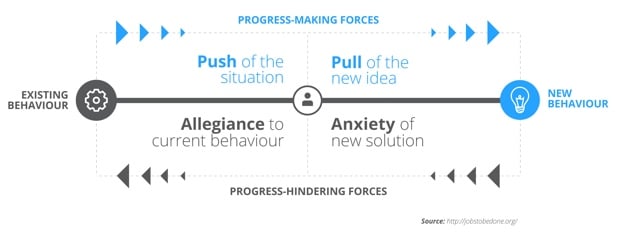
The progress-making forces diagram has been particularly useful for me in client work, since it helps people understand how difficult it can be to change existing user behavior. I’m not a huge fan of the diagram on the JTBD site, so we made a new one:

Progress making forces diagram

The basic premise of the diagram is this. For someone to move from their existing behavior (a product they’re currently using) to new behavior (switching to a new product), there are two types of forces at work: progress-making forces, and progress-hindering forces.

Progress-making forces move people from their existing behavior to the new behavior, and consists of the push of the current situation (things they’re not happy with in the current product) and the pull of the new idea (things that sound appealing about the new product). Progress-hindering forces, on the other hand, hold people back from switching to new behavior. It consists of allegiance to the current behavior (things they really like about the current product) and the anxiety of the new solution (worries about learning curves and not being able to accomplish their goals with the new solution).

What this comes down to is that for someone to switch from an existing product to a new product, the progress-making forces have to be stronger than the progress-hindering forces. This might seem obvious, but applying this model to your product planning can inject an extremely healthy dose of reality. Is the product really that much better than a current solution? What does the new product have to do to overcome people’s allegiance to what they’re currently using?

In the context of product design this can be a crucial component to making a go/no-go decision on whether to go ahead with an idea, so it’s always a mental test I run with the teams when we’re working through our planning.

Why Facebook shouldn't try to buy all the things

Last month I posted a theory on how Facebook might get taken down by competitors. From Taking down Facebook, piece by piece:

Facebook is in a classic position where, as a dominant provider of horizontal social services, it is in danger of being taken down piece by piece by several vertical players who provide specific, narrow experiences very well. Facebook has become a social media firehose. It won’t be replaced by another firehose, but by a bunch of different cocktails that users can customize as they please.

Over the past few weeks, a couple of things happened that appears to back up that theory. First, there’s The Guardian report Teenagers say goodbye to Facebook and hello to messenger apps:

Their gradual exodus to messaging apps such as WhatsApp, WeChat and KakaoTalk boils down to Facebook becoming a victim of its own success. The road to gaining nearly 1.2 billion monthly active users has seen the mums, dads, aunts and uncles of the generation who pioneered Facebook join it too. No surprise, then, that Facebook is no longer a place for uninhibited status updates about pub antics, but an obligatory communication tool that younger people maintain because everyone else does. All the fun stuff is happening elsewhere.

And then, of course, there is yesterday’s news that Snapchat Spurned $3 Billion Acquisition Offer from Facebook:

Facebook is interested in Snapchat because more of its users are tapping the service via smartphones, where messaging is a core function. Facebook has rapidly increased the share of its revenue coming from mobile advertising, but said last month that fewer young teens were using the service on a daily basis.

Perhaps trying to acquire all their vertical competitors is the wrong approach for Facebook. Ben Evans summed it up very well in Instagram and YouTube:

So buying Instagram certainly looks like a good trade — it would be worth a lot more if it was selling today. But as a strategic move, it’s looking increasingly irrelevant. Is FB going to buy WhatsApp, Snapchat, Line, Kakao and the next ten that emerge as well? Sure, some of those will disappear, but it doesn’t look like FB will crush the competitors the way it did on the desktop. On mobile, FB will be just one of many.

Just maybe, Facebook might have been better off rethinking the core product instead of buying what turned out to be just one of a swarm of alternative services.

That last sentence is key. Instead of trying to expand their territory, Facebook should fortify their core product and defend that territory to the death. Even though everything was different in 2009, I think the conclusion I drew back then in Why Facebook should forget about Twitter still holds true:

So here is my advice to Facebook: go where your users are. Understand how they use the site, what their needs and behaviors are. Go visit them, talk to them, watch them navigate around, understand why they are there in the first place. And then enhance your platform to fulfill those needs. Build new ways to feel closer to the people in your life. Make it easier to share and discuss media. Build families-only mini-communities. Who knows what you can come up with if you just understand your users and build a web site for their needs?
Twitter and the design constraints of the advertising revenue model

Dan Frommer weighs in with a positive view of Twitter’s more visual timeline in The Best Part Of Twitter’s New Design Is That It’s Experimenting In Public:

Love or hate Twitter’s new design features — I like the in-line photo and video previews, but the reply/fav/retweet icons under every tweet feel a little too noisy — they say one great thing about Twitter: That it’s not afraid to experiment boldly in public. […]

Remember: Twitter’s goal is to maintain its independence, and soon become a large, profitable, public media company. If Twitter can try new things — in public — that make its service easier to understand, easier to use, easier to monetize, and easier to grow, that’s a big victory for the company and its users.

The key point in Frommer’s analysis is what Twitter has become: a media company that makes money through advertising. This means that there needs to be a way to show ads more prominently, so that they can charge more for those ads. That places very specific constraints on how the product can be designed. If ads need more clicks, ads need more prominence. One way to give ads more prominence is to make them take over a larger part of the screen. So Twitter is testing one way of accomplishing that with their “more visual timeline”.

Of course, brands figured out pretty quickly that they can take up more of the screen if they add a photo to their links:

Twitter ads

Contrast that with Tweetbot’s view of the same Co.Design tweet (and others):

Twitter ads

I think what we’re forgetting is that Twitter has chosen their path. Sorry for repeating myself, but they’ve become a media company that makes money through advertising. For the foreseeable future, all product decisions will reflect that. This is where I disagree with Frommer. I don’t think this change makes the service easier to understand and easier to use. It does, however, make it easier to monetize, and easier to grow.

The bottom line is this. Don’t think for a minute that Twitter doesn’t realize that inline images hurt the user experience by reducing the scanability of tweets. Of course they know. But they don’t have a choice. They are now operating within the design constraints of the company they have chosen to become. If you don’t like it, buy Tweetbot before they hit their API limit.

Comment on Google+

The trouble with Microsoft

John Gruber in Thoughts and Observations Regarding This Week’s Apple Event Introducing the iPad Air and Retina iPad Mini:

This puts Microsoft in a tight spot. Apple gives away software for free in exchange for your buying their hardware. This is not charity. It’s also in marked contrast to Google, who gives away software for free in exchange for selling your attention (and personal information) to advertisers. Apple and Google are squeezing Microsoft from both sides, and the result is that less and less perceived value in the industry resides solely in software. You can make money selling hardware (like Apple) or make money selling ads (like Google), but given the popularity of Apple’s hardware and Google’s apps and services, it’s getting harder for Microsoft to make money by selling software.

John Moltz in Rudderless Microsoft:

I don’t think Microsoft is going anywhere. I mean that in two ways: 1) I mean they’re not going away and 2) right now they’re not going where the puck is going. They’re sailing somewhat aimlessly though increasingly margin-less waters. And the degree to which Microsoft’s investors, boosters and followers are OK with that is rather baffling.

It’s hard to write about Microsoft. If you think they’re doing great things you get ridicule from the Apple side. If you think they’re headed for disaster you’re labeled as a brainwashed fanboy. As with most things, the truth is more likely somewhere in the middle. But even the most die-hard Microsoft fan has to admit that Microsoft has been painted into a corner:

  • By making OS X 10.9 and its core apps free, Apple is creating an expectation that all operating systems should be free. It doesn’t matter that fewer computers run OS X — it’s about the precedent and how that affects consumer expectations.
  • By making services like Gmail and Docs “free”1, and by continuing to reduce the feature set gaps between those services and Microsoft Office, Google is forcing users to ask tough questions about the software they’re using, and why they’re paying so much for it. When authors like Charles Stross start taking on industry conventions by writing Why Microsoft Word must Die, you need to realise that your product is walking very close to the edge of a tipping point.

And yet, Microsoft appears to be doubling down on what are their two biggest strategic mistakes.

First, they’re not owning the whole hardware/software supply chain. Reading Gartner’s advice to Apple in 2006 is almost funny now in how wrong it ended up being:

Increasing component costs and pressure to cut its prices mean Apple’s best bet for long-term success is to quit the hardware business and license the Mac to Dell, analyst firm Gartner claimed on Tuesday.

The point is simple: if Microsoft can’t make money on PC hardware (which they can’t), they need to make money on the software. But that gets very hard when the “free” options become more and more appealing. Yes, most organizations still rely on Exchange for their mail and calendars. But how long can that last when employees all switch to Gmail and can’t shut up about how horrible Outlook is? RIM thought they had the enterprise market locked up because they controlled IT managers. How did that work out for them once employees starting rushing the IT castle, demanding support for their iPhones?

Second, Microsoft is sticking with their “You don’t have to compromise!” philosophy. Does Surface run a a desktop OS, or a tablet OS? Neither, and both! And that is a huge problem. By not making “compromises” they’re actually compromising way too much. Perhaps Doug Bowman summed it up best:

@gruber On the C word. Someone recently put it to me that all design is a series of compromises; but good design finds the right ones.

— Doug Bowman (@stop) February 6, 2013

Trying to use a desktop OS on a tablet isn’t “no compromise”, it’s utter frustration, and it doesn’t look like Microsoft is planning to stop doing that any time soon. From Engadget’s Microsoft Surface Pro 2 review:

As a tablet, the Surface Pro has made fewer strides. And that’s a shame, since the Pro is, at its heart, a tablet. […] The new Pro is much improved, but it’s still at its best in notebook mode. Indeed, whoever buys this needs to want a tablet and laptop in more or less equal measure. Because if what you really want is a laptop you can occasionally use as a tablet, you’re still better off with a convertible Ultrabook.

This inability to compromise has always been a problem for Microsoft. Back in 2006 Microsoft gave us a look at the most-used features in Word 2003, and it includes this paragrah:

Beyond the top 10 commands or so, however, the curve flattens out considerably. The percentage difference in usage between the #100 command (“Accept Change”) and the #400 command (“Reset Picture”) is about the same in difference between #1 and #11 (“Change Font Size”) This is what makes creating the new UI challenging — people really do use a lot of the breadth of Office and beyond the top 10 commands there are a lot of different ways of using the product.

Apple would look at that data and say, “let’s cut the bottom 200 commands.” Microsoft looked at it and said, “We’re going to need a bigger ribbon.”2

In short, what Microsoft needs most now is a leader who knows how to make the right compromises. It needs someone who can figure out how to bring the success of the Xbox integrated business (oh look, they make the hardware and the software for that!) to the rest of the company.

Update: As the honorable Mr. Maughan points out, this relates nicely to his post Compromise and glorified ignorance.


  1. The usual “If you’re not buying the product, you are the product” disclaimer applies. 

  2. For another example, see Improvements in Windows Explorer