Menu

Posts tagged “product strategy”

Customer request list != product roadmap

Rich Mironov’s We Don’t Hire Product Owners Here is a treasure trove of advice and clear thinking on the dangers of not taking the Product Owner role seriously in companies that make the switch to Agile development. There are so many good sound bites, but I’ll stick with just one that hits close to home:

Don’t let your customer request list become your roadmap. Kano analysis teaches us that letting current customers prioritize your backlog for you leads to market failure.  Don’t let your product owners confuse “this is what the enhancement request says” with “understanding and solving real customer problems.”

An introduction to technical debt

Maiz Lulkin has a great overview of one of the most important and most misunderstood issues in software development in his post Technical debt 101:

In software development, the dreadful consequences of sacrificing quality are widely misunderstood by non technical managers. They underestimate how detrimental it is to continued productivity and morale, and ultimately, to the overall strategy of the company.

He goes on to explain why…

Release early and often?

Some truth from Joshua Porter in There is no later for your customers (my emphasis added):

There is no later for your customers. The only thing that matters is what they’re using right now. They don’t give a shit about your roadmap, your brilliant feature pipeline, or your vision of a better future. They’re trying to get work done right now and they only know what you’ve already delivered. So build a discipline around your launches, knowing that your ‘temporary, let’s get this out quickly and iterate later’ release is the current reality for your customers. Build up your attention to detail and force yourself to treat every launch like it is your final launch. Imagine that you’ll never be able to deploy something after this…have you done your best work?

Release early, release often is not an excuse to release crap…

The real problem with Facebook's latest ad targeting move

Cotton Delo in Facebook to Use Web Browsing History For Ad Targeting:

But what Facebook is now enabling is far more expansive in terms how it uses data for ad targeting. In a move bound to stir up some controversy given the company’s reach and scale, the social network will not be honoring the do-not-track setting on web browsers. A Facebook spokesman said that’s “because currently there is no industry consensus.” Social-media competitors Twitter and Pinterest do honor the setting. Google and Yahoo do not.

There’s going to be a lot of handwringing about this over the next few days. And then we’re going to forget about it and move on. I’m guilty of this myself — the number of times I’ve quit and rejoined Facebook over the last few years is embarrassing. But I do think this might be the time I unfriend Facebook1 for good. Here’s why.

I’m becoming increasingly uncomfortable with how online data collection is driving product decisions. If a product’s sole source of revenue is advertising, then the design is going to reflect that. The product is going to be optimized for data collection so that it can provide better accuracy for advertisers. And if a product’s direction is driven by anything other than user needs, that product becomes worse for end users. That is inevitable. Nothing you can do about it.

This is why the “Well, what’s wrong with better ads?” argument doesn’t hold water. It’s not that I want to see less relevant ads (or no ads at all). It’s that I don’t want a company’s design decisions to be driven by a need to get as much data out of people as possible (as apposed to how to meet their core needs better).

I think Nicholas Carr summarized the problem with this type ad targeting very well in his post A complicated courtship:

Anyone who has a car accident today, and mentions it in an e-mail, can receive an offer for a new car from a manufacturer on his mobile phone tomorrow. Terribly convenient. Today, someone surfing high-blood-pressure web sites, who automatically betrays his notorious sedentary lifestyle through his Jawbone fitness wristband, can expect a higher health insurance premium the day after tomorrow. Not at all convenient. Simply terrible. It is possible that it will not take much longer before more and more people realize that the currency of his or her own behavior exacts a high price: the freedom of self-determination. And that is why it is better and cheaper to pay with something very old fashioned — namely money.

I want to use products that I pay for, so that I can say with reasonable certainty that those products are designed based on my needs, not to satisfy the never-ending data hunger of a faceless entity.

(link via Daring Fireball)


  1. Sorry. I’m putting myself in internet time-out for that joke. 

Web navigation: stop showing users your app if they want to see TVs

This navigation article by Gerry McGovern is from 2006, but it’s still so spot on. I’ll quote this one bit from Web Navigation is About Moving Forward, but you should definitely read the whole thing:

Navigation should primarily be about helping us keep on going in the direction we have chosen. If I choose a link for “notebooks” then I have made a decision. Continuing to present me with links for servers and desktops decreases my ability to focus on the notebook direction I have chosen.

When I choose a link for “ultralight notebooks” that indicates that I am not interested in multimedia notebooks. Once I arrive at the ultralight notebooks webpage, the overwhelming focus of the navigation must be to help me find the right ultralight notebook.

Good web navigation design is not about giving people lots and lots of choices. It is not about second guessing decisions we have made. It’s not about asking what if we want to get back to where we were. It’s about looking forward, not about looking backward.

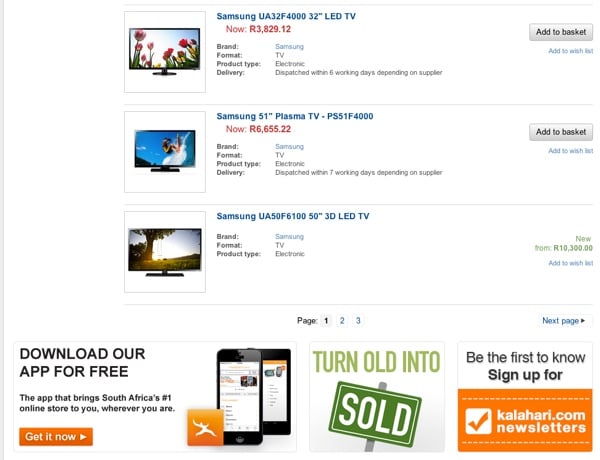
This is unfortunately still such a common practice on e-commerce sites. Why continue to show users unrelated product ads once they’ve made a decision on what they want? Here’s the search results page on Kalahari.com when I do a search for “Samsung TV”:

Samsung Kalahari

This isn’t the time to punt apps, newsletters, and the marketplace. I’ve indicated that I want a Samsung TV, so sell me a Samsung TV!

AeroPress: An origin story of design and tenacity

One of my favorite articles of the year so far is Zachary Crockett’s The Invention of the AeroPress:

The AeroPress was conceived at Alan Adler’s dinner table. The company was having a team meal, when the wife of Aerobie’s sales manager posed a question: “What do you guys do when you just want one cup of coffee?”

A long-time coffee enthusiast and self-proclaimed “one cup kinda guy,” Adler had wondered this many times himself. He’d grown increasingly frustrated with his coffee maker, which yielded 6-8 cups per brew. In typical Adler fashion, he didn’t let the problem bother him long: he set out to invent a better way to brew single cup of coffee.

It might sound like an article about coffee, but it’s more about entrepreneurship, product design, and the sheer tenacity of true inventors. Great read.

A product strategy approach to understanding Facebook, Instagram, and WhatsApp

A few months ago I wrote about the forces at work when people choose a product. I discussed the Jobs-To-Be-Done concept of Progress-Making Forces, and shared this diagram to illustrate what happens when we try to get people to use our product instead of someone else’s:
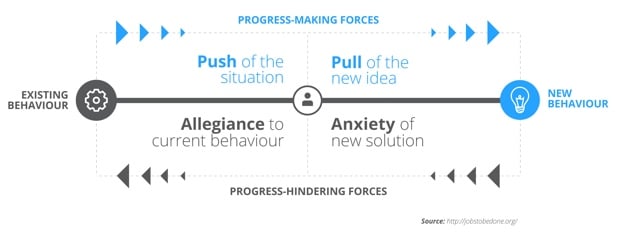
Progress making forces

In this article I want to discuss this framework in the context of a practical example: WhatsApp vs. Instagram Direct (now both owned by Facebook). I started thinking about this recently after MG Siegler wrote his post Going Against The Grain:

We’re seeing over and over again now that the behemoths can’t simply add a startup’s functionality into their own app as a feature and kill said startup. But it’s equally important to note that if you are able to establish your startup, especially those in app form, it may be hard to get your users to do anything other than what they originally came to do. Especially if the new functionality is against the grain in any way.

So, let’s consider this statement in the context of the Progress-Making Forces, and apply it to Instagram’s decision to add private photo sharing with Instagram Direct. First, let’s talk about existing photo sharing behavior. How do people currently send photos to each other? Facebook used to be the king of photos, but people are increasingly using messaging apps for this instead:

WhatsApp is processing 500 million images per day, compared to 400 million Snapchat (“snaps”) per day, which could include photos or videos. For its part, Facebook processes a comparatively paltry 350 million photos a day.

Enter Instagram Direct, a way for Facebook to try to claim back some of the private photo sharing pie. That’s the new behavior in the context of the the forces diagram. So the big question for Facebook is this: How do you get people to move their private photo sharing from WhatsApp (existing behavior) to Instagram (new behavior)? According to our framework, the progress-making forces need to be stronger than the progress-hindering forces, so let’s look at each force in turn:

  • Push of the situation. Is there anything people are not able to do by sending photos through WhatsApp that they wish they could do? It doesn’t seem that way. Some of the biggest advantages of using WhatsApp for photos are that (1) it’s completely private, and (2) it ties into your phone’s camera roll, so you have access to any photo, not just the ones from a particular app.
  • Pull of the new idea. Is there anything in Instagram Direct that could entice people away from WhatsApp? Again, it doesn’t look like it. Using Instagram Direct is simply more work than using WhatsApp for photos. If the photo isn’t in Instagram yet you have to import it. You have to apply a filter because that’s what you do in Instagram. Only then can you send it. But then the entire conversation is centered around photos. You still have to use WhatsApp for text messaging. So now you’re communication is fragmented, while it’s all seamlessly integrated in WhatsApp. There’s no pull here.
  • Allegiance to current behavior. How strongly are people attached to their WhatsApp experience? Extremely. The benefits of having all conversations and photos centrally located in WhatsApp can’t be overstated. You’re not just sending photos, you’re talking about life. It becomes a timeline of your relationships, and everything is there.
  • Anxiety of new solution. How worried are people that the shift would ruin their experience? Well, it seems there would be quite a bit of anxiety involved in moving to a product that doesn’t support the functionality you’re used to, and sits within a walled garden.

This analysis clearly shows that while the progress-making forces for moving people to Instagram Direct are relatively weak, the progress-hindering forces are extremely strong. This keeps people glued to WhatsApp, and it explains Instagram Direct’s apparent failure.

So what happened here? I think Facebook realized that they won’t be able to change people’s existing photo-sharing behavior. And that’s why they bought WhatsApp.
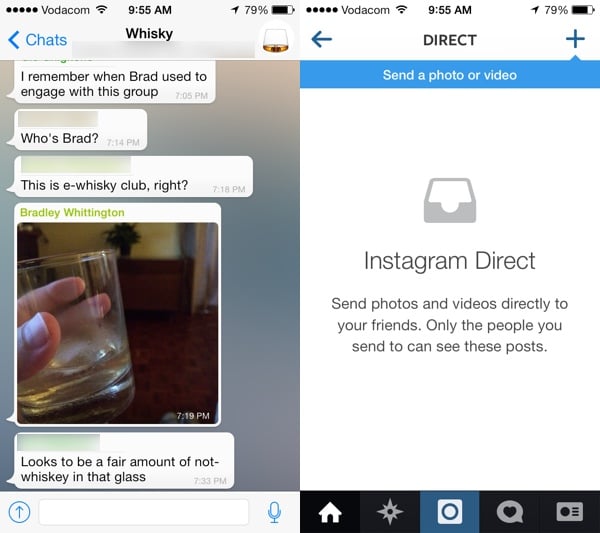

Whatsapp Instagram Direct

Where A/B testing does (and doesn't) make sense

Peter Seibel discusses data-driven design at Etsy in his post Building websites with science. After going over the dangers of relying solely on A/B testing for product decisions, he concludes:

Ultimately the goal is to make great products. Great ideas from designers are a necessary ingredient. And A/B testing can definitely improve products. But best is to use both: establish a loop between good design ideas leading to good experiments leading to knowledge about the product leading to even better design ideas. And then allow designers the latitude to occasionally try things that can’t yet be justified by science or even things that my go against current “scientific” dogma.

This echoes Julie Zhuo’s thoughts in The Agony and Ecstasy of Building with Data:

You can’t A/B test your way into big, bold new strategies. Something like the iPhone is impossible to A/B test. If you had asked people or invited them to come into the lab to try some stuff out, they would have preferred a physical keyboard to a virtual one. If you had them use an early prototype of the touch screen where not every gesture registered perfectly, it would have felt bad and tested poorly. […]

Data and A/B test are valuable allies, and they help us understand and grow and optimize, but they’re not a replacement for clear-headed, strong decision-making. Don’t become dependent on their allure. Sometimes, a little instinct goes a long way.

This all relates back to the difference between variation (trying out different ideas) and iteration (small changes to improve an existing idea). A/B testing is great for iteration, but not for variation. For variation we need our brains, and lots of paper and pencils.

Doing it right vs. doing it over

Cap Watkins in Just Ship*:

We work in a world now where fast isn’t good enough. Where quantity is fairly regularly getting edged out by quality. You shipped twelve just-good-enough things this year? You’re about to get smoked by folks who shipped three of those things thoughtfully and holistically. Where you cut corners on twelve projects to get them out the door, someone else crafted three focused experiences and left themselves little-to-no design or technical debt.

This also describes why arbitrary release dates are poison to good quality products. It forces teams to cut corners to hit a date, which puts them in a more vulnerable position than if they just took the time to do things right.

Also:

Why do we never have time to do it right, but always have time to do it over?

— Alan Skorkin (@skorks) April 10, 2013

Why are we building this app?

Jeff Atwood wrote a glorious rant about the proliferation of unnecessary mobile apps called App-pocalypse Now1:

The more apps out there, the more the app stores are clogged with mediocre junk, the more the overall noise level keeps going up, which leads directly to this profligate nagging. Companies keep asking how can we get people to find and install our amazing app instead of the one question they really should have asked.

Why the hell are we building an app in the first place?

He makes some other really great points about the current state of the app ecosystem as well.


  1. I really struggle with puns. I don’t like them. So publishing this title is a big step forward in my ongoing therapy.