Menu

Posts tagged “music”

What Spotify wants: that you should forget that you’re listening

Liz Pelly’s Streambait Pop is a fascinating look at the “Spotify sound” and other changes in pop music brought about by streaming:

The Spotify sound has a few different variations, but essentially it’s a formula. “It has this soft, emo-y, cutesy thing to it,” Matt says. “These days it’s often really minimal and based around just a few simple elements in verses. Often a snap in the verses. And then the choruses sometimes employ vocal samples. It’s usually kind of emo in lyrical nature.” Then there’s also a more electronic, DJ-oriented variation, which is “based around a drop … It’s usually a chilled-out verse with a kind of coo-y vocal. And then it builds up and there’s a drop built around a melody that’s played with a vocal sample.”

The really interesting part to me is how it’s a sound that’s essentially designed to make you forget about it, so that you just keep streaming endlessly:

The chill-hits Spotify sound is a product of playlist logic requiring that one song flows seamlessly into the next, a formula that guarantees a greater number of passive streams. It’s music without much risk—it won’t make you change your mind. At times, these whispery, smaller sounds even recall aspects of ASMR, with its performed intimacy and soothing voices. When everyone wants your attention, it makes sense to find reprieve in stuff that requires very little of it, or that might massage your brain a bit.

After I read this article I went through my Spotify playlists and counted how many of them had the word “chill” in it. Let’s just say I’m too embarrassed to tell you…

But moving on, I think this “inoffensiveness” in music is one of the reasons I’ve started to listen to so many more genres over the past few years. I now like music that feels like it just doesn’t quite sit right. Any artist or band that combines a little discomfort with a lot of skill has my attention. Just one recent example that comes to mind is Double Negative by Low. I still don’t really know what it is. But I know it’s something really special.

The problem with Instagram alternatives

I’ve been a long-time subscriber and fan of Craig Mod’s newsletter. In the latest edition he has some really interesting thoughts on Instagram, and social media in general:

Instagram will only get more complex, less knowable, more algorithmic, more engagement-hungry in 2019.

I want to have a place very far apart from that, where I can post photos on my own terms. Not have an algorithm decide which of my posts is best. And I don’t want to be rewarded for being anodyne, which is what these general algorithms seem to optimize for: things that are easily digestible, firmly on the scale of “fine, just fine.” It becomes a self-fulfilling prophecy, as the more boring stuff we shove into our eyeballs, the more boring our taste becomes.

I’ve long since deleted my Facebook account, but in what has become a fairly familiar form of hypocrisy in myself and many of my friends, I’ve stubbornly held on to Instagram. I’ve toyed with Sunlit in conjunction with Micro.blog as an option, but as with most of the Instagram “alternatives” out there, the network effect simply isn’t there.

The other important distinction is that I see a major difference between photographers and Photographers (capital P). Craig is a Photographer, so it makes sense for him to be way more thoughtful and concerned about where he shares his photos. I mostly post pictures of whatever vinyl I’m listening to, so it’s not exactly high art.

Which brings me to an even bigger question… what is the purpose of sharing photos for small-p photographers? For me, I want to connect with people I know, make them part of my life, maybe influence their music taste a little bit. And I want to see similarly mundane things about their lives. And that is why starting a photography newsletter like Craig — or moving to Sunlit — isn’t really an option for me. Because I need to use the thing where my people are at.

I just wish the thing I have to use was less yucky. I’d absolutely pay a monthly fee to remove the yucky parts.

Filling our empty moments with sound and noise

In Filling the Silence with Digital Noise, Kate Moran and Kim Flaherty share some research-based findings on how people use digital background noise to make sure it’s never quiet around them:

While many participants reported feeling the need to have some sort of audio in the background during their silent moments, others reported a more intense version of this phenomenon: the need to fill all the empty moments in their lives with some activity to avoid boredom or downtime. This behavior fills the ‘silence’ in a figurative way — people use their devices to keep their minds constantly occupied.

I read this article with interest, because I also do this—albeit for a different reason. I have a condition called tinnitus, which is a consistent ringing in the ears. There is no cure for it—the only way to deal with it is to learn to manage and be ok with it. For those of us who suffer from tinnitus, silence is torture. Because there is no silence. Your only choices are (1) the sounds/noises you put on around you, or (2) a loud ringing in your head that comes from nowhere and everywhere and never goes away.

Guess which option we usually go for…

The rise of “real-time mood-based marketing”

Ok this is creepy:

Over the past few years, Spotify has been ramping up its data analytic capabilities in a bid to help marketers target consumers with adverts tailored to the mood they’re in. They deduce this from the sort of music you’re listening to, coupled with where and when you’re listening to it, along with third-party data that might be available.

And they’re not alone:

Spotify is far from the only platform helping brands target people according to their emotions; real-time mood-based marketing is a growing trend and one we all ought to be cognizant of. In 2016, eBay launched a mood marketing tool, for example. And last year, Facebook told advertisers that it could identify when teenagers felt “insecure” and “worthless” or needed “a confidence boost”.

Vinyl Me, Please and the power of product thinking

I’ve been a Vinyl, Me Please customer since January 2015. Back then things were pretty basic. For roughly $25/month they would send you a “Record of the Month”, along with a custom art print and cocktail recipe. It was cool, and helped to expand my musical palate quite a bit.

But sometime over the over the past year or so they kicked things into high gear. VMP now offers a “Classics” track (my favorite!) and a “Hip Hop” track in addition to their “Essentials” track (the original “Record of the Month”). But what’s even more apparent now is how Vinyl Me, Please has grown into a role model of how to provide value to music lovers in the digital era. The thought and care that went into this month’s “Essentials” release proves it once again.

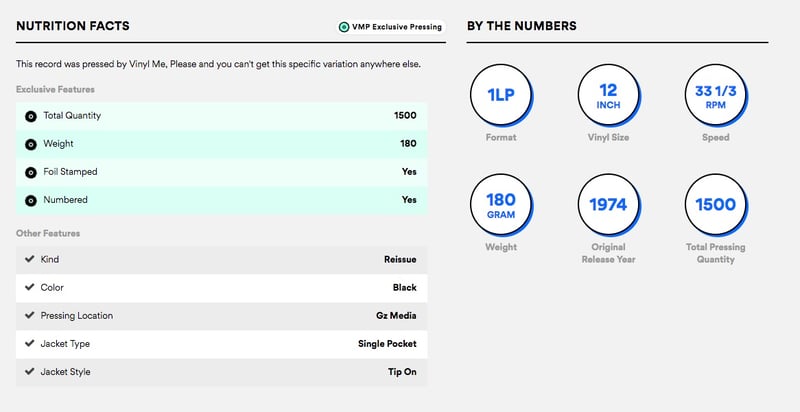
I noticed yet another example yesterday. The Vinyl Me, Please store now shows the “nutrition content” of each record they sell:

Vinyl nutritionn facts

Ask any vinyl collector and they will tell you how much this small detail improves the shopping experience. This is all the information we usually have to hunt for on product pages and do multiple Google searches about — but presented in a consistent, easy-to-read format. It’s such a relief and a breath of fresh air.

I’ve seen quite a few attempts to define “product thinking” lately. This example, to me, sums it up perfectly. “Product thinking” means gaining a deep understanding of what users need and what kind of friction they experience, and then providing a product solution that makes that friction go away in a delightful way.

Platforms and serendipity on the internet

In Filter Failures Ethan Chiel asks if platforms are sucking the joy out of the internet, and he makes a pretty compelling argument:

The internet as we use it now is, for the most part, what the large platforms want it to be: an engine for serving us what their various systems think we want, or what we wanted before, or what our demographics want en masse.

Here’s the problem:

What’s lost in the process is whatever you might have found that neither you nor an algorithm might guess is interesting. Some song in a forum thread you idly clicked on, a news item about something you’ve never expressed interest in or heard of that you read because you had 5 minutes to kill and it caught your eye.

This reminds me of how we used to browse music stores. We idly flipped through CDs, and picked a few to try out in the listening booth based on the cover, the song titles, and some undefined ¯_(ツ)_/¯ factor. Now we just see and hear what we’ve seen and heard before, and the cycle continues…

Spotify and the business of making hits

Spotify has been in the news quite a bit recently, especially since their IPO announcement. The best article I’ve read so far about Spotify’s business model (and challenges) is Ben Thompson’s Lessons from Spotify:

Spotify’s margins are completely at the mercy of the record labels, and even after the [lower royalties] rate change, the company is not just unprofitable, its losses are growing, at least in absolute euro terms.

Ben goes further to explain how difficult it would be for Spotify to cut out record labels completely:

Notice how little power Spotify and Apple Music have; neither has a sufficient user base to attract suppliers (artists) based on pure economics, in part because they don’t have access to back catalogs. Unlike newspapers, music labels built an integration that transcends distribution.


Profitability aside, it’s fascinating and kind of scary to get a sense of the oversized role that Spotify plays in deciding what becomes a hit song. Austin Powell digs into the details in his article Inside the booming black market for Spotify playlists:

The biggest of those playlists can essentially manufacture hits. A single add to Spotify’s influential RapCaviar, which boasts more than 8 million followers, can result in hundreds of thousands of streams, depending on where it’s placed and how long it stays there. RapCaviar has been credited, for example, with making Smokepurpp’s “Audi” go gold, with 68 million streams and counting.


But wait, there’s more (as the say). Some of Spotify’s biggest playlists are owned by none other than the record labels themselves. From Liz Pelly’s The Secret Lives of Playlists:

On other playlists, you’ll occasionally notice different logos: the thick cursive word Filtr, the all-caps logo for Topsify, or simple rounded text reading Digster. These are the playlisting brands owned by the major labels: Filtr by Sony, Topsify by Warner, and Digster by Universal.

What does this mean?

Outside of the Spotify staff-curated playlists, those curated by Filtr, Digster and Topsify have more visibility on the Browse pages than any other playlisting brands, individuals or labels. With these playlists, employees of Filtr, Digster and Topsify can simply log in and add tracks.

“Things like Topsify, Digster and Filtr remain good resources, especially for [major label] developing artists,” says Jeff. “I know that I can plug in such-and-such track to five [of our] playlists and start to rack up some plays, some revenue for that artist, get it in front of some new listeners, and you also get some algorithmic stuff going. Like Release Radar and Discover Weekly.” By using Filtr, Topsify and Digster playlists to generate activity on their own material, the majors effectively use these playlists to pump their artists into Spotify-owned algorithmic playlists.

The musical world belongs to the “curators” and algorithms. We’re just listening in it. And the company that has the most control over it all is not even close to being profitable.
Mutemath on creative collaboration and the importance of (sometimes) working alone

I’m a really big Mutemath fan. If you haven’t listened to their latest album, please do yourself a favor and get on that! In the Rolling Stone interview Mutemath’s Paul Meany on Near-Breakup, New LP ‘Play Dead’ they talk about their creative process on the album:

Mutemath assembled the track list in an unconventional way. Instead of arguing endlessly over what songs to pull from their massive pile of 30 demos, the musicians each hand-picked three and assembled the basic framework themselves before bringing the other back into the process.

”We just trusted each of us to go into our corners and materialize a vision for that particular song and bring it back to the band to finish the puzzle together,” Meany says. “And it was exciting to watch everyone in the band firing on all cylinders. The mantra was just ‘indulge,’ and we trusted each other to do that. And we wouldn’t have been able to do that a few albums ago. If you just get into ‘indulge’ mode, that’s usually the recipe for garbage. Every person in the band should always feel that – someone’s gotta to create some parameters at some point. But I think we’ve worked together long enough now and have developed the trust within that creative space to just say ‘go.’ This was the culmination of all that.”

I tend to think that’s a great way to collaborate on design as well. Go away and do your thing with no constraints, come up for air and get feedback and make changes, rinse and repeat.

What we lost when sound systems stopped being furniture

Kate Wagner explores How speakers went from statement furniture to unseen tech:

In today’s wireless age, most want their sound system to be out of sight and out of mind. “If interior designers had their way,” says Scott Orth, director of electroacoustics at Sound United, “there would be no speakers at all.” Orth adds that “the trend among average consumers has been to go smaller for the last thirty years.”

But there was a time when speakers were as essential a piece of furniture as the sofa: The peak of home hi-fi offered handcrafted teak consoles and towering pairs of floor speakers. Today, small, easily hidden speaker systems are the mainstays of home listening. But how did we get from full cabinetry to speakers not much bigger than a tin can?

When we moved into our house we made a conscious decision not to make the TV the centerpiece of our living room. Instead, everything is laid out around this (the TV is banished to the basement):

The family sound system

I didn’t think much of it at the time, it was just something we wanted to try out. But the results have been positive: we watch less TV, and listen to (and argue about!) music more. I think when TVs started pushing sound systems out of the way in living rooms, we lost more than just a beautiful piece of design. We also lost an important connection point within families.

The changing role of the record label

There are a couple of interesting articles about Frank Ocean’s new album and how it’s causing a lot of waves in the music industry. The short version is that Ocean found a clever way to get out of his agreement with his label Def Jam, and sign an exclusive deal with Apple Music instead. As Ben Sisario notes in Frank Ocean’s ‘Blonde’ Amplifies Discord in the Music Business, the labels aren’t happy:

“The unprecedented run of exclusives by digital music services has put a tremendous strain on the relationship between artists and their record companies,” said Larry Miller, an associate professor of music business at New York University’s Steinhardt School. “We are seeing that play out in public now.”

In Def Jam Can’t Compete With Apple Justin Charity explains further how Apple has become a giant player in the music industry:

Today, with Iovine’s connections and industry guile, Apple Music is becoming a de facto record label of its own. In just over a year, Apple has struck deals with Drake, Future, Chance the Rapper, and Travis Scott. […]

In response, Universal Music Group, which owns Def Jam, is quickly mobilizing against Apple Music’s exclusive streaming-rights model, which naturally limits the audience for new music. Without this model, Apple Music would be back to a prolonged competition to differentiate itself from its streaming competitors. With it, there’s a new, unprecedented competition: conventional record labels, which ideally develop artists into stars, versus Apple Music, which pays stars well.

I’m going to be in the minority here, but I don’t like Apple getting into the record label business. The entire idea of “exclusive” music releases rubs me the wrong way. And I’m just going to say it — this is the kind of stuff that happens when we get rid of physical media.