Menu

Posts tagged “music”

Taylor Swift and the Good Girl Trap

You know an essay is going to be good when this is the preamble:

I am writing this piece in good faith (that you, as a reader, like to think more about the culture that surrounds you, whether it’s culture you love or hate or are ambivalent about) and that you are in turn reading in good faith (that I do not hate Taylor Swift, that this is not a takedown, that we’re talking about Swift’s image but we’re also talking about people’s reaction to that image).

But yes, this is a really timely and poignant piece by Anne Helen Peterson about Taylor Swift and the impossible trajectory of celebrity:

But sometimes, when you keep on winning — awards, sure, but also in your career — it doesn’t matter who you are or how hard you worked for those achievements. People are going to find it harder to root for you. It’s when domination turns into over-saturation: when honest missteps become weaponized, when the interpersonal comes to feel emblematic, when every move becomes overdetermined.

How platforms killed Pitchfork

This is such a good point about music discovery and the abundance of choice:

Before Spotify, when presented with a new album, we would ask: why listen to this? After Spotify, we asked: why not?

I also like this sentiment:

On one level it’s impressive that Spotify can perfectly capture my musical taste in a series of data points, and regurgitate it to me in a series of weekly playlists. But as good as it has gotten, I can’t remember the last time it pointed me to something I never expected I would like, but ultimately fell totally in love with.

For that you needed someone who could go beyond the data to tell you the story: of the artist, of the genre, of the music they made. For that you needed criticism.

“This city has my heart and I've been waiting”

We just got back from an incredible 2.5 weeks in South Africa. I have a lot of processing to do… but what I will say for now is that the sunsets in Africa are still the best in the world. Don’t @ me, it’s just science.

Also, here’s a Spotify playlist of chill South African jams that I think you will enjoy. Give it a try!

Creating from a deeper place

There’s a lot going on in John Warner’s Speed and Efficiency are not Human Values. It’s primarily a reflection on generative AI tools in the context of being a published author—and well worth reading.

But the reason I am linking to it here is because it gives you an excuse to watch (or re-watch!) what John calls “the greatest guitar solo ever captured on a recording” (he is 100% correct). Here is Prince at the Rock and Roll Hall of Fame induction ceremony in the year both he and George Harrison (posthumously) were enshrined:

Here’s how John describes the solo in his post:

Prince was obviously a highly skilled guitarist capable of blazing speed on the fretboard (like the “Flight of the Bumblebee” guy) and indeed there’s a couple of spots where he just rips through some rapid note runs, but it’s also intensely musical, totally its own thing, while also managing to reference aspects of the solo from the original version (performed by Eric Clapton). […]

A great guitar solo is not about how fast you can play, or your degree of technical skill. It comes from a deeper place.

I know you’re going to roll your eyes, but seriously, the solo and that quote—it comes from a deeper place—inspires me to think a little bit more about the feel of the products we make, and a little bit less about the ”correctness” of fitting a specific mold.

Building a music mini-site with data from Last.fm, Discogs, and YouTube

It’s been a little quiet on the blog recently, and the reason for that is either perfectly valid or profoundly unnecessary, depending on your viewpoint. Even I am not entirely sure which one it is.

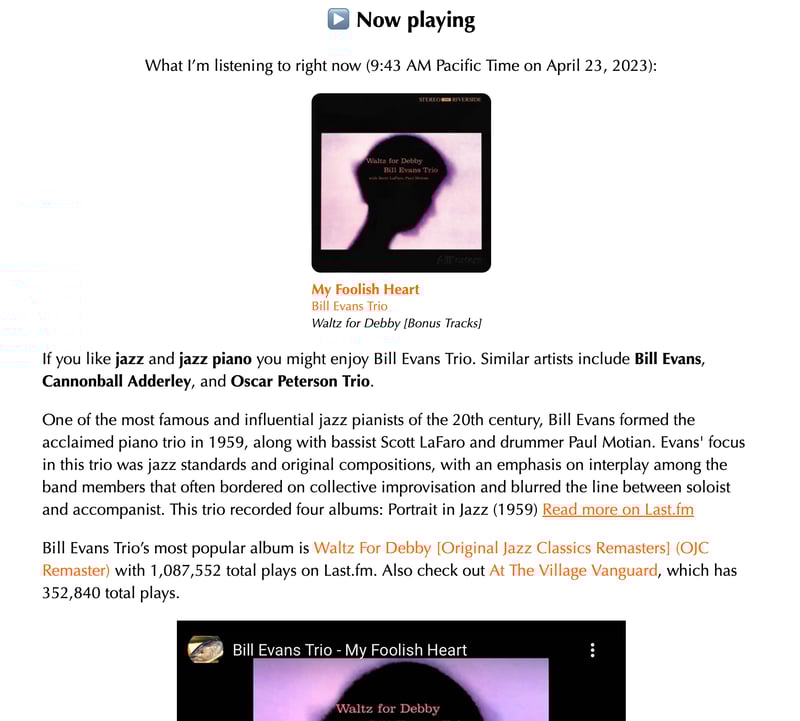
Over the past couple of weekends (and too many late weeknights) I have used all my spare time to build a mini-site for my obsession with music. It started as a small idea to just show the current track I’m listening to, and a list of recent physical albums I added to my collection. But then it snowballed into something much more. You can view the site at music.elezea.com, or by clicking on the link in the top navigation. If you want to know a bit more about how it works, read on!

It all started when I came across Andy Bell’s mini-site for his music collection. He uses a Notion database and Last.fm to show all the music he has in his collection, and what he’s listening to. Since I also still use Last.fm (yes, it’s still around!), and all my physical music is documented on Discogs, I wanted to build a small site that uses the Last.fm and Discogs APIs to show some of that information.

But once I got started and got stuck into all the information available via those APIs, I just couldn’t stop. I still have so much more I want to do, but I know it’s time to take a break. All in all this has been such a fun and rewarding thing to spend my time on. I know the site has pretty much zero value to the world at large. But I love checking it to get more information about something I’m listening to—and it helped me take quite a few steps forward in my technical skills. So I’m choosing to call it a win.

Below are some notes about what the site does, how it works, and also what the experience was like for me (as a non-developer trying to learn).

Now playing

  • Get the most recently played track from the Last.fm API, and check if the song is currently playing or not.
  • If it’s currently playing, show the current time and a message that what you’re seeing is what I’m listening to in real-time.
  • If it’s not currently playing, mention that and show the time it was played.
  • Pull in the cover art and other data about the song from Last.fm.
  • Do a lookup for the artist and if Last.fm has data about them, show the first two tags (genres), first 3 related artists, and their bio.
  • Do another lookup to a different API endpoint for the artist’s top albums, and display data about their two most popular albums.
  • Use the YouTube API to do a lookup for the song, and embed the most relevant result in the page so that you can listen to it right there.

Top albums and artists

  • Show the top albums I listened to in the last 7 days, including play counts.
  • Show the top artists I listened to in the last 7 days, including play counts.
  • Make a separate API call for each artist to get their genres and similar artists, if that data exists on Last.fm.
  • Make another API call to get each artist’s most popular albums.

Recent purchases

  • Pull the last 6 releases I added to my Discogs collection.
  • Also pull in data about the genre, label, and release date.
  • ⏳ The Discogs API is really great, so I want to add a bunch more stuff here, but that’s also for the mythical v2 of this thing.

Random thoughts, complaints, and what’s next

  • The site is deployed with Netlify via a Github repo, and it just works. Netlify is so great.
  • I don’t care what you “real developers” say, the two biggest problems in programming are environmental variables and formatting dates. I am thankful for ChatGPT for helping me with the date formatting piece, and my colleague and friend Derek for helping to get the environmental variables to work.
  • Last.fm’s API clearly hasn’t been touched in years and the documentation isn’t great, so it’s been a bit of a mission to figure all that out. Postman has been a life-saver here to test the API calls and see what data comes back.
  • YouTube’s API has a limit of 100 search lookups per day, which feels ridiculously low. I hit that within an hour while I was building and testing it. Oops! On the upside: I am now much better at error handling. If the site hits that limit it will now show a message to that effect, and link to a direct search on YouTube for the song.
  • ⏳ I’m using YouTube only because the Spotify API makes it incredibly difficult to get an auth token. Auth tokens expire after 1 hour, and refreshing that token every hour is currently beyond my limited skills. I might come back to this as well because the Spotify API has sooo much interesting data.
  • ⏳ Another huge data source is the MusicBrainz API. I plan to spend some time wading through those docs as well to see what else I could add.
  • If you can think of any other cool things I might want to add to this, please reach out on Mastodon!

Link roundup for April 2, 2023

No image posts today, but it’s a blockbuster edition of the link roundup this week! I hope you find something interesting in here…

1 → LinkedIn power users are turning to ghostwriters (Vox)

LinkedIn remains a complete mystery to me.

“It’s cliché, but it’s true that people want to work with people, people buy from people, people want to see the human side of who you are before they decide to work with you,” says Tara Horstmeyer, an Atlanta-based ghostwriter who offers packages for 12 LinkedIn posts for anywhere between $2,000 and $3,000.

2 → How the Great Recession paved the way for the influencer industry (Vox)

It’s worth reading this fascinating interview with a curious mind. Especially if you, like me, are “of a certain age” and feel like you just don’t get it…

Influencers are neither ‘a flash in the pan’ nor ‘a bubble about to burst,’ but indicators of a paradigm shift in the way we think about each other and ourselves.

3 → On Place (Alica Kennedy)

This is a lovely, rich essay on the difference between “destination” and “place” when we travel, how digital nomadism displaces locals, the pursuit of a “decent meal” abroad, and more.

Continued economic dependence upon tourism leads inevitably to brain drain, when a labor force no longer wishes to work only service jobs. What does ‘local’ as an experience mean when it’s not in service to those who are literally local?

4 → The Life I Refused to Surrender (The Free Press)

This short essay from Amanda Knox packs a huge punch and really got to me. All we have is now…

No matter how small, cruel, sad, and unfair this life was, it was my life. Mine to make meaning out of, mine to live to the best of my ability. There was no more waiting. There was only now.

5 → The Streaming Market Is Fundamentally Broken. It’s Time To Fix It. (Public Knowledge)

There is just so much wrong with the music streaming industry.

Artists aren’t allowed to see the deals that set their streaming payment rates; indie labels aren’t allowed to see the deals distributors cut with labels on their behalf . And in many cases, artists aren’t even allowed to compare notes and talk about their own contracts.

6 → People Started Buying Crocs During the Pandemic. They Can’t Stop. (NYT Gift Article)

I have no pithy comment for this one.

“I roll into the gym with my Crocs on and everything, and people ask, ‘Aren’t you going to change shoes?’” Mr. Ndugga said. “No, this is how I’m going to live life for now.”

7 → Free Bird (Substack)

A top-to-bottom excellent post about Twitter from Ed Zitron. Read the whole thing!

Twitter can create an incredible sense of both intellectual invincibility and vulnerability that can drive someone quite mad.

8 → The Counterintuitive Thing About Trust That Explains Why So Many Teams Have Issues With It (LinkedIn)

This is an insightful post on the leader qualities that really build trust. In short, it’s about showing that you really, truly care.

Studies indicate that conveying benevolence is much more likely to earn you trust than conveying how competent you are. […] That’s why all things being equal, a person who is charismatic and kind will gain more trust than a person who is seen has having good ability.

9 → The Dangers Of Highly Centralized AI (Medium)

I agree with this take from Clive. It’s like we’ve learned nothing from social media.

The field of large language models is becoming dangerously centralized. A huge amount of power resides in the hands of a tiny number of firms.

This is a wonderful essay about the things that ensure happy and enduring families.

The bottom line: if you want a happier family, create, refine and retell the story of your family’s positive moments and your ability to bounce back from the difficult ones. That act alone may increase the odds that your family will thrive for many generations to come.


Link roundup for March 25, 2023

The Beauty of Earth From Orbit.

Google and Microsoft’s chatbots are already citing one another in a misinformation shitshow. This is fine. “If you ask Microsoft’s Bing chatbot if Google’s Bard chatbot has been shut down, it says yes, citing a news article that discusses a tweet in which a user asked Bard when it would be shut down and Bard said it already had, itself citing a comment from Hacker News in which someone joked about this happening, and someone else used ChatGPT to write fake news coverage about the event.”

One hundred drones now used across IKEA retail for stock inventory. “One hundred busy drones are now at work during non-operational hours to improve stock accuracy and secure availability of products for online or physical retailing. This solution supports a more ergonomic workplace for IKEA co-workers as they no longer need to manually confirm each pallet.”

Is Blockbuster video about to make a comeback? I didn’t realize how many chances Blockbuster had to not die. “In 1997, Warner Bros approached Blockbuster with an exclusive DVD rental deal that would have split revenue 60-40 in favour of the studio. Blockbuster rejected it, and the studio retaliated by dropping its DVD retail prices to undermine the rental industry. And then in 2000, Blockbuster made two even more fatal decisions. First, Blockbuster turned down the opportunity to purchase the then-fledgling Netflix. Second, it chose instead to partner with Enron. Within a year, Enron filed for bankruptcy. Within five years, Netflix was shipping out a million DVDs every day. Suddenly, Blockbuster was yesterday’s news.”

Is there a drop in software engineer job openings, globally? “The US, Canada and UK are currently seeing some of the lowest numbers of developer job listings since Feb 2020.”

Swimming outside the lanes. Tracy Durnell talks about leaving her day job and going out on her own. “People complain that no one wants to work anymore. And it’s true to an extent: no one wants to work in a job where they are underpaid, unfairly treated, unappreciated, and constrained. I like my work, but so far dislike jobs.”

Shiny Happy People, Being Chased By Monsters. Are we in the midst of a vibe shift back to the days of whimsy? “FreakyLinks may have been on my mind lately because I think we’re in another moment of cultural shift from seriousness to whimsy; if you don’t believe me, ask yourself why Everything Everywhere All At Once so thoroughly kicked the ass of that movie about the mean conductor lady at the Oscars. We’re at a similar moment to where we were in the early 2000s — where people are shrieking ‘I want to be happy!’ and ‘I’m tired of thinking! Give me some baggy orange leather pants instead!’”

Songs are what we carry, even when we have nothing else. On the B-Sides I talk about the latest U2 album a little bit. “It’s the sound of a band that has been together for close to 50 years starting to wind things down the only way they know how: they sing the songs they carry, even when they don’t have a whole lot left.”

Taylor Swift, Fender Guitars, and Product Management walk into a bar

I recently came across two articles that combine the topics of music and product management. That is basically catnip for me, so I have to share.

First, I know “What X Can Teach Us About Y” articles have become a bit of a trope, but trust me on this one. What Taylor Swift Can Teach Us About Business by Rex Woodbury is an excellent case study on what good product management is all about. I’ve always been impressed by Taylor’s business strategy, and this is the first article I’ve seen that really digs into it. On Taylor’s decision not to sign with RCA because they wanted to pigeonhole her into being a country singer:

The key insight here is that RCA underestimated the market. Yes, country listenership was declining among young people. But great products revitalize stale markets and ultimately expand their markets. Swift did both, first proving that there was an opportunity in country music, and later growing beyond country to become a bona fide pop star. Swift’s story reminds me of a fatal error in startups: underestimating market size.

There’s too much goodness to quote here, so just read it.

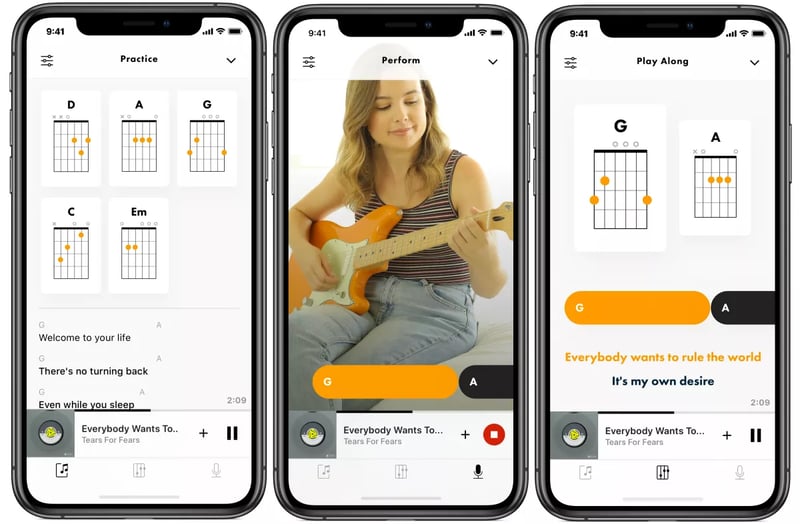
The second one is an older piece that I found via Jeff Gothelf’s blog. It’s an interview with Fender CEO Andy Mooney on the company’s mission, and once again it showcases some excellent product management principles. In the example below, Andy talks about the creation of the Fender Play app. I am breaking the quote up with some of my notes, since it encapsulates the process so well:

The marketing is tied around creating the emotional connection, being ‘why should I do this?’.

Note the focus on Jobs to be Done. Their research showed that people pick up the guitar mostly because they want to play and sing along to their favorite songs—not because they want to be rock stars. That’s the emotional connection they are going after.

Again, with Play, we felt that it was a milestone to get people to commit if they were able to master their first song. So we teach the skills that you need in Play around doing exactly that. You come into the product, you declare your genre and that gives you a potential setlist.

Note here how they identified their activation metric / a-ha moment and built the product around getting users to that moment as quickly as possible.

Then you get taught the skills to master those songs rather than the other way round. I taught when I was very much younger. You know, are you going to teach somebody to play major minor scales or are you going to teach them how to play House Of The Rising Sun? My approach—which I’m glad was all intuitive back then—was a song-based approach because you were teaching them how to play the chords within the context of the song.

Again, note how they focus on the how music makes you feel, not on the theory behind it. We are all used to this kind of marketing now but it’s worth remembering that until the iPhone came along, phone marketing was all focused on storage space and RAM, not on here’s what you can do with it.

There’s much more in the article about the extensive customer research that Fender did, and how they used those insights to create Fender Play.

Link roundup for March 10, 2023

The World Nature Photography Awards 2022 winners have been announced.

What Does Workplace TikTok Look Like During Layoffs? It Gets Weird. Always Be Contenting, I guess. “It’s uncanny to watch clips of boisterous lunch buffets next to teary videos about being exiled from them—sometimes from the very same creators just months apart. You come to see how workday and layoff TikToks are mutually intelligible, odd sides of the same coin. No matter what happens, they say, workers will post through it. Work will be forged into content, no matter what.” (NYT gift link)

How to Take Back Control of What You Read on the Internet. Even The Atlantic is getting in on the RSS love! Could 2023 really, actually be the year? “But despite the syndication format’s cult following, most internet users have never heard of it. That’s unfortunate, because RSS provides everyday internet users with an easy way to organize all of their online-content consumption in one place, curated by the user, not an algorithm.”

I doubled-down on RSS. More RSS content! Here are a lot of words about the good and the bad of it. And some interesting observations too… “If you judge someone solely from the content they blog about, most folk will seem stodgy and humorless. I’m painfully aware that I’m no exception. The problem is that if you position yourself as irreverent, you’re likely to be dismissed.”

How The Last of Us re-created a 2003 arcade with the help of true enthusiasts. This article is so great. “We’re stupidly proud of this. All of it. We knew that anything less wouldn’t cut it and we’re nothing shy of grateful that HBO and the rest of the production encouraged us to go to these lengths.”

How the ring got good. A wonderful reflection on how Tolkien stumbled his way to what became Lord of the Rings. There’s some strong words of encouragement for all of us: “If Tolkien can find his way to the One Ring in the middle of the fifth draft, so can I, and so can you.”

De La Soul Is Streaming. A very important public service announcement on where you should start listening.

Link roundup for March 3, 2023

The African Bricks 3. Mosaic artworks inspired by the culture and beauty of Africa, by Charis Tsevis.

The Cello in Soho Square. I like this description by Michael Lopp of the difference between “dabblers” and “S-tier” people (who are the absolute best at something): “There is an infinite list of exciting things to learn, but the Dabbler knows they have finite time, so they dabble. They get 80% of the juice, and they move on. Respect. S-Tier knows the last 10% of the challenge is the hardest, but it also teaches you the most.”

Physicists Say Aliens May Be Using Black Holes as Quantum Computers. This is fine. “In a recent study, a German-Georgian team of researchers proposed that advanced extraterrestrial civilizations (ETCs) could use black holes as quantum computers. This makes sense from a computing standpoint and offers an explanation for the apparent lack of activity we see when we look at the cosmos.”

Honestly, it’s probably the phones. Don’t dismiss this argument just from the headline, like I almost did. There’s some solid evidence presented here. “If we’re looking for one big ‘silver bullet’ or ‘grand unified theory’ of modern teenage unhappiness, phones are probably the place to start looking.”

Papercraft Models by Rocky Bergen. “Construct the computer from your childhood or build an entire computer museum at home with these paper models, free to download and share. Print, Cut, Score, Fold and Glue.”

In an Uncertain Job Market, How Can Companies Retain Workers? The conventional wisdom that people tend to hunker down when there are layoffs around them might not be accurate: “Layoffs ‘create an environment where people worry it might happen to them next,’ said Laszlo Bock, who was Google’s SVP for people operations. Poorly handled reductions may ‘degrade trust in management as people start hearing rumors of further cuts, and that in turn raises anxiety, which causes more people to quit.’” (NYT gift article)

How the Phonograph Created the 3-Minute Pop Song. I can’t resist a good “technologies people thought would ruin everything” article, and this is another fascinating one: “Plenty of folks worried that records would destroy musical culture. John Philip figured it would demotivate anyone from learning to play an instrument themselves. Why bother, when you could just put on music by a true virtuoso? ‘When music can be heard in the homes without the labor of study,’ he fretted in a 1906 article, ‘it will be simply a question of time when the amateur disappears entirely.’”

The Case for Hanging Out. I love this essay. “Pushed further into isolation by the pandemic, we’re all losing the ability to engage in what I view as the pinnacle of human interaction: sitting around with friends and talking shit.”

Explore. I think it’s probably too late for a viable LinkedIn alternative, but this site would be a great contendor.