This song is all over my Instagram Reels for some reason and it is such a vibe I can’t get enough of it.
Posts tagged “music”
Deezer: AI-generated tracks now represent 44% of all new uploaded music
This is characteristically dry press release language, but the stats are interesting:
Deezer, the global music experiences platform, is now receiving almost 75,000 AI-generated tracks per day, representing roughly 44% of the daily uploads. This amounts to more than 2 Million AI-generated tracks uploaded per month. Thanks to Deezer’s industry unique measures, consumption of AI-generated music on the platform is still very low, between 1-3% of the total streams. In addition, a majority (85%) of these streams are detected as fraudulent and are demonetized by Deezer.
I’m simultaneously surprised (but not, because grifters) that the amount of uploads is that high, and surprised (but not, because music lovers) that it’s generally a very unsuccessful way to make money. My continuing refrain will be that let’s use AI for the things that it’s good at, and leave the really important stuff (like art) to humans.
Is Hip-Hop in Decline? A Statistical Analysis
I love this blog and try not to link to it too much, but this one about how fewer people listen to hip hop was especially great.
So, what’s filled the space hip-hop once dominated? A blend of new arrivals and familiar mainstays. Latin music—led by Bad Bunny—and Asian pop, powered by K-pop acts like BTS, have expanded their global footprint. At the same time, legacy formats are resurging: country is booming, driven in large part by Morgan Wallen, while the loosely defined “alternative” category continues to gain share across the charts.
I particularly love how he tries to avoid causation/correlation errors in his hypotheses. Like this one I hadn’t thought about:
Streaming adoption laggards: Hip-hop uniquely benefited from early streaming adopters in the 2010s. Younger listeners—who were predisposed to the genre—were among the first to embrace platforms like Spotify, giving hip-hop an outsized digital footprint. More recently, late adopters—like country fans, older cohorts, and global audiences—have rebalanced the charts, lifting genres like country and K-pop.
The invention of "classic rock"
Daniel Parris wrote a statistical analysis of when rock became “classic rock”, and it’s not the story I expected.
He assumed the genre emerged organically from music nerds debating on message boards and in the pages of Rolling Stone. Instead:
What I found was a deliberate realignment engineered by music executives chasing an ephemeral advertising demographic. Like many entertainment industry decisions, it was a small (mostly male) group of executives quietly deciding the future of popular culture behind closed doors.
The data shows two concentrated periods when stations rapidly switched to classic rock: the mid–1980s (to capture aging Boomers entering their peak earning years) and the mid–1990s (after the Telecommunications Act enabled Clear Channel to buy up local stations and prioritize low-risk, high-profit formats).
The kicker is that this rebrand was designed around economic incentives that have since eroded. Radio isn’t the default distribution channel anymore. On streaming, music can just exist without being packaged for a hyper-valuable consumer cohort.
Another reminder that so much of what feels like culture is really just business decisions made in conference rooms.
Don't Outsource Your Love of Music to AI
I’m late to this one, but I like Liz Pelly’s take on Spotify Wrapped. It’s not just about music—it’s about what happens when we let corporations automate our memories:
Spotify Wrapped now feels like just another example of something personal and precious that is being automated away from us; another example of a supposedly unbearable task of thinking and writing being “offloaded” in order to make life more frictionless.
The post is essentially about friction—and why we need it. She argues that working through the process of remembering what mattered to us and thinking critically about our year is what keeps us sharp and curious. When we just accept what a streaming service tells us about our taste, we’re not just outsourcing a task. We’re losing our own sense of what connected with us and why.
It encourages music fans to believe that the records they streamed the most must be the ones they liked the most, which is surely not always the case.
Her suggestion is straightforward: write your own list. It doesn’t have to be polished—a notes app screenshot, a handwritten list, whatever. Just something that came from you, not from an algorithm optimizing for engagement metrics.
Building a music discovery app (and what I learned about Product)
I miss liner notes. In the age of infinite streaming and algorithmic playlists I find myself longing for the days when you’d flip open a CD case and actually read about the music you were listening to. Who produced this? What’s the story behind the album? Why does this track feel different from everything else they’ve made?
Spotify and Apple Music are great at giving you more music. They’re less good at helping you understand why you might love something, or what to explore next. So I built my own solution—and then rebuilt it twice.
The problem I was trying to solve
My relationship with Last.fm goes back to 2007. In case you’re not familiar, Last.fm is a service that “scrobbles” (tracks) everything you listen to, building a comprehensive history of your musical life. It’s become a wonderful archive of my taste evolution over nearly two decades.
Last.fm is great at telling you what you listened to. It’s less useful for helping you understand why you might love something, or what else you should explore. Spotify and Apple Music’s algorithmic playlists are fine, but they often feel like they’re optimizing for engagement rather than genuine discovery.
I wanted a tool that would:
- Show me context about the artists and albums in my listening history
- Help me discover music through similarity and connection, not just popularity metrics
- Give me that “liner notes” depth I was craving
- Work with my existing Last.fm data (18 years of listening history is a lot to throw away)
So I started building, first by copy-pasting from GPT–4 (the olden days!), and most recently with Antigravity + Claude Opus 4.5 (we’ve come a long way since 2023). Here’s where it all stands today…
Listen To More: three iterations and counting
Listen To More is the core project—a music discovery platform that combines real-time listening data with AI-powered insights.
The first version was simple: a personal dashboard that pulled my Last.fm data and displayed it nicely. Functional, but limited. The second version added some AI summaries using OpenAI’s API. Better, but still rough around the edges.
The current version—iteration three—is a complete rebuild focused on speed and multi-user support. What started as “a thing I made for myself” is now something anyone can use. Sign in with your Last.fm account, and you get:
- Rich album and artist pages with AI-generated summaries, complete with source citations (so you know the AI isn’t just making things up)
- Your personal stats showing recent listening activity, top artists and albums over different time periods.
- Weekly insights powered by AI that analyze your 7-day listening patterns and suggest albums you might love
- Cross-platform streaming links for every album—Spotify, Apple Music, and more
- A Discord bot so you can share music discoveries with friends
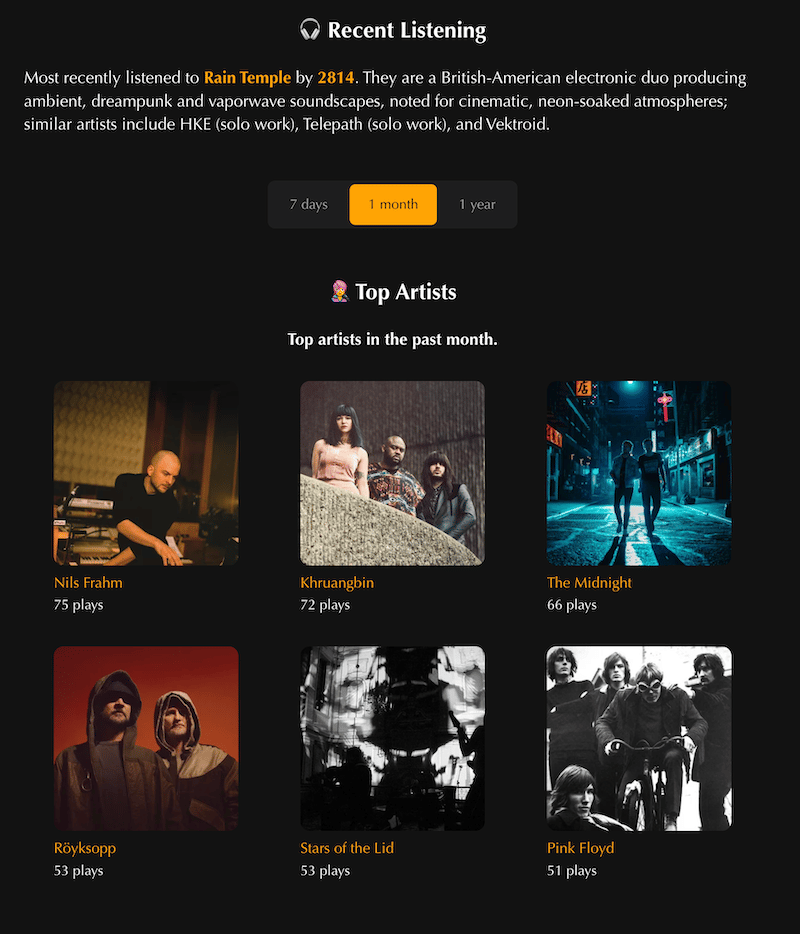
The tech stack is Hono on Cloudflare Workers, with D1 (SQLite) for the database and KV for caching. The whole thing is server-side rendered with vanilla JavaScript for progressive enhancement. Pages load in about 300ms, then AI summaries stream in asynchronously.
I chose this stack partly because I work at Cloudflare and wanted to understand our developer platform better. More on that later.
Extending the ecosystem with MCP servers
MCP stands for Model Context Protocol. In plain terms, it’s a standard that lets AI assistants (like Claude) connect to external data sources and tools. Think of it as giving an AI the ability to actually use personalized data rather than just answer questions based on pre-training.
I built two MCP servers to extend my music discovery ecosystem:
Last.fm MCP Server
Available at lastfm-mcp.com, this server lets AI assistants access your Last.fm listening data. Once connected, you can have conversations like:
- “When did I start listening to Led Zeppelin?”
- “What was I obsessed with in summer 2023?”
- “Show me how my music taste has evolved over the years”
The AI can pull your actual scrobble data, analyze trends, and give you personalized insights. It supports temporal queries (looking at specific time periods), similar artists discovery, and comprehensive listening statistics.
Discogs MCP Server
This one connects to Discogs—the massive music database and marketplace that’s especially popular with vinyl collectors. If you have a Discogs collection, the MCP server lets AI assistants:
- Search your collection with intelligent mood mapping (“find something mellow for a Sunday evening”)
- Get context-aware recommendations based on what you own
- Provide collection analytics and insights
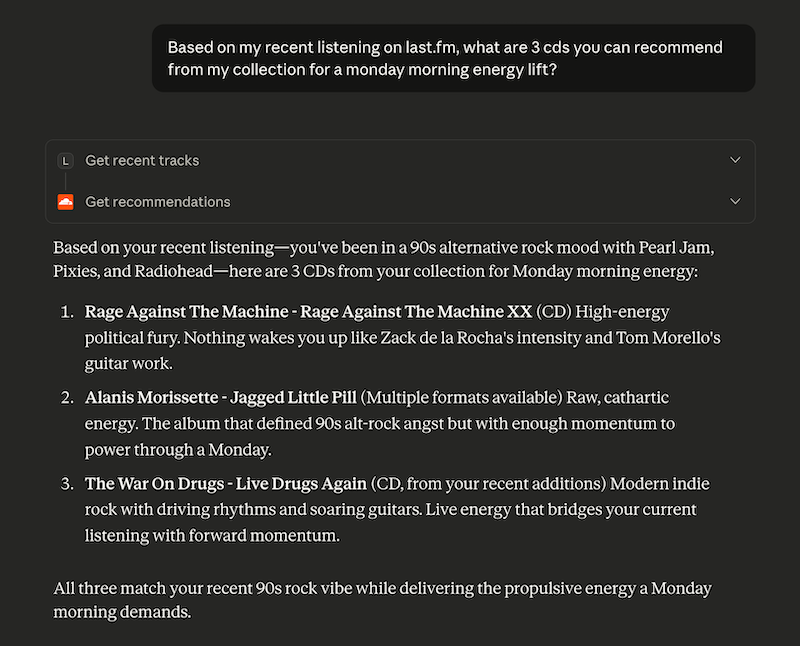
Both servers run on Cloudflare Workers and use OAuth for secure authentication. They’re open source if you want to poke around or deploy your own.
What I learned
I’m a Product Manager, not an engineer. But I’ve found that having more technical depth broadens the scope of things I am able to contextualize—and makes me more confident in my interactions with engineers. Here’s what building these projects reinforced for me:
- Side projects are a low-stakes learning environment. When you’re building for yourself, there’s no pressure to ship by a deadline or meet someone else’s requirements. You can experiment, break things, and iterate freely. I tried approaches that would have been too risky to propose in a work context—some of them broke the site spectacularly, others worked beautifully.
- There’s no substitute for using your own product. I use these tools every day. That constant exposure surfaces issues and opportunities that you’d never catch in a quarterly review or user interview. The feature prioritization becomes obvious when you’re feeling your own friction.
- Building with your company’s tools is invaluable. I now have deep, practical knowledge of Cloudflare Workers, D1, KV, and the rest of our developer platform. When I’m talking to customers or evaluating feature requests, I’m drawing on real experience, not just documentation. I can empathize with the developer experience because I’ve lived it.
- The fun matters. I keep coming back to these projects because I genuinely enjoy working on them. The satisfaction of solving a problem you personally care about is different from the satisfaction of shipping something at work. Both are valuable, but the former is what sustains a side project through the inevitable rough patches.
What’s next
I have a list of features I’d love to add—better recommendations, more sophisticated listening pattern analysis, maybe even integration with other music services. But I’m also learning to pace myself. These projects aren’t going anywhere, and part of the joy is the slow, steady improvement over time.
If you’re curious, you can check them out here:
- listentomore.com — The main music discovery platform
- lastfm-mcp.com — Connect AI assistants to your Last.fm data
- Discogs MCP Server — Connect AI assistants to your Discogs collection
And if you’re a PM thinking about starting a technical side project: do it. Pick something you personally care about, use tools you want to learn, and give yourself permission to build slowly. The lessons transfer in ways you won’t expect.
Horrible edge cases to consider when dealing with music
Metadata is the hardest problem in software, and these examples prove my point. Don’t @ me!
My favourite: a band named brouillard, with a single member called brouillard, whose every single album is named brouillard, and of course, so is every single track.
Source: Horrible edge cases to consider when dealing with music →
Requiem for a Beam
This is a beautifully-written love letter to the CD—and I agree completely:
The commitment for the listener is light—one press of the button—and the challenge for the artist is pleasantly tough. You have to make all the songs work in a row, and there is a very good chance the listener will hear the entire album. One long unbroken work is also like a stage play, which is what I knew best in high school. […] The CD still delights me and helps me frame the idea of a collected set of songs.
Source: Requiem for a Beam →
Apple Music’s hi-res audio is *still* standing in its own light
Man. Standing ovation to this quote. I just want to know!!!
I’m not here to debate if the jump from lossy AAC to lossless ALAC is audible. Many people say they cannot hear the difference between the two (lucky them). Others say they can. Most importantly for any comments section, that second group is not seeking permission from the first group to stream losslessly. Apple Music supplies ‘Lossless’ and ‘Hi-Res Lossless’ streams at no extra cost to the subscriber, and some listeners just want to know that their audio hasn’t been lossy compressed along the way, even if they’re not 100% sure they can always hear the benefits. Many of these same people already know that an album’s mastering technique will impact its sound quality more than the delivery format.
Anyway. This article is your reminder that if you’re using AirPlay or Bluetooth with Apple Music you’re not getting lossless.
Source: Apple Music’s hi-res audio is *still* standing in its own light →
The Most ‘CD Album’ Albums Ever, Ranked
This is a great Xennial list. And I am glad I’m not the only one who thinks R.E.M.’s Monster is actually pretty good.
Monster is commonly regarded as the most “used CD” CD of all time. Which I think is somewhat unfair and due in large part to how conspicuous the blaze orange packaging is. I would bet that Come Away With Me or Eric Clapton’s Unplugged or my beloved New Miserable Experience are just as common. They just blend in with the pack better. Though I don’t think being the most “used CD” CD is a bad thing, if it’s true. So long as it’s not used as shorthand for lack of quality. I love Monster, I love used CDs, and I will strenuously defend both against all haters.
Source: The Most ‘CD Album’ Albums Ever, Ranked →