Menu

Posts tagged “music”

Sharing books and music: not as similar as we might think

Nicholas Carr looks at the differences between customers who buy/share books vs those who buy/share music, specifically within the context of piracy. In Books ain’t music he notes:

The unauthorized copying of songs and albums did not begin with the arrival of the web or of MP3s or of Napster. It has been a part of the culture of pop music since the 1960s. There has been no such tradition with books. Xeroxing a book was not an easy task, and it was fairly expensive, too. Nobody did it, except, maybe, for the occasional oddball. So, even though the large-scale trading of bootlegged songs made possible by the net had radically different implications for the music business than the small-scale trading that had taken place previously, digital copying and trading didn’t feel particularly different from making and exchanging tapes. It seemed like a new variation on an old practice.

His observations are fascinating. It shows that even though record labels certainly deserve their share of the blame when it comes to the dismal state of the commercial music industry, the history and context of music sharing has an enormous part to play in the rise of modern-day music piracy. The publishing industry has a very different historical context, so we can’t just apply the “lessons” from the music industry to the challenges introduced by digital books.

On criticism, cynicism, and how to turn John Cage quotes into Internet jokes

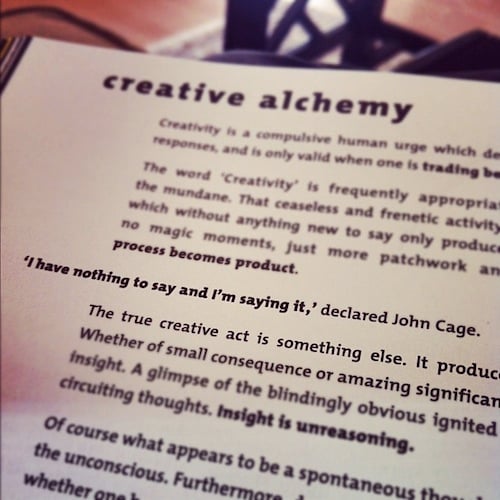
A couple of weeks ago I read this quote by John Cage in The Art of Looking Sideways:

I have nothing to say and I'm saying it

I have nothing to say and I’m saying it. Is your mind racing about all the ways that statement applies to life on the Internet? Yeah, me too. In fact, the phrase immediately made me think of a joke I could make on Twitter, which I wrote down right away. But I wanted to get my facts right, so I started reading up on John Cage - as you do when you’re on vacation. This is where I ask you to please stick with me as we go on a brief detour about the nature of criticism.

My rabbit-hole journey into the world of John Cage led me to a great 2004 essay by Joe Dacey called John Cage Defined in the 1950s. It outlines how the phrase “I have nothing to say and I’m saying it” comes from his “Lecture on Nothing”:

In this lecture, he outright tells the listener that the lecture has no point and will go nowhere, “I am here and there is nothing to say. If among you are those who wish to get somewhere, let them leave at any moment”. He implores the audience to enjoy each and every moment of the lecture even though he admits that it is pointless. He advocates that, “Our poetry now is the realization that we possess nothing. Anything therefore is a delight (since we do not possess it) and thus need not fear its loss” and “It is not irritating to be where one is. It is only irritating to think one would like to be somewhere else”.

It’s not just you - that is a weird thing to do. What fascinates me most about Cage is that he never bothered to reflect on any criticism of his work. Ever.

Cage mostly ignored criticism he received believing that most people didn’t understand why he composed the music he composed. In fact, he saw society as “one of the greatest impediments an artist can possibly have” to creating good art. After receiving a review for a concert he gave in Seattle that stated the performance was “ridiculous,” Cage’s responded that he had no interest in the review because he “knew perfectly well it wasn’t.”

Knowing when to ignore criticism and when to listen to it is one of the hardest skills to learn, and so easy to get wrong. On the one extreme is the John Cage approach, where you view all criticism as bogus or not worthy of your attention. On the other extreme there are people (and companies) who change course with every little piece of feedback they get, regardless of its merit.

But somewhere in between is a happy medium where you use criticism as a springboard to ask yourself tough questions. If you’re a designer, those questions might be things like, “Why did I put this button here?” or “Why might someone find this interface confusing?”. Those are excellent questions to ask yourself. If you can answer them, and defend the decisions you made, you can move on to the next thing. If your questions lead you to make some changes, well, that’s great too because your end result is going to be a better product.

I like the way The 99 Percent approaches the process of finding this middle ground in their article On Criticism, Cynicism & Sharpening Your Gut Instinct:

Criticism is doubt informed by curiosity and a deep knowledge of a discipline related to your work. Whether the criticism you receive is constructive or not, it comes from knowledge. Informed insights like “I’m not sure someone would ever pay that much” or “you may not want to outsource that given the high-touch required” may cause you to question your approach.

By contrast, cynicism is a form of doubt resulting from ignorance and antiquated ways. Industry experts will often express doubt based on an ingrained muscle memory of past experiences that handicaps their vision for the future. Cynical statements like, “People will never read a book on a computer” or “Why would anyone want to put their rolodex online?” are famous doubts expressed by experts with handicapped vision.

Their advice is simple: Savor criticism, shun cynicism. That seems like a sound approach to me.

Anyway, I mention all of this to ensure you of the accuracy of the joke I ended up making:

“I have nothing to say and I am saying it” - John Cage in his 1949 lecture on posting Foursquare check-ins to Twitter

— Rian van der Merwe (@RianVDM) May 14, 2012

You are, of course, welcome to disagree and send me your criticism.

The necessity of risk and failure in the creative process

There’s an interesting discussion on The Verge entitled Filters vs. failure: Instagram’s perfect messes could spell trouble for creativity. Joshua Kopstein argues that the problem with Instagram and other digital creation tools like Paper is that it removes the ability to make mistakes. It’s virtually impossible to take a bad picture on Instagram, and he believes that this is a problem for creativity in general:

By removing risk we have fundamentally changed the nature of the medium, or technically speaking, switched to an entirely different one. Because the process is now streamlined and offers near-infinite forgiveness, the way we approach a camera has changed drastically from tools defined by limited exposures and semi-predictable chemicals, and the resulting product always reflects that.

Instagram’s foremost blasphemy isn’t that it “ruins” images or misrepresents reality ”” it’s that it mines another medium for selective, aesthetic purposes despite being unable to represent the processes and risks that define that medium. The software curates, emulates and packages appropriated qualities that its creators consider desirable, creating a risk-free detour that fast-tracks the creative process.

Kopstein also links to a very interesting article by Derek Holzer called Schematic as Score: Uses and Abuses of the (In)Deterministic Possibilities of Sound Technology. Holzer discusses the move from analog to digital creation in the music industry, and makes a similar point about the absence of risk in the creative process:

I consider it axiomatic that, for any art work to be considered experimental, the possibility of failure must be built into its process. I am not referring to the aestheticized, satisfying glitches and crackles valorized by Kim Cascone, but to the lack of satisfaction produced by a misguided or misstepped procedure in the experiment, whether colossal or banal. These are not errors to be sought out, sampled and celebrated, but the flat-on-your-ass gaffs and embarrassments that would trouble the sleep of all but the most Zen of musicians or composers.

The presence of failure in a musical system represents feedback in the negative, a tipping point into anti-climax, irrelevance, the commonplace, the cliche or even unintended silence. Many artists try to factor out true, catastrophic failure by scripting, scoring, sequencing or programming their work into as many predictable, risk-free quanta as possible ahead of time. But this unwelcome presence also guarantees the vitality of that hotly-contested territory ”“ the live electronic music performance.

The resulting compositions from the most “easy” and “simple” software tools are often nothing more than “digital folk” art ”“ the endless and endlessly similar permutations which are possible merely from the tweaking of a few basic presets. Perhaps the artistic tragedy of the digital age lies in the social and economic pressure to immediately release “results” which barely get beyond this initiatory phase.

I find these discussions fascinating. Sweeping generalizations are dangerous, of course, but I do agree that taking the risk out of creativity also makes it much harder to make something truly great. I see this in my own creative pursuits as well. I love writing first drafts of pieces. I absolutely hate editing those pieces to become something that’s worth publishing. But it’s in the editing process - which is basically the discovery and correction of failures - that the opportunity for doing good work really presents itself.

If software came along that magically made every first draft look acceptable, writers would lose out on the surprising spurts of creativity that come from the editing process. And I think this is the same for Instagram and electronic music. If we can walk any direction we want and never get a course correction, how will we get where we need to go?

A story about Miles Davis and the nature of true genius

I’ve been listening to Kind of Blue all week. More specifically, I have the 180g vinyl copy of the Miles Davis jazz classic on constant rotation. It’s an album that never gets old and therefore needs no specific reason to be listened to, but in this case I do have one. See, I’m reading Frank Chimero’s excellent book The Shape of Design at the moment, and he references Kind of Blue quite a bit. It’s this passage in particular that sent me back for another listen:

Kind of Blue is unequivocally a masterpiece, a cornerstone to jazz music created in just a few short hours by altering the structure of the performance. The musicians accepted the contributions of one another, and ventured out into a new frontier, using their intuitions as their guides. Davis amassed a stellar group of musicians, and with a loose framework of limitations to focus them but plenty of space for exploration, he knew they would wander with skill and play beyond themselves.

This is such a great description of the album, and as Chimero points out in his book, an apt metaphor for meaningful creative work. I started going down the rabbit hole a bit more (thanks, Wikipedia!), and eventually found Stephen Thomas Erlewine’s review of the album. He says:

Why does Kind of Blue possess such a mystique? Perhaps because this music never flaunts its genius. Yet Kind of Blue is more than easy listening. It’s the pinnacle of modal jazz - tonality and solos build from the overall key, not chord changes, giving the music a subtly shifting quality.

Ok, hold on a second. Did you catch that? This music never flaunts its genius. What an interesting way to put it, and I’ve been thinking about that phrase all week. I’ve been wondering what it means not to flaunt your genius, and why we find it so compelling in the rare cases that we stumble upon such genius.

As I dug deeper into my own obsession with Kind of Blue, I realized that my truth lies somewhere in the middle of Chimero and Erlewine’s respective takes on it. I think what draws me to this album is the enormous restraint that each of these brilliant musicians show. Just look at the members of the sextet: Miles Davis, Bill Evans, Jimmy Cobb, Paul Chambers, John Coltrane, and Julian “Cannonball” Adderley. They were all extraordinary musicians at the top of their games, and yet they came together and produced a piece of work that doesn’t feel strained or over the top. There is a sense of comfort - of rightness - to every note on the album.

But why am I so drawn to this restraint? I think it’s because we all know instinctively that restraint is so much harder than flaunting, and therefore takes much more skill. Consider social media - the perfect platform for flaunting your undeniable awesomeness. I was just at a conference yesterday where one of the speakers stopped for a moment so we could all tweet how awesome he is. Yes, of course he was making a joke, but it’s precisely the non-absurdity of the idea that makes the joke funny. The speaker was simply exaggerating behavior we see online every day.

But here’s the thing. Telling people how awesome you are is easy. You don’t even have to be awesome to tell people how great you are. It’s the unwritten rules of the game: online, we get to be the versions of ourselves that we wished we were in real life. And it’s easy to do so. On Twitter, talking is easy; shutting up is the hard part.

And this brings me to the point of this little journey: what having Kind of Blue on endless rotation for the past few days has taught me. Three things:

One, be exceptional at something. These musicians didn’t just show up and play some tunes. They spent years and years practicing and honing their respective crafts. They weren’t all great at everything, but they were exceptional at their chosen instruments. These days we call it being T-shaped, but I think the point is simple: pick one or two instruments, and become really good at playing them through continuous learning and practice.

Two, give others room to shine. On Kind of Blue these giants of jazz somehow manage never to step on each other’s toes. Instead, they know when it’s time to play a solo and when it’s time to hang back and be the support for whatever is going on in the foreground. Ubuntu says that “a person is only a person through other people”, and we’d be well served to remember that philosophy in our work. We are stronger - and we can accomplish more - once we know when it’s time to lead, and when it’s time to make others look good.

Let’s not be afraid to celebrate the successes of others, and partner with people we feel threatened by. If Coltrane didn’t think he was good enough for Miles Davis - or that he’s much better and deserved more solo time - we wouldn’t have had the album they ended up giving us.

Three, proceed with cautious courage. Kind of Blue marked a change in recording style for Miles Davis:

In 1953, the pianist George Russell published his Lydian Chromatic Concept of Tonal Organization, which offered an alternative to the practice of improvisation based on chords and chord changes. Abandoning the traditional major and minor key relationships of classical music, Russell developed a new formulation using scales, or a series of scales, for improvisations: This approach led the way to “modal” in jazz. Influenced by Russell’s ideas, Davis implemented his first modal composition with the title track of his studio album Milestones, and his first sessions with Bill Evans, 1958 Miles. Satisfied with the results, Davis prepared an entire album based on modality

Notice the progression here. George Russel brings modality to jazz music. Miles Davis then tries it out on a single track. Once he tested it and liked the results, he proceeded to record a full album in that style. Davis recognized a change in musical styles and embraced it, but he did so with cautious courage - testing his ideas on a small scale first before going all out.

There are so many ways we can apply this idea to the work we do. On the one end of the spectrum, think of industries like music, movies, and publishing - industries that are in trouble because they refuse to embrace the digital changes that happened despite their attempts to stop it. On the other end, think of products that are launched without an audience or a purpose, stuck in endless cycles of “pivoting”. Somewhere in the middle lies the Miles Davis approach: recognize opportunity and go for it, but do so in a measured, careful way.

Maybe Kind of Blue has something very specific to teach us about the nature of true genius. It shows that there is a kind of magic to things that are made by exceptional people who are not in need of the false security that flaunting so often provides. And maybe this is the message that all jazz music tries to teach: make great things with your friends, and don’t be afraid to let them have the spotlight every once in a while. If it’s good, your recognition will come. Just ask Miles Davis.
4 design lessons we can learn from U2 concerts

If you’re a designer (or just into good design) and a music fan, I’d like to recommend the book U2 Show. The book is about how the various U2 tours were designed — from Boy all the way through Elevation. It explains the countless hours that go into stage design, lighting design, sound & speaker stack design, and a whole bunch of other areas (and it has some great photos too). I really enjoyed the window this book provides into what goes into the design of a large rock concert, and it showed me again that basic principles of good design translate to all media forms.

Here are some things I believe the design community can learn from the way U2 design their shows:

1. Don’t place limits on the design in the beginning

U2 tour manager Willie Williams on how the PopMart tour came into being:

There was also a very direct (and very rare) brief to me that this tour would be “˜design-led’, rather than being intimidated by scale or logistics. Having proved to themselves and to the world with ZooTV that, in terms of what can be toured, “˜anything is possibl’, U2 were of a mind that the only limits to be placed on the creative ambitions of this tour were to be financial ones.

This is a really good principle.  The time for realism and feasibility will come — but in the beginning, think big

2. Challenge the limits of possibility

On the impossible design requirements given to the sound engineers:

Mark Fisher’s frustration with years of stage design constrained by traditional loudspeaker stacks led him to propose that we should keep the huge video screen free from clutter by placing the entire sound system in one central ball. Most sound engineers would have resigned on the spot, but Joe O’Herlihy rose to the challenge of mixing a live show through what would essentially be a mono PA.

Even during feasibility discussions, it is important to challenge your beliefs on what is possible.  Involve the engineering team in the product discussion — and challenge them to test the limits too!

3. Let the content shine through

I like how they talk about the huge differences between the PopMart tour and the Elevation tour:

After the broad, churchy strokes of the Lovetown show and the sensory assault of Zoo TV and the garish, high-concept japery of PopMart, here are U2 playing their songs hard, straight and in your face.

If you’ve seen the Elevation tour, you know what they mean.  The show was tastefully designed, but without distractions.  Just like a web site should be.  Design’s ultimate goal is to get users to the content and functionality they need as easily and pleasantly as possible.

4. Don’t design in silos

The book goes into detail on the simplicity of the Elevation stage and lighting design:

Video is not something that can simply be added to a show, a fact that is the downfall of many otherwise potentially interesting stage productions. We are so conditioned to look at television that moving camera pictures automatically become the focus of attention.

Because of this they went with what they call “Unmediated iMag”, which means that the screens showing the band members would be static cameras, showing everything in black-and-white to avoid distraction from what is happening on stage:

This is why it’s so important for Product Managers to include all parts of the organization during design, and why holistic design is so important.  You don’t want your company’s organizational structure to shine through in your design.

Pick up this book at Amazon if you’re interested — with more than just pretty pictures it brings a great design perspective to the enormous live concert industry.