Menu

Posts tagged “creativity”

2001, Alien, and how we used to see the future

Jason Z. Resnikoff’s Seeing the Sixties and Seventies Through 2001 and Alien is a wonderful essay about his father’s experiences as a computer scientist growing up in the era of 2001: A Space Odyssey and Alien. Here’s a taste:

My father was so buried in computers that when he saw 2001 he very much liked HAL, the spaceship Discovery’s villainous central computer. To this day, he enjoys quoting the part of the movie where HAL tries to explain away his own mistake—the supposed fault in the AE35 unit—by saying, “This kind of thing has cropped up before, and it has always been due, to human error,” an excuse that more or less sums up my father’s considerably erudite understanding of computers. According to my father’s interpretation of the film, HAL wanted to become something more than he was. Becoming, always and ever becoming, is in my father’s eyes a worthy, nay, a noble way to go through life, always trying finally to be yourself, that most elusive of goals. The mission to Jupiter was a mission to take the next step in evolution, and HAL wanted to be the one to evolve. My father made this sound like a very reasonable desire, one that makes HAL the hero of the movie.

It’s a story about two iconic movies, but also about how we used to see the future. Turns out we won’t be space babies after all.

The stories behind our passwords

There are some wonderful and surprising stories in Ian Urbina’s The Secret Life of Passwords:

SEVERAL YEARS AGO I began asking my friends and family to tell me their passwords. I had come to believe that these tiny personalized codes get a bum rap. Yes, I understand why passwords are universally despised: the strains they put on our memory, the endless demand to update them, their sheer number. I hate them, too. But there is more to passwords than their annoyance. In our authorship of them, in the fact that we construct them so that we (and only we) will remember them, they take on secret lives. Many of our passwords are suffused with pathos, mischief, sometimes even poetry. Often they have rich back stories. A motivational mantra, a swipe at the boss, a hidden shrine to a lost love, an inside joke with ourselves, a defining emotional scar — these keepsake passwords, as I came to call them, are like tchotchkes of our inner lives. They derive from anything: Scripture, horoscopes, nicknames, lyrics, book passages. Like a tattoo on a private part of the body, they tend to be intimate, compact and expressive.

I now use 1Password to create unique passwords for each service, but the article did take me back to the one password story I do have. Back in college, when it was time to select a password I could remember easily, I remember leaning back in my chair and giving it some serious thought.

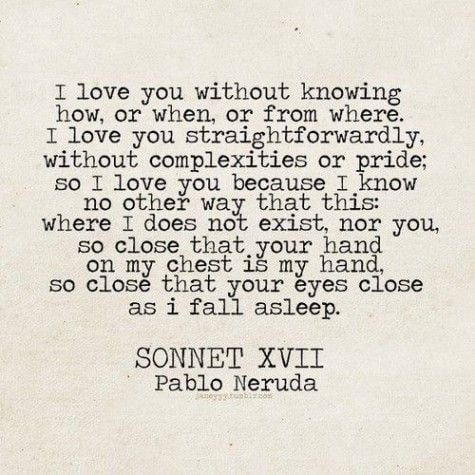
I had just seen Patch Adams and top of mind for me was part of a poem the character recited that really stuck with me (full version here):

Pablo Neruda

I know it’s ridiculously syrupy, but I apparently used to be a romantic. Huh.

Anyway, my default password became two words from the poem, smashed together. Even though I don’t use the password any more I just can’t get myself to tell you which words, though. I guess some of this story needs to remain mine alone.

Do what you love?

My latest column for A List Apart is called How to Do What You Love, the Right Way, and it’s out today. It’s a response to that mantra we hear so often, and loosely based on a rant by Merlin Mann on one of his Back to Work podcasts. Here’s the gist:

Doing what you love doesn’t necessarily mean quitting your job and starting a coffee shop. Most often, it means building your own platform, and crafting your own work, one step at a time.

[Sponsor] Readymag: Web Publishing Tool for Creative People

Usually we use a bunch of different software for creating such things as websites, presentations, photo stories and online magazines. The truth is — it all can be done easier and with one tool.

Do design, forget about coding.

Readymag provides a simple online tool for designing and publishing all forms of content, helping to focus on the creative process, rather than interface complexity and code. Among the main Readymag’s features:

  • Viewport: Easily create responsive layouts for mobile deviсes.
  • 1500+ free web fonts: From Typekit, Webtype and Google Fonts.
  • Password protection: Create private publications and share with specific audience.
  • PDF-export: Save and view your work offline.
  • Ready-to-use templates: Made by talented designers from around the world.
  • Plus: Free hosting, custom domain and analytics.

Stay creative. Try Readymag now for free.

Readymag

Sponsored via Syndicate Ads

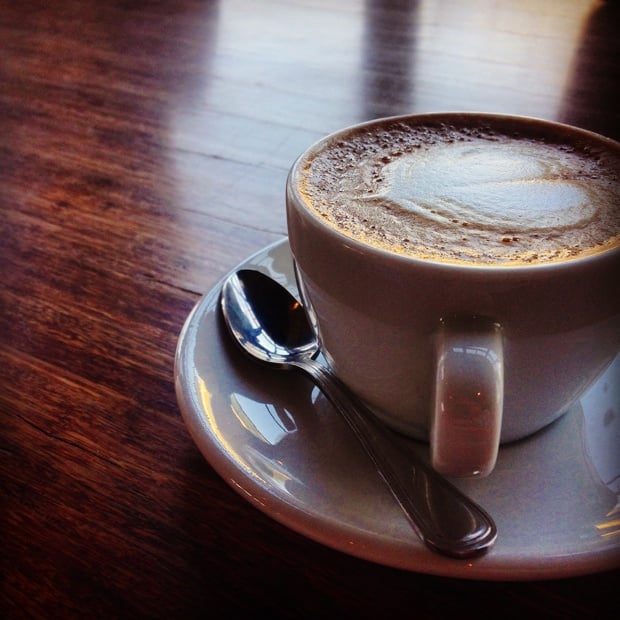
Coffee and Craft

Coffee and Craft

My favorite story about coffee is from the year 1600, when Pope Clement VIII was the head of the Catholic Church. As the story goes, the Pope’s advisers urged him to make coffee a forbidden drink for Christians. They argued that since Muslims were not allowed to drink wine, Satan invented this “hellish black brew” as a substitute. In a moment of remarkable foresight the Pope asked to try a cup before he made his decision. He was so enamored with the concoction that he came up with a different plan. “This Satan’s drink,” he declared to his advisers, “is so delicious that it would be a pity to let the infidels have exclusive use of it. We shall cheat Satan by baptizing it.”

And so it came to be that despite our vast ideological differences across regions and cultures, we can at least all agree on one thing: coffee is a deeply spiritual experience.

It’s not that I didn’t always have a strong connection with my eldest daughter. It’s just that recently, as she’s running headlong into her fifth year of life, we’ve started to connect in ways I didn’t expect. For example, this weekend we spent most of early Sunday morning building Lego models together. How did that happen? How did she suddenly get into stuff I remember liking as a child?

I know everyone always talks about how quickly kids grow up. I don’t agree with that at all. Growing up takes a long time. But I do find these sudden jumps in growth quite surprising sometimes. I feel like I should be better prepared for each jump so I can catch her if she stumbles. I guess that feeling will never go away — especially when she starts dating. Man. That’s going to be rough.

Anyway. A few weeks ago my wife brought the girls to our office for a visit one morning. I made my daughter a Babycino (frothed milk + hot chocolate sprinkles), and myself a Cappuccino. While I was making the coffee drinks my daughter sat at the table and asked me questions about what I’m doing and how the espresso machine works. I talked to her about bean extraction and crema and milk steaming, thinking that it would bore her to tears. But she was really into it. So I kept going and we ended up having a conversation about craft and why it’s cool to take your time to learn how to do things well and how good it makes you feel when you really master a skill.

I can’t remember when my obsession with coffee started. I just know that one day I started reading books about coffee history, and the best ways to brew a good cup. Then I bought an AeroPress and starting Googling for recipes. Next I bought a grinder, and a Chemex, and became annoyingly picky about beans. And before I knew it, I was that guy at dinner parties. The guy who makes you stop what you’re doing to explain where the coffee came from, how I was going to prepare it, and what they should look for when they taste it. But mark my words: when you do eventually taste the coffee you instantly forget how weird I am, and instead start talking about the unexpected party in your mouth (A guest once remarked that it tasted like angels peeing on his tongue. It is, perhaps, my proudest moment).

Charles Maurice de Talleyrand-Périgord — the Prime Minister of France during the early 1800s — once wrote a completely over the top description of how coffee made him feel. Even though he was very likely under the influence of a vast amount of caffeine when he wrote these words, I swear when I’m drinking a great cup of coffee I want to nod in vigorous agreement:

A cup of coffee detracts nothing from your intellect; on the contrary, your stomach is freed by it and no longer distresses your brain; it will not hamper your mind with troubles but give freedom to its working. Suave molecules of Mocha stir up your blood, without causing excessive heat; the organ of thought receives from it a feeling of sympathy; work becomes easier and you will sit down without distress to your principal repast which will restore your body and afford you a calm delicious night.

Yes, the taste of a good cup of coffee is amazing, but it’s about so much more than that. Most of the joy of any craft — and coffee is no exception — is how you get there. My obsession gave me much more than the ability to make a decent cup. The process — the grind, the bloom, the slow pour — is now a comforting ritual that I associate with mindfulness. It’s a deep mental breath to allow my brain to process what’s going on around me. Most of us spend our days being outlandishly busy. But as with all crafts, during the 10 minutes it takes to make a pot of Chemex, nothing else exists. Time slows down, and I’m focused on getting every detail right. Making coffee keeps the chaos out for a few minutes every day — and it helps me focus when I return to my work.

What is your craft? It doesn’t have to be coffee. But is there something that takes you away from this world for a few minutes every day? Something that’s hard enough that it takes such intense concentration that you (gasp!) even forget to check Twitter? Something with a knowledge well deep enough that you’ll never reach the bottom? Those kinds of obsessions are healthy and necessary because they keep us on our toes, curious, always growing, always learning, always grounded because you can’t win a craft. There is always more to learn.

What you get from craftsmanship is not the end of the story. Despite its many personal benefits, I’ve found craft to be surprisingly social. Hours after my family’s visit a few weeks ago I was still thinking about the brief time I had with my daughter that morning. I couldn’t help but feel like it was significant, and that I should create more of those types of moments with her. And not just with her, but with friends and colleagues too. A discussion about craft — especially if it happens around that craft — usually leads into a discussion about passion, and that easily spirals out of control to anything from a new appreciation of life to brilliant product ideas. As people who create software, those discussions can be invaluable for the work we do.

So here we are: our lives intertwined with a drink that had the potential to divide nations, but instead ended up being the catalyst for the creation of many newspapers and universities; the common element in countless debates, first dates, and last dates; and the ever-present, unassuming ingredient to any everyday conversation or meeting. This hellish heavenly brew might just be the perfect ambassador for the value of learning and practicing a craft. It doesn’t just show us how much we personally have to gain from constant learning and a focused mind. It also shows us how a big part of the joy of craft is found in the gathering of people around its edges, and the ideas that are sparked and shared as a result. Let’s actively create and seek out those moments of shared passion for the world and all we get to do in it.

Preferably around a cup of coffee.

What 11 technology books tell us about our moment

Monica Guzman spent the summer on a tech book binge. She read 11 technology books to get a sense of our current technological moment. In the short article How my summer tech book binge changed the way I think about tech she explains some of the things she learned:

Tech serves us best when we create rather than consume. Where [Nicholas] Carr saw the worst of tech’s impact, Clive Thompson, in “Smarter Than You Think,” saw the best. One difference was that Carr — in arguing, for example, that the rise of short, fast media makes our contemplative muscles weak — all but ignored how tech boosts creation. It’s a common oversight: We’re transitioning from a world where public creation was difficult to one where it’s a cinch.

The same goes for public collaboration. Great things happen when we swirl together and build. Think Wikipedia. Blogs. The Internet itself.

This is, if nothing else, a great reading list.

Want to do something? Begin now.

Who doesn’t love Ira Glass? What a legend. His I’m Ira Glass, Host of This American Life, and This Is How I Work feature in LifeHacker is really good:

I’d just say to aspiring journalists or writers—who I meet a lot of—do it now. Don’t wait for permission to make something that’s interesting or amusing to you. Just do it now. Don’t wait. Find a story idea, start making it, give yourself a deadline, show it to people who’ll give you notes to make it better. Don’t wait till you’re older, or in some better job than you have now. Don’t wait for anything. Don’t wait till some magical story idea drops into your lap. That’s not where ideas come from. Go looking for an idea and it’ll show up. Begin now.

I also loved this response to the question What’s your best time-saving shortcut/life hack?:

I’ve got nothing. Reading other people’s answers to this question on your website today made me realize I live my life like an ape. I eat the same breakfast and lunch everyday, both at my desk. I employ no time-saving tricks at all.

So, I guess in related news, I bought making-it-right.com and I don’t know maybe it will become something, maybe not…

No pen could ever suggest

Clive Thompson’s “I can’t even” is easily my favorite essay of the week. Clive goes back 100 years and finds an author that excelled at… well, I’ll let him tell you:

It must be said: Lovecraft is not a great literary stylist. His prose is good, but not great.

The one exception? This linguistic subgenre—the craft of finding new ways to say that he can’t say something. When Lovecraft does describe a monster straightforwardly, he often stumbles, defaulting to pretty journeyman prose. But when he describes the way a monster can’t be described? He is endlessly inventive. I read and reread my collection of Lovecraft, slapping in a Post-It Note whenever I hit upon one of these I-can’t-even moments, and soon the book was crammed with stickies. I’m starting to believe these catchphrases may be his most enduring contribution to English letters.

My favorite example?

The frantic playing had become a blind, mechanical, unrecognizable orgy that no pen could ever suggest.

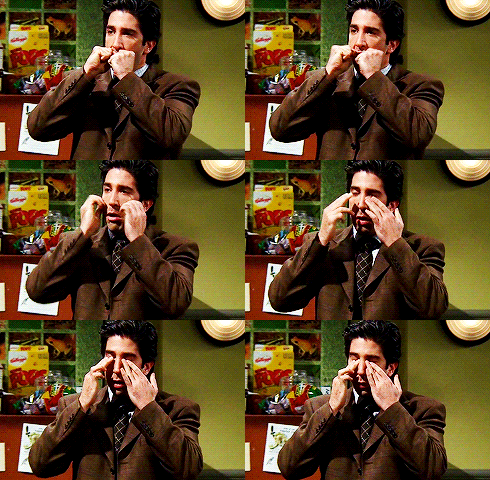
Masterful. Even better than my go-to “I can’t even” gif:

I can’t even

Topography and how we see the world

I don’t quite know how to describe Peter Richardson’s The Lay of the Land. It’s about topography, maps, and cartoons, but actually about how we see the world:

Eventually I escaped my fjord, but a few lessons of my youth have been repeatedly confirmed: topography is important, and there’s no faster way to make an impression than with a cartoon. And by “cartoon” I mean a simplification which exaggerates some details and omits others. You could also say “model,” but I like the connotations of “cartoon”; it retains a transgressive frisson that the word “model” doesn’t have, unless you’re in fashion. But anyway.

Great essay — a bit rambling, but in a way that keeps you engaged.

Software as collective language

Paul Ford’s The Great Works of Software is definitely going on my “Best of 2014” list:

The greatest works of software are not just code or programs, but social, expressive, human languages. They give us a shared set of norms and tools for expressing our ideas about words, or images, or software development. Great software gives us tremendous freedom, as long as we work within its boundaries.

Seriously, read the whole thing…