Menu

Posts tagged “creativity”

Being your own biggest critic

Ryan Singer in Identifying conflicts in a UI design:

When I’m working on a UI design I look for things that are wrong. I have to do that because ther’s no checklist of things that are “˜right’ that make a perfect product. You can’t check a requirements list and say “Yep, everything’s there!” and conclude that you made a good design. You have to look at the design itself and hunt around for problems: things that cause friction, things that aren’t clear, things that take too long, things that break expectations.

These conflicts are the heart of design. If we could just pile features one on top of the other, we wouldn’t have to do design. Design is what you do when piling elements onto each other doesn’t work. It’s the process of identifying and resolving conflicts.

This is so true. As the debate about unsolicited redesigns rage on (most recently on ignore the code), I often think about the dangers of pointing out the flaws in designs. I try to remind myself that there are most likely missing details and nuances behind design decisions that I don’t know about. As Rebekah Cox says:

Design is a set of decisions about a product. It’s not an interface or an aesthetic, it’s not a brand or a color. Design is the actual decisions.

That said, Ryan’s article reminded me that pointing out what’s wrong with a design (based on objective principles, not feelings) is the most effective way to figure out what’s right. And that process has to start at home. If we’re serious about relentless quality we have to be the biggest critics of our own designs.

The struggle between Writing and Design, or Why everyone should write

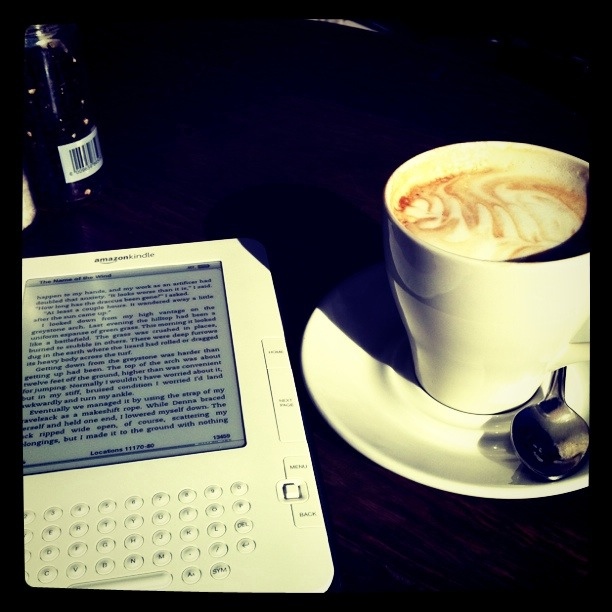
[caption id=“attachment_1181” align=“alignright” width=“240” caption=“Thinking about writing at Melissa’s Food Shop, Cape Town.”][/caption]

How good I am at my job as a software Product Manager depends on my ability to do two things: Understand the needs that real people have when they go online (whether they can articulate it or not), and building products that satisfy those needs as well as meet business goals. It occurred to me this morning that in many ways writing is about doing the exact opposite. To a large extent, writing is about being selfish.

Virtually any book or article you read about writing gives the same advice: Write what you know and what you’re passionate about. Write what’s in you, not what you think people want to read. Just last week James Shelley reminded us that people cannot help but notice an individual with passion. In another post he says:

Although passion may at times appear dangerous, the planet does not need less human passion right now, it needs more passion than ever before ”” passion that refuses to be immunized by the lulling caress of consumption and the crippling inundation of knowledge.

But it is this apparent struggle between Design and Writing (with a big D and W) that makes it so damn difficult to write sometimes. As user experience designers we’re trained to get out of our own shoes and into those of others. It’s about their needs, not our likes and dislikes. “You are not the user,” we often say.

But I have a feeling that the best writers (and designers, for that matter) are those who are able to balance this apparent conflict between user needs and internal passion effortlessly. Writers and designers who truly astound us with their work are those whose understanding of what people need are so ingrained in their beings, so much part of them, that they’re able to express their passion in a way that meets those needs “without fuss or bother,” as the NN Group definition of User Experience states.

It is for this reason that I think if you’re in software, you should write. Anil Dash got me thinking about this when he said:

Some ideas are just bigger than 140 characters. In fact, most good ideas are. More importantly, our ideas often need to gain traction and meaning over time. Blog posts often age into something more substantial than they are at their conception, through the weight of time and perspective and response.

If nothing else, the practice of writing down your thoughts (yes, about the things you are passionate about) will teach you how to create words in a way that resonates with those who read it. And just go ahead and try to convince me that won’t make you a better designer.

The biggest problem is, of course, that we all hate our own work, especially in the beginning. As Ira Glass so eloquently puts it:

Nobody tells this to people who are beginners, I wish someone told me. All of us who do creative work, we get into it because we have good taste. But there is this gap. For the first couple years you make stuff, it’s just not that good. It’s trying to be good, it has potential, but it’s not. But your taste, the thing that got you into the game, is still killer. And your taste is why your work disappoints you. A lot of people never get past this phase, they quit.

He goes on to give this advice:

And if you are just starting out or you are still in this phase, you gotta know it’s normal and the most important thing you can do is do a lot of work. Put yourself on a deadline so that every week you will finish one story. It is only by going through a volume of work that you will close that gap, and your work will be as good as your ambitions.

If you’re noticing a change in this blog over the past few weeks, you’d be right. I’ve redesigned to put the focus on the content, and I hope to write just a bit more - even if that means fewer long-form posts. I have to test this theory that writing better words will help blur the lines between what I’m good at and what people need from software. We’ll see how it goes.

And you - yes, YOU. Go write something, ok?
On the creative process, getting started, and chasing Flow.

Last week I delivered a new talk at a Cape Town SPIN meeting (the Software Process Improvement Network). While I was preparing for it I thought of a working title for my next talk:

A talk about preparing a presentation for a talk about preparing a presentation for a talk.

You see, I have a love/hate relationship with new talks. I love delivering a new talk, and I love getting feedback on what worked and what didn’t. I love making it better. And I hate pretty much every moment leading up to delivering it.

But this is, of course, the problem with the creative process.  It’s blood, sweat, and tears, most of the way. Rands recently wrote a post entitled A Hard Thing is Done by Figuring Out How to Start. He writes:

Those who do not understand creativity think it has a well-defined and measurable on/off switch, when in reality it’s a walking dial with many labels. One label reads “Morose and apathetic” and another reads “Unexpectedly totally cranking it out”. This dial sports shy, mischievous feet - yes, feet - that allow it to simply walk away the moment you aren’t paying attention, and each time it walks away, it finds a new place to hide.

I’ve spent a good portion of my life wondering where that damned dial is hiding.

He goes on to explain how random moments of discovery and seemingly useless tangents are all part of the preparation process, and that we shouldn’t be so hard on ourselves when we’re struggling to get started. He closes with this:

W’re addicted to quick fixes, top ten lists, and four-hour work weeks, but the truth is - if it wasn’t hard, everyone would be doing it and a hard thing is never done by reading a list or a book or an article about doing it. A hard thing is done by figuring out how to start.

You’ve been spending a lot of time thinking the result is what matters. You have a bright and shiny goal in mind that is distracting you with its awesomeness. It is this allure of awesomeness that is the continued reason why you keep searching around your house looking for that mischievous walking dial.

My guarantee is that what is going to make this bright and shiny thing awesome isn’t finishing. It’s all the little, unexpected details you discover trying to start. It’s all the small pieces of unexplainable execution that will not only make it yours, but also continue to teach you how you get things done. And when you’re done, you’ll discover finishing, while cathartic, is just a good reason to go start something else.

I’ve absolutely found that to be true. My basic process for preparing a new talk is as follows:

  • First, I spend weeks researching and saving articles to Delicious.
  • Then I live in FreeMind for a few days, building the outline of the talk.
  • I then proceed to tell myself I’m ready to roll, so I  spend another week or more getting all those thoughts onto slides.
  • This is followed by several nights of bad sleep as I start seeing the holes in my thinking, and struggle to find the right words/pictures/length/style/order.
  • And then, suddenly and without fail, about two nights before the talk, I hit Flow. That “mental state of operation in which a person in an activity is fully immersed in a feeling of energized focus, full involvement, and success in the process of the activity.” Things suddenly fit, I spend 10 minutes re-ordering slides and it suddenly all makes sense. From that point on, the process is an absolute joy.

Why is Flow so hard to find? Or is it meant to be hard to find, because the creative process requires struggle as its fuel?

Whatever the reason, Rands helped me relax a little bit and panic less during the beginning phases of the creative process. Because all those starts, stops, and anxiety eventually come together to collide in the ultimate high that happens when things just… flow.

Inspiration for designers stuck in the 'sheer undiluted slog'

I recently read two book excerpts, both about art and the creative process, that I think are extremely relevant to web design, so I wanted to share it here. The first is from the book Art & Fear: Observations on the Perils (and Rewards) of Artmaking, and it tells the story of a ceramics teacher on his first day of instruction:

A ceramics teacher announced on opening day that he was dividing the class into two groups. All those on the left side of the studio, he said, would be graded solely on the quantity of the work they produced. All those on the right would be graded solely on their works’ quality.

His procedure was simple: On the final day of class he would bring in his bathroom scales and weigh the work of the quantity group; 50 pound of pots rated an A, 40 pounds a B, and so on. Those being graded on quality, however, needed to produce only one pot — albeit a perfect one — to get an A. At grading time, the works with the highest quality were all produced by the group being graded for quantity.

It seems that while the quantity group was busily churning out piles of work — and learning from their mistakes — the quality group had sat theorizing about perfection, and in the end had little more to show for their efforts than grandiose theories and a pile of clay.

The second is from Absolute Truths, where a character in Susan Howatch’s novel talks about the struggles she encounters as a sculpter:

But no matter how much the mess and distortion make you want to despair, you can’t abandon the work cause you’re chained to the bloody thing, it’s absolutely woven into your soul and you know you can never rest until you’ve brought truth out of all the distortion and beauty out of all the mess - but it’s agony, agony, agony - while simultaneously being the most wonderful and rewarding experience in the world - and that’s the creative process so few people understand.

It involves an indestructible sort of infidelity, an insane sort of hope, an indescribable sort of… well, it’s love isn’t it? There’s no other word for it… and don’t throw Mozart at me… I know he claimed his creative process was no more than a form of automatic writing, but the truth was he sweated and slaved and died young giving birth to all that music. He poured himself out and suffered.

That’s the way it is. That’s creation. You can’t create without waste and mess and sheer undiluted slog. You can’t create without pain. It’s all part of the process, it’s in the nature of things.

So in the end every major disaster, every tiny error, every wrong turning, every fragment of discarded clay, all the blood, sweat, and tears - everything has meaning. I give it meaning. I reuse, reshape, recast all that goes wrong so that in the end nothing is wasted and nothing is without significance and nothing ceases to be precious to me.

These stories are some of the best descriptions of the creative process that I’ve ever read. The next time you’re mid-design and feel like you’re stuck in the “sheer undiluted slog” that is sometimes the reality of what we do, think of this.

You’re not just theorizing about perfection - you’re doing.

Think about how you can reuse, reshape, and recast all the failed efforts.

Give it meaning by letting it lead you to the next, better solution.

4 design lessons we can learn from U2 concerts

If you’re a designer (or just into good design) and a music fan, I’d like to recommend the book U2 Show. The book is about how the various U2 tours were designed — from Boy all the way through Elevation. It explains the countless hours that go into stage design, lighting design, sound & speaker stack design, and a whole bunch of other areas (and it has some great photos too). I really enjoyed the window this book provides into what goes into the design of a large rock concert, and it showed me again that basic principles of good design translate to all media forms.

Here are some things I believe the design community can learn from the way U2 design their shows:

1. Don’t place limits on the design in the beginning

U2 tour manager Willie Williams on how the PopMart tour came into being:

There was also a very direct (and very rare) brief to me that this tour would be “˜design-led’, rather than being intimidated by scale or logistics. Having proved to themselves and to the world with ZooTV that, in terms of what can be toured, “˜anything is possibl’, U2 were of a mind that the only limits to be placed on the creative ambitions of this tour were to be financial ones.

This is a really good principle.  The time for realism and feasibility will come — but in the beginning, think big

2. Challenge the limits of possibility

On the impossible design requirements given to the sound engineers:

Mark Fisher’s frustration with years of stage design constrained by traditional loudspeaker stacks led him to propose that we should keep the huge video screen free from clutter by placing the entire sound system in one central ball. Most sound engineers would have resigned on the spot, but Joe O’Herlihy rose to the challenge of mixing a live show through what would essentially be a mono PA.

Even during feasibility discussions, it is important to challenge your beliefs on what is possible.  Involve the engineering team in the product discussion — and challenge them to test the limits too!

3. Let the content shine through

I like how they talk about the huge differences between the PopMart tour and the Elevation tour:

After the broad, churchy strokes of the Lovetown show and the sensory assault of Zoo TV and the garish, high-concept japery of PopMart, here are U2 playing their songs hard, straight and in your face.

If you’ve seen the Elevation tour, you know what they mean.  The show was tastefully designed, but without distractions.  Just like a web site should be.  Design’s ultimate goal is to get users to the content and functionality they need as easily and pleasantly as possible.

4. Don’t design in silos

The book goes into detail on the simplicity of the Elevation stage and lighting design:

Video is not something that can simply be added to a show, a fact that is the downfall of many otherwise potentially interesting stage productions. We are so conditioned to look at television that moving camera pictures automatically become the focus of attention.

Because of this they went with what they call “Unmediated iMag”, which means that the screens showing the band members would be static cameras, showing everything in black-and-white to avoid distraction from what is happening on stage:

This is why it’s so important for Product Managers to include all parts of the organization during design, and why holistic design is so important.  You don’t want your company’s organizational structure to shine through in your design.

Pick up this book at Amazon if you’re interested — with more than just pretty pictures it brings a great design perspective to the enormous live concert industry.