Menu

Posts tagged “content strategy”

Clutter is an information problem, not a design problem

Scrivs brings up an interesting point about cluttered design in Why Are We Scared to Design Less?:

Will larger companies ever get on board and understand that adding more doesn’t produce better results? I don’t think the issue is that managers and executives think that more information is needed on pages, I think the issue is that the information isn’t designed well enough so that it doesn’t require a million images or words to get across.

I agree, and it goes back to a point a made a few weeks ago about a lack of Information Architecture in many UX projects.

The exhaust of our digital lives

Frank Chimero provides another eloquent take on frictionless sharing (automated posts in news feeds, like what song you’re listening to on Spotify):

The less engaged I become with social media, the more it begins to feel like huffing the exhaust of other peopl’s digital lives. It’s a bit of a weird situation: all that’s needed is a simple filter to prioritize manually posted content over automated messages.

He doesn’t explicitly say this, but the point in his post is clear. Automated content shows up in your stream not because it adds value to the network, but because it’s good Marketing ROI for brands.

You cannot design without content (structure)

Mark Boulton wrote a fantastic piece called Structure First. Content Always. He makes a strong case that it’s unrealistic (and just plain wrong) to require content to be written before design happens:

Let’s be really clear about this. It is unrealistic to write your content ”“ or ask your client to write the content ”“ before you design it. Most of the time. Content needs to be structured and structuring alters your content, designing alters content. It’s not “˜content then design’, or “˜content or design’. It’s “˜content and design’.

I often utter the phrase “you cannot design without content”, but in practice I still fall back on old habits when push comes to shove and content simply isn’t available. Mark provides a great solution in his post as he explains what content structure is all about, and how it fits into the design process.

Creepy content

“Content” Creep is an important article by Drew Breunig. I try to shy away from the word “must-read”, but this is probably as close as it gets. Breunig takes a step back to analyze the constant stream of web content we see every day, and he draws some interesting macro conclusions about the current state and future of publishing on the web.

He starts off by explaining the problems with the word “content” itself, and goes on to use the content farm “company” Demand Media as an example of the problem with measuring quality in web publishing:

Unfortunately, even if we assume page views are capable of measuring quality Demand’s business model prevents them from doing so. Because Demand’s “approach is driven by consumers’ desire to search for and discover increasingly specific information across the Internet”, page views are only capable of reflecting how well Demand’s “content” has been optimized for search engines. If a piece appears in search results, is clicked by a user, and closed because the writing is shoddy, Demand is only able to measure everything before the click. At best the page views metric can measure the quality of the headline. At worst they reflect the SEO tricks employed by a site.

Or to put it more succinctly:

Demand has created an environment which incentivizes SEO hacks more than good writing.

This is so true, and results in the type of ad-infested web sites I’ve written about before as well. Breunig goes on to explain what he calls the impending “content crunch”, and the need to adjust business models to account for quality. His conclusion is spot on:

It’s hard to believe a single word could slate an entire industry for failure. On its own, the word “content” is merely awkward. But as a unit of measurement, “content” affects business is real ways. Ignoring the variables audiences care about in order to populate Excel spreadsheets incentivizes weak writing short on substance and attention spans. All this would be tremendously depressing if it wasn’t creating an enormous opportunity for people with the courage to look beyond the numbers, where it’s too messy to measure, and invest in journalism, videos, photography, and art people might actually enjoy.

A site that immediately comes to mind as an example of the kind of courage Breunig speaks of is the brilliant Brainpickings - “a human-powered discovery engine for interestingness, culling and curating cross-disciplinary curiosity-quenchers, and separating the signal from the noise to bring you things you didn’t know you were interested in until you are.”

The article and Breunig’s main conclusions remind me of one of Clay Johnson’s points in his book The Information Diet:

Just as food companies learned that if they want to sell a lot of cheap calories, they should pack them with salt, fat, and sugar””the stuff that people crave””media companies learned that affirmation sells a lot better than information. Who wants to hear the truth when they can hear that they’re right?

The problem lies not just with the content farms, but also with us - the people who click on the links because it gives us more of what we want (even if it’s not good for us). The only solution to this problem is something that sounds like a pipe dream - expecting readers to be more conscious about the information they allow into their lives so that content farming ceases to be effective. In Johnson’s words:

The first step is realizing that there is a choice involved. As much as our televisions, radios, and movie theaters would have us believe otherwise, information consumption is as active an experience as eating, and in order for us to live healthy lives, we must move our information consumption habits from the passive background of channel surfing into the foreground of conscious selection.

For bonus points, read A long sentence is worth the read - it’s also a really good related discussion on the topic:

Enter (I hope) the long sentence: the collection of clauses that is so many-chambered and lavish and abundant in tones and suggestions, that has so much room for near-contradiction and ambiguity and those places in memory or imagination that can’t be simplified, or put into easy words, that it allows the reader to keep many things in her head and heart at the same time, and to descend, as by a spiral staircase, deeper into herself and those things that won’t be squeezed into an either/or.

Beautiful.

Mark Twain's excellent 19th century guidelines for writing on the web

We just don’t rant like we used to. Sure, there have been some good ones recently, but we have lost the art of being angry and highbrow at the same time - a skill that gives the rant a deliciously icy, brutal feel. For example, when you read something like Mark Twain’s 1895 rant about the rules of fiction, the current crop of angry that comes across our Twitter feeds feels a bit Mickey Mouse.

One of Mr. Twain’s specific complaints in the aforementioned rant is about the rules of good dialogue in fiction. As I read through it, I realized it provides a scarily perfect contrast to the language used on many web sites today:

[When] the personages of a tale deal in conversation, the talk shall sound like human talk, and be talk such as human beings would be likely to talk in the given circumstances, and have a discoverable meaning, also a discoverable purpose, and a show of relevancy, and remain in the neighborhood of the subject at hand, and be interesting to the reader, and help out the tale, and stop when the people cannot think of anything more to say. But this requirement has been ignored from the beginning of the “Deerslayer” tale to the end of it.

That’s unfortunately not what most of the web sounds like - but this paragraph from 1895 contains some of the best guidelines we have for effective web writing. Web site and application copy should:

  • Not sound robotic.
  • Use words that two people would use in everyday conversation.
  • Not be gibberish words strung together to sound fancy, but mean something to normal people.
  • Not just exist to fill up space, but have an identifiable purpose for being on that page and in that context.
  • Be relevant to the flow the user is currently in.
  • Be interesting and help tell the story.

It would seem that Mark Twain was one of our first (and best) web Content Strategists.

Craggy rocks: content strategy and the art of language design for the web

They paddled a little further, then Salty looked through his telescope again.
”A pirate ship!” he cried. “Let’s have a battle.”
“Oh dear,” said Button. “I don’t want to meet a pirate.”
“Don’t worry,” said Salty. “I’ll be the hero.”
But when they got close they found that the pirate ship was just a craggy rock.

- Angela McAllister, Salty and Button

I picked up Salty and Button for my 2-year old daughter on a whim. I just felt like we both needed a break from Winnie the Pooh. He’s a nice enough bear, but the dude’s got some serious honey issues. Much to my delight the book quickly became my daughter’s favorite, and we’re now reading it several times a day.

Yesterday something interesting happened. My daughter suddenly became fixated with one specific part of the story. The two friends think they see a pirate ship, but it ends up being just a rock. “Wher’s the craggy rock?”, she keeps asking. “Let’s go find it!” And when we find the page she points to it and says the words “craggy rock” over and over, with obvious delight.

I am now convinced that she does this just because she loves saying the words. She loves the way they sound, and the way the phrase rolls off her tongue. Craggy rock is no cellar door, but it’s pretty close. Seeing my daughter delight in language for its own sake fills me with so much joy. It reminds me of a story I just read in Clay Johnson’s excellent The Information Diet. He quotes Helen Keller, the renowned deaf-blind activist, as she describes her first experience with language:

We walked down the path to the well-house, attracted by the fragrance of the honeysuckle with which it was covered. Someone was drawing water and my teacher placed my hand under the spout. As the cool stream gushed over one hand she spelled into the other the word water, first slowly, then rapidly. I stood still, my whole attention fixed upon the motions of her fingers. Suddenly I felt a misty consciousness as of something forgotten - a thrill of returning thought; and somehow the mystery of language was revealed to me. I knew then that “w-a-t-e-r” meant the wonderful cool something that was flowing over my hand. That living word awakened my soul, gave it light, hope, joy, set it free! There were barriers still, it is true, but barriers that could in time be swept away. I left the well-house eager to learn. Everything had a name, and each name gave birth to a new thought. As we returned to the house every object which I touched seemed to quiver with life. That was because I saw everything with the strange, new sight that had come to me.

I can see this realization in my daughter’s eyes as she continues to learn new words. She’s learning that everything has a name, and that names can be beautiful.

I recently wrote about about some problems I have with language the New York Times used in one of their emails. On the Hacker News thread for the post this comment appeared:

Honestly, this just seems like nitpicking. Your main complaint about their email is that their apology isn’t phrased in the vernacular? Don’t we have better things to do with our time than complain about things like this?

The comment got to me more than it probably should have. Is the commenter right? Is it a waste of time to nitpick language? My daughter’s love for the phrase craggy rock makes me think that it’s a worthy cause to fight, after all. At the risk of stating the absolute obvious, language is the soul of civilization. We have to not just protect it, but help it thrive. We have to find the joy and the power in the names of things. In Patrick Rothfuss’ epic fantasy novel The Name of the Wind he describes the power of language like this:

“What do you mean by blue? Describe it.” I struggled for a moment, failed. “So blue is a name?” “It is a word. Words are pale shadows of forgotten names. As names have power, words have power. Words can light fires in the minds of men. Words can wring tears from the hardest hearts. There are seven words that will make a person love you. There are ten words that will break a strong man’s will. But a word is nothing but a painting of a fire. A name is the fire itself.”

So, here’s the point I’m trying to make.

Those of us who write for the web need to remember that the words we choose are not just about comprehension, but also about feeling. Phonaesthetics teach us that the sound of certain words and sentences have an inherent pleasantness or beauty (euphony), while others can be quite unpleasant (cacophony). Just as a typeface (the artistic representation or interpretation of characters) adds emotion to letters, word aesthetic can be in total harmony with other design elements.

Beauty in design isn’t just the job of visual design. Content strategy has a specific role to play in creating the desired aesthetic of a web site. And beauty is quite important in a changing landscape where aesthetic longevity is the new product expiration date. So the next time you write a paragraph for the web, ask yourself the following question:

Will the sound of these words make that one guy’s 2-year old daughter’s face light up?

Update 1/4/2012: “Nick” emailed and pointed me to the fascinating essay Politics and the English Language, where George Orwell discusses “language as an instrument for expressing and not for concealing or preventing thought”, particularly in politics. He ends with some great writing tips.

The New York Times non-apology, and the end of lazy marketing language

Yesterday I received an email from the New York Times in which they told me, “Our records indicate that you recently requested to cancel your home delivery subscription.” They proceeded to use a phrase that bears an uncanny resemblance to something I told a girlfriend who dumped me when I was 15: “We do hope you’ll reconsider.”

Here’s the problem: I canceled my subscription 3 years ago. No big deal though, mistakes like this happen all the time. I hit the Archive button and forgot about it. But this morning I woke up to another email from the Times, this one with the subject line “CORRECTION: Important information regarding your subscription.” One of the paragraphs read as follows:

This e-mail was sent by us in error. Please disregard the message. We apologize for any confusion this may have caused.

I find passive voice non-apologies like this frustrating and insulting - worse than the original mistake, because it somehow manages to avoid taking responsibility for what happened. And it looks like I can finally move on from the idea that I’m the only one who feels this way. Here’s Clinton Forry:

“This e-mail was sent by us in error.” -New York Times email. I’ll just sit here and wait for an apology for that use of passive voice.

”” Clinton Forry (@wd45) December 28, 2011

And John Holdun:

JUST ONCE I’d like a big company to omit their “We apologize for any inconvenience this may have caused” in favor of a “Sorry.” ”” John Holdun (@johnholdun) December 28, 2011

In Subscribing to The New York Times, a post about the paper’s subscription pricing, Khoi Vinh alludes to a recurring pattern in their email communications:

In the run up to my subscription expiring, the company had been sending me promotions that were urgent in their warnings but exasperating in their vagueness. Each email was unequivocal about the number of days that remained in my subscription, but the renewal rates were only hinted at.

“Urgent in their warnings but exasperating in their vagueness.” That’s a great description.

This is a big deal. Content Strategy has become mainstream, and more and more businesses are finding out that it’s more effective to talk to their customers like real people (and get to the point quickly). Yet too many old school companies continue to speak to us in that patriarchal tone, assuming that since they clearly know what’s best for us we’ll just go ahead and click that “Buy now” button (if we can find it, because we’re not that smart you see). That’s why the Times didn’t just say this in their “apology” email:

Yesterday we made a mistake and sent you an incorrect email about your subscription. We’re sorry about that. You can delete the email.

The problem is that we’re starting to notice when we’re being talked down to. This has very real implications for marketing, where traditional slogans like “Your savings start here!” and “Unbeatable service!” lose their power to pull the wool over our eyes if they’re not backed up by something real. I recently lamented the laziness of the slogan “Everything you could ever want. And more. For less.” I wondered what it would cost for some happiness and a toilet made out of solid gold, because if you take that slogan at face value I should be able to get that, right?

The lesson to companies is simple: We’re smarter than you think. Be honest about the product or service you provide, and just say “sorry” when you made a mistake. We’ll love you for it.

No more unedited first drafts

Mandy Brown in Babies and the Bathwater, a great article for the first edition of Contents Magazine:

Something about the nature of digital content seems to give us permission to slack off editorially. Digital formats are routinely marked by slapdash editing and nonexistent proofreading””a sign of how little anyone cares. Many online publications rearrange content based on the needs of machines rather than people. As the web forces us to speed up our publishing process, editing is often the first thing to be thrown out.

This is one of my pet peeves as well. Publishing is cheap, but that doesn’t mean we don’t have to do it right. I like how Merlin Mann puts it in Better:

What worries me are the consequences of a diet comprised mostly of fake-connectedness, makebelieve insight, and unedited first drafts of everything.

Words continue to matter more and more. Let’s not forget to edit them.

Please let this not be the future of reading on the web

In The Pummeling Pages, Brent Simmons sums up the experience of reading on the web, which is something I’ve become increasingly frustrated with as well:

I was there because I just wanted to read something. Words. Black text on a white background, more-or-less. And what I saw ”” at a professional publication, a site with the purpose of giving people something good to read ”” was just about the farthest thing from readable.

The site has good writing. But the pages do everything possible to convince people not to try. “Don’t bother,” the pages say. “It’s hopeless. Oh ”” and good luck not having a seizure!”

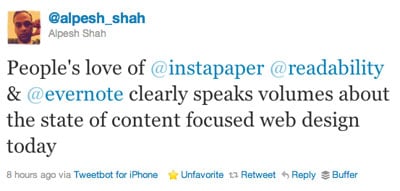
I see the sentiment echoed everywhere, including tweets like this one by Alpesh Shah:

alpesh.jpg

Just to be clear about what we’re talking about, here are a few examples that illustrate why there is such a growing frustration with reading on the web.

First, here is an article on Harvard Business Review that not only blocks me from reading anything until I click to dismiss the ad, it also messes with the other ads on the page:

HBR.jpg

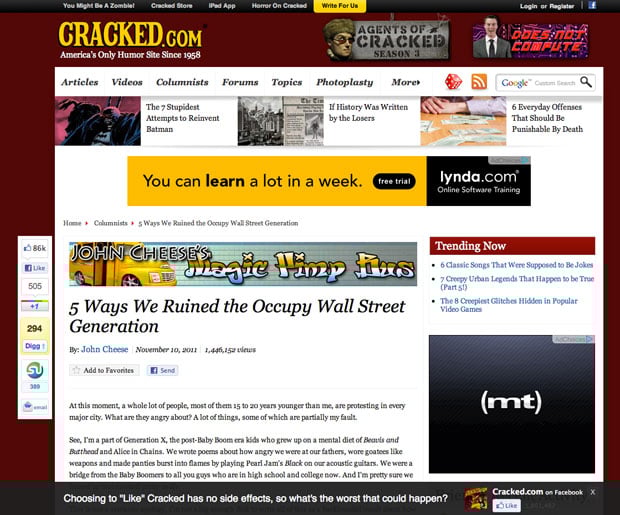
Here’s a story from Cracked.com, where in my unscientific estimation about 15% of the page above the fold is devoted to the actual text of the article:

cracked.jpg

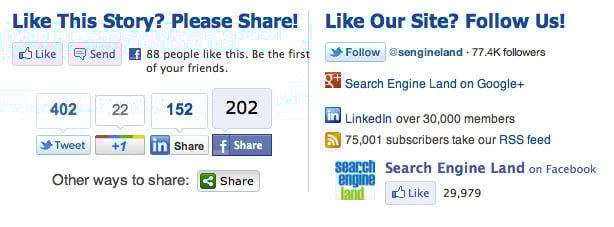
And finally, an example from Search Engine Land that illustrates the following sentiment in Brent’s article:

They’re filled with ads and social-media sharing buttons ”” and more ads. And Google plus-onesies and Facebook likeys. And also more ads. Plus tweet-this-es. Plus ads. (And, under-the-hood, a whole cruise-ship-full of analytics. The page required well-more than 100 http calls.)

sel.jpg

Is this the future of reading on the web? I sincerely hope not. I keep reminding myself of these words by Jeffery Zeldman:

Most of all, I worry about web users. Because, after ten-plus years of commercial web development, they still have a tough time finding what they’re looking for, and they still wonder why it’s so damned unpleasant to read text on the web ”” which is what most of them do when they’re online.

The scary thing is that Zeldman wrote that in 1999 (he revised the post slightly in 2005). And many years later the experience of reading text on the web seems to be getting worse, not better. As I wrote in The demise of quality content on the web, I’m worried that the wells of attention are being drilled to depletion by linkbait headlines, ad-infested pages, “jumps” and random pagination, and content that is engineered to be “consumed” in 1 minute or less of quick scanning ”“ just enough time to capture those almighty eyeballs.

As advertising clickthrough rates continue to drop, the ads become more desperate and invasive, and readers are starting to notice and do something about it. I’m doing the majority of my reading in RSS and Instapaper where I can read in peace without being pummeled by distractions.

The thing is, there are better ways to make money from writing - ways that are more respectful of readers. Ad networks like The Deck come to mind, as well as the growing number of sites that offer memberships (like The Loop and Daring Fireball).

It’s time for publishers to think different.

"You keep using that word. I do not think it means what you think it means."

Here’s another great example of how differently designers and users see the world. When we hear the word “clutter”, we think of visual noise. But Jared Spool explains what users mean when they say that word:

Over the years, w’ve learned that users have a different meaning of “clutter” than the designers do. It’s not the visual design the users are reacting to. It’s the actual content. Clutter is what happens when we fill a page with things the user doesn’t care about. Replace the useless stuff with links, copy, and content the users really want, and the page suddenly becomes uncluttered.

Here’s the kicker - their redesign was actually more cluttered, but users didn’t care:

We put the old and new pages side-by-side. The new page definitely had more text, less whitespace, and more dense information design. Yet, when we asked the users to tell us which one was more cluttered, they were unamimous: the old design was the cluttered design.

It’s another reminder (sorry, yawn) about the importance of Content First. I keep coming back to Jeffrey Zeldman’s classic essay Style vs. Design:

Most of all, I worry about web users. Because, after ten-plus years of commercial web development, they still have a tough time finding what they’re looking for, and they still wonder why it’s so damned unpleasant to read text on the web ”” which is what most of them do when they’re online.