Menu

Posts tagged “writing”

The problem with the apostrophe

Benjamin Samuel dissects the humble comma in the absolutely brilliant The Comma From Which My Heart Hangs. But it’s his enraged rant against the use of apostrophes to indicate possession that really makes this a special essay:

My colleagues might argue that the apostrophe is a perfectly normal, even useful, if not vital punctuation mark. But I say that if language adapts with the times, then it is representative of society, and that if our need for awarding possession is so great as to warrant such a tawdry and sickening punctuation mark, then the apostrophe is indicative of precisely what is wrong with our society: our inability to communicate effectively, to build relationships, to share and support the goals of others—even when those goals mean working temporarily but yet quite hard in a less glamorous position as one pursues a more respectable appointment among his true colleagues.

I don’t personally have a gripe with the apostrophe, but his passion will definitely make me more wary of our obsession with owning things. Good writing often has that effect — it forces us to look at old things in new ways.

Give it a minute

Since I’m currently knee-deep in the sheer undiluted slog of writing a book, wondering what I was thinking, Ben Yu’s There are no shortcuts really resonated with me:

Take the time to do things right — a shortcut will end up costing much more time in the long run as things come crashing to the ground.

Also, optimize for the long run. Constantly aiming for the short term, particularly in the frantic and ever-changing startup world (hoping to build a lot of hype, raise a lot of money, and get acquired in two years), tends to encourage the taking of illusory shortcuts which have the fate of failure stamped on them from the very outset.

This follows hot on the heels of something Louis C.K. said in an excellent interview:

There’s people that say: “It’s not fair. You have all that stuff.” I wasn’t born with it. It was a horrible process to get to this. It took me my whole life. If you’re new at this — and by “new at it,” I mean 15 years in, or even 20 — you’re just starting to get traction. Young musicians believe they should be able to throw a band together and be famous, and anything that’s in their way is unfair and evil. What are you, in your 20s, you picked up a guitar? Give it a minute.

So I’m learning to stop complaining, do the necessary hard work, and just give it a minute.

(“No shortcuts” link via @mobivangelist)

We're talking about hashtags again?

Hey, it’s time to argue about hashtags again! The Internet got all revved up about it this week when Daniel Victor published Hashtags considered #harmful:

In most searches, the quantity of tweets is overwhelming and the quality underwhelming. It’s worth questioning how many users find hashtag searches useful, but it’s hard to know, since Twitter doesn’t provide such data.

He goes on to make the argument that most blog posts and tweets about the article focused on:

I believe hashtags are aesthetically damaging. I believe a tweet free of hashtags is more pleasing to the eye, more easily consumed, and thus more likely to be retweeted (which is a proven way of growing your audience)

Sean Sperte followed up with On #hashtags1:

Hashtags actually do increase engagement. It may be tough to recognize through subjectivity, but the reality is, hashtags provide a mechanism for easier discovery, encourage brevity, promote a single key binding for disparate data, and even help inject tone/personality.

Whatever your personal thoughts on the use of hashtags2, it’s worth reminding ourselves that the American Dialect Society voted “hashtag” as the word of the year for 2012. So for a bit of history on our volatile relationship with the thing, have a look at these articles.


  1. Link via Kyle Baxter

  2. I agree with Daniel that they’re ugly, and I wonder if @beep is on to something

[Announcement] Elezea is joining The Syndicate

You may have seen a sponsored post here last Monday, and wondered what’s going on… Well, that was a test we ran with the good folks at The Syndicate ad network. And I can now announce that as of this week I’m officially joining the network, which includes many sites I read every day — like Shawn Blanc, TightWind, and Behind Companies.

What this means is that you’ll see one sponsored post per week, usually on a Tuesday. These posts will be clearly marked with the [Sponsor] signifier so you can tell ad content from other articles. They are high quality ads, so I also hope that you’ll find the sponsored posts useful, and visit their sites when you find something that interests you. For example, the sponsor this coming week is Wufoo — the company that I already happen to use as the contact form on Elezea.

I’m happy to answer any questions or comments you might have about this. I can assure you that being part of this network will push me to work even harder to produce good content throughout the week, to make it all worth your while.

As always, thank you for reading, and enabling my writing habit.

Design for now, but make it last

Frank Chimero talks about the misuse of the word “timeless” as it relates to design in Let’s talk about timeless design. Here’s one of his complaints:

Why is timeless design always the goal? What’s wrong with making something look like it was made when it was made? Why do designers all of a sudden want to exist outside of time, like Scott Bakula in Quantum Leap? […]

Other people: can you help me understand what is happening in this world of ours? I want to know what technology is doing to my brain. How do I stay human in a digital world? I want to understand what all this technology does to my expectations of myself, other people, and the world. None of this is timeless. These problems are right now.

I agree with Frank on this point (and the others), so it’s a little embarrassing to admit that I wrote in favour of timeless design about a year ago in The elusive goal of lasting beauty in web design. But having just read that post again, and in keeping with Frank’s point that words matter, I think it’s important to make a distinction between design that is timeless and design that lasts. I concluded my piece with the following:

I wonder what would happen if we felt the weight of responsibility a little more when we’re designing. What if we go into each project as if the design will be around for 100 years or more? Would we make it fit into the web environment better, aim to give it a timeless aesthetic, and spend more time considering the consequences of our design decisions? Would we try to design something that “makes life worth living”?

Sure, I use the word “timeless” there (probably incorrectly), but the point I’m trying to make is slightly different. I’m trying to say that the ephemeral and fickle nature of digital products shouldn’t be used as an excuse to put out unconsidered, throwaway work. Our designs don’t have to be timeless — and they should solve the problems we have now — but we should go into each project with the care and attention needed to make things last for a long time.

Email signoffs: the end is (hopefully) near

I know there are more important things in the world to get annoyed with, but I completely agree with Matthew J.X. Malady’s rant about email signoffs:

After 10 or 15 more “Regards” of varying magnitudes, I could take no more. I finally realized the ridiculousness of spending even one second thinking about the totally unnecessary words that we tack on to the end of emails. And I came to the following conclusion: It’s time to eliminate email signoffs completely. Henceforth, I do not want—nay, I will not accept—any manner of regards. Nor will I offer any. And I urge you to do the same.

And while I’m complaining about things that shouldn’t bother me, is there a way to make airlines stop telling us to “disembark the plane” instead of just asking us to get off the thing? Here’s an idea: the next time an airline announcer asks you to “commence boarding procedures”, launch into the following speech:

Research process: note-taking for one

The ideal situation for any qualitative research project is for the facilitator to rely on someone else to take notes. That way the facilitator can focus all their attention on the participant. This holds true for contextual inquiries, in-depth interviews (IDIs), as well as usability tests. However, sometimes it’s just not possible to have a separate note-taker on a project. In those cases the interviewer has to take their own notes — but that can be distracting and terribly inefficient.

So, what’s the best way to be your own note-taker?

I’ve seen interviewers taking their own notes in a variety of ways, but the inherent flaws in each approach has always made me uncomfortable. Some interviewers use their laptops to make notes while the interview is going on. This is very efficient (there’s no transcribing afterwards), but the clicking of the keyboard can be distracting and off-putting to the participant.

Others print out their interview scripts, and leave blank spaces for writing notes about each question. The problem here is that scripts are fluid. You sometimes skip over questions, while other times you go off on an important tangent that isn’t covered in the script. So you tend to end up with empty spaces and cramped notes, all spanning multiple pages. Not ideal.

I am currently working on a project to make it easier for talk radio producers to do their jobs. As a first phase we’re doing a bunch of IDIs with producers — and I have to take my own notes. So I decided to try a new approach, and I like it so far.

I started the project with a long, free-form interview with one of the project leads to develop a generic user journey for producers. I looked for common elements that remain constant regardless of the process each producer might use to perform their tasks, and used that to build a basic journey model for talk radio production. It’s not a full-on journey map, just a list of steps that all producers have to complete when they put on a show.

I then created an A3 sheet (6.5 x 11.7 in) for each interview, consisting of the participant’s name, time slot, and the headings for each of the steps in the journey. While conducting the interview I filled out any insights that came out for each of the steps — as we worked our way through the script. Here’s an example of what a sheet looked like after an interview:
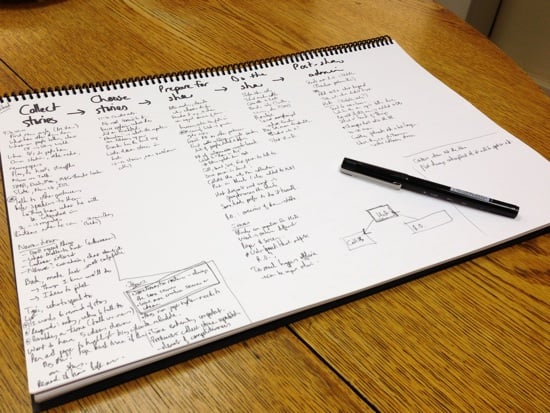
Note taking for one

I discovered that this approach has several advantages over other note-taking methods I’ve tried:

  • It’s script-agnostic. The interview questions address each of the steps in the journey, but I don’t have to stick to it religiously — it’s ok to jump around and make notes in a different column if needed.
  • Everything is on one page. This not only makes note-taking more efficient, but it’s also going to make the analysis phase easier. I’ll be able to lay out the sheets on a table and see all the data in one place as I start the affinity diagram process.
  • It makes me a better listener. I was worried that the note-taking would be distracting to participants, but I found the opposite to be true. By taking notes while we talk (and looking them in the eyes when I’m not writing), participants could tell that I’m really listening to them — not just pretending. And this made for much better interviews.

I’m sure this method of note-taking isn’t perfect, but I’m quite happy with how it turned out. Please let me know if you have any suggestions to improved this process — or if you have a different method that works well for you.

Why the Google Reader shutdown matters

I was going to write about the Google Reader shutdown but Brent Simmons beat me to the argument I was going to make. In Why I love RSS and You Do Too he sums up why we should all care about Google Reader’s demise:

Even if you don’t use an RSS reader, you still use RSS. If you subscribe to any podcasts, you use RSS. Flipboard and Twitter are RSS readers, even if it’s not obvious and they do other things besides. Lots of apps on the various app stores use RSS in at least some way. […] And those people you follow on Twitter who post interesting links? They often get those links from their RSS reader. One way or another, directly or indirectly, you use RSS. Without RSS all we’d have is pictures of cats and breakfast.

Killing Google Reader doesn’t kill RSS, for sure, but it’s such a big part of the ecosystem that we should be concerned about the health of the platform. From the perspective of a guy with a blog this is pretty depressing news. RSS subscribers are extremely difficult to grow, but they are, by far, the best kind of readers. I’ve written about this before, but to reiterate: they’re loyal, they read almost everything, and they share your stuff. It’s the best way to build an audience. Hunter Walk makes this point succinctly:

Google Reader impact also undercounted if you strictly look at # users bec many power-curators/sharers use it as a discovery system

— Hunter Walk (@hunterwalk) March 14, 2013

But Scott Stein has perhaps the best TL;DR version of the whole debacle:

Google Reader is to Twitter as a well-labeled filing cabinet is to a bag of insane cats.

— Scott Stein (@jetscott) March 14, 2013

So, what now? For a bit of nostalgia, Buzzfeed has a great history of Google Reader. It’s a fascinating story, worth reading. And then, Om Malik has an interview with the original creator of Google Reader. Once you’re done grieving and ready to move on, Lifehacker has a very comprehensive post on the alternatives.

Data confusion is a failure of design, not an attribute of information

I just came across this great interview with Edward Tufte from 2011. I love his description of bad information design, and how it’s not the data’s fault:

Overload, clutter, and confusion are not attributes of information, they are failures of design. So if something is cluttered, fix your design, don’t throw out information. If something is confusing, don’t blame your victim — the audience — instead, fix the design. And if the numbers are boring, get better numbers. Chartoons can’t add interest, which is a content property. Chartoons are disinformation design, designed to distract rather than inform. Thus they reduce the credibility of your presentation. To distract, hire a magician instead of a chartoonist, for magicians are honest liars.

Chartoons. Heh.

Anyway, I find this particularly poignant in our current infographic age, where Mashable recently posted — without irony — an infographic on infographics. Here are some of my other favorite infographic takedowns:

(link via @ericatjader)

The thing that breaks us

It’s not the load that breaks you down, it’s the way you carry it.

Lou Holtz (retired American football coach, author, and motivational speaker)

I can’t stop thinking about this quote ever since I saw it on Quote Vadis. At some point over the last three or four years, life became pretty heavy. The pressures of two kids, a career, and a life that’s just public enough to invite some nastiness every once in a while can really wear you down.

So it’s easy to fix your eyes on the load. The weight, the texture, the uncomfortableness of it all.

And then I read Austin Kleon’s words of encouragement in his post On writing post-fatherhood.

You owe your kid food, safety, and love, but you also owe him your example. You give up on The Thing, and then when the kid grows up, he might give up on His Thing, too.

So don’t give up on The Thing.

The Thing in this context is writing, but it applies to so much more. It’s the dream you can’t let go of — the products you want to build, the lives you want to affect positively, the tiny dent you want to make in the universe. If we let the load break us, The Thing will never happen, and worse — our kids will watch us give up on what’s important, and maybe do the same.

I can’t let that happen.

Here’s to carrying the load better.