Menu

Posts tagged “writing”

Passion takes practice

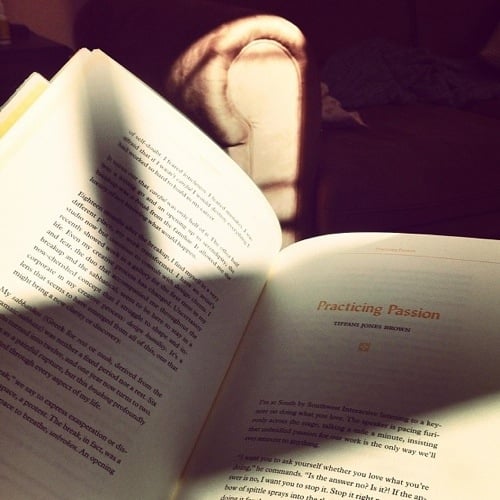
I’m slowly making my way through Issue #3 of The Manual. If you haven’t read these books, I highly recommend it — they’re wonderful essay collections. This morning I read Practicing Passion by Tiffani Jones Brown, in which she dissects the whole idea of following your passion and doing what you love. She starts with this observation:

Sure, I’d been excited to start my own business. And sure, I’d loved the idea of writing for a living. Yet banal and frustrating tasks — the kind you approach with a groan, not a fist-pump — make up much of my job. So do I feel over-the-moon about my work? I truly like it. I feel good when I get better at it. Passion overstates the point.

She then goes on to recommend a more tempered approach to the passion thing:

Instead of asking “what will make me feel passion?” we should ask, “how can I make passion happen?” The answer is to cultivate a way of living and working that makes passion more likely. Passion takes practice.

But the point that really resonated with me is the part where she talks about flow:

You can get into flow doing almost any activity, no matter how good you are at it, no matter how mundane the task. Only two things are required: the activity has to have a clear goal and a challenge. You need to be really plugged in and focused; what you’re doing must stretch your body or mind. You won’t achieve flow while multitasking or surfing the internet but you might, odd as it seems, while doing a content audit or cleaning up comps.

Those are good words to remember. Sometimes we do what we want to do. The rest of the time we do what we need to do to get the job done and get better at what we do. Anyway, I guess the point is, buy The Manual. It’s such a treat.
Practicing Passion

A tribute to the quiet ones

I’ve really been enjoying Tim Kreider’s columns for the New York Times. His essay called The ‘Busy’ Trap got a lot of attention, and for good reason. His latest is called The Quiet Ones:

We’re a tribe, we quiet ones, we readers and thinkers and letter writers, we daydreamers and gazers out of windows. We are a civil people, courteous to excess, who disdain displays of anger as childish and embarrassing. But the Quiet Car is our territory, the last reservation to which we’ve been driven. And we can be pushed too far.

I don’t want to spoil it, so I’ll just link there quietly.

Reimagining the traditional blog format

I’ve become increasingly dissatisfied with the reverse-chronological order on this site (and most blogs, for that matter). For me, the problem is that the latest few posts on the home page aren’t necessarily the most important posts I’d like readers to see. In addition to that, if a new reader visits an article through a link from elsewhere, and then checks out the home page, they won’t immediately get an idea of what the site is about.

That’s why I’m so excited about Ben Brown’s concept of Reader Aware Design. He begins with a question:

Presenting everything as a reverse chronological stream of posts made sense when we knew our readers were sitting at a desk, hitting reload on 30 tabs all day long at work. Does it still make sense when content arrives on an e-paper watch, an Xbox or a tiny slip of paper?

Ben says no, and he provides some recommendations as well as a proof-of-concept they’ve been working on. Read his post for the detail. Exciting stuff!

How to be less boring

Scott Simpson tells us something I think we all desperately need to hear in his article in Issue 4 of The Magazine:

You are boring. So, so boring.

Don’t take it too hard. We’re all boring. At best, we’re recovering bores. Each day offers a hundred ways for us to bore the crap out of the folks with whom we live, work, and drink. And on the Internet, you’re able to bore thousands of people at once. […]

The Big Bore lurks inside us all. It’s dying to be set loose to lecture on Quentin Tarantino or what makes good ice cream. Fight it! Fight the urge to speak without listening, to tell a bad story, to stay inside your comfortable nest of back-patting pals. As you move away from boring, you will never be bored.

This relates really well to a recent post by Able Parris called Focus Means Ignoring:

We need to spend less time looking to others for interesting things, and start spending more time doing the things that make us interesting. […]

Similarly, and I am saying this more for myself, it’s easy to give time and attention to the things you enjoy or are easy, but true character comes when you give focus to the things that are difficult but must be done. This means you have to ignore everything else, and know that you will be better because of it.

Just imagine the virtuous cycle this could set off… As people post fewer boring things like Foursquare checkins and retweets of how awesome they are, and we all take the conscious decision to read fewer boring things and instead spend that time listening, learning, and doing new things, we could slowly and collectively pull the current state of the social web out of that cesspool of boringness. Well, that’s a pipe dream, of course. And to be fair — there’s nothing wrong with clicking on a good animated gif every once in a while.

Anyway, back to Scott’s article. One of his recommendations for fighting the descent into becoming boring is what he calls “Expanding your circles”:

When you expand your social and intellectual range, you become more interesting. You’re able to make connections that others don’t see. You’re like a hunter, bringing a fresh supply of ideas and stories back to share with your friends.

This is very much related to Mark Granovetter’s 1973 theory of weak ties1. The theory states that because a person with strong ties in a network more or less knows what the other people in the network know, the effective spread of information relies on the weak ties between people in separate networks.

In other words, to get more interesting information out of Twitter or any other social network, you need to follow people who give you access to additional knowledge clusters. If you see too many tweets about the same thing in your timeline, or if your RSS reader shows 5 consecutive links to the same tech article, you may have too many strong ties.2

Go and and find those weak ties at the edges of your interests, and strengthen them. Otherwise we’ll just continue to talk about the same stuff over and over and over again. And that’s boring.


  1. “The Strength of Weak Ties”, Mark Granovetter, 1973. PDF link

  2. I wrote about this extensively in How to get more out of Twitter

Technology is wonderful, and terrible

Stephen Hackett’s Parenting Technology is a haunting piece of writing for The Magazine. I don’t want to give the story away, so I’ll just quote a couple of key paragraphs:

How many little moments have I missed in my kids’ lives by checking Twitter on my iPhone while they play in the yard? How many hours have I spent writing or hacking away on my Web site while I should have been reading books to Josiah?

Technology saved my son’s life, yet has left him with terrible scars. It allows me to work from the hospital on days when I need to, but distracts me from being engaged at home. Technology is wonderful, but terrible, all at once.

How we deal with that balance — with what technology wants — remains one of the biggest struggles of our time.

Poster: a great iOS WordPress app

Back in May I posted my wish list for a mobile WordPress publishing platform. Since then nothing official has come out of Wordpress to help with that list. But I’ve been using Tom Witkin’s Poster app for a while now, and it’s close enough to what I need that it has significantly increased the amount of writing and publishing I do from my iPhone and iPad.

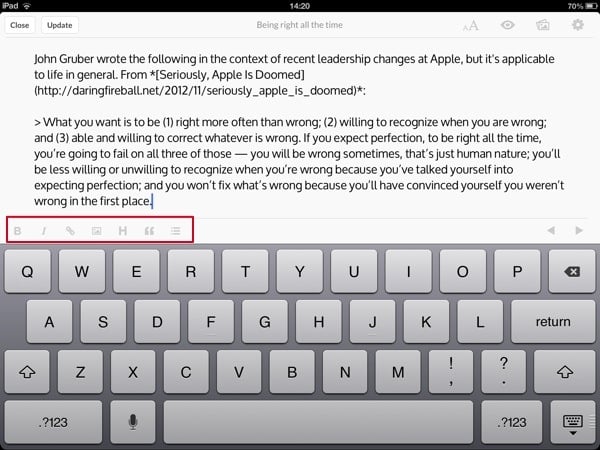
Poster’s interface is clean and focused on what’s most important: writing. It has full support for Markdown and TextExpander touch — including some custom keyboard commands to insert commonly used Markdown attributes:

Poster edit screen

The built-in preview screen makes it easy to proofread and make sure you didn’t miss anything:

Poster preview screen

The only thing that is still missing for me is a mobile Safari bookmarklet that lets me send a piece of selected web page text — along with the page title and URL — to Poster as a new post that’s ready for editing. It would also be great to see Poster integration with apps like Instapaper and Reeder.

If you run WordPress and have stayed away from mobile blogging because it seemed like too much of a hassle, give Poster a try.

Links for Poster: Official site | On iTunes

New article on Smashing Magazine: The Immersive Web And Design Writing

My latest article for Smashing Magazine came out yesterday. The Immersive Web And Design Writing is about the resurgence we’re seeing in longform writing that’s done with much patience and care. I interviewed the publishers of three such examples: Andy McMillan of The Manual, Nick Disabato of Distance, and John Boardley of Codex. After all the editing was done, I came to the following conclusion:

So, maybe what I initially thought was an article about design publications is actually an article about all of us instead. The point is not just that we should have a balanced information diet, but that the real power of that balanced diet lies in the energy it gives us to get started on our own projects. Seek out these nutritious words. You won’t regret it.

I hope you like the article!

The quantified self as a hologram of the past

I love Craig Mod’s writing, and Paris and the Data Mind is another great piece. It starts off as an article about Fitbit, and more broadly, the Quantified Self (“a movement to incorporate technology into data acquisition on most aspects of a person’s daily life”). But it quickly expands to an essay about memory in the age of data that never disappears:

I think of our check-ins, our food photos, our tagged friends. I think of our steps, our Fuel Points. I think of the myriad and nearly endless streams of data—data now actively collected but becoming increasingly passive. I think of all this and I can’t help but see a hologram projected somewhere off in the distance. A reconstitution of something, someone, miles away, years out. […]

How specific and formful our collections—these collections that constitute our selves—have become. Still not entirely whole, but closer than they’ve ever been. We play them back—literally, scrolling out timelines. A life of thoughts, granular GPS, and time-coded data. Holograms of ourselves, transparent and broken, from another time and place. They skip like a worn record, or a dusty movie reel, with pieces missing here and there. But they are us, however scratchy, and their resolution increases daily.

This theme has come up quite a bit recently — how the Internet prevents memories from fading. Craig ends up challenging the idea that unforgotten memories are necessarily a good thing.

To be creative, your most important tool is utter concentration

Mark Helprin offers up some great advice to writers in Skip the Paris Cafés And Get a Good Pen, but it’s advice that works just as well for all creative pursuits:

Your most important tools will be your honesty, labor, courage, practice, luck and utter concentration. […] More valuable than speed or being struck by what you think is lightning (and others usually do not) is concentration. When asked how he managed to come up with the calculus, surely one of the greatest achievements possible for the mortal mind, Newton replied, “I thought of nothing else.”

I love the writing style in this piece. For example, while expanding on his advice not to try to be Hemingway by writing in cafés all over Europe:

Literary skill, much less greatness, cannot be had with a pose, and exhibitionism extorts the price of failure. Also, have pity on the weary Parisians who have wanted only a citron pressé but have been unable to find a café where every single seat is not occupied by an American publicly carrying on a torrid affair with his moleskin.

When I grow up, I want to write like that.

The power of words to defy the laws of nature

Adam Kirsch’s Neverending stories is a very interesting exploration of fairy tales, and why they’ve had such longevity in our culture. The essay struggles to find its way in the first half, but it picks up steam when Adam starts to speculate about why these ancient stories continue to be so popular. I especially like this theory:

Rather, what fairy tales obsessively conjure up is a world of mutability, in which things and people are not immured in their nature. The frog becomes a prince, the wolf becomes a grandmother, the little mermaid becomes a woman, the beast becomes a handsome man, the 12 brothers become a flock of ravens. So much of the appeal of these stories, in a preliterate, premodern culture, must have been simply in their demonstration of the power of words to defy the laws of nature. In this way, the storyteller enacts the magic powers he describes and possesses the wealth he fantasises about.

All good writing conjures up thoughts and images that go beyond the immediate realities of the story that is being told.

I recently finished reading Paul Soulellis’s essay in Issue #3 of The Manual called “Design Humility”. I’ll write about it more at some point, but for now, phrases like “walking slow, but looking hard” and “amplified vulnerability” are racing through my mind at such speed that I don’t know what to do with it all yet. I love writing like that. Writing that makes you dizzy with sudden understanding and new ideas. Writing that defies the laws of nature.