
Menu

Posts tagged “user research”

How to get buy-in on your design process

Coffee at Pink Boutique, Cape Town

I recently had a long conversation about coffee with the manager at the flagship TRUTH.coffeecult retail store. Talking to people who have a passion for their craft — regardless of what that craft is — always invigorates me in my own work as well. One of the things Dominic told me is that since they’re a roaster that supplies coffee to other businesses, TRUTH’s retail coffee shops aren’t their most lucrative business opportunity. So why do they even bother with retail spaces? His answer really got me thinking:

We want to give people the tools they need to tell that our coffee is better than others.

TRUTH realizes that for most people, coffee is just coffee. Whether it’s Starbucks, Denny’s, or Ricoffy doesn’t really matter, as long as it has caffeine in it. But people like Dominic and the team at TRUTH aren’t ok with that. They see a city full of people who are losing out on the joys of an artisan coffee experience, and they want to change that.

But they also know that in order to accomplish their goal, they can’t just give people a cup of TRUTH and leave them to it. They have to teach them why it’s better. They have to explain the roasting process, show the care and precision that goes into pulling an espresso shot, and provide guidance on the flavours they need to look for. Only then will their customers be able to appreciate why TRUTH is better than other coffees.

This is not unlike the work we do in web design. When we work with clients or internal teams who are not aesthetically inclined, or don’t immediately see the value in prototyping and user research, we can’t just yell, “BUT OUR WAY IS BETTER!” and storm off in a fit of righteous anger. Instead, we have to give clients and teams the tools they need to tell that an iterative, research-led approach is better than just pumping out some PSDs real quick. We have to show case studies, and we have to explain how the investment will result in major returns for the business. We need to show passion for our craft, we need to speak confidently about what we do and why we do it, and we need to communicate the benefits to them in a clear and concise way.

Dominic went on to tell me how one person came into TRUTH earlier that day and asked to see how they make a cappuccino. The barista brought her around, showed her how the machine works, and she ended up pulling her own shot and steaming her own milk. The barista didn’t care about sharing secrets, or letting some “lesser being” touch his espresso machine. Because his goal isn’t to show people how good he is. His goal is to get people to love coffee. And if that means letting someone pull their own shot — imperfect as it may be — then so be it.

Our role as designers isn’t to show people how good we are, either. It also shouldn’t be our primary goal to win industry awards. Our goal should be to get the people we work with to fall in love with the design process, and to utilize that passion in them and ourselves to design great solutions. And the only way we’re going to be successful at that is if we invite our clients and teams to step behind the counter to see how and why we do what we do.
Don't let user experience design methods die

Des Traynor did a great interview with Ryan Singer, Product Manager at 37signals. I’m a huge fan of Ryan’s, and I agree with most of what he says in the interview. But there’s one part I’d like to challenge a bit.

Answering the question “Did you ever consider techniques like personas or user journeys, or any of those UX design methods?” Ryan says, “That stuff is all terrible”. He then obliterates the use of personas before going into a bit more detail a couple of questions later:

The things that get called User Experience come from the agency world. It really seems to be like that. Every time you meet people who are doing all of these UX methodologies they come from the consulting world. My background isn’t in the agency world; it’s in the product world. The whole game changes when you don’t have the pressure of delivering to a client on time, or trying to convince a client that you’re worth hiring or worth sticking with.

For example, if you’re working on products, and you’ve got a really capable team that can prototype things in real code, of course you don’t need wireframes, because you don’t need to get sign-off on something from a client.

This is where I disagree. I started my career in the product world. I worked at big companies, startups, and now an agency. I’ve used (and have observed others using) these “terrible” UX methods very successfully. Ryan is extremely lucky to work at a company like 37signals where personas, user journeys, and wireframes are not needed. But that is evidence of how great the 37signals culture is, not that certain UX methods are useless. I think Josh Brewer said it best:

Re: design processes—Everything depends on the context and the needs of the project. There are no absolutes. You do what needs to be done.

— Josh Brewer (@jbrewer) February 22, 2013

To get a bit more specific, here are just a few scenarios and contexts where using personas, user journeys, and even wireframing (which was pronounced dead again this week) can be really useful:

  • At large organizations, not everyone is focused on and has an understanding of what experience design is about. There’s often a lot of “I am the user” thinking going on, and an inability to see interactions from the perspective of users. In those circumstances, personas and user journeys in particular can be enormously beneficial to help the organization see their products from a user’s perspective. Personas aren’t prescriptive, they’re descriptive. You can’t identify a persona and then try to predict people’s behavior off it. But you can use personas to help focus development efforts on users, and help define what features are included in (and just as importantly, excluded from) the product.
  • At startups as well as large organizations, we’ve used user journeys effectively to guide the organization away from systems thinking that’s focused on internal structures and technologies, to user process thinking that results in the design a of much better experience. Once again, when you’re dealing with people who come from non-UX backgrounds, making this shift can be tougher than it seems.
  • At agencies, we like to help companies wherever we can. To do this, we say that user experience and user-centred design scales well. Therefore, running a task-based usability test in a controlled lab environment will get the best results, but if there isn’t budget, guerilla testing is better than nothing. Similarly, sketching interfaces and then building a clickable prototype for iteration is absolutely the preferred way to go. But lacking budget, flat wireframes for quick iteration is better than doing no iteration at all. We can’t be so idealistic that we’re not willing to scale down our processes when we need to.

So, just to reiterate my point. 37signals appears to be an organization that is in lock-step agreement about their vision and goals. This means that they can build prototypes in code, iterate on that together, and they might not need reminders about their user personas and journeys. That is a fantastic place for a company to be in.

But to call UX methods “terrible” ignores the fact that most of us work in organizations where building good experiences is only 50% design challenge. The other 50% is organizational challenge to get all stakeholders pulling in the right direction. And in the right context, UX methods can be extremely helpful to address both types of challenges.

Further reading:

Using personas for more effective client work

In my latest article for Smashing Magazine I discuss How To Sell Your UX Design Solution To Clients:

How do you convince clients to trust you with their valuable and much-loved product? In my experience, the best way to sell work to clients is to apply user-centered design not only to the work we produce, but also to the clients who commission that work.

We have to understand who our clients are, what is important to them and what their goals are. And then we have to deliver work that not only meets the needs of end users, but also satisfies the personalities within the company itself.

I go through three different “client personas”, and how we adjust our process slightly for each. If you’re in the business of doing client work, I hope you’ll find the article useful.

Alternatives to User-Centered Design

Cennydd Bowles casts a critical eye on the UCD process in Looking Beyond User-Centered Design. He lists several weaknesses of UCD, including the negation of style — the idea that “Good design is invisible”:

By negating the idea of a designer’s influence, we also negate the idea of style within the UX discipline. We’re saying that, done properly, it should be impossible to tell one UX designer’s work from another’s. There should be no signature elements, no philosophical movements, no overarching tenets except that of transparency. […]

Of course our designs must put users first. But there is never just a single way to meet user goals. Instead of trying to deprecate style, we should embrace it as a way to drive our practice forward and lend personality to the things we make. In a marketplace of bewildering clutter, products with a damn opinion are by far the most interesting.

Cennydd’s main point is not that UCD is a bad methodology and that we should stop using it, but that its dominance might be a problem. Designers should be familiar with many modes of design, so that we can draw on a variety of techniques, not just our favorite one. It’s a good article, well worth your time.

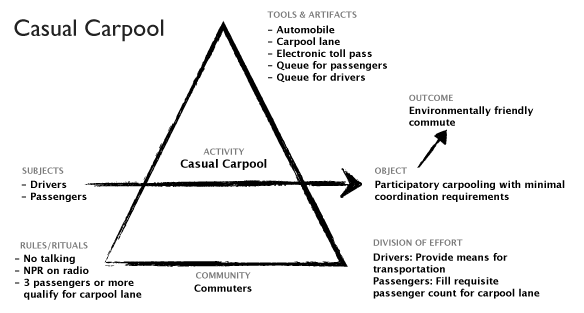
One of the alternative approaches that Cennydd touches on is Activity-Centered Design (ACD). I want to focus on that because Mike Long wrote a great article about ACD recently, cheekily called Stop Designing for “Users”. He discusses some limitations of personas before introducing Activity Theory, and a technique they use often called the Human Activity System Diagram.

As an example, Mike shows how he used the diagram to understand behaviors and actions in a local carpool:

Image source: Stop Designing for “Users”

Mike explains how ACD resulted in a better understanding of the problem (and possible solutions) than UCD would have:

By analyzing the whole system, rather than individuals, I came to the realization that the objective for drivers and passengers to carpool with minimal coordination was already happening. In the casual carpool pickup spots rituals and norms naturally emerge with readily available tools and artifacts. Namely, vehicles and queues. What about other issues like lost-and-found items? The system has already compensated: If someone forgets to take a purse or a phone when they get out of a vehicle, the driver can simply post “found” signs at the head of the passenger queue. Any other solution I can think of would require another layer of coordination between drivers and passengers.

Both these articles challenged me to think broader than UCD and explore other design systems — even ones I’ve been skeptical about in the past, like Genius Design. I realised that even though UCD is a proven way to build great user experiences, it would be foolish to ignore the good lessons we can learn from other methodologies.

What users really care about

In his introduction to a very interesting user research case study on the MailChimp blog, Gregg Bernstein writes:

Here at MailChimp, we’re realists—as much as we love email and all the things you can do with it, we understand that building a campaign is a task, not a life event. You want to get in, get done, and get on with things. Duly noted.

The post goes on to explain how they managed to shave an average of 32 seconds off a core email campaign creation task at MailChimp. But it’s that opening sentence I’d like to dwell on for a bit.

I wish more companies understood this crucial point. As designers and product managers we obsess over every detail of our product, but it most likely makes up a minuscule part of our users’ days. Unless you work for Facebook or Twitter users don’t wake up wondering what new features you’ve released, how your conversion rate has changed over time, or what awards you’ve won. They care about getting a task done, and they care about nothing getting in their way — they care about getting on with their lives.

Yesterday The Onion published an article that is such a spot-on commentary on how we’re mostly ignoring this reality. From Internet Users Demand Less Interactivity:

Tired of being bombarded with constant requests to share content on social media, bestow ratings, leave comments, and generally “join in on the discussion,” the nation’s Internet users demanded substantially less interactivity this week.

Speaking with reporters, web users expressed a near unanimous desire to visit a website and simply look at it, for once, without having every aspect of the user interface tailored to a set of demographic information culled from their previous browsing history.

Exactly. We’re in an environment where too often products and functionality are shaped by who we are and what’s technically possible, not by what user needs call for. XKCD called us on it years ago, but we’re just not listening:

University website

The solution to this problem is to get out into the world and understand how our products and services fit into the lives of our users. How we can help them accomplish their tasks more effectively. Mark Hurst summed this up well in his post What is a career in user experience really about?:

Good user research isn’t a matter of learning the steps of some trendy methods, as though one were just following a cookbook. Instead, good UX work requires a genuine interest in observing, listening to, and learning from other people: primarily the customers themselves, but also the organization that owns the product. That observation, and that listening, must stem from a genuine human interest in people.

We can all do with a shot of humility about our products. We might think what we’re making is a gift to humankind that deserves proper respect — and we absolutely should be proud of our work. But a bit of human empathy will show us that most users have only a passing fly-by relationship with our products. That’s ok though. Understanding how our products fit into people’s lives realistically will help us to improve that fit and (hopefully) become indispensable to them. That’s our job as User Experience Designers.

Growing up on the social web

Hunter Walk wrote a great article about Facebook Connect and how difficult it is to own the social web, called Trying to be the one true social graph is like trying to hold water in your fist. One of the fascinating parts is his observation about how the next generation is using technology:

Each new group of kids come of age wanting a space they can discover together and call their own. This is DNA, not computer science. It’s not about tech changing (oh, this is Facebook if it was build only for tablets) - it’s about getting to a dry piece of land when you’re 13 years old and being able to plant your own flag. I don’t see how you get beyond the anthropology of this.

In light of that, Josh Miller’s Tenth Grade Tech Trends and Justin Hoenke’s follow-up Tenth Grade Tech Trends (Take Two) are important data points to know about. These are very anecdotal, sure, but Josh and Justin’s takeaways are definitely worth debating. Here, for example, is Josh’s insight based on his 15-year old sister’s comment that Tumblr is just for middle schoolers:

I can’t get over the “middle schoolers use it” comment, especially since they use Tumblr as an identity tool. That’s exactly how my friends and I used Myspace in middle school, and we too abandoned it (for Facebook) once we reached high school. So in middle school you care a lot about your personal presentation (themes and cultural images on your Myspace or Tumblr page), but once you reach high school you care more about the people you present yourself with (photos on Facebook and Instagram)?

If you’re interested in how teens use social media, it’s worth following danah boyd’s blog. She is a researcher on media and youth culture, and her insights are always interesting. Here’s a particularly relevant excerpt from her post Risk Reduction Strategies on Facebook:

Shamika deletes every wall message, status update, and Like shortly after it’s posted. She’ll post a status update and leave it there until she’s ready to post the next one or until she’s done with it. Then she’ll delete it from her profile. When she’s done reading a friend’s comment on her page, she’ll delete it. She’ll leave a Like up for a few days for her friends to see and then delete it. When I asked her why she was deleting this content, she looked at me incredulously and told me “too much drama.” Pushing further, she talked about how people were nosy and it was too easy to get into trouble for the things you wrote a while back that you couldn’t even remember posting let alone remember what it was all about. It was better to keep everything clean and in the moment. If it’s relevant now, it belongs on Facebook, but the old stuff is no longer relevant so it doesn’t belong on Facebook.

With behaviour like that, it’s no surprise that ephemeral apps like Snapchat and Poke are so successful.

Designers should be in a constant state of observation

I really enjoyed Sarah Doody’s article in UX Magazine called The Flâneur Approach to User Experience Design. Flâneur is a French word that means “to stroll.” Sarah explains:

The flâneur’s mind is always in a state of observation. He or she connects the dots through each experience and encounter that comes his or her way. The flâneur is in constant awe of his surroundings. In the article “In Search Of Serendipity” for The Economist’s Intelligent Life Magazine, Ian Leslie writes that a flâneur is someone who “wanders the streets with purpose, but without a map.”

In the world of product design and start ups, there’s growing pressure to focus prematurely on the solution, to connect the dots backward instead of forward, to design the system before you’ve addressed the story. But, as user experience designers, we know that our greatest purpose is to develop the most intimate understanding of the people we design for and the problems they’re facing. To do this, we must be flâneurs.

It’s really worth reading the whole article to see more of Sarah’s conclusions and advice.

People care about stories, not products

Here’s an important reminder that tools don’t matter as much as we think they do. What matters is how the tools enable people to accomplish their goals. From Chana Joffe-Walt’s Why Legos Are So Expensive — And So Popular (my emphasis added):

But Lego did find a successful way to do something Mega Bloks could not copy: It bought the exclusive rights to Star Wars. If you want to build a Death Star out of plastic blocks, Lego is now your only option.

The Star Wars blocks were wildly successful. So Lego kept going — it licensed Indiana Jones, Winnie the Pooh, Toy Story and Harry Potter.

Sales of these products have been huge for Lego. More important, the experience has taught the company that what kids wanted to do with the blocks was tell stories. Lego makes or licenses the stories they want to tell.

No one cares about your product as much as you do. But they do care about their stories. And understanding that can help you make better products.

Going beyond usability to design meaningful experiences

Giorgio Baresi wrote a long and very interesting post on how designers have an opportunity (and responsibility) to go beyond usability to build meaningful products that enrich people’s lives. From Designing Life-Changing Solutions :

The spread of widely available technology, such as sensors, smartphones, and high-speed mobile networks, puts us on top of a mountain of data and allows designers to tackle problems in ways that were unimaginable even a few years ago. By making sense of this abundance of data, designers are able to create life-changing products and services that help people achieve goals and objectives in relevant, meaningful, and actionable ways.  This ability moves design beyond the “A to B” scenario to embrace whole new solutions in which the starting point is known but the destination and the path to get there cannot be precisely defined upfront. Clear goals with clear paths have broadened, becoming as vague as “taking good care of yourself,” “living a healthy lifestyle,” or “managing your personal finances.”

This creates the opportunity for designers to work together with psychologists, as well as other subject matter experts, to better define how these broad challenges can be translated into meaningful products and services that are able to become true life companions.

Giorgio shares some great examples, as well as three design principles to help turn these goals into reality. It’s definitely worth making time for this one.

Quote: Jordan Moore on designing for the right people

If you are build­ing a web­site (re­spon­sive or oth­er­wise) and your pro­ject per­sonas be­come in­dus­try he­roes rather than those you painstak­ingly iden­ti­fied at the be­gin­ning of a pro­ject then it’s time to worry.

— Jordan Moore, Be careful who you build for.