Menu

Posts tagged “technology”

The awkwardness of IM chat indicators

I really enjoyed Ben Crair’s essay on those indicators that show you when someone else is typing during an IM chat — which he calls The Most Awkward Feature of Online Chat. I thought I was the only one who started getting anxious when I see that indicator sit there for more than a few seconds. A quote from Clive Thompson sums it up:

Hmmm, why did they start typing and then stop? Obviously, most of the time this isn’t an issue, but if you’re involved in a sensitive or emotionally charged conversation, these questions of pausing can become emotionally charged themselves!

And this:

But knowing when your partner is typing can also have the unsettling effect that Thompson described: It makes visible the care with which we pick our words. And the more visible this care becomes, the more the reader distrusts the message. Conversation is supposed to feel natural, after all. The quip is less funny if it’s not offhanded. Flirtation is not so flattering if it appears to require labor. And the apology can seem less heartfelt when you know it’s been self-lawyered.

The Internet is hard.

Smart cities as citizen-inspired networks

Every time someone writes about smart cities my ears perk up. Sommer Mathis just published a great interview with Anthony Townsend (the author of the new book Smart Cities: Big Data, Civic Hackers, and the Quest for a New Utopia). From The Rise and Fall and Eventual Rise Again of the ‘Smart City’, quoting Townsend:

But our “smart” cities are going to look much more like the web, where there’s going to be a lot of things deployed by individual decision, talking to each other through open standards in very ad hoc, loosely knit ways.

And what I like about that is that kind of architecture is actually what a good urbanist would tell you builds a good city. You build an open grid, you allow people to customize the pieces of it that they have jurisdiction over, and you get this fine-grained, resilient, vibrant kind of system with a lot of complexity, as opposed to a very controlled, hierarchical system that’s actually fairly brittle when it comes under stress.

It’s great to see smart city thinking evolve away from large centralised systems to citizen-inspired networks. Some more interesting articles on this topic:

Technology invasion fear-mongering

Poorna Bell’s So Long, FOMO is making the rounds today:

At nearly every restaurant table I saw, there was at least one person (if not most) who spent most of their time taking photos or video to put on Facebook later, or searching for something on the internet, or playing games or just checking for texts. For more and more of us, technology is taking over, invading even our most personal and private of moments.

This idea that technology is turning us into antisocial monkeys is getting pretty old. Putting photos on Facebook helps you connect with others around the experience. Searching for something on the internet helps you move conversations forward (or change direction completely). All these activities are inherently social. Jason Feifer’s impassioned rejection of Sherry Turkle’s doom-and-gloom ideas provides a very good counterargument to all the fear-mongering:

Turkle imagines that any interaction with technology somehow negates all the time spent doing other things. She also imagines that we must devote ourselves in only one way to every task: At a dinner table, we are only serious and focused on conversation; at a memorial service, we are only mournful. That is not the way we live. It’s never been the way we live. And that’s the beauty of technology, which Turkle cannot see: We can use it for all purposes, to express joy and sadness, to have long conversations or send short texts. We made it. It is us.

It’s time for us to realise that we are evolving the way we communicate with each other, and that’s ok. I’m not saying we shouldn’t be mindful about how much time we spend staring at our phones, but we should recognize how much more social our devices are making us. Clive Thompson points this out in his book Smarter Than You Think:

What are the central biases of today’s digital tools? There are many, but I see three big ones that have a huge impact on our cognition. First, they allow for prodigious external memory: smartphones, hard drives, cameras, and sensors routinely record more information than any tool before them. We’re shifting from a stance of rarely recording our ideas and the events of our lives to doing it habitually. Second, today’s tools make it easier for us to find connections—between ideas, pictures, people, bits of news—that were previously invisible. Third, they encourage a superfluity of communication and publishing. This last feature has many surprising effects that are often ill understood.

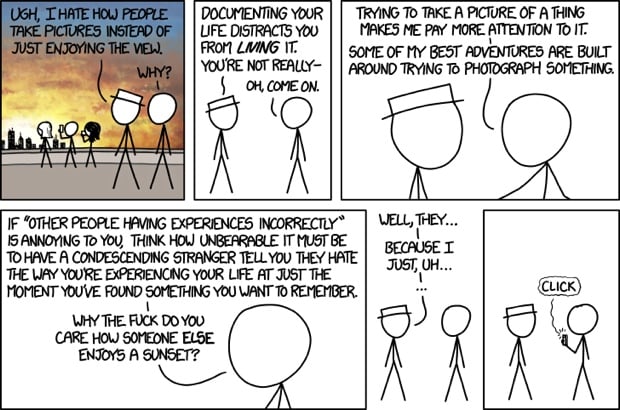
And we should also remember that it’s not up to us to tell people how to experience the moments that are important to them. As usual, XKCD says it best:
Photos

Postmodernism vs. Big Data

It took me a while to get through Michael Pepi’s The Postmodernity of Big Data. It’s dense, and the premise seemed so far-fetched that I wasn’t sure it would be worth the time investment:

But beyond economic motivations for Big Data’s rise, are there also epistemological ones? Has Big Data come to try to fill the vacuum of certainty left by postmodernism? Does data science address the insecurities of the postmodern thought?

Yes, I know, that sounds like a bit of a stretch. But I’m glad I stuck with it. The essay brings up some really interesting thoughts around the certainty promised by Big Data (even though some view it as nothing more than a clever marketing campaign for something that has been around a long time), and how that might be a response to the relativism of postmodernism:

Though both are projects that address positions about empiricism and meaning making, postmodernism and Big Data are in some senses opposites: Big Data is an empirically grounded quest for truth writ large, accelerated by exponentially expanding computing power. Postmodernism casts doubt on the very idea that reason can unearth an inalienable truth. Whereas Big Data sees a plurality of data points contributing to a singular definition of the individual, postmodernism negates the idea that a single definition of any entity could outweigh its contingent relations. Big Data aims for certainties — sometimes called “analytic insights” — that fly in the face of postmodernist doubt about knowledge. Postmodernism was confined to the faculty lounge and the academic conference, but Big Data has the ability to dictate new rules of behavior and commerce. An e-commerce outfit is almost foolish not to analyze browsing data and algorithmically determine likely future purchases, or as Jaron Lanier put it in Who Owns the Future, “your lack of privacy is someone else’s wealth.”

Consider this your difficult but satisfying weekend reading project.

In defense of web standards

Jeffrey Zeldman in a strong defense of web standards:

While many of us prefer to concentrate on design, content, and experience, it continues to be necessary to remind our work comrades (or inform younguns) about web standards, accessibility, and progressive enhancement. When a site like Facebook stops functioning when a script forgets to load, that is a failure of education and understanding, and all of us have a stake in reaching out to our fellow developers to make sure that, in addition to the new fancy tricks they’ve mastered, they also learn the basics of web standards, without which our whole shared system implodes.

I’ll add this to the ever-growing case for progressive enhancement.

The networked camera

Craig Mod’s Goodbye, Cameras kicked off an interesting discussion on the future of photography and connected devices:

As I’ve become a more network-focussed photographer, I’ve come to love using the smartphone as an editing surface; touch is perfect for photo manipulation. There’s a tactility that is lost when you edit with a mouse on a desktop computer. Perhaps touch feels natural because it’s a return to the chemical-filled days of manually poking and massaging liquid and paper to form an image I had seen in my head.

Yet if the advent of digital photography compressed the core processes of the medium, smartphones further squish the full spectrum of photographic storytelling: capture, edit, collate, share, and respond. I saw more and shot more, and returned from the forest with a record of both the small details — light and texture and snippets of life — and the conversations that floated around them on my social networks.

Also see Camera makers are desperately trying to stay a step ahead of smartphones—and failing and Connectedness for some interesting follow-up discussions.

The absurdity of "personal productivity"

Mark O’Connell wrote a very interesting article about a fairly unsettling iOS app called Days of Life — “a counter for the days you have left to live.” In Deathwatch he explores just how weird and absurd this app turns out to be:

Days of Life is one of those technologies that seems to incidentally satirize our relationship with technology more broadly. It sits in the “Productivity” folder on my iPhone’s home screen, along with my calendar and a to-do list app called Remember the Milk, but it would be as appropriately housed in a folder called “Existential Terror.”

So much of what we value in technology is its promise to upgrade the hardware of our lives, to make us more useful to ourselves — more productive, more profitable, more effective. Days of Life functions like a reductio ad absurdum of the logic of personal productivity. The pie chart becomes a special way of being afraid: an image of the self as a micro-economy of numbered days.

We sometimes have such a warped view of what it means to be “productive”, and this essay does a good job of shining a spotlight on that.

Netflix's 76,897 micro-genres and the age of data-driven art

Alexis Madrigal — who is turning into one of the most interesting journalists of our time — goes deep on Netflix’s 76,897 (often bizarre) micro-genres in How Netflix Reverse Engineered Hollywood:

Netflix has meticulously analyzed and tagged every movie and TV show imaginable. They possess a stockpile of data about Hollywood entertainment that is absolutely unprecedented.

Netflix is putting in a staggering amount of effort on the structured data of their TV shows and movies. And of course, it’s all for one reason — to get to know you better:

They capture dozens of different movie attributes. They even rate the moral status of characters. When these tags are combined with millions of users’ viewing habits, they become Netflix’s competitive advantage. The company’s main goal as a business is to gain and retain subscribers. And the genres that it displays to people are a key part of that strategy. “Members connect with these [genre] rows so well that we measure an increase in member retention by placing the most tailored rows higher on the page instead of lower,” the company revealed in a 2012 blog post. The better Netflix shows that it knows you, the likelier you are to stick around.

And now, they have a terrific advantage in their efforts to produce their own content: Netflix has created a database of American cinematic predilections. The data can’t tell them how to make a TV show, but it can tell them what they should be making. When they create a show like House of Cards, they aren’t guessing at what people want.

What’s interesting is that similar things are happening in other forms of media as well. Spotify and Rdio’s knowledge of our listening data can be used to inform record labels what type of albums they should invest in. And as David Streitfeld reports in As New Services Track Habits, the E-Books Are Reading You, a new crop of companies are helping authors figure out what type of books they should write:

The move to exploit reading data is one aspect of how consumer analytics is making its way into every corner of the culture. Amazon and Barnes & Noble already collect vast amounts of information from their e-readers but keep it proprietary. Now the start-ups — which also include Entitle, a North Carolina-based company — are hoping to profit by telling all.

“We’re going to be pretty open about sharing this data so people can use it to publish better books,” said Trip Adler, Scribd’s chief executive. […]

Scribd is just beginning to analyze the data from its subscribers. Some general insights: The longer a mystery novel is, the more likely readers are to jump to the end to see who done it. People are more likely to finish biographies than business titles, but a chapter of a yoga book is all they need. They speed through romances faster than religious titles, and erotica fastest of all.

All of this raises familiar questions about the loss of serendipity — finding interesting things we’re not looking for. But I still think this is an unnecessary fear.

Mixing public and private moments on social networks

Megan Garber takes on Instagram Direct1 in Behold, Facetwitterest: The Standardized Future of Social, and makes this observation:

So one of the biggest challenges facing the major (and the trying-to-be-major) social networks is a structural one: How do you build yourself up and out in ways that balance users’ desire for intimacy with their desire for publicity? How do you merge the web’s ability to create communities with its ability to create universalities? 

You could read Direct as Instagram’s (and Facebook’s) latest attempt to navigate that tension. The service is, basically, attempting to add a layer of privacy to its existing, public-leaning architecture. But Instagram isn’t just Snapchatting itself. It’s offering its users a Snapchat-like functionality within the context of its much more public social network. It’s trying to have it both ways — cynically, but perhaps ingeniously — by offering a refuge of privateness within a very public service.

It reminds me of something Luke Wroblewski said recently:

Every mobile app attempts to expand until it includes chat. Those applications which do not are replaced by ones which can.

Direct appears to be a necessary defensive move by Instagram — private messaging is now a basic expectation for social networks. But it also looks like people are getting more savvy about their privacy and what happens to their data (Thanks, NSA!), so it will be interesting to see how this mixing of public and private plays out in 2014.


  1. The ability to send photos privately to people in your network 

Maybe social media won't make us forever alone after all

Forever alone

Clive Thompson takes on the “social media is bad for teens” narrative in Don’t Blame Social Media if Your Teen Is Unsocial. He discusses some findings by Microsoft researcher Danah Boyd:

What she has found, over and over, is that teenagers would love to socialize face-to-face with their friends. But adult society won’t let them. “Teens aren’t addicted to social media. They’re addicted to each other,” Boyd says. “They’re not allowed to hang out the way you and I did, so they’ve moved it online.” […]

The result, Boyd discovered, is that today’s teens have neither the time nor the freedom to hang out. So their avid migration to social media is a rational response to a crazy situation. They’d rather socialize F2F, so long as it’s unstructured and away from grown-ups. “I don’t care where,” one told Boyd wistfully, “just not home.”

Thompson and Boyd are joining a growing number of authors who push back against the notion that technology makes us stupid, social media is bad for us, etc. I’m currently making my way through Thompson’s book, Smarter Than You Think: How Technology is Changing Our Minds for the Better. It’s really great so far, and I’ll write a full review when I’m done, but his core argument comes down to this:

What are the central biases of today’s digital tools? There are many, but I see three big ones that have a huge impact on our cognition. First, they allow for prodigious external memory: smartphones, hard drives, cameras, and sensors routinely record more information than any tool before them. We’re shifting from a stance of rarely recording our ideas and the events of our lives to doing it habitually. Second, today’s tools make it easier for us to find connections—between ideas, pictures, people, bits of news—that were previously invisible. Third, they encourage a superfluity of communication and publishing. This last feature has many surprising effects that are often ill understood.

Also consider Jason Feifer’s impassioned rejection of Sherry Turkle’s doom-and-gloom ideas1 in Google Makes You Smarter, Facebook Makes You Happier, Selfies Make You A Better Person:

Turkle imagines that any interaction with technology somehow negates all the time spent doing other things. She also imagines that we must devote ourselves in only one way to every task: At a dinner table, we are only serious and focused on conversation; at a memorial service, we are only mournful. That is not the way we live. It’s never been the way we live. And that’s the beauty of technology, which Turkle cannot see: We can use it for all purposes, to express joy and sadness, to have long conversations or send short texts. We made it. It is us.

I’m coming around to the idea that online connections are as real as “IRL” connections2. We’re just going through a reframing that happens every time a new technology comes along, and that’s ok. I also think we need both sides of the argument — pessimists as well as optimists — to help us work through it all and find our middle ground.


  1. Yes, I know, I’ve written about her stuff quite a bit. It’s time to start looking at the other side of the argument. 

  2. Also see my post The fetishization of the offline, and a new definition of real