Menu

Posts tagged “technology”

Screens don't have to melt our kids' brains

Melt

Mat Honan’s Are Touchscreens Melting Your Kid’s Brain?1 set off the latest in what has become a recurring tech theme over the past few years:

I’m perpetually distracted, staring into my hand, ignoring the people around me. Hit Refresh and get a reward, monkey. Feed the media and it will nourish you with @replies and Likes until you’re hungry and bleary and up way too late alone in bed, locked in the feedback loop. What will my daughter’s loop look like? I’m afraid to find out.

This has been a difficult topic for me for a long time. In 2012 I wrote an article for Smashing Magazine called A Dad’s Plea To Developers Of iPad Apps For Children, in which I aired some of my frustrations with apps for kids. That piece brought out a lot of anger, including a comment that I’ll never forget:

Wow really?? great parents here.. having a kid under 7 stare at a screen, really?? come on!! no kid under 7 should use an iPad for what?? play outside, play with your toys, your friends, read. People who have a 2yr old use an ipad/iphone, shouldn’t have kids in the first place! shame on you

I started writing a passionate reply, explaining our reasoning and the rules my wife and I have for screen time, but I ended up just dropping it. No one has ever changed their opinion based on a comment they read on a blog, so why bother.

Anyway, I digress. I tend to agree with Robert McGinley Myers’ response to Mat’s article. In Screens Aren’t Evil (which you should read in its entirety) he says:

But we need to get beyond worrying about whether “screens” are melting our kids’ brains. What we need to be conscious of is encouraging our kids, and ourselves, to engage in activities that enrich us. Sometimes that’s interacting with each other, sometimes that’s a hike in the forest, sometimes thats a great book, and sometimes that’s an incredible video game. It’s not the medium that matters, but what we take from it.

Now that’s a moderate stance I can get behind.


  1. Betteridge’s law alert! 

Surrender your eyes and ears!

Once we have surrendered our senses and nervous systems to the private manipulation of those who would try to benefit by taking a lease on our eyes and ears and nerves, we don’t really have any rights left.

Marshall McLuhan

In other news, Google Glass is on sale today.

Secret, Whisper, and the lure of annonymity

Austin Hill wrote what is so far the best critique I’ve seen of apps like Whisper and Secret. Here’s the general point from his essay On your permanent record:

When a participant in iterative prisoners’ dilemma has no identity or feels free from the responsibility of their actions in social interactions communities quickly degenerate into a race to the bottom. This is when trolls, abusers and the worst part of our humanity starts to become a strategic advantage in seeing your actions get more attention by continuing to push the envelope of acceptable behaviour.

And about those apps specifically:

Out of all the problems on our planet that need our skills as entrepreneurs, out of all the incredible opportunities to improve the lives of our customers or fellow human beings — we need to fund & waste engineering talent to build a better TMZ?

I do not doubt that voyeurism and rumour mongering are popular leading to profitability. It’s the reason why every grocery store check-out isle is packed with tabloid magazines and not Popular Science or The Economist. But really?

This point led me to tweet this the other day in response to a question about the VCs who fund these apps:

@flyosity Investing in the worst of human nature is easy money. Investing in meaningful work takes courage & a purpose beyond getting rich.

— Rian van der Merwe (@RianVDM) March 18, 2014

Mark Suster added his voice in another good article called How do I Really Feel About Anonymous Apps Like Secret?:

My general instinct is that most anonymity apps breed car-like behavior. Intolerance. For all the terrible things people have said over the years about me on Hacker News simply because they didn’t agree with my opinion on some topic I feel certain that if most spent an afternoon with me they would feel very differently. It’s like racism or prejudice. It’s very easy to hate a group with whom you never interact and when you live in a big city where there are many ethnicities and sexualities you realize we are all just human. Same wants. Same needs. Same goals. Even VCs.

I’ll leave the final word to Tim Fernholz in When it comes to secrets, Wall Street titans and Silicon Valley VCs see eye-to-eye:

So if you’re an ardent believer in anonymity, be careful: If you reveal something important enough to be legally protected on one of these platforms, your anonymity might not be secure. The only secrets you can safely reveal on these platforms (and even then, only as long as they’re not crimes) are your own.

Speed-reading and comprehension

In the excellent Reading to Have Read Ian Bogost sums up why I’m not a fan of Spritz, a speed-reading app that’s been making the rounds:

In today’s attention economy, reading materials (we call it “content” now) have ceased to be created and disseminated for understanding. Instead, they exist first (and primarily) for mere encounter. This condition doesn’t necessarily signal the degradation of reading; it also arises from the surplus of content we are invited and even expected to read. But it’s a Sisyphean1 task. We can no longer reasonably hope to read all our emails, let alone our friends’ Facebook updates or tweets or blog posts, let alone the hundreds of daily articles and listicles and quizzes and the like. Longreads may offer stories that are best enjoyed away from your desk, but what good are such moments when the #longreads queue is so full? Like books bought to be shelved, articles are saved for a later that never comes.

The core issue with Spritz (and speed-reading in general) as a way of dealing with this kind of overload is this:

But can you really read a novel in 90 minutes with full comprehension? Well, like most things that seem too good to be true, the answer unfortunately is no. The research in the 1970s showed convincingly that although people can read using rapid serial visual presentation (RSVP) at normal reading rates, comprehension and memory for text falls as RSVP speeds increase, and the problem gets worse for paragraphs compared to single sentences. One of the biggest problems is that there just isn’t enough time to put the meaning together and store it in memory (what psychologists call “consolidation”).


  1. That’s the dude who was punished for chronic deceitfulness by being compelled to roll an immense boulder up a hill, only to watch it roll back down, and to repeat this action forever. 

Smart cities need to bring citizens into the discussion

Gary Graham writes about some of the dangers of the smart city movement in Too-smart cities? Why these visions of utopia need an urgent reality check:

Ideally a future city will have inner-city areas that are sustainably created through private, for-profit initiatives, and investment based on genuine competitive advantage — not through artificial inducements, charity or government mandates.

The people living in cities far outnumber the people making decisions about what those cities should look like in the future. They are disconnected from the plans being made by companies and even governments on their behalf.

We need to start working with everyday citizens to find the right questions — and then work with them towards developing solutions to the problems they raise.

The article also mentions the city of Brasília as an example of a failed experiment because it didn’t take the needs of its citizens into consideration. That’s a topic that’s near and dear to me:

Together, we can avoid building digital Brasílias — projects that generate buzz, but don’t meet the needs of the people who live there.

The need for "demanding technologies"

Tim Wu brings up some interesting points in Why Making Technology Easier to Use Isn’t Always Good:

We make ourselves into what we, as a species, will become, mainly through our choices as consumers. If you accept these premises, our choice of technological tools becomes all-important; by the logic of biological atrophy, our unused skills and capacities tend to melt away, like the tail of an ape. It may sound overly dramatic, but the use of demanding technologies may actually be important to the future of the human race.

Wu explains that if everything is easy, we’ll simply stop learning things. So what are these “demanding technologies” like?

Three elements are defining: it is technology that takes time to master, whose usage is highly occupying, and whose operation includes some real risk of failure. By this measure, a piano is a demanding technology, as is a frying pan, a programming language, or a paintbrush. So-called convenience technologies, in contrast — like instant mashed potatoes or automatic transmissions — usually require little concentrated effort and yield predictable results.

How WordPress deals with technical debt

In WordPress: How It Came To Be And Where It’s Heading Alex Moss interviews Matt Mullenweg and Mike Little, the two cofounders of WordPress. The whole interview is interesting, but their approach to technical debt caught my eye in particular:

We rewrite or refactor about 10 to 15% of WordPress in most releases, so that we can keep users getting updates and new features quickly, while doing the “ground up rebuild” incrementally in the background, fixing bugs and getting feedback as we go.

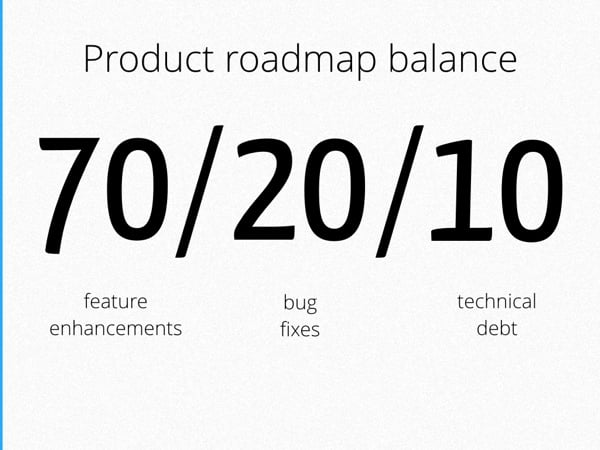
This is, in my experience, the best way to handle technical debt: pay down a little bit of it in every release. To steal a slide from my Product Management course, here’s my general rule of thumb (and of course there will be exceptions) for balancing a product roadmap:

A balanced roadmap

Space shuttle Columbia: what could have been

Lee Hutchinson, who was a system administrator at Boeing at the time of the space shuttle Columbia disaster in 2003, looks back at that tumultuous time in a long but absolutely fascinating article for Ars Technica:

In August 2003, the Columbia Accident Investigation Board (CAIB) issued its final report. Behind the direct cause of the foam strike, the report leveled damning critiques at NASA’s pre- and post-launch decision-making, painting a picture of an agency dominated by milestone-obsessed middle management1. That focus on narrow, group-specific work and reporting, without a complementary focus on cross-department integration and communication2, contributed at least as much to the loss of the shuttle as did the foam impact. Those accusations held a faint echo of familiarity—many of them had been raised 17 years earlier by the Rogers Commission investigating Challenger’s destruction.

The report also asked a team at NASA to figure out what a rescue plan might have looked like:

To put the decisions made during the flight of STS-107 into perspective, the Board asked NASA to determine if there were options for the safe return of the STS-107 crew.

The rest of the article explains the possible rescue plan in detail. If you have any interest in science or space exploration this is a must-read.

I found the article particularly interesting because I had just finished reading my favorite novel of the year so far: The Martian by Andy Weir. The article echoed a lot of the concepts mentioned in the novel, which gave me a new appreciation for the story. I highly recommend this surprisingly plausible and funny book as well.


  1. See, this is a problem everywhere, not just in software development… 

  2. This too. 

Space syntax and urban design

I really enjoyed Nick Stockton’s exploration of the space syntax concept in architecture in There’s a Science to Foot Traffic, and It Can Help Us Design Better Cities. He explains:

Space syntax [is] the science of how cities work. In the late 1970s, British architects Bill Hillier and Julienne Hanson hit on the idea that any space within a city — or the entire city itself — could be analyzed in terms of connectivity and movement. They reasoned that a city’s success depended largely on how easy it was for people to move about on foot.

This wasn’t a huge revelation. Studies reaching as far back as 1960s have shown walkable cities have higher property values, healthier residents, and lower crime. What set Hillier and Hanson’s ideas apart was the notion that a city’s geometry did more for movement than any other design factor. They argued that every other cog in a city’s engineering depends on the walkable grid. Cars, buses, trains, and bikes play a role, too, but only as much as they transport people to places where they then proceed to walk around.

There’s some great examples in the article, including a case study on the redesign of Trafalgar Square in London.

[Sponsor] Creative Labs Intelligent Wireless Sound System

A big thanks to Creative Labs for sponsoring Elezea’s RSS feed this week with their AXX 200 sound system!

We believe there’s so much more that your portable wireless speaker should do for you. That’s why we made the AXX 200.

The AXX 200 is a Bluetooth wireless speaker + Sound Blaster audio processor. This means a portable wireless speaker with power for real-time audio enhancement.

Intelligence. That’s what the AXX 200 brings to the table.

  • Make a call. Listen to music. AXX 200 intelligently adjusts the audio settings for you.
  • The Sound Blaster Central App for your iOS or Android device places the control in your hands.
  • Built-in quad array microphone - That’s FOUR microphones in a single wireless speaker for 360° of clear, unmatched audio pickup for voice calls and recording.
  • A wireless speaker that automatically cancels out noise during voice calls. For real.

It’s for work, it’s for play. It can be everything you need it to be.

The AXX 200 is now on sale for a limited time at Creative.com and Amazon.com.