Menu

Posts tagged “technology”

With self-driving cars cities will need 90% less parking

In An End to Parking? Clive Thompson writes about an aspect of self-driving cars that I haven’t seen before: the impact it will have on urban design. In particular, the amount of space we need for parking should change dramatically:

Robot cars could also drive much more closely to one another, packing far more vehicles onto a street. […]

What’s more, they’d never need to park. At the University of Texas-Austin, Kara Kockelman—a professor of transportation engineering—modeled the impact of autonomous ride-sharing vehicles and found that each one could replace up to a dozen regular cars. The robocars could drive all day long, stopping only to refuel or for maintenance; at night, when there was less demand, they could drive out to a remote parking spot on the outskirts of town. The upshot, Kockelman figures, is that if you shifted the entire city to autonomous cars, it would need a staggering 90 percent less parking than it needs today.

Personal AI assistants: the battle and the war

A friend once told me that for him, one of the weirdest moments as a parent was the realization that their kids have a relationship with each other, not just with him. That conversation always stuck with me, and when our own daughters started to have a bond with each other that’s completely separate from their bond with us, I understood what he meant. It’s just something that is, for some reason, very difficult to wrap one’s head around—these people you made, suddenly having lives apart from you. Today I’m thinking of that conversation again, but in a very different context—personal AI assistants, and what that means for how we design their interfaces.

But before I get there, let me take a step back and recap some of the recent conversations about personal AI. In The internet bundle is already here Dieter Bohn writes that AI personal assistants are a threat to net neutrality:

The bundle is already here, it came from places we haven’t been watching closely enough, and it has many names. There’s more than enough doomsaying about the issues related to Instant Articles, Internet.org, and Binge On. Instead, I’d like to take a minute to doomsay what could become the other opponents to the kind of free, transparent, and open internet we all want: Siri, Cortana, Alexa, Facebook M, and Google Now.

These intelligent assistants are great. I use them every day and expect I will continue to use them for, well, ever. But there’s a problem that’s built into them: they only seem to work with certain parts of the web and — here’s the real rub — certain apps.

Mark Wilson makes a similar argument in Why Every Gadget You Own Suddenly Wants To Talk To You, and then takes the argument further to imagine what happens when you have a bunch of non-neutral devices in your home:

But the problem with a scenario in which you can talk to anything is that you’re no longer talking to one thing. Only so many ears can live in one room. If I muse aloud that I need more shampoo in the shower, what hears me? Is it my iPhone sitting at the sink? Alexa networked in my apartment? Some new smart water nozzle from Kohler? […]

As consumers, we’re caught in the middle of the convenience. Do we choose to side with Siri, Alexa, or Cortana, and talk only to her, despite looming bias and the risk of growing dependent on a single voice—a voice that could take advantage of us? Or do we side with a free market that gives a voice to every stupid overzealous object in our lives, however confusing that may be, in a world where ordering milk becomes a bidding war on a commodities training floor?

Which future do you root for? They both sound horrible.

All of this is part of a big “the conversation is the interface” trend we’ve been seeing a lot of recently (see The search for the killer bot and 2016 will be the year of conversational commerce). From a design perspective the main challenge we seem to be thinking about is how to give these AI assistants the right personality (see The Next Phase Of UX: Designing Chatbot Personalities and The New Intimacy Economy). But I wonder if that’s the wrong AI design focus. I wonder if we should rather spend our time encouraging design for what Alan Cooper calls The Edges:

The difficulty in making these systems work smoothly comes from their edges, not from their centers. Each vendor builds a reliable and effective product, and through diligent testing assures that they meet high standards of performance. The only place where those standards fall is at the edges, where the maker is unsure of the requirements.

The edges are the interfaces with entities outside their control, outside their offices. Out there they are a little unsure of what they have to do and what forces affect them. Inside the company’s four walls they know exactly what they’re making, how it should behave, and what it should do. But for the entities outside those four walls, some measure of haziness creeps in, notably, the user.

Applied to AI assistants (and back to my parenting story), this means we need to start thinking about not just how humans interact with Siri and Alexa, but how Siri and Alexa interact with each other. There is, of course, a huge disconnect here between user needs and business goals. It would be very beneficial for users if different AI assistants could interact with each other, but that doesn’t help companies to strengthen their silos.

The trouble is that if we don’t figure out how to do this (and do it profitably), we might lose more than the battle of whose personal assistant wins. We might lose the war of personal AI getting any significant user adoption.

The streaming music ceiling

Cortney Harding makes some good points about the behaviors of different music buying personas in Is There a Streaming Ceiling?

The future is beginning to look like it will be a two tiered system — the top group of music fans will pay for streaming and everyone else will buy a handful of albums a year. Think of all the people you know who bought the Adele album, and I’ll bet that for many of them, it was the only album they bought this year. Many of these consumers aren’t all the interested in what streaming can offer them — they are content with hearing new music on the radio, buying one or two albums a year, and perhaps seeing one or two concerts.

It feels like the music industry has never been this complicated.

Customer needs up and down the technology stack

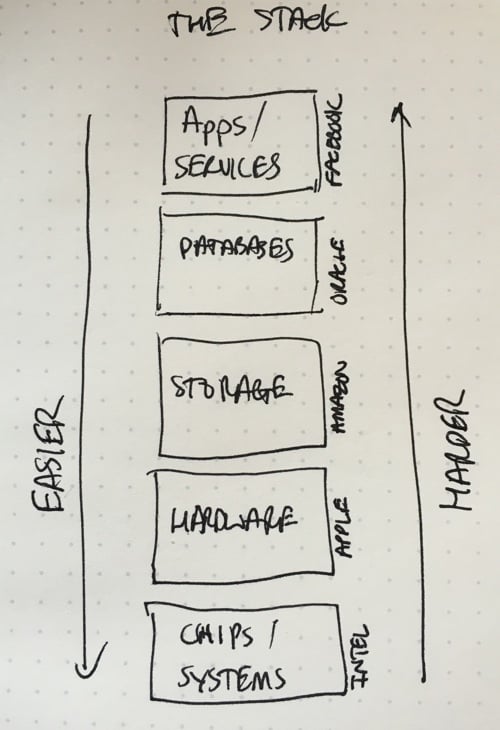
I’ve seen Anshu Sharma’s Why Big Companies Keep Failing: The Stack Fallacy come up in my feeds a bunch of times over the last couple of days. I personally found the writing quite confusing, and had to read it several times to figure out what he was trying to say. I even drew a picture to help me.

If I understand the argument correctly, Anshu is saying that wherever your core business is in the technology stack, it’s easier to expand your market by going down the stack than up. Like so:

Stack Fallacy

This is obviously an oversimplification and leaves a lot of things out, but it was just a way for me to make sense of the article. That said, it’s this part in particular that stood out for me:

The bottleneck for success often is not knowledge of the tools, but lack of understanding of the customer needs. Database engineers know almost nothing about what supply chain software customers want or need. They can hire for that, but it is not a core competency.

The reason for this is that you are yourself a natural customer of the lower layers. Apple knew what it wanted from an ideal future microprocessor. It did not have the skills necessary to build it, but the customer needs were well understood. Technical skills can be bought/acquired, whereas it is very hard to buy a deep understanding of market needs.

In other words, it’s easier for Apple to take on Intel than it is for Apple to take on Facebook. Likewise, it’s easier for Amazon (AWS) to take on hardware manufacturers than it is for them to take on Salesforce. And the reason for this is that most companies understand the customer needs of the components their core business is built out of, but they don’t understand the customer needs of the businesses that other companies build using their components.

Update: This tweet from Peter Matthaei is a much better summary than the one I came up with:

.@RianVDM If your company uses something, it’s down the stack; anything that companies can build with your stuff is up the stack.

— Peter Matthaei (@mobivangelist) January 20, 2016

It’s an interesting theory, especially if you consider the logical conclusion that apps and services like Facebook and Salesforce (etc.) are at the top of the stack, and everyone not originally in the software business is going to have a really difficult time competing with them. I’d be curious to hear what others think of this…

What happens when connected homes disconnect

Nick Bilton quit his Nest Thermostat because a software malfunction left him unable to heat his house for a while. In Nest Thermostat Glitch Leaves Users in the Cold he extrapolates to concerns about what happens when connected devices stop working as they should:

We’ve seen this before, with wireless fobs for keyless cars. They are supposed to make life easier by letting us do away with car keys, but they also make it easier for thieves to break in (by using a simple radio amplifier).

It also happened recently with Fitbit, the maker of wearable activity trackers. The company was hit with a class-action lawsuit in San Francisco asserting that the wristbands failed to “consistently and accurately record wearers’ heart rates,” which is vital for those with certain medical conditions.

I’ve heard dozens of other stories from people with connected homes who were locked out by malfunctioning door touch pads, or about newfangled security alarms going off in the middle of the night because a bug (one with wings, not a digital one) flew by.

This reminds me of Daniel Rivero’s Robots are starting to break the law and nobody knows what to do about it. Since companies are starting to require customers to sign agreements that prohibit them from filing law suits in the event of a malfunction, there is no one to hold responsible. Combine this with last week’s The internet of all the things, and I’m suddenly not so keen on this “connected home” thing any more.

Online chat therapy for online addiction

Sarah Kessler sets out to treat an unproved disorder with an unproven form of therapy, and lived to tell the tale. From What I Learned In 12 Weeks Of Therapy For Social Media Addiction, about using online chat therapy provider Talkspace:

Though everyone says they’re addicted, [Roni Frank, co-founder of Talkspace] says, they aren’t necessarily motivated to solve the problem. She compares it to cigarettes. “In the early years, people were smoking like crazy,” she says, “and at some point, everybody started to be aware of how harmful it is. I think the same thing will happen with social media, and how it is basically promoting poor mental health.”

Social media therapy is not the only aspect of Talkspace that has yet to be fully embraced by the mainstream. The idea that therapeutic help can come from an app, in general, has been met with some skepticism. “Developing a relationship with your patients in online therapies can be a problem, because you can’t see emotional cues,” Madalina Sucala, a clinical psychologist at the Icahn School of Medicine at Mount Sinai who has researched how clinicians feel about e-therapy, told The Verge, “and sometimes you can’t convey empathy.”

Filing this in my ever-growing “what a time to be alive” category.

Pretending at closeness

Leigh Alexander wrote a very interesting essay on how Facebook is getting a little… “intimate” with its users lately. She extrapolates that to a growing trend in The New Intimacy Economy:

Pretending at closeness is really the only way forward for anyone who wants to make money on the internet. As such, watch as organizations pretend, with increasing intensity, that they are individuals. Start counting how many times platforms, services and websites entreat you in human voices, with awkward humor, for money. Watch as the things we expect to be invisible, utilitarian, start oozing emojis and winky-smileys. Even Silicon Valley, global epicenter of whitewashed empathy voids and 1-percenter sci-fi wank fantasies, is going to pretend it cares about you.

AAPL the stock vs. Apple the company

Neil Cybart has a very interesting analysis of AAPL, the stock, and Apple, the company. From The Two Apples:

While AAPL investors look at changing revenue sources and Apple entering new industries as risk factors, for Apple such characteristics are normal business and according to plan. It is this divide that will likely continue indefinitely, suggesting it is unwise to expect AAPL to one day begin to follow Apple. Just as a declining AAPL stock price is no indication of a struggling Apple, there will likely come a time when AAPL outperforms peers even though Apple, the company, may be struggling.

The whole article is worth reading if you’re interested in the disconnect between a company that seems to be doing really well, and a stock price that doesn’t reflect that.

Apple Revenue

The internet of all the things

In Why Every Gadget You Own Suddenly Wants To Talk To You Mark Wilson imagines a scenario where every single thing in your home is always connected, always listening:

As consumers, we’re caught in the middle of the convenience. Do we choose to side with Siri, Alexa, or Cortana, and talk only to her, despite looming bias and the risk of growing dependent on a single voice—a voice that could take advantage of us? Or do we side with a free market that gives a voice to every stupid overzealous object in our lives, however confusing that may be, in a world where ordering milk becomes a bidding war on a commodities training floor?

Which future do you root for? They both sound horrible.

This is the current situation we are in—The Internet of Way Too Many Things. We’ll eventually figure it out and make useful connected products, but right now it’s just a race to be first, although no one really seems to know first at what.

From the phonograph to streaming and how we now listen to music

I really enjoyed Clive Thompson’s history of How the Phonograph Changed Music Forever. I found a couple of observations particularly interesting. First, on the “new” phenomenon of listening to music alone:

A curious new behavior emerged: listening to music alone. Previously, music was most often highly social, with a family gathering together around a piano, or a group of people hearing a band in a bar. But now you could immerse yourself in isolation. In 1923, the writer Orlo Williams described how strange it would be to enter a room and find someone alone with a phonograph. “You would think it odd, would you not?” he noted. “You would endeavor to dissemble your surprise: you would look twice to see whether some other person were not hidden in some corner of the room.”

This is particularly interesting when you consider it in the context of the latest trend: headphones as the new walls for people in open-plan offices. We went from listening to music together, to listening to music alone, to using music to indicate we don’t want to be bothered. Also see How Headphones Changed the World as a great companion article to the phonograph one.

Second, this is something I hadn’t considered before1:

“In the age of the iPod, and the age of Pandora, and the age of Spotify, we’ve seen the average college student go from being a hard-core ‘rock fan’ or a hard-core ‘hip-hop fan’ to being a connoisseur of a lot of different genres, and a casual fan of dozens more,” he says. “It’s very rare to come across someone of college age or younger who’s only invested in one or two styles of music,” and they’re less likely to judge people on their musical taste.

I’ve written before on the tyranny of endless musical choice, and how much we lose in the age of streaming, but this is most certainly a positive thing. We used to be narrowly defined by the genres we liked, and now we’re able to dip in and out of interesting musical experiences we wouldn’t have been exposed to in the age of the phonograph and CDs.


  1. These “man, I’m old” moments are happening with increasing and concerning frequency now.