Menu

Posts tagged “technology”

Old music, new music, and our not-so-new fear of technology

I get these weird obsessions sometimes—a thing that starts small in my head until it becomes all-consuming for weeks on end. Maybe you can relate? Anyway, my current obsession is centered around jazz, and how much we can learn from it about technology, how we listen to music, and yes, even design.

If you follow me on Twitter you’ll know that I just finished reading How to Listen to Jazz, a book I thoroughly enjoyed. I shared screen shots of some of my favorite sections from the book here, but suffice to say it is about so much more than jazz, and I highly recommend it not just for music lovers, but for anyone who works in a creative role.

Right on cue, as so often happens on the internet, I came across Ken Norton’s excellent post Please Make Yourself Uncomfortable, about some of the leadership lessons we can learn from great jazz records (especially the all-time best one, Kind of Blue):

Miles, Ella, and Duke were adept at guiding their bands into the optimal anxiety zone, making them restless and opening up a space where they could create masterpieces. Such talent is also needed in product management. So much of what we’ve learned, our instincts, are to do the complete opposite. We’re told to minimize risk, communicate a clear plan, and document every step. As product managers, our most important job is to help our teams find the place of optimal discomfort—the goldilocks zone of ambiguity and uncertainty.

The same day I read Gretta Harley’s The Slow Listening Revolution, about why she still has a vinyl collection:

Why vinyl? Commitment. In this mid-second decade of the 21st century, music is being taken for granted on a collective scale. An entire generation of music listeners will never pay for music, nor do they believe that they should. The long form music medium has taken a back seat to song culture, yet the average person only listens to a song for approximately 24 seconds before deciding if it’s worth their time to continue to listen. I ponder the substantive value of something that our capitalistic, corporate-model culture places on “free.” When we can listen to a whole song, or usually only 24 seconds of a song without paying for it, do we really value the music? I wonder if we listeners are as committed to music as we were pre-internet? I really like the internet, so these words are in no way a complaint or indictment, but merely observation.

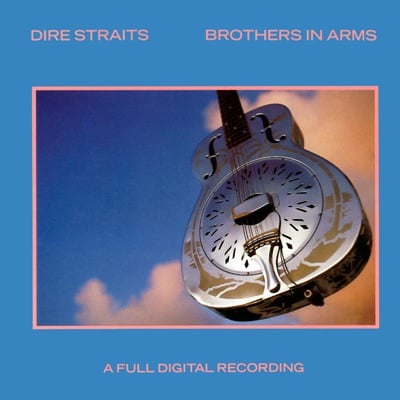
All of this—jazz, new music, old habits—came together as I picked up Dire Straits’s 1985 CD Brothers In Arms, which in some versions had this cover:

It used to be that proclaiming “A FULL DIGITAL RECORDING” was a selling point. Now, the first thing I look for when I buy an album is the phrase Mastered from the original master tapes, a sure sign of its 100% no-digital, analog-only experience.

Or, wait, maybe we’re just being anti-technology in our criticisms of digital music? There has always been a reluctance to adopt new things—a longing for the past and how things used to be. Clive Thompson gives us another example of this historical skepticism in That cursed newfangled technology, “electric lights”:

Robert Louis Stevenson penned “A Plea for Gas Lamps” in 1878, hoping to dissuade London’s authorities from installing obnoxious electric streetlamps like those in Paris. “A new sort of urban star now shines at night,” he wrote, “horrible, unearthly, obnoxious to the human eye; a lamp for a nightmare!”

So I don’t think we’ll solve this particular “which one is better” musical argument any time soon. But if history teaches us anything, it’s that it’s not a new argument, so we should just roll with it. And rock with it1.


  1. Sorry, that’s a really bad joke. I’ll see myself out. 

Build software to feed the world, not eat it

Kevin Slavin’s Design as Participation is one of those articles that stays with you for days. There are multiple ways to read it, but I view it as a thoughtful critique of my primary field of focus: user-centered design (UCD). There have been other discussions on this topic, most notably Cennydd Bowles’s excellent Looking Beyond User-Centered Design, and Mike Long’s Stop Designing for Users. Kevin’s is a worthy addition to the debate.

Kevin’s main thesis is that UCD is selfish (since it puts a user at the center of everything), and we should instead see users as active participants in a design:

Broadly, UCD optimizes around engagement with the needs, desires and shortcomings of the user and explores design from the analysis and insight into what the User might need or want to do. Simply, it moves the center from the designer’s imagination of the system to the designer’s imagination of the user of the system.

But we are no longer just using computers. We are using computers to use the world. The obscured and complex code and engineering now engages with people, resources, civics, communities and ecosystems. Should designers continue to privilege users above all others in the system? What would it mean to design for participants instead? For all the participants?

Also:

Some contemporary work suggests that we are not only designing for participation, but that design is a fundamentally participatory act, engaging systems that extend further than the constraints of individual (or even human) activity and imagination. This is design as an activity that doesn’t place the designer or the user in the center.

If this all seems overly academic, fear not, practitioners! Kevin shows several examples of “Design as Participation” in his essay, and also ends with this call to action:

A new generation of designers has emerged, concerned with designing strategies to subvert this “natural default-setting” in which each person understands themselves at the center of the world.

These designers do this by engaging with the complex adaptive systems that surround us, by revealing instead of obscuring, by building friction instead of hiding it, and by making clear that every one of us (designers included) are nothing more than participants in systems that have no center to begin with. These are designers of systems that participate – with us and with one another – systems that invite participation instead of demanding interaction.

We can build software to eat the world, or software to feed it. And if we are going to feed it, it will require a different approach to design, one which optimizes for a different type of growth, and one that draws upon – and rewards – the humility of the designers who participate within it.

It’s always hard to see one’s views challenged, but Kevin does it in the best possible way here. He understands UCD and why it came about, he presents a compelling argument about its issues, and then he shows us how we can do better.

I don’t think this means the end of UCD (or even that we should stop using its basic methods like personas and usability testing). But I do agree that we need to shift our thinking so that we’re less concerned about the success of an individual user (or groups of users), and more concerned about how different systems interact with each other. Alan Cooper touches on this topic in his wonderful essay The Edges:

What each organization has to do today is to regard the edges of its products with as much diligence and attention as they give the center. The quality of both their outside system connections (known as application program interfaces, or APIs) and their user interfaces demand levels of expertise and investment that have historically fallen short.

As nebulous as Kevin’s idea of “building software to feed the world” sounds, I like the sound of it. I like the hope and the desire to do good in the world that it communicates. We need to make that idea concrete in our daily design worlds, and I don’t think we quite know how to do that yet. But every practical mission starts with a grand vision, and I quite like this one.

Meetings and email: maybe they're not so terrible after all

There are two things everybody in business (say they) hate: meetings and email. So the past few years have seen a great many startups that try to re-invent, revolutionize, and strategerize the crap out of meetings and email. However, recently we seem to have come to a disappointing realization: meetings and email are the worst ways to get things done, except for all the other ways.

In Meet Is Murder Virginia Heffernan goes deep on the topic of meetings: why we hate them, what people have tried differently, and how we just can’t seem to quit them. Her resigned conclusion hints at what really might be the source of our meeting hatred:

What’s so bad about meetings, after all? At bottom, they are nothing but time with your fellows. Which suggests that hating meetings might be akin to hating traffic, families or parties—just another way to express our deep ambivalence about that hard fact of existence: other people.

Meanwhile, in Slack, I’m Breaking Up with You Samuel Hulick shares his dismay with Silicon Valley’s latest darling company. These kinds of articles are inevitable at this point—we’re almost certainly approaching 6 PM SVT (Silicon Valley Time) for Slack. Anyway, Samuel wrote a break-up letter to Slack, but at times it reads more like a subtle “Please come back!” letter to email. For example:

While it’s true that email was (and, despite your valiant efforts, still very much is) a barely-manageable firehose of to-do list items controlled by strangers, one of the few things that it did have going for it was that at least everything was in one place.

And this:

When work gets done over email, there’s a general expectation of a response buffer of at least an hour or two. In you, though, people can convene and decide on anything at any time.

Also this:

When I started feeling like our relationship was getting to be just a little too much, I decided to take a few days off. That was never a problem when I was with email—I’d just fire up a vacation autoresponder and be on my merry way.

I’ve always liked email (which, sorry, I know, is like a Portlander saying “Oh you just found out about Kale? I’ve been eating Kale all my life!”), and felt that the bigger problem is not the system but the way we deal with it. I tried Google Inbox and that Mailbox thing that Dropbox bought and shut down, but I could just never get into a groove with a system that tries to sort my email for me. Instead I just do something that works really well for me: I read every email, and file each message in the appropriate place when I’m done dealing with it. That’s it.

I’m also not as against meetings as I used to be. My rules there are equally simple: always walk out of a meeting with an artifact. This could be a whiteboard sketch or a note about a thing you need to go research—it doesn’t really matter. Just walk out of there with something. Meetings should focus on facilitating the things that meetings are good at: collective thinking. Meetings that energize me are the ones where most people are standing, working together on a common goal. From customer journey workshops to design studio sessions to analyzing usability testing results, there are plenty of useful ways to spend our times in meetings. That’s my only criterium for a good meeting: make progress.

These guidelines are probably way too simple for the majority of businesses and people. But I do think that when we try to “reinvent” meetings and email we’re trying to solve a people problem with technology, and that’s just never going to work. Technology can help, for sure, but at its core we need to figure out why we hate email and meetings, and then fix that first. And I think the main problem with meetings and email is that we don’t spend enough time taking personal responsibility to make them more effective. Until we stop trying to offload our personal responsibility on the shoulders of technology, nothing will change.

Why movies are scarier than they used to be

Patricia Pisters explores why horror movies are much scarier than they used to be in her essay Neurothriller:

Consciously or unconsciously, contemporary filmmakers not only tap into increased knowledge about the brain offered by neuroscientific experiments, but their films also stimulate the neural senses of emotions without the detour of narrative. […]

But the difference between the classic thriller and the neurothriller is not simply the difference between a narrative-driven plot and a character-driven plot. It is not necessary, and often not possible, to identify or engage with the character at the beginning of a neurothriller at all. In contemporary cinema, we are often denied an establishing shot or introductory scenes situating the character in a narrative context. Thrown in the middle of a confusing situation, we first connect on the immediate primal level, expressed through cinematography’s aesthetic stand-in for the emotional mind: close-ups, grainy images, colours, sounds can all have direct impact without being connected to either a story or a person. The neurothriller has ‘embodied’ the emotion of the film, just as the human body embodies the emotion of the mind.

The most dangerous thing about self-driving cars

Cliff Kuang makes some interesting points in his essay The Secret UX Issues That Will Make (Or Break) Self-Driving Cars:

Recall that first principle that [Brian Lathrop at Volkswagen] laid out for designing autonomous cars—that the driver has to know whether the car is driving itself. That harks to probably the oldest dictate in interface design; mode confusion causes 90% of airplane crashes, and that insight helped invent the field of human-computer interaction. Think about all the times you’ve heard news reports about a pilot being confused about whether the flaps of the wings were down, or whether to auto-pilot was properly set. If you’ve ever failed to realize that your car was in park when you hit the accelerator, or you’ve ever tried typing into the wrong window on your computer screen, you’ve been a victim of mode confusion.

So, the scariest thing about self-driving cars is not whether or not the car can drive safely, but whether it can effectively communicate when it is driving and when it is not. It’s the age-old Visibility of system status UI heuristic in action.

There's nothing wrong with reading ebooks

Paula La Farge challenges the idea that ebooks are inferior to physical books in The Deep Space of Digital Reading:

There’s no question that digital technology presents challenges to the reading brain, but, seen from a historical perspective, these look like differences of degree, rather than of kind. To the extent that digital reading represents something new, its potential cuts both ways. Done badly (which is to say, done cynically), the Internet reduces us to mindless clickers, racing numbly to the bottom of a bottomless feed; but done well, it has the potential to expand and augment the very contemplative space that we have prized in ourselves ever since we learned to read without moving our lips.

Last year I went through a phase of reading physical books again, but I gave it up pretty quickly. There are two things about the Kindle platform that I missed too much:

  • The ability to highlight sections, share to Goodreads, and access those highlights any time at the hugely under-appreciated kindle.amazon.com (I tried the app TextGrabber for a while to turn passages from a book into digital text, but it’s just not worth the effort).
  • I can’t live without the X-ray function that lets you look up details about the book and its characters.

Anyway, one of the major academic complaints about e-books is that reader comprehension is lower. But, hey, turns out…

It’s true that studies have found that readers given text on a screen do worse on recall and comprehension tests than readers given the same text on paper. But a 2011 study by the cognitive scientists Rakefet Ackerman and Morris Goldsmith suggests that this may be a function less of the intrinsic nature of digital devices than of the expectations that readers bring to them. Ackerman and Goldsmith note that readers perceive paper as being better suited for “effortful learning,” whereas the screen is perceived as being suited for “fast and shallow reading of short texts such as news, e-mails, and forum notes.” […]

If those same students expected on-screen reading to be as slow (and as effortful) as paper reading, would their comprehension of digital text improve? A 2015 study by the German educator Johannes Naumann suggests as much. Naumann gave a group of high-school students the job of tracking down certain pieces of information on websites; he found that the students who regularly did research online—in other words, the ones who expected Web pages to yield up useful facts—were better at this task (and at ignoring irrelevant information) than students who used the Internet mostly to send email, chat, and blog.

My guess is that a generation from now this simply won’t be a debate any more.

When the internet makes us relive bad memories

Facebook’s “On This Day” feature has always felt really strange to me. It’s an algorithm that’s aware of its weirdness, hence the almost apologetic “We care about you and the memories you share here” message that surrounds it. As if it knows it’s bound to get it wrong and show you something you don’t want to be reminded of.

Leigh Alexander provides an interesting perspective on that feature and our social media “memories” in What Facebook’s On This Day shows about the fragility of our online lives:

Part of the palpable dissonance comes from the fact that many of our posts were never intended to become “memories” in the first place. An important question gets raised here: what’s the purpose of all this “content” we serve to platforms, if it’s useless in constructing a remotely valuable history of ourselves? Are we creating anything that’s built to last, that’s worth reflecting on, or have social media platforms led us to prize only the thoughts of the moment? […]

We generally think of social media as a tool to make grand announcements and to document important times, but just as often – if not more – it’s just a tin can phone, an avenue by which to toss banal witterings into an uncaring universe. Rather, it’s a form of thinking out loud, of asserting a moment for ourselves on to the noisy face of the world.

Despite multiple attempts I still don’t understand how Snapchat works, but from what I understand from the Young People this is a big reason for its appeal. There isn’t an expectation that something you post on Snapchat has to be profound enough to become a permanent memory. As one of my friends Simon1 put it: Snapchat is there to “Share (not remember) moments.” (Side note—if you haven’t done so yet, please read Ben Rosen’s My Little Sister Taught Me How To “Snapchat Like The Teens”. It is absolutely bonkers.)

So Alexander’s point is an interesting one: how do we take control of our online memories? It’s not possible to know for sure, in a moment, if we’re experiencing something we’d like to remember forever. Maybe the best solution is to keep it the way it’s always been: rely on our brains to remind us of things. We can always then dig up those old photos ourselves—without the help of an algorithm—if we really want to relive the moment.


  1. Some of my best friends are Young People. 

Why being online is worth the effort

Matthew Malady has an interesting take on the “I went offline and lived to talk about it” essay. In The Useless Agony of Going Offline he discusses one of the biggest benefits of technology—knowing more things:

At the end of the experiment, I wasn’t dying to get my phone back or to access Facebook. I just wanted to get back to being better informed. My devices and the Internet, as much as they are sometimes annoying and frustrating and overflowing with knuckleheads, help me to do that. If getting outside and taking walks, or sitting in silence, or walking dogs, or talking with loved ones on the phone got me to that same place, I’d be more than happy to change things up.

This is similar to Clive Thompson’s main thesis in his excellent book Smarter Than You Think. Our ability to gain knowledge and collaborate more effectively makes all the negative aspects of being online worth the effort.

Automated empathy in healthcare

This is an interesting story on the topic of algorithmic empathy1. In Hospitals Employ Email ‘Empathy’ To Help Doctors And Patients Keep In Touch Barbara Feder Ostrov discusses a program that sends patients automated emails to ask them how they’re doing:

Doctors can send daily emails with information timed to milestones in surgery prep and recovery and ask patients or caregivers for feedback on specific issues patients may face during recovery.

The doctors may write their own email scripts, as Newport Orthopedics’ physicians did, or use the company’s suggested content. An online dashboard helps doctors and administrators keep track of which patients are doing well and who might need more follow-up care. Patients can also communicate with office staff about medications and office visits. Their responses to daily emails can trigger a call from the doctor’s office.

A patient might see this message: “How are you? Let me know so I can make sure you’re okay. I have four questions for you today.”

The program has had some promising results, but I’d be interested to know if patients are aware that the messages are automated. To put it another way, is it ethical for doctors to send automated, health-related messages that look like they’re individually crafted?


  1. See Personal AI assistants: the battle and the war

PowerPoint: Does it suck or is it evil?

In a journal article for Computational Culture Erica Robles-Anderson and Patrik Svensson presents a scholarly critique of PowerPoint, and it is fantastic. It’s long and in-depth and the rare academic article that is a joy to read. From the conclusion of “One Damn Slide After Another”: PowerPoint at Every Occasion for Speech:

PowerPoint is just one example of the oft-overlooked conditioning of knowledge production. The software profoundly shaped basic social expectations, technical conditions, and architectural pre-requisites for speech yet it was uncritically absorbed in nearly every quarter. PowerPoint does not zoom. It does not allow spontaneous comparisons. It does not accommodate several screens, multiple threads, or distributed live collaborations. It makes the analytic move of systematic comparison, so prevalent in late nineteenth and early twentieth century information presentations, extremely difficult to make. Moreover, its expansion has meant that once distinct situations have become more alike. Meetings, sermons, lectures, and talks increasingly employ the technics of commercial demonstration. Twenty-first century occasions for speech are structured by a platform that enforces the paradigm of one-slide-at-a-time.