Menu

Posts tagged “social media”

Why being online is worth the effort

Matthew Malady has an interesting take on the “I went offline and lived to talk about it” essay. In The Useless Agony of Going Offline he discusses one of the biggest benefits of technology—knowing more things:

At the end of the experiment, I wasn’t dying to get my phone back or to access Facebook. I just wanted to get back to being better informed. My devices and the Internet, as much as they are sometimes annoying and frustrating and overflowing with knuckleheads, help me to do that. If getting outside and taking walks, or sitting in silence, or walking dogs, or talking with loved ones on the phone got me to that same place, I’d be more than happy to change things up.

This is similar to Clive Thompson’s main thesis in his excellent book Smarter Than You Think. Our ability to gain knowledge and collaborate more effectively makes all the negative aspects of being online worth the effort.

Medium as RSS reader

Despite its ridiculous name I’ve become quite fond of the POSSE movement (Publish on your Own Site, Syndicate Everywhere). It’s pretty easy to hook up and automate, so I’ll just mention the basics (and then move on to the problem child):

I can add more things through IFTTT, but I think that’s all I need for now. Except for Medium. I really didn’t know what to do with Medium, especially considering this and this:

2015 was the year of Medium and Newsletters, but I feel like we should use 2016 to Make The Personal Blog Great Again™.

— Rian Van Der Merwe (@RianVDM) January 2, 2016

But then it dawned on me… Indie publishers have been thinking about Medium all wrong. We’ve been thinking about Medium as a thing that eats all the world’s content with zero regard for publishers. But Medium is, in fact, nothing more than a next-generation RSS reader. You can follow people and publications, and presumably things will then show up in your feed (it’s all a little confusing to me). That’s when I realized that I should treat Medium not as a publishing platform but as an RSS platform just like Google Reader (may it rest in peace) or Feedly.

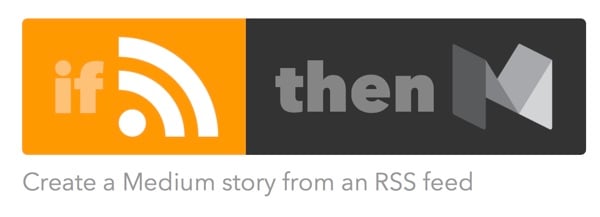
So back I went to IFTTT, and did this:

Medium RSS

Now every post on this site will automatically appear on Medium as well. So I guess my point is that if Medium is your RSS reader of choice, you can now subscribe to Elezea on Medium here.

The product forces that keep people on Facebook

Ben Thompson wrote a characteristically astute analysis of How Facebook Squashed Twitter. The whole essay is worth reading, but it’s this part in particular that stood out for me:

Facebook has developed its own interest graph that is far more powerful and effective and easier-to-use than Twitter’s ever was. Yes, Twitter still owns niches like NBA Twitter, and news hounds like myself (and most of you reading this article) will continue to find it essential, but for nearly everyone else in the world it is Facebook that is the first thing people check, not just in the morning but in all of the empty spaces of their lives. In short, it’s not simply that Twitter needs to convince users to give the service a second-chance, something that is already far more difficult than getting users to sign up for the first time; it’s that even if the service magically had the perfect on-boarding experience leading to the perfect algorithmically-driven feed, it’s not clear why the users it needs would bother looking up from their Facebook feeds.

This is a perfect example of The forces at work when choosing a product. In short, the progress-making forces that might push people from Facebook to Twitter are not nearly as strong as the progress-hindering forces that keep them on happily on the “good enough” that is Facebook.

When being alone on our smartphones, together, is okay

Emma Brockes wrote an essay for The Guardian called In praise of being alone on our smartphones, together:

The act of being with someone—or better yet, a group of people—and on one’s phone is just the modern iteration of a key pleasure of family life: to be among those whom one is sufficiently comfortable with to drift in and out of communication. Like doing homework at the kitchen table, it is the state of doing your own thing while others do theirs around you. The point is, whatever you are doing on your phone, it would be less pleasurable were you to be doing it alone in your room.

Screen addiction alters this, and there are levels of disengagement that can turn a sentient being into a piece of furniture, but the parameters of acceptable phone use should surely widen at this point to permit some middle way between being on one’s phone and considered rude, or turning the device off altogether.

The title of the essay is a clever reference to Sherry Turkle’s book Alone Together: Why We Expect More from Technology and Less from Each Other. It’s a book I enjoyed a lot, despite it being relentlessly full of depressing paragraphs like this:

Now demarcations blur as technology accompanies us everywhere, all the time. We are too quick to celebrate the continual presence of a technology that knows no respect for traditional and helpful lines in the sand.

[A] stream of messages makes it impossible to find moments of solitude, time when other people are showing us neither dependency nor affection. In solitude we don’t reject the world but have the space to think our own thoughts. But if your phone is always with you, seeking solitude can look suspiciously like hiding.

I recommend danah boyd’s It’s Complicated: The Social Lives of Networked Teens as a positive palate cleanser afterwards.

Anyway, back to Emma’s article. She also references Susan Dominus’s Motherhood, Screened Off, an article that was in heavy rotation towards the end of last year. Susan makes the point that smartphones result in a lack of transparency, since people (i.e. our kids…) don’t know what we’re up to when we’re on them:

It is that loss of transparency, more than anything, that makes me nostalgic for the pre-iPhone life. When my mother was curious about the weather, I saw her pick up the front page of the newspaper and scan for the information. The same, of course, could be said of how she apprised herself of the news. […] All was overt: There was much shared experience and little uncertainty. Now, by contrast, among our closest friends and family members, we operate furtively without even trying to, for no reason other than that we are using a nearly omnipresent, highly convenient tool, the specific use of which is almost never apparent.

And that’s where the answer to all of this comes back to “it’s complicated.” Yes, sometimes it’s ok to be alone on our devices, together in quiet contentment. But other times the lack of transparency about what we’re doing can be incredibly alienating to others. This wouldn’t be a problem if we could tell the difference between the two situations perfectly, every time. But alas, we are only human.
The streaming music ceiling

Cortney Harding makes some good points about the behaviors of different music buying personas in Is There a Streaming Ceiling?

The future is beginning to look like it will be a two tiered system — the top group of music fans will pay for streaming and everyone else will buy a handful of albums a year. Think of all the people you know who bought the Adele album, and I’ll bet that for many of them, it was the only album they bought this year. Many of these consumers aren’t all the interested in what streaming can offer them — they are content with hearing new music on the radio, buying one or two albums a year, and perhaps seeing one or two concerts.

It feels like the music industry has never been this complicated.

Online chat therapy for online addiction

Sarah Kessler sets out to treat an unproved disorder with an unproven form of therapy, and lived to tell the tale. From What I Learned In 12 Weeks Of Therapy For Social Media Addiction, about using online chat therapy provider Talkspace:

Though everyone says they’re addicted, [Roni Frank, co-founder of Talkspace] says, they aren’t necessarily motivated to solve the problem. She compares it to cigarettes. “In the early years, people were smoking like crazy,” she says, “and at some point, everybody started to be aware of how harmful it is. I think the same thing will happen with social media, and how it is basically promoting poor mental health.”

Social media therapy is not the only aspect of Talkspace that has yet to be fully embraced by the mainstream. The idea that therapeutic help can come from an app, in general, has been met with some skepticism. “Developing a relationship with your patients in online therapies can be a problem, because you can’t see emotional cues,” Madalina Sucala, a clinical psychologist at the Icahn School of Medicine at Mount Sinai who has researched how clinicians feel about e-therapy, told The Verge, “and sometimes you can’t convey empathy.”

Filing this in my ever-growing “what a time to be alive” category.

Pretending at closeness

Leigh Alexander wrote a very interesting essay on how Facebook is getting a little… “intimate” with its users lately. She extrapolates that to a growing trend in The New Intimacy Economy:

Pretending at closeness is really the only way forward for anyone who wants to make money on the internet. As such, watch as organizations pretend, with increasing intensity, that they are individuals. Start counting how many times platforms, services and websites entreat you in human voices, with awkward humor, for money. Watch as the things we expect to be invisible, utilitarian, start oozing emojis and winky-smileys. Even Silicon Valley, global epicenter of whitewashed empathy voids and 1-percenter sci-fi wank fantasies, is going to pretend it cares about you.

The myth (and danger) of the 'perfect response'

Adam Sternbergh breaks down The Internet Fantasy of the ‘Perfect Response’, that mythical one-liner that puts someone in their place, makes them realize the error of their ways, and changes their minds in an instant:

But the Perfect Response you cheer for and re-post frantically also tends to be one that (a) confirms whatever you already believe and (b) sticks it to someone you already despise. The Perfect Response is, in essence, not a radical new perspective, but simply a person saying a thing you agree with to a person you disagree with. It’s a kind of linguistic record-scratch, a perfectly crafted gotcha that ostensibly stops trolls in their troll-tracks and forces them to deeply reconsider the sad wreckage of their wasted lives. Which means the Perfect Response is also largely a figment of the internet’s imagination.

The problem is that the idea of a ‘Perfect Response’ makes us think that changing hearts and minds isn’t hard work. And that’s simply not true:

The Perfect Response, while apparently so bountiful in theory, is actually appealing precisely because, in practice, it’s so rare as to be almost nonexistent. It’s just a fantasy we yearn for, and to which we happily subscribe, because the hurly burly of actual internet interaction can be so imperfect, and frustrating, and wearying, and hard. The give-and-take of real debate can be all of those things as well, but it also has the attractive by-product of potentially leading to change, something no Perfect Response has ever done. Which is how we ended up with the phenomenon of the Perfect Response in the first place—it’s an imperfect response to just how difficult real communication can be.

An invitation to bring back your personal site

Buried somewhere in the middle of Will Oremus’s article about Twitter’s decision to increase the 140-character limit we find this important paragraph:

What’s really changing here, then, is not the length of the tweet. It’s where that link at the bottom takes you when you click on it—or, rather, where it doesn’t take you. Instead of funneling traffic to blogs, news sites, and other sites around the Web, the “read more” button will keep you playing in Twitter’s own garden.

I’m nowhere near up to date or involved enough in the Open Web movement, but I’ve been writing this site since 2009 and since 6 years is a lot of time to invest in something, I do have Opinions on the matter. Hence one of the first things I tweeted this year:

2015 was the year of Medium and Newsletters, but I feel like we should use 2016 to Make The Personal Blog Great Again™.

— Rian Van Der Merwe (@RianVDM) January 2, 2016

The tweet prompted some interesting discussion, including links to a couple of excellent articles about Medium: Matthew Butterick’s The billionaire’s typewriter and Mandy Brown’s Ferengi (thanks for sending those, Chris!). There’s no need for me to reiterate their arguments here, except to say that this move to proprietary platforms—from Medium to Instant Articles to now Twitter’s entry to long-form publishing—seems to be a dangerous threat to the Open Web.

There are the political arguments around access and inequality that are all very valid, but I want to focus on another aspect here: content platforms as shortcuts. One of the main reasons for writing on a platform like Medium or Twitter or Facebook, as opposed to your own site, is that it’s supposed to give you easier access to a huge audience. And this is no small thing, because building an audience on your own site is, as far as I know, statistically impossible.

Okay, maybe that’s being a bit dramatic. But I’ll tell you that after 6 years of trying to do it I was exhausted and had to take a bit of a break recently. Now, you could argue that the reason I don’t have a huge following on this site is simply that my writing sucks, and you probably won’t be too far off track there. Yet I’d like to think that there’s more to it than that. Building an audience is just really hard because people have to seek out your content, and the truth is that most of the time nobody wants to read your shit.

But I digress. The point is that publishing on Medium and Twitter and Facebook gives you an immediate shortcut to a huge audience, but of course those companies’ interests are in themselves, not in building your audience, so it’s very easy for them to change things around in a way that totally screws you over (remember Zynga? Yeah, me either).

All this to say that I think it’s time we bring blogging and personal sites back. Some of my favorite sites are the ones that give me a glimpse into everything a person is interested in (I think my current favorite is Josh Ginter’s understated and eclectic The Newsprint). It’s a way to get to know someone through their interests, and to learn a bunch of things along the way. So I invite you not just to follow along here as I expand into topics beyond design and technology1, but to start your own personal blog up again if you’ve been neglecting it for a while. I’m really interested in the things you are passionate about. I want to learn from you. But don’t just do it for me, do it for you. Because it turns out there is an immense power in avoiding shortcuts and instead doing things the long, hard, stupid way.


  1. Fair warning: I’m a little rusty… 

Hiding stories on Facebook: intent vs. usage

From Will Oremus’s insightful story How Facebook’s news feed algorithm works:

Facebook’s data scientists were aware that a small proportion of users—5 percent—were doing 85 percent of the hiding. When Facebook dug deeper, it found that a small subset of those 5 percent were hiding almost every story they saw—even ones they had liked and commented on. For these “superhiders,” it turned out, hiding a story didn’t mean they disliked it; it was simply their way of marking the post “read,” like archiving a message in Gmail.

This reminds me of a story I read a while back about how tons of people flagged and reported news stories about Lance Armstrong for “drug abuse”. This is why qualitative research is so incredibly important. Analytics can never tell us the whole story.