Menu

Posts tagged “social media”

Innovation consequences: it’s complicated

In Airbnb and the Unintended Consequences of ‘Disruption’ Derek Thompson uses Airbnb as an example to explain how it’s not as easy to call tech innovation a good or a bad thing. It’s complicated…

Airbnb lowered prices for tourists, supplemented the income of renters, and simply made travel to major cities more fun. But upon inspection, it shares some things in common with more-controversial companies—albeit with less grave implications. Facebook and Twitter design for attention, but incidentally encourage mendacious outrage and trolling. eBay and Amazon design for open marketplaces, but incidentally encourage the frenzied resale of bulk-ordered toys around Christmas. Airbnb was supposed to challenge hotels by letting tourists pay renters. But its platform is unwittingly producing a subsidy of tourists, paid for by nonparticipating urban dwellers, who bear the cost of higher rental prices.

How Facebook realized that it’s more than a platform

Nicholas Thompson and Fred Vogelstein has a gripping feature in Wired called Inside Facebook’s Two Years of Hell. It’s long, but very much worth reading. It takes us through a journey that starts with Facebook’s years of denial:

It appears that Facebook did not, however, carefully think through the implications of becoming the dominant force in the news industry. Everyone in management cared about quality and accuracy, and they had set up rules, for example, to eliminate pornography and protect copyright. But Facebook hired few journalists and spent little time discussing the big questions that bedevil the media industry. What is fair? What is a fact? How do you signal the difference between news, analysis, satire, and opinion? Facebook has long seemed to think it has immunity from those debates because it is just a technology company—one that has built a “platform for all ideas.”

And it ends at the point they are at now: starting to realize that they can’t hide behind the “we’re just a platform” excuse any more.

Deep Work and the power of attention

Craig Mod’s How I Got My Attention Back is one of those essays that I think will become a classic. It strikes that rare and difficult balance of talking about technology dependence without falling into the “ALL TECHNOLOGY BAD!” trap we often see in similar pieces. There’s so much that resonated with me, but this part in particular stood out:

The more I thought about my attention the more I thought about the limits to human scale. How technologies inevitably amplify ourselves — the best and worst parts — in a way that is almost impossible for us to comprehend. How that scale is so easily co-opted to attenuate our attention with the worst possible diet of high-sugar, high-carb nothingness.

I also appreciated the point he makes that as much as we tend to blame ourselves for being too “weak-willed” to give up Facebook or Twitter, we have to remember that there are thousands of people on the other side of that product who are trying to figure out new and innovative ways for us not to give it up. He quotes from Bianca Bosker’s Addicted to Your iPhone? You’re Not Alone:

“You could say that it’s my responsibility” to exert self-control when it comes to digital usage, he explains, “but that’s not acknowledging that there’s a thousand people on the other side of the screen whose job is to break down whatever responsibility I can maintain.” In short, we’ve lost control of our relationship with technology because technology has become better at controlling us.

I’ve had my own struggles with this over the past year as I dealt with a huge personal loss. In the end, my re-entry to a more sustainable online presence came from a very unlikely source: a book I would never have read if someone didn’t force me…

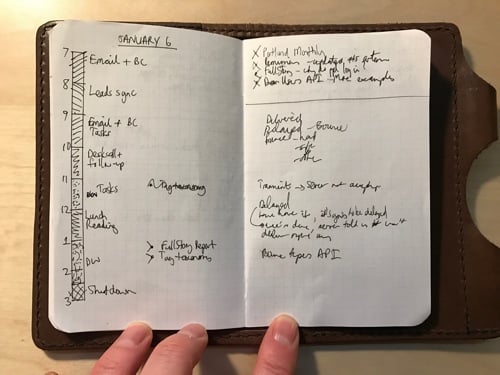
Our CEO sent us all a copy of Deep Work: Rules for Focused Success in a Distracted World and asked us to read it. I expected to snigger my way through it but boy, was I wrong. It is a fantastic plea for taking back our attention at work, and it provides some really useful guidelines on how to do that. For my part, the idea of “work blocks” is one I’ve taken to heart, and it’s done wonders for my productivity. I also bit the bullet on RescueTime, and it really is as good and useful as everyone says it is.

Work blocks

For more on work blocks and other non-digital productivity methods, check out Chris Bowler’s excellent resource on Working with Pen & Paper.

So I guess my one recommendation is, read Deep Work. Even if (or maybe especially if?) you don’t usually like business books. You won’t be disappointed.

Good design and positive change

Kashmir Hill writes about How Nextdoor reduced racist posts by 75%. Nextdoor tested a bunch of different approaches:

Some just saw the addition of new language: “Ask yourself: Is what I saw actually suspicious, especially if I take race or ethnicity out of the equation?” Some were asked to say in advance whether they were reporting an actual crime or just “suspicious activity.” Others actually had their posts scanned for mentions of race (based on a list of hundreds of terms Nextdoor came up with) and if a post did mention race, the user got an error message and was asked to submit more information about the person.

This is proof that good design can make a positive difference in the world.

The changing role of the record label

There are a couple of interesting articles about Frank Ocean’s new album and how it’s causing a lot of waves in the music industry. The short version is that Ocean found a clever way to get out of his agreement with his label Def Jam, and sign an exclusive deal with Apple Music instead. As Ben Sisario notes in Frank Ocean’s ‘Blonde’ Amplifies Discord in the Music Business, the labels aren’t happy:

“The unprecedented run of exclusives by digital music services has put a tremendous strain on the relationship between artists and their record companies,” said Larry Miller, an associate professor of music business at New York University’s Steinhardt School. “We are seeing that play out in public now.”

In Def Jam Can’t Compete With Apple Justin Charity explains further how Apple has become a giant player in the music industry:

Today, with Iovine’s connections and industry guile, Apple Music is becoming a de facto record label of its own. In just over a year, Apple has struck deals with Drake, Future, Chance the Rapper, and Travis Scott. […]

In response, Universal Music Group, which owns Def Jam, is quickly mobilizing against Apple Music’s exclusive streaming-rights model, which naturally limits the audience for new music. Without this model, Apple Music would be back to a prolonged competition to differentiate itself from its streaming competitors. With it, there’s a new, unprecedented competition: conventional record labels, which ideally develop artists into stars, versus Apple Music, which pays stars well.

I’m going to be in the minority here, but I don’t like Apple getting into the record label business. The entire idea of “exclusive” music releases rubs me the wrong way. And I’m just going to say it — this is the kind of stuff that happens when we get rid of physical media.

The social media lives of teens

Mary Choi’s Wired feature on the social media lives of teens is utterly fascinating. I don’t even know where to begin. Let’s start with this bit from Like. Flirt. Ghost: A Journey Into the Social Media Lives of Teens:

Then there is the rule about likes and comments. According to Lara and Sofia, when your friend posts a selfie on Instagram, there’s a tacit social obligation to like it, and depending on how close you are, you may need to comment. The safest option, especially on a friend’s selfie, is the emoji with the heart eyes. Or a simple “so cute” or “so pretty.” It’s too much work to do anything else. If there’s any deviation, “you have to interpret the comment,” Sofia says. “If it’s nice, you’re like, is this really nice or are you …” “… I don’t know,” finishes Lara. Is the comment sincere? Or slyly sarcastic? Formulaic responses breed zero confusion. Instagram is not a place for tone or irony.

The whole article is full of examples like this that just makes me wonder how complicated it must be to be a teen right now. Of course, it’s not complicated to them, it just seems that way to us old folk. But seriously:

But back to the ladies. After a few mutual photo likes, the flirtation often escalates to emoji. If an emoji with the heart eyes gets another one in return, he says, you’re good. Other positive responses: an ellipsis thought-bubble to convey that she’s thinking about you; the bashful see-no-evil monkey. “‘Oh, thank you! I appreciate it’ is what I get from that emoji,” he says. Any of these responses means he’ll take it to DM (as in direct message). Other emoji are suboptimal. “The thinky face is like, ‘What are you doing commenting on my pictures?’” He says this isn’t a hard no, but it’s not great. The worst emoji—easily—is one you may not expect. “The smiley face,” says Ahmad with a pained expression. “Yeah, that’s the ‘Thank you, but I’m not interested.’”

I did do quite a double-take when I read this though:

Ubakum loves her [Android] phone. Deeply. iPhones for her are too easy, a little basic. “I’m not a fan of user-friendliness.”

I don’t really know what to make of that. It’s a fascinating statement, and I wish I could follow up to understand the sentiment more. If it’s true that a new generation of users don’t want products to be easy to use, what does that mean for us as designers? My head hurts.

Facebook as political platform

This NYT report on the massive political news force Facebook has become is quite something. From John Herrman’s article Inside Facebook’s (Totally Insane, Unintentionally Gigantic, Hyperpartisan) Political-Media Machine:

But truly Facebook-native political pages have begun to create and refine a new approach to political news: cherry-picking and reconstituting the most effective tactics and tropes from activism, advocacy and journalism into a potent new mixture. This strange new class of media organization slots seamlessly into the news feed and is especially notable in what it asks, or doesn’t ask, of its readers. The point is not to get them to click on more stories or to engage further with a brand. The point is to get them to share the post that’s right in front of them. Everything else is secondary.

This is the crux of the matter:

Such news exists primarily within users’ feeds, its authorship obscured, its provenance unclear, its veracity questionable. It exists so far outside the normal channels of news production and distribution that its claims will go unchallenged.

The problem with #blessed

Kate Bowler’s Death, the Prosperity Gospel and Me is the best thing I’ve read this year so far. It’s funny, sharp, and deeply moving. Kate recently got cancer, some time after writing an academic book on the prosperity theology phenomenon in many American churches. Prosperity theology—the idea that “good” faith in God can make you rich and keep you healthy—is an immensely damaging philosophy, and Kate addresses this with poise and clarity.

I hesitate to quote anything from the essay because you really should read the whole thing, but one of my favorite paragraphs deals with the recent rise of the #blessed hashtag:

Over the last 10 years, “being blessed” has become a full-fledged American phenomenon. Drivers can choose between the standard, mass-produced “Jesus Is Lord” novelty license plate or “Blessed” for $16.99 in a tasteful aluminum. When an “America’s Next Top Model” star took off his shirt, audiences saw it tattooed above his bulging pectorals. When Americans boast on Twitter about how well they’re doing on Thanksgiving, #blessed is the standard hashtag. It is the humble brag of the stars. #Blessed is the only caption suitable for viral images of alpine vacations and family yachting in barely there bikinis. It says: “I totally get it. I am down-to-earth enough to know that this is crazy.” But it also says: “God gave this to me. [Adorable shrug]. Don’t blame me, I’m blessed.”

I am thankful for people like Kate who, instead of saying “Everything happens for a reason,” says “Life is really hard—and yet, I still believe.”

The power of a secret in the age of over-sharing

When everything about your life is out in the open, there is power in keeping some of it secret. The ironic side-effect of social media is that it makes it easier to hide. When people think that you share everything, they don’t expect you to keep anything secret.

I recently went on a brief trip to South Africa to visit family, and I stayed (mostly) off social media. It felt weird—I felt this strange guilt, like I was “hiding” something because so many of my friends didn’t even know I was in the country. I know it was the right thing to do considering the circumstances of my visit, but still. Our minds can be deceptively cruel to us.

Anyway, I started thinking about it because Jim Farber explores this from a celebrity standpoint in his really interesting article The New Celebrity Power Move: Keeping Secrets:

Meanwhile, the stars get to both circumvent the media and to float an image of utter transparency through their promiscuous use of social media. In fact, that may only obscure them further. “Digital media creates this notion that we can know everything,” [Kathleen Feeley, co-editor of a scholarly study of celebrity gossip] said. “But it’s still a performance. It just creates a false intimacy.”

The audience’s belief in social media as the most direct route to a star exacerbates “the expectation that everyone will tell everything,” said Daniel Herwitz, a professor at the University of Michigan who wrote “The Star as Icon.” “Against all that, it becomes totally extraordinary when somebody doesn’t tell. On one hand, the public is in awe of the fact that the star, for the moment, resisted the system. But they’re also disappointed, as if somebody let them down. ‘Why didn’t I know this? The media dropped the ball!’”

“Why didn’t I know this”, also known as Why wasn’t I consulted?

When the internet makes us relive bad memories

Facebook’s “On This Day” feature has always felt really strange to me. It’s an algorithm that’s aware of its weirdness, hence the almost apologetic “We care about you and the memories you share here” message that surrounds it. As if it knows it’s bound to get it wrong and show you something you don’t want to be reminded of.

Leigh Alexander provides an interesting perspective on that feature and our social media “memories” in What Facebook’s On This Day shows about the fragility of our online lives:

Part of the palpable dissonance comes from the fact that many of our posts were never intended to become “memories” in the first place. An important question gets raised here: what’s the purpose of all this “content” we serve to platforms, if it’s useless in constructing a remotely valuable history of ourselves? Are we creating anything that’s built to last, that’s worth reflecting on, or have social media platforms led us to prize only the thoughts of the moment? […]

We generally think of social media as a tool to make grand announcements and to document important times, but just as often – if not more – it’s just a tin can phone, an avenue by which to toss banal witterings into an uncaring universe. Rather, it’s a form of thinking out loud, of asserting a moment for ourselves on to the noisy face of the world.

Despite multiple attempts I still don’t understand how Snapchat works, but from what I understand from the Young People this is a big reason for its appeal. There isn’t an expectation that something you post on Snapchat has to be profound enough to become a permanent memory. As one of my friends Simon1 put it: Snapchat is there to “Share (not remember) moments.” (Side note—if you haven’t done so yet, please read Ben Rosen’s My Little Sister Taught Me How To “Snapchat Like The Teens”. It is absolutely bonkers.)

So Alexander’s point is an interesting one: how do we take control of our online memories? It’s not possible to know for sure, in a moment, if we’re experiencing something we’d like to remember forever. Maybe the best solution is to keep it the way it’s always been: rely on our brains to remind us of things. We can always then dig up those old photos ourselves—without the help of an algorithm—if we really want to relive the moment.


  1. Some of my best friends are Young People.