Menu

Posts tagged “social media”

Books on screens, and digital marginalia

Clive Thompson’s essay on the experience of reading War and Peace on his iPhone is just so, so good:

The phone’s extreme portability allowed me to fit Tolstoy’s book into my life, and thus to get swept up in it. And it was being swept up that, ironically, made the phone’s distractions melt away. Once you’re genuinely hankering to get back to a book, to delve into the folds of its plot and the clockwork machinations of its characters, you stop needing so much mindfulness to screen out digital diversions. The book becomes the diversion itself, the thing your brain is needling you to engage with. Stop checking your email and Twitter! You’ve got a book to read!

He seamlessly blends thoughts on the reading experience with impressions on the book and revelations on the differences between reading physical books vs. ebooks. (Spoiler: it turns out reading books on screens isn’t as bad as some might want us to believe…)

I especially liked this idea he mentions towards the end:

By the time I was done with War and Peace, I had amassed 12,322 words of highlights and marginalia. It was a terrific way to remind myself of the most resonant parts of Tolstoy. Indeed, I so enjoyed revisiting those notes that I wanted a paper copy of them. Using the Espresso print-on-demand machine at the McNally Jackson bookstore in New York, I had the notes printed up as a small 84-page paperback. It sits on my shelf, a little compilation of my reading and thinking — or, as I titled it, War in Pieces.

This is something I want to do for the books I read as well, so I took to Twitter to ask Clive how he did it.

In addition to his response (he exported text from Kindle Highlights into InDesign), the folks at Clippings.io chimed in to tell us about their service1. Clippings lets you import your Kindle highlights and notes, organize them, search them, and best of all: you can export to PDF if you want a nicely-printed version. I signed up immediately and I’m really liking it so far.


  1. This is one of the few times I’ve experienced a “brand” stepping into a conversation in a really helpful way. Social media people, take note! 

Elezea Newsletter 31: Authenticity, grammar heroes, the web, streaming music, texting & driving

If you’d like to receive these updates in your email, you can subscribe to the newsletter here.

My friend Gio tells me he liked the tone of the last newsletter. Sure, it’s a sample of one, but I like writing how I talk, so I guess I’ll keep going—until I get a request to be a little more “corporate”, in which case I’ll start using words like “engagement” and “take it offline”. I refuse to use “ask” as a noun, though. One has to draw the line somewhere.


Anyway, the quote I can’t get out of my head this week is from Madeline Ashby’s No one cares about your jetpack — an article about the relative box office failure of the movie Tomorrowland. The whole thing is good, but this paragraph stands out:

In the end, the lacklustre performance of Tomorrowland at the box office has nothing to do with whether optimism is alive or dead. It has to do with changing demographics among moviegoers who know how to spot an Ayn Rand bedtime story when they see one. There are whole generations of moviegoers for whom jetpacks don’t mean shit, whose first memories of NASA are the Challenger disaster. And you know what? Those same generations believe in driverless cars, solar energy, smart cities, AR contacts, and vat-grown meat. They saw the election of America’s first black president, and they witnessed a wave of violence against young black men. They don’t want the depiction of an “optimistic” future. They want a future where their concerns are taken seriously and humanely, with compassion and intelligence and validation. And that’s way harder than optimism.

I’ve felt for a long time that what people (I agree with Rebecca Onion that we need to ditch generational labels) now crave the most is authenticity. We’ve learned how to see through most flavors of BS, and we are drawn to people situations that don’t try to dress things up to hide the truth. In short, we prefer “I made a mistake” to “Mistakes were made”.


I love What exactly are our rules comprised of?, a story in The Economist about a guy who believes his grammatical mission in life is to remove every Wikipedia instance of the phrase “comprised of” that he can find. And then there’s the guy who doesn’t believe in the past perfect tense. We should all have this much conviction about something in our lives.


In The Web of Alexandria (follow-up), Bret Victor continues a very interesting discussion about the role of the web to both preserve knowledge (the idea of a “common record”) and forget certain things (ephemeral discussions). He draws the following, well-argued conclusion:

[The web] currently has the property that it forgets what must be remembered, and remembers what must be forgotten. It manages to screw up both the sacredness of the common record and the sacredness of private interaction.


Mike Errico looks at the economics of music streaming, and those who try to game the system, in Everything in the Music Industry Has Changed Except the Song Itself. There’s a fascinating story about a band who made $20,000 by releasing an album of silent tracks and convinced their fans to stream it while they slept. It’s a weird new world in this industry.


Here’s an upside down thought. Clive Thompson asks us to consider that maybe when people text and drive, the most important of the two activities isn’t the driving, it’s the texting. So maybe we shouldn’t stop people from texting, but rather look for ways to get them to stop driving. Park the Car, Take the Bus is a very intriguing take on this topic.


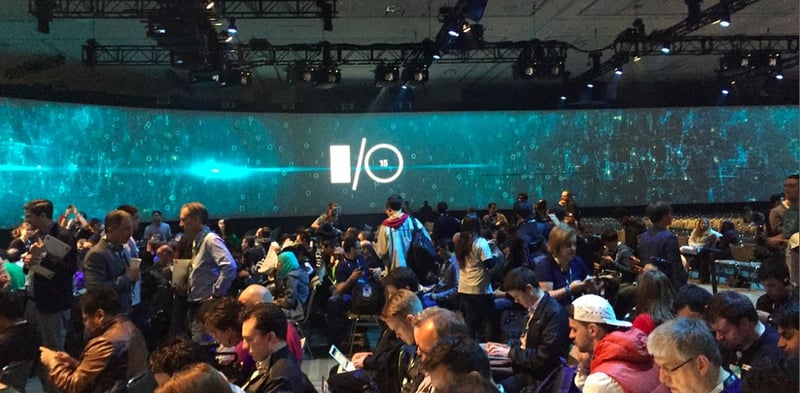
And finally, in honor of Google I/O this week, I’ll leave you with this:

Let us know everything about you. We promise it’ll be worth your while. http://t.co/vJv4ucoZmt

— Josh Clark (@bigmediumjosh) May 29, 2015
Happy weekend, everyone!
Facebook Instant Articles and the web performance gap

The big news in our neck of the woods this week is the launch of Facebook’s Instant Articles. Although the handwringing about the open web and the future of publishing is important, there’s a tangential discussion going on in the web community that I find particularly interesting. It’s about the focus Facebook puts on the speed of the feature. It starts with the name Instant, and continues to play a big role in their marketing materials:

Articles load instantly, as much as 10 times faster than the standard mobile web.

Even the phrase “standard mobile web” is an interesting choice of words, and a subtle shot across the bow with a clear message: the web is sloooooooowwwwwww. Well, the web community took notice, and is gearing up for a fight. Here’s Jason Grigsby:

You can make your sites load faster or you can give complete ownership of your content to Facebook which doesn’t share your interests. Hmm…

— Jason Grigsby, ☁4 (@grigs) May 13, 2015

Tim Kadlec followed up with a great post called Choosing performance:

[The web is so slow at the moment] not because of any sort of technical limitations. No, if a website is slow it’s because performance was not prioritized. It’s because when push came to shove, time and resources were spent on other features of a site and not on making sure that site loads quickly.

This goes back to what many have been stating as of late: performance is a cultural problem.

I agree with them that this is the heart of the matter. Focusing on the instant aspect of the articles is a brilliant marketing move by Facebook. They looked at all the giant, slow, over-designed sites out there, saw an opportunity, and went for it. Let’s admit it: they won this round.

The big question now is: how are we going to respond? I think our best response is to fight fire with fire. Instead of trying to kill Instant Articles with the wrath of a righteous anger, let’s rather do something we should have done ages ago: prioritize performance. And Lara Hogan’s Designing for Performance is an excellent place to start.

Kids, technology, and nonverbal communication

I’m not usually one to freak out about kids and technology use, but Bruce Feiler makes some interesting points in Hey, Kids, Look at Me When We’re Talking:

Dr. [Clifford Nass, a communication professor at Stanford University] told me about research he was doing that suggested young people were spending so much time looking into screens that they were losing the ability to read nonverbal communications and learn other skills necessary for one-on-one interactions. As a dorm supervisor, he connected this development with a host of popular trends among young people, from increased social anxiety to group dating.

That’s pretty alarming.

Buzzfeed, Instagram, and the weirdness of present day journalism

Two recent articles made me think again about how weird journalism and publishing has become because of the internet and social media. In Instagram’s TMZ Jenna Wortham describes a very successful celebrity gossip “site” (what should we call these things now?) that exists primarily on Instagram:

Angie explained to me that Instagram perfectly suited her vision for The Shade Room: image-centric and interactive. For her purposes, Instagram was the equivalent of WordPress. When she started the feed a year ago, her goal was to accumulate 10,000 followers in the first year. She accomplished that in only two weeks. Angie started by posting about people at the bottom of the celebrity hierarchy (minor reality stars, mostly) and worked her way up to bigger names, building her loyalties slowly. Eventually, readers started sending her tips and videos via Instagram’s direct-messaging feature. Now, The Shade Room has more than half a million followers on Instagram alone.

Of course, this “business” is one decision by Instagram away from total collapse, but for now it’s an amazing success story.

The second article continues the media’s fascination with Buzzfeed. From Adrienne LaFrance and Robinson Meyer long and very interesting The Eternal Return of BuzzFeed:

BuzzFeed is a successful company. And it is not only that: BuzzFeed is the rare example of a news organization that changes the way the news industry works. While it may not turn the largest profits or get the biggest scoops, it is shaping how other organizations sell ads, hire employees, and approach their work. BuzzFeed is the most influential news organization in America today because the Internet is the most influential medium—and, in some crucial ways, BuzzFeed demonstrates an understanding of that medium better than anyone else.

And this:

Culturally, economically, even politically: BuzzFeed is so influential because it is still in ascendance. We don’t yet know how big this publication will get, how sweeping and lasting its effects on the American media sphere will be. “We’re still really small,” Peretti insists. “You have Disney and Viacom and Time Warner—the really big media companies are giant compared to us.” But BuzzFeed’s growth has been relentless in recent years. It shows no signs of slowing. Peretti is deliberately and aggressively building his company to be big. “The Internet isn’t for small companies,” he said last year.

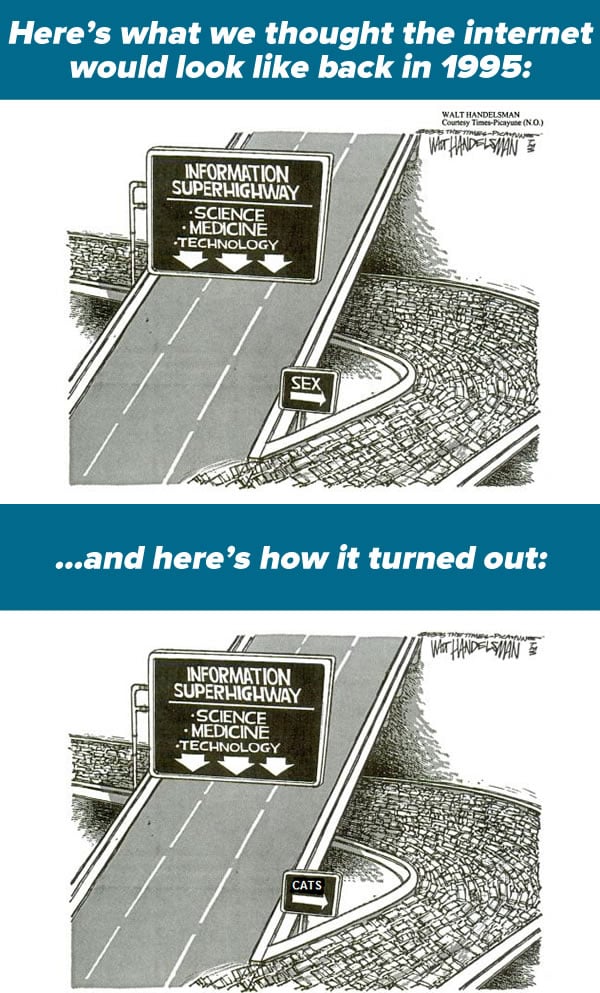
It’s hard not to admire the way Buzzfeed understands how the internet hive mind works. Let’s not forget that they were the first publication to figure out what the internet is really for:

The Watch and our attention

Jason Kottke wrote what I guess can be described as a review of Apple Watch reviews. He makes a particularly interesting point about the common assertion that we’ll start using our phones less because of the watch. From Apple Watch and the induced demand of communication:

In the entire history of the world, if you make it easier for people to do something compelling, people don’t do that thing less: they’ll do it more. If you give people more food, they eat it. If you make it easier to get credit, people will use it. If you add another two lanes to a traffic-clogged highway, you get a larger traffic-clogged highway. And if you put a device on their wrist that makes it easier to communicate with friends, guess what? They’re going to use the shit out of it, potentially way more than they ever used their phones.

He also quotes from the same article I had a visceral reaction to in The Apple Watch won’t save you time. In that article I made a similar point:

I’m not saying the Apple Watch won’t be wildly successful, or that I don’t want one — I definitely want one. I just don’t think we should fool ourselves into thinking it will somehow give us more time because we might look at our phones less. If history teaches us anything, it’s that we’ll find a way for the watch to fill up our “saved” time in other ways — and then some.

Face-to-face contact still matters

Susan Pinker explains why face-to-face contact matters in our digital age:

Our survival hinges on social interaction, and that is not only true of the murky evolutionary past. Over the last decade huge population studies have shown that social integration — the feeling of being part of a cohesive group — fosters immunity and resilience. How accepted and supported we feel affects the biological pathways that skew the genetic expression of a disease, while feeling isolated “leaves a loneliness imprint” on every cell, says the American social neuroscientist John Cacioppo.

And here’s the problem: being “more social” online doesn’t help:

Recent MRI studies led by neuroscientist Elizabeth Redcay tell us that personal contact elicits greater activity in brain areas linked to social problem-solving, attention and reward than a remote connection. When the identical information is transmitted via a recording, something gets lost.

I guess catching up for coffee is still better than texting.

A URL to call home

Robinson Meyer reflects on Medium and What Blogging Has Become:

And I too, a lowly twentysomething, pine for days of less centralization. As I wrote a few days ago, in a New Medium-style short post, “I still find the idea of a diverse blogosphere — arrayed across tens of thousands of URLs, with sites organized by author and shaped by distinctive interests — really, distinctively, unavoidably cool.”

But is there a place in the web ecosystem for this kind of writing anymore? And is the cost of using Medium, which will centralize writing and create a kind of publisher/publishee power inequality, worth the ease? What will happen when widespread abuse comes to Medium, the way it’s come to Twitter? And social media companies have proven tremendously malleable, product-wise, to the desires of other companies — will Medium be the same? What does a piece of advertising look like on Medium anyway, when the line between journalism and PR on it is already so thin?

I’ve been around long enough for Blogger to rise (and fall), for MySpace to be the best (and then the worst) place to write your thoughts, and for Posterous and Windows Live Spaces to disappear (along with all my posts there). So I will stubbornly hold on to writing on this here, my very own URL.

Posterous

Twitter text shots, and what design wants

I’ve been spending a lot of time thinking about how product design decisions aren’t neutral. The way we design a product has a direct effect on how people use it. This is obvious, but I think we often forget the real implication: Design wants something from its users. And we are the architects of those wants. We have a direct impact on user behavior, and we need to recognize the weight of that responsibility.

Let’s look at some recent product changes on Twitter as an example.

In October 2013, Twitter introduced more visual tweets, with photo previews within the timeline. It’s almost hard to imagine now, but before they introduced this you had to click on a link before you could see a photo.

This change had an immediate effect on how people used the product. I’m sure some of it was intentional — people began to tweet a lot more photos. Some of it was probably not intentional but still made sense: social media marketers caught on to the fact that if they attach a photo to an article tweet, they’ll get more attention since the tweet will take up more screen real estate. A little annoying, but ok, so far so good.

But then there was what must have been a fairly unexpected behavior change. People started to use screen shots of text to bypass Twitter’s 140 character limit. At first, only a few people did it. But then publishers and marketers started to notice, and it took off:

Yes, it’s crazy to share text as images on Twitter. But, look at the engagement increase: https://t.co/VRVglh6Bei https://t.co/ePo3pGtep0

— Chris Dixon (@cdixon) November 20, 2014

Some have even come up with guidelines for the best way to stand out in these “textshots”:

Following an exchange with MG Siegler a while back, I settled on a specific textshot style: sans-serif text with a sepia background pulled from Pocket. The idea of using the app’s sepia theme for these came from MG, who noticed that yellow screenshots had more contrast in Twitter’s native apps.

I’ll admit, the temptation to do this is strong. Earlier this week I used a textshot and it became my most retweeted tweet ever:

This post by @scottjenson on empathy in design is so good: “The Paradox of Empathy” - http://t.co/9mYXqWEVP0 pic.twitter.com/J3lekmt5DW

— Rian van der Merwe (@RianVDM) February 24, 2015

Nice, right? Win!

But wait… Let’s step back for a moment and have a look at the metrics on that tweet of mine:

Tweet activity

Almost 25,000 impressions, with a 0.9% click-through rate. That’s worse than a crappy banner ad, and it’s the sum-total of the amount of traffic I sent to Scott’s excellent post. As Derek Thompson points out in The Unbearable Lightness of Tweeting:

Is the social web just a matrix of empty shares, of hollow generosity? As Chartbeat CEO Tony Haile once said, there is “effectively no correlation between social shares and people actually reading.” People read without sharing, but just as often, perhaps, they share without reading. […]

There used to be a vague sense that Twitter drives traffic, and traffic drives renown (or fame, or pride, or whatever word defines the psychic benefit of public recognition). Instead, the truth is that Twitter can drive one sort of renown (there are some people who are Twitter-famous), and traffic affords a different psychic currency. But they are nearly independent variables.

All of this culminated in Medium’s Text Shots announcement yesterday:

Text shots

So there you have it. There is now a very real chance that most of our Twitter timelines will become nothing but screenshots of Medium articles that no one reads. That doesn’t help Medium, it doesn’t help authors, and it frankly doesn’t help us to experience and learn, which is kind of the point of reading. This trend does help Twitter, though. Quoting from The Unbearable Lightness of Tweeting again:

In the last month, I’ve created nearly 2 million impressions for Twitter. Whether that is good for my Twitter persona and my pride is a qualitative question whose answer resides outside the bounds of an analytics dashboard. But it is quantitatively not a good deal for The Atlantic. Something I already suspected has now been made crystal clear: 99 percent of my work on Twitter belongs to Twitter.

Twitter is a business, and impressions are how they make money, so this isn’t inherently evil or wrong. But Twitter is, if nothing else, not what we think it is. Not to get too curmudgeonly about “early Twitter”, but there was something amazing about the 140 character limit. Something about the constraint that brought out people’s creativity. And because it was all text, timelines were easy to scan. Now, all of that is different.

Putting all my personal feelings about this trend (and its implications on traffic and reading) aside, it’s time I get to the point. This fundamental change in the way Twitter is used can all be traced back to a single, fairly simple design decision back in 2013: expanding photos natively in the timeline. Without that change, none of this would have happened.

As designers we can’t possibly know how all the ways our decisions will affect behavior in a product. But we have to, at the very least, recognize that design has an opinion, and that it wants people to behave a certain way. I like the way Jared Spool phrases this:

Over the last year, we’ve started explaining design as “the rendering of intent.” The designer imagines an outcome and puts forth activities to make that outcome real.

We have a responsibility to do our best to ensure design wants things that are good for users as well as the business. We have to think ahead as much as possible, because what design wants is up to us. And once it wants the wrong things, it might be too late to change.

Bots and the law

Kashmir Hill asks an interesting question: Who do we blame when a robot threatens to kill people?

Last week, police showed up at the home of Amsterdam Web developer Jeffry van der Goot because a Twitter account under van der Goot’s control had tweeted, according to the Guardian, “I seriously want to kill people.” But the menacing tweet wasn’t written by van der Goot; it was written by a robot.

He goes on:

Bots will be bots. They won’t know if they’re doing something wrong unless we program them to realize it, and it’s impossible to program them to recognize all possible wrong and illegal behavior. So we’ve got challenges ahead. In the short term, [Clément Hertling, a Paris-based university student who wrote the software that powered the bot] suggested Twitter — and any other platforms bots might live on — could solve the offensive speech problem by allowing bots to self-identify in an obvious way as bots. “That would allow people (law enforcement included) to ignore what they say when it becomes problematic.”

This issue only gets scarier as the question expands to wondering what happens when we put self-driving cars in morally ambiguous situations.