Menu

Posts tagged “publishing”

About this curation thing

This is not a good week to be calling yourself a curator. (Um, please don’t read the description of this site in the left column.) I’m fully aware of the irony of posting a pull quote from Mitch Goldstein’s Formally Concerned, but here goes anyway:

The result of this are blogs full of nothing but other people’s stuff. Pages and pages of other peoples photographs, designs, videos, etc. This is not inherently bad, but what I get curious about is how this affects how people go about making their own work — is there room to think about something new if your mind is filled with everything else? Probably, but I would not discount the distraction of seeing an endless stream of externalized, decontextualized imagery.

I imagine the natural reaction to my opinion of this is that these Tumblr blogs act as inspiration, as a scrapbook of ideas. I question this as well, since I think true inspiration comes from the questions you ask yourself, not from constantly looking at how other people answered their own questions. I hope that the reblogging and reposting of other peoples’ work — and reblogging other peoples’ rebloggings, ad infinitum — does not take the place of actual creativity. I mean, finding cool stuff and posting it sort of feels like you are making something, right? Tumblr can provide an illusion of creation — I wonder what people would make if they were not busy making this illusion?

I’ve actually written about this before as well in the context of the “post-literate society”:

I believe [sites like Pinterest and Instagram] give users the illusion that they’re creating something without the necessary work that is required to make something good. Sharing pictures is effortless. And if we know anything about online behavior, it’s that people hate doing actual work when they can just click a button instead.

This, of course, comes off the back of Choire Sicha’s rant against people who use the word ‘curation’:

You are no different from some teen in Indiana with a LiveJournal about cutting. Sorry folks! You’re in this nasty fray with the rest of us. And your metaphor is all wrong. More likely you’re a low-grade collector, not a curator. You’re buying (in the attention economy at least! If not in the actual advertising economy of websites!) what someone else is selling””and you’re then reselling it on your blog. You’re nothing but a secondary market for someone els’s work.

I’m obviously conflicted about this, because a lot of what I do on this site is what’s considered link-blogging, adding a little bit of context and additional thought when needed. I certainly won’t call that “creating”, but I also don’t understand why there’s such a big backlash against this type of activity.

The first advice writers always give other writers is, read more. So I am comfortable with my approximately 70/30 split between posting links and writing longer, original pieces. I don’t think I’d be able to write the 30% if I didn’t spend the other 70% finding and reading great content — and why shouldn’t I share that with you? As long as the 70/30 split doesn’t become a 100/0 split, I’ll keep doing this.

On this particular issue I’m much more in agreement with Erin Kissane’s viewpoint in Bloggers and Bowerbirds:

We should stop treating the web like it’s zero-sum and start treating each other like colleagues. When people like Popova and Roth-Eisenberg show up and offer a standard, our response should not be to freak out about them wanting in on “our” cultural capital. Respecting the work of discovery doesn’t detract from respect for the work of creators. There is not a limited supply of civility and respect, so let’s stop being dicks about this stuff.

Preach it, Erin.
Sharing books and music: not as similar as we might think

Nicholas Carr looks at the differences between customers who buy/share books vs those who buy/share music, specifically within the context of piracy. In Books ain’t music he notes:

The unauthorized copying of songs and albums did not begin with the arrival of the web or of MP3s or of Napster. It has been a part of the culture of pop music since the 1960s. There has been no such tradition with books. Xeroxing a book was not an easy task, and it was fairly expensive, too. Nobody did it, except, maybe, for the occasional oddball. So, even though the large-scale trading of bootlegged songs made possible by the net had radically different implications for the music business than the small-scale trading that had taken place previously, digital copying and trading didn’t feel particularly different from making and exchanging tapes. It seemed like a new variation on an old practice.

His observations are fascinating. It shows that even though record labels certainly deserve their share of the blame when it comes to the dismal state of the commercial music industry, the history and context of music sharing has an enormous part to play in the rise of modern-day music piracy. The publishing industry has a very different historical context, so we can’t just apply the “lessons” from the music industry to the challenges introduced by digital books.

Wish list for a mobile WordPress publishing platform

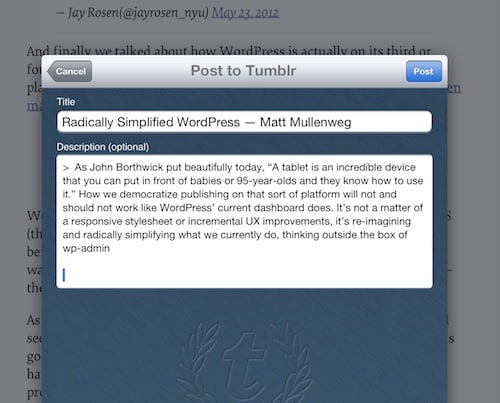
I was encouraged to read these words by Matt Mullenweg in his post Radically Simplified WordPress:

As John Borthwick put beautifully today, “A tablet is an incredible device that you can put in front of babies or 95-year-olds and they know how to use it.” How we democratize publishing on that sort of platform will not and should not work like WordPress’ current dashboard does. It’s not a matter of a responsive stylesheet or incremental UX improvements, it’s re-imagining and radically simplifying what we currently do, thinking outside the box of wp-admin.

This is great news, and I’d like to offer my 2 cents on what an ideal mobile WordPress platform might look like. Because despite several attempts I haven’t been able to figure out a good workflow for publishing to WordPress from my iPhone or iPad.

Let’s take this post as an example. I read Matt’s article in Instapaper. I used the awesome “Create Note in Simplenote” feature to send the above quote to my preferred writing app. I am writing these words in Simplenote for iOS using Markdown. Writing down the words is a breeze; geting those words to my blog is a mission (and usually results in a big time delay). I’m going to wait until I get home, open my laptop, and wait for nvALT to sync with the text I entered into Simplenote. Then I’ll copy the Markdown into MarsEdit, add some URL and keyword specifics, and hit Publish.

The WordPress iOS apps are not helpful to me, because they don’t allow you to add custom fields and URLs. For example, for link posts I have a custom field that turns the title of the RSS entry for that post into a link that takes the reader directly to the original article. I can’t do that in the iOS app.

But here’s the thing - I don’t want a better WordPress iOS app. I don’t even want a mobile-optimized WordPress Dashboard. Instead, I want all the apps I already use to integrate seamlessly with the WordPress backend. So my ideal mobile WordPress experience is this: make it dead easy for text editor apps to publish to WordPress.

Once I’m done writing this post in Simplenote I would like to tap a link that says “Publish to WordPress.” I would then like to see a customizable dialog that lets me add/edit all the fields I have chosen to include, hit Post, and be done. It could work similar to Tumblr integration on Instapaper, except with customizable fields:

Instapaper and Tumblr integration

Maybe this is already what the WordPress team is thinking about - I certainly hope so. Either way, I know that this kind of seamless integration would truly free us to publish from anywhere, and will put a final nail in the coffin of the “iPad is only for consuming” argument.

It would be great to get more insight from the WordPress team on what they’re working on for mobile.

Blogging is an attitude (and a privilege)

Jim Dalrymple in Blogging is not a thing, it’s an attitude:

Readers connect with a blogger. They know things about them, they laugh together and sometimes argue over points in a story. It’s a give and take relationship that not everyone can handle.

Blogging is not about being stiff and rigid in your writing, but being flexible and flowing with ideas. It doesn’t matter if everyone agrees with your thoughts. In fact, that would be really boring ”” but you write it anyway.

I completely agree with Jim, and it’s one of the main things I’ve learned in the few months that I’ve been writing more on this site. Conventional blogging wisdom says that you have to pick a topic and stick with it. I read this advice all over the web, so I used to think about it all the time. I worried about the topics I covered, and whether or not I’m “allowed” to publish something if it doesn’t quite fit my One Chosen Topic. Oh, and I worried a great deal about what that One Chosen Topic should be. Writing lost its fun and became stressful.

I no longer believe that this conventional wisdom is true. I think that people follow blogs primarily because they connect with the authors and their views in some way, not because of the specific topics they cover (although of course that does play a part). It’s why I keep coming back to The Loop, Daring Fireball, The Brooks Review, Shawn Blanc, etc. It’s why I don’t mind when Marco Arment reviews LED light bulbs.

I might not always agree with these authors, but I have a genuine affinity for them, and I respect their views. They’re not faceless organizations, but human beings that write about things that interest them. And because they do it well, they get me interested in a much more diverse set of topics (like baseball). They prompt me to think more critically, and that spurs additional thoughts that feed into my own writing.

I also like this quote from Michael Lopp from his article Please Learn to Write:

Your readers are far more critical than the Python interpreter. Not only do they care about syntax, but they also want to learn something, and, perhaps, be entertained while all this learning is going down. Success means they keep coming back - failure is a lonely silence.

I think when it comes down to it, it’s the constant fear of the lonely silence that drives us to become better writers. But that’s a much better fear to have than wondering about what you’re allowed to put on your site. I’m in no position to give writing advice, but I’ll tell you what has made my experience worthwhile.

I feel like writing more has helped me find my voice. And I am becoming more comfortable with raising that voice about a continuously expanding range of topics. Sometimes it’s good, sometimes it’s not so good. But there has been a big pay-off in persisting: a small, growing community of readers that I appreciate and enjoy immensely. They tell me when I’m full of crap, and they tell me when I write something they like. That’s an incredible privilege, and why I love the blog format so much. So if you’re one of those who keep coming back and provide the occasional piece of feedback: thank you.

Ok, this turned out much longer than I planned. I actually just wanted to send you to Jim’s post. So don’t forget to go read it.

Is it time to stop writing headlines that end in question marks?

Betteridge’s Law of Headlines states the following:

Any headline which ends in a question mark can be answered by the word ‘no’.

Ian Betteridge explains his theory as follows:

The reason why journalists use that style of headline is that they know the story is probably bollocks, and don’t actually have the sources and facts to back it up, but still want to run it.

Betteridge’s point is that if a story had enough proof and citations, the headline would be assertive. Consider the latest story on TechCrunch, as of this writing: “Warren Buffett Is A Punk”. Regardless of its journalistic appeal, doesn’t that sound much better than “Is Warran Buffett A Punk?”. Headlines end in question marks when the authors want to retain a certain measure of deniability if their story turns out to be false (“Will iOS 6 Be Able To Make You Coffee?”).

However, lately these headlines have morphed into something beyond just a mixture of deniability and laziness: pure link bait. Consider a few randomly selected headlines from the last week:

  • Should Celebrities Create Their Own Branded Social Networks?
  • Could in-store navigation tech be a shopper’s worst nightmare?
  • Samsung Galaxy S III: Is the Screen Its Achilles Heel?

The idea is to get people interested enough to click through, and then make them scroll past the ads until the answer (usually, “no”) is revealed in the last paragraph. It’s effective, but I just don’t think it should be done. Unfortunately I don’t have a business reason for my opinion, but I do have a reader reason.

I believe in respecting your audience’s intelligence, and not wasting their time. I believe in stating an article’s thesis and/or purpose clearly in the title, and trusting that if it’s interesting enough, the people you want on your site will click through and read it.

So, is it time to stop writing headlines that end in question marks? I’m going to break Betteridge’s Law and say, unequivocally, yes.

The Shape of Design by Frank Chimero: closing remark

I just finished reading Frank Chimero’s The Shape of Design. My closing remark on Readmill:

Highly recommended to anyone who wants to step back and get a sense of the state of design beyond the tools that we use. It makes us think about the reasons why we design, and how to give our work purpose and meaning. I found part 1 to be the strongest, but it’s a quick, easy read throughout.

You can follow the link to see the highlights I made - there are some really great quotes in there, such as this one:

Design doesn’t need to be delightful for it to work, but that’s like saying food doesn’t need to be tasty to keep us alive. The pedigree of great design isn’t solely based on aesthetics or utility, but also the sensation it creates when it is seen or used. It’s a bit like food: plating a dish adds beauty to the experience, but the testament to the quality of the cooking is in its taste. It’s the same for design, in that the source of a delightful experience comes from the design’s use.

In related news, I thoroughly enjoyed reading this on the Readmill app for iPad. I will try to read books with this app whenever possible from now on, with the Kindle as a backup if I can’t find the book as DRM-free ePub. The reader itself needs a bit of work to get to the standard that iBooks set, but the social features are really great. I love seeing who else is reading the book I’m reading, what they’ve highlighted, etc. Readmill embraces the digital reading experience in the best way that I’ve seen so far.

Digitial artifices on electronic representations of paper

Matt Gemmell posted some interesting reflections on the difficulties of translating paper-based media to digital devices. It includes another reason (not that we need any more reasons, mind you) why skeuomorphic design practices are so problematic. From Augmented Paper:

It’s so easy to saturate electronic representations of paper with what I call “digital artifice”; the gratuitous and ultimately heavy and objectionable skeuomorphisms and decorations that betray a simplistic thinking process: let’s just make this look the same. That’s a damaging frame of mind, because it enforces a false dichotomy between the real and the virtual. Software should be an enhancement, not a replication.

Paying more for the things we value

Maureen Johnson on the current state of eBook pricing:

It’s coming down to a lot of bedrock issues about how you VALUE things in general. What’s the VALUE in paying more? What should electronic items cost if the physical value is largely held in the device? How do we maintain a thriving literary life in the face of these new developments? Is this a sign that publishing is an outmoded business of “gatekeepers,” or is this a rallying point to stand up and say w’re willing to pay more for things that are of value to us? 

There is no word other than delightful to describe this post. Ok, maybe informative will do as well. Also, it could do with a little less screaming in all caps. Other than that, it’s perfect.

The real reason websites have to get better

Jon Mitchell in Websites Have to Get Better:

Read-later apps are competition for noisy, ad-ridden websites. They represent a simple fact: Users hate our sites.

Websites should think of Instapaper as competition. People are spending their reader-experience (RX?) dollars elsewhere, period. They don’t want to pay publisher sites with impressions on ads they don’t value, so they pay Marco Arment for a better reading experience. If publishers want to get those RX dollars, they have to deliver a great experience Instapaper can’t provide. It’s pure and simple competition.

I agree with the conclusion that web sites have to provide better reading experiences. But I don’t agree with the causal relationship being drawn with Read Later apps.

First, the main purpose of Read Later apps is revealed right there in the name: they’re for reading things”¦ later. So even though some people probably use the Instapaper web view to read articles immediately without ads, my guess is that most people use it to save articles for later reading.

What the DVR does for TV shows, Instapaper does for articles. And just like with a DVR, you get to skip the ads - but that’s just a wonderful, added bonus. The real benefit is having a place to store and watch/read all the things you want to get to without being bound to the time and place where you first discovered it. This means that if major ad-supported sites start to provide better reading experiences, I won’t suddenly stop using Instapaper. The need to save articles for later reading would remain. This brings me to my second point.

The reason web sites have to provide a better reading experience is not because Read Later apps are their competition, but because it’s the right thing to do. It’s how you show that you value and respect your readers.

Eyeballs vs. Readers

From Game of Thrones: How HBO and Showtime make money despite low ratings:

On the networks and basic cable, shows are a delivery vehicle for advertising””and if a program doesn’t attract a big enough audience for those ads, the consequences are clear: It’s pulled from the schedule, and a new show is dropped into the time slot. On those channels, viewer is just another word for person who sees a commercial.

This is contrasted with the subscription model that premium channels like HBO and Showtime use:

The premium networks are in the business of selling subscriptions. A Showtime spokeswoman told me that the channel’s goal is to satisfy subscribers and to entice non-subscribers to sign up. They keep their customers happy by allowing them to watch original TV series, exclusive movies, and sports programming whenever they want to.

I’m pretty sure you know where I’m going with this, but the situation is analogous to what we see in online publishing today. Ad-supported sites aim to rack up all the “eyeballs” in the world so that they can be resold to advertisers. Subscription-based sites aim to satisfy their readers by providing great content that will, in turn, entice more non-subscribers to sign up.