Menu

Posts tagged “publishing”

An invitation to bring back your personal site

Buried somewhere in the middle of Will Oremus’s article about Twitter’s decision to increase the 140-character limit we find this important paragraph:

What’s really changing here, then, is not the length of the tweet. It’s where that link at the bottom takes you when you click on it—or, rather, where it doesn’t take you. Instead of funneling traffic to blogs, news sites, and other sites around the Web, the “read more” button will keep you playing in Twitter’s own garden.

I’m nowhere near up to date or involved enough in the Open Web movement, but I’ve been writing this site since 2009 and since 6 years is a lot of time to invest in something, I do have Opinions on the matter. Hence one of the first things I tweeted this year:

2015 was the year of Medium and Newsletters, but I feel like we should use 2016 to Make The Personal Blog Great Again™.

— Rian Van Der Merwe (@RianVDM) January 2, 2016

The tweet prompted some interesting discussion, including links to a couple of excellent articles about Medium: Matthew Butterick’s The billionaire’s typewriter and Mandy Brown’s Ferengi (thanks for sending those, Chris!). There’s no need for me to reiterate their arguments here, except to say that this move to proprietary platforms—from Medium to Instant Articles to now Twitter’s entry to long-form publishing—seems to be a dangerous threat to the Open Web.

There are the political arguments around access and inequality that are all very valid, but I want to focus on another aspect here: content platforms as shortcuts. One of the main reasons for writing on a platform like Medium or Twitter or Facebook, as opposed to your own site, is that it’s supposed to give you easier access to a huge audience. And this is no small thing, because building an audience on your own site is, as far as I know, statistically impossible.

Okay, maybe that’s being a bit dramatic. But I’ll tell you that after 6 years of trying to do it I was exhausted and had to take a bit of a break recently. Now, you could argue that the reason I don’t have a huge following on this site is simply that my writing sucks, and you probably won’t be too far off track there. Yet I’d like to think that there’s more to it than that. Building an audience is just really hard because people have to seek out your content, and the truth is that most of the time nobody wants to read your shit.

But I digress. The point is that publishing on Medium and Twitter and Facebook gives you an immediate shortcut to a huge audience, but of course those companies’ interests are in themselves, not in building your audience, so it’s very easy for them to change things around in a way that totally screws you over (remember Zynga? Yeah, me either).

All this to say that I think it’s time we bring blogging and personal sites back. Some of my favorite sites are the ones that give me a glimpse into everything a person is interested in (I think my current favorite is Josh Ginter’s understated and eclectic The Newsprint). It’s a way to get to know someone through their interests, and to learn a bunch of things along the way. So I invite you not just to follow along here as I expand into topics beyond design and technology1, but to start your own personal blog up again if you’ve been neglecting it for a while. I’m really interested in the things you are passionate about. I want to learn from you. But don’t just do it for me, do it for you. Because it turns out there is an immense power in avoiding shortcuts and instead doing things the long, hard, stupid way.


  1. Fair warning: I’m a little rusty… 

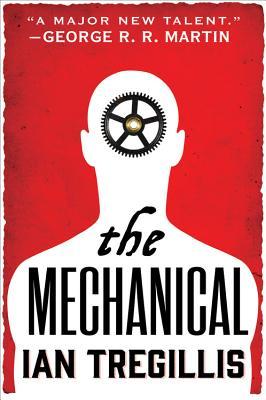
Book Review: The Mechanical by Ian Tregillis

For the creation of the mechanicals was a seismic event, an earth-rending convulsion that left nothing untouched: palaces, thrones, and empires, yes, but also the way men and women thought about themselves and their relationship to the world, to God, even their own bodies.

― Ian Tregillis, The Mechanical

The Mechanical wasn’t on my radar until a friend recommended it, but it jumped to the top of my reading queue as soon as I read the blurb. I’m not usually a fan of alternate history or steampunk, but this story about a mechanical creature that attains free will—and thereby freedom from his creators—felt too good to pass up. And I wasn’t disappointed.

The plot is a new twist on the story we’ve seen many times before in movies like The Terminator and I, Robot. Humans create a thing that becomes self-aware, and general chaos ensues. What makes this story interesting is the mid-1900s setting, an unbalanced war between the Dutch (who created the mechanicals) and the French (who struggle to find weapons that can compete), and the fascinating inner thoughts of Jax, our mechanical protagonist.

As with most good stories, this one is only about robots and war on the surface. Dig a little deeper and you find insightful reflections on free will from the perspective of someone who wasn’t born with it. Here is Jax, describing what it feels like to be free from the geis (the painful compulsion to serve his masters) he’s been under since his creation:

Freedom felt like… nothing. Free Will was a vacuum, a negative space. It was the absence of coercion, the absence of compulsion, the absence of agony. A gap in his consciousness where geasa had perpetually jostled for priority, demanding his obedience. It was the photographic negative of Jax’s existence during every minute of the 118 years since he’d been forged. It was overwhelming. Exhilarating. Terrifying.

And a little later in the story, his realization that free will comes with certain responsibilities:

But he’d given her his word. And Jax realized, to his own surprise and disappointment, he didn’t want that to be meaningless. What point in having the freedom to enter into promises of your own choosing, to forge bonds of your own design, if your only aim is to shatter them? No. That couldn’t be his legacy.

I’m not sure what genre to put this book in. It’s a bit of sci-fi and alternate history combined, but it has a distinct literary fiction feel to it with its beautiful prose and wonderful storytelling. I have a couple of small complaints—the story meanders a bit at times, and it stops rather suddenly (but that’s ok, because the second book in the trilogy just came out). It still gets a big thumbs up and recommendation, though. I really enjoyed it.

Buy The Mechanical on Amazon

Facebook Instant Articles and the web performance gap

The big news in our neck of the woods this week is the launch of Facebook’s Instant Articles. Although the handwringing about the open web and the future of publishing is important, there’s a tangential discussion going on in the web community that I find particularly interesting. It’s about the focus Facebook puts on the speed of the feature. It starts with the name Instant, and continues to play a big role in their marketing materials:

Articles load instantly, as much as 10 times faster than the standard mobile web.

Even the phrase “standard mobile web” is an interesting choice of words, and a subtle shot across the bow with a clear message: the web is sloooooooowwwwwww. Well, the web community took notice, and is gearing up for a fight. Here’s Jason Grigsby:

You can make your sites load faster or you can give complete ownership of your content to Facebook which doesn’t share your interests. Hmm…

— Jason Grigsby, ☁4 (@grigs) May 13, 2015

Tim Kadlec followed up with a great post called Choosing performance:

[The web is so slow at the moment] not because of any sort of technical limitations. No, if a website is slow it’s because performance was not prioritized. It’s because when push came to shove, time and resources were spent on other features of a site and not on making sure that site loads quickly.

This goes back to what many have been stating as of late: performance is a cultural problem.

I agree with them that this is the heart of the matter. Focusing on the instant aspect of the articles is a brilliant marketing move by Facebook. They looked at all the giant, slow, over-designed sites out there, saw an opportunity, and went for it. Let’s admit it: they won this round.

The big question now is: how are we going to respond? I think our best response is to fight fire with fire. Instead of trying to kill Instant Articles with the wrath of a righteous anger, let’s rather do something we should have done ages ago: prioritize performance. And Lara Hogan’s Designing for Performance is an excellent place to start.

Buzzfeed, Instagram, and the weirdness of present day journalism

Two recent articles made me think again about how weird journalism and publishing has become because of the internet and social media. In Instagram’s TMZ Jenna Wortham describes a very successful celebrity gossip “site” (what should we call these things now?) that exists primarily on Instagram:

Angie explained to me that Instagram perfectly suited her vision for The Shade Room: image-centric and interactive. For her purposes, Instagram was the equivalent of WordPress. When she started the feed a year ago, her goal was to accumulate 10,000 followers in the first year. She accomplished that in only two weeks. Angie started by posting about people at the bottom of the celebrity hierarchy (minor reality stars, mostly) and worked her way up to bigger names, building her loyalties slowly. Eventually, readers started sending her tips and videos via Instagram’s direct-messaging feature. Now, The Shade Room has more than half a million followers on Instagram alone.

Of course, this “business” is one decision by Instagram away from total collapse, but for now it’s an amazing success story.

The second article continues the media’s fascination with Buzzfeed. From Adrienne LaFrance and Robinson Meyer long and very interesting The Eternal Return of BuzzFeed:

BuzzFeed is a successful company. And it is not only that: BuzzFeed is the rare example of a news organization that changes the way the news industry works. While it may not turn the largest profits or get the biggest scoops, it is shaping how other organizations sell ads, hire employees, and approach their work. BuzzFeed is the most influential news organization in America today because the Internet is the most influential medium—and, in some crucial ways, BuzzFeed demonstrates an understanding of that medium better than anyone else.

And this:

Culturally, economically, even politically: BuzzFeed is so influential because it is still in ascendance. We don’t yet know how big this publication will get, how sweeping and lasting its effects on the American media sphere will be. “We’re still really small,” Peretti insists. “You have Disney and Viacom and Time Warner—the really big media companies are giant compared to us.” But BuzzFeed’s growth has been relentless in recent years. It shows no signs of slowing. Peretti is deliberately and aggressively building his company to be big. “The Internet isn’t for small companies,” he said last year.

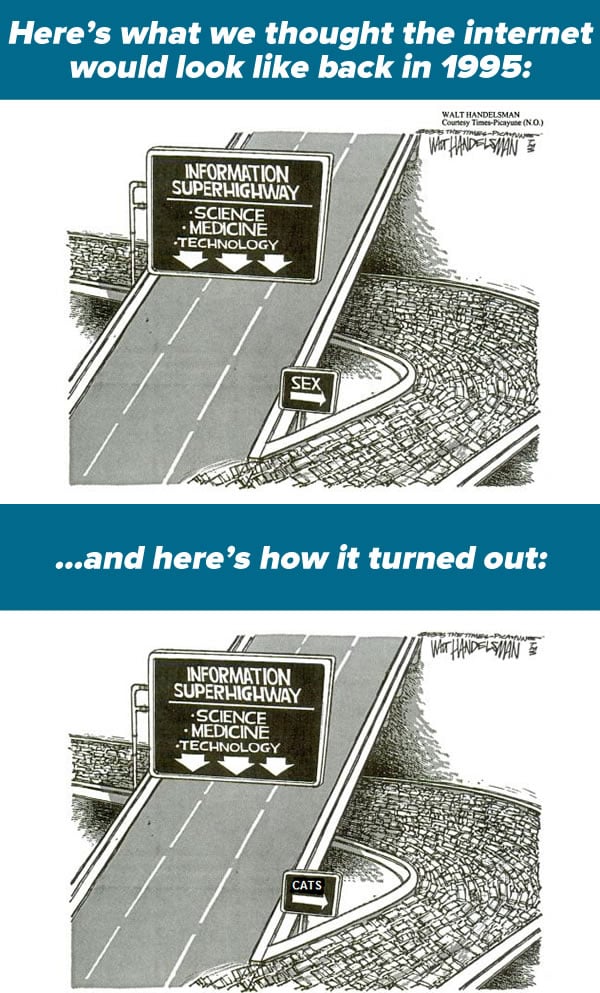
It’s hard not to admire the way Buzzfeed understands how the internet hive mind works. Let’s not forget that they were the first publication to figure out what the internet is really for:

Blogging with Pinboard

I’m a long-time Pinboard fan, and from the moment I became a paid user I couldn’t shake the feeling that it is one of the most underrated services out there. It’s basically the center of my personal internet. I have years of articles tagged and cached, and available immediately whenever I need to remember something. For me, it represents the best of what technology has to offer as an “external brain”1.

But it’s even more powerful than that. I recently started wondering if Pinboard could become more central in my blogging workflow as well. My flow when I find an article I want to write about used to be two steps: (1) save to Pinboard, and then (2) start a new text file (with an excerpt from the article) and start writing.

Since I don’t always have time to write immediately after I read something, the disjointedness of these two steps means that I forget to post articles sometimes — or that I can’t remember which part I want to write about. So I needed a way to save Pinboard links for later, in a way that lets me pick up writing whenever I have time.

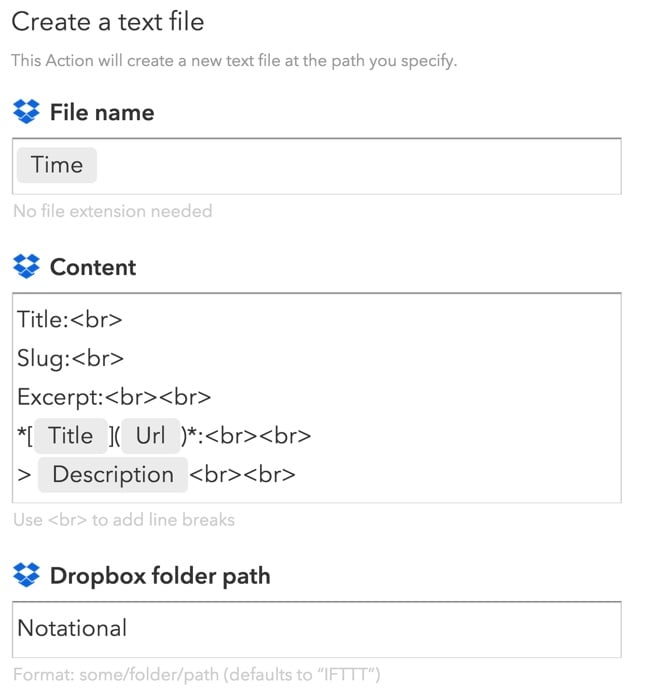
The solution I came up with isn’t rocket science, but it has made such a big difference to the way I write that I wanted to share it here. The key is a simple IFTTT recipe that takes any new link I save to Pinboard and creates a Markdown-formatted text file that I can use to start writing whenever I want to.

Here is a link to the IFTTT recipe: Post any new Pinboard link to a new text file in Dropbox.

And this is what it does:

Pinboard and IFTTT

I always put a pull quote in the “Description” field when I save a Pinboard link, so the recipe creates a text note with a Markdown-formatted URL, the pull quote, and space for me to add a title, slug, and excerpt once I’m ready to post to the site. Putting the note in a Dropbox folder means I can continue typing and editing on any device — I use Editorial on iOS and nvALT on Mac.

As for posting… I still haven’t found a mobile blogging platform that works for me, so even though I write many posts on my iPhone or iPad, I still post exclusively from MarsEdit. So I also went one step further and made a Keyboard Maestro macro (download here) that transfers the text from nvALT to MarsEdit as soon as I’m ready to post.

You know, the internet is pretty cool sometimes.


  1. Clive Thompson discusses the idea of external memory in detail in his excellent book Smarter Than You Think

A URL to call home

Robinson Meyer reflects on Medium and What Blogging Has Become:

And I too, a lowly twentysomething, pine for days of less centralization. As I wrote a few days ago, in a New Medium-style short post, “I still find the idea of a diverse blogosphere — arrayed across tens of thousands of URLs, with sites organized by author and shaped by distinctive interests — really, distinctively, unavoidably cool.”

But is there a place in the web ecosystem for this kind of writing anymore? And is the cost of using Medium, which will centralize writing and create a kind of publisher/publishee power inequality, worth the ease? What will happen when widespread abuse comes to Medium, the way it’s come to Twitter? And social media companies have proven tremendously malleable, product-wise, to the desires of other companies — will Medium be the same? What does a piece of advertising look like on Medium anyway, when the line between journalism and PR on it is already so thin?

I’ve been around long enough for Blogger to rise (and fall), for MySpace to be the best (and then the worst) place to write your thoughts, and for Posterous and Windows Live Spaces to disappear (along with all my posts there). So I will stubbornly hold on to writing on this here, my very own URL.

Posterous

"Making It Right" now available in paperback

I try not to overwhelm you with posts about the product management book I wrote recently, but I do think this deserves a post. After a few hiccups, Making It Right is now available in paperback on Amazon, through CreateSpace Independent Publishing.

If you like papery things and margins, I’m sure you will like it.

Buy ‘Making It Right’ on Amazon.

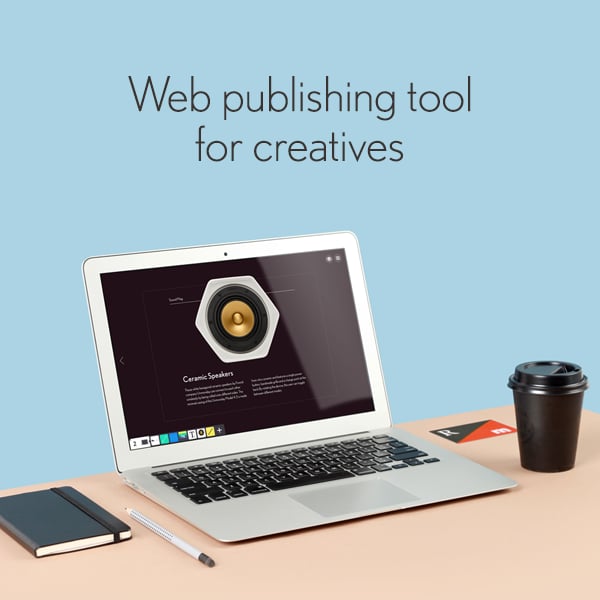
[Sponsor] Readymag: Web Publishing Tool for Creative People

Usually we use a bunch of different software for creating such things as websites, presentations, photo stories and online magazines. The truth is — it all can be done easier and with one tool.

Do design, forget about coding.

Readymag provides a simple online tool for designing and publishing all forms of content, helping to focus on the creative process, rather than interface complexity and code. Among the main Readymag’s features:

  • Viewport: Easily create responsive layouts for mobile deviсes.
  • 1500+ free web fonts: From Typekit, Webtype and Google Fonts.
  • Password protection: Create private publications and share with specific audience.
  • PDF-export: Save and view your work offline.
  • Ready-to-use templates: Made by talented designers from around the world.
  • Plus: Free hosting, custom domain and analytics.

Stay creative. Try Readymag now for free.

Readymag

Sponsored via Syndicate Ads

Book Excerpt: Making It Right

As I’m sure you’re extremely tired of hearing by now, I recently wrote a book on Product Management. For those of you who are too cheap to buy it (I kid, I kid1), there is now an edited chapter excerpt up on Smashing Magazine. In Why Companies Need Full-Time Product Managers (And What They Do All Day) I give my definition of Product Management, and go into some of the characteristics of a good PM. Also:

The truth is that, to be effective, the role of a manager for a particular product or area must not be filled by multiple people. It is essential for the product manager to see the whole picture — the strategic vision as well as the details of implementation — in order to make good decisions about the product. If knowledge of different parts of the process resides in the heads of different people, then no one will have that holistic view, and all value will be drained of the role.

Enjoy the freebie!


  1. But not really. PLEASE BUY IT

Want to do something? Begin now.

Who doesn’t love Ira Glass? What a legend. His I’m Ira Glass, Host of This American Life, and This Is How I Work feature in LifeHacker is really good:

I’d just say to aspiring journalists or writers—who I meet a lot of—do it now. Don’t wait for permission to make something that’s interesting or amusing to you. Just do it now. Don’t wait. Find a story idea, start making it, give yourself a deadline, show it to people who’ll give you notes to make it better. Don’t wait till you’re older, or in some better job than you have now. Don’t wait for anything. Don’t wait till some magical story idea drops into your lap. That’s not where ideas come from. Go looking for an idea and it’ll show up. Begin now.

I also loved this response to the question What’s your best time-saving shortcut/life hack?:

I’ve got nothing. Reading other people’s answers to this question on your website today made me realize I live my life like an ape. I eat the same breakfast and lunch everyday, both at my desk. I employ no time-saving tricks at all.

So, I guess in related news, I bought making-it-right.com and I don’t know maybe it will become something, maybe not…