Menu

Posts tagged “productivity”

Obsession, endless curiosity, and the joy of iterative projects

I love when people get obsessed with a topic and then turn that obsession into an “iterative project” where they do the same thing over and over until the topic has nothing left to give. An example: my friend Dave watches sci-fi movies hundreds of times and obsesses about the typography for his blog Typeset in the Future. I think his post on Alien is my favorite:

The opening credits for Alien are nothing short of a typographic masterpiece. You can watch them in their entirety on the Art Of The Title web site, but here’s the general gist: a slow, progressive disclosure of a disjointed, customized Futura reveals the movie’s central theme over 90 seconds of beautifully-spaced angular lettering.

Dave’s book is also amazing and you should buy it.

Clive Thompson wrote about this topic recently in his essay The Power of Indulging Your Weird, Offbeat Obsessions. His point about the value of following your obsessions is this:

It’s enormously valuable to simply follow your curiosity—and follow it for a really long time, even if it doesn’t seem to be leading anywhere in particular. Surprisingly big breakthrough ideas come when you bridge two seemingly unconnected areas.

A few other recent examples got me thinking about this again. Ander Monson watched Predator 146 times and wrote a book about it. From an interview with him:

In following every rabbit hole of his obsession with the film through to its end, Monson creates a book that is truly one-of-a-kind—not just a dose of nostalgia for movie buffs, but a revelatory investigation for anyone who’s ever really loved a singular piece of culture, enough that it got tangled inextricably in their identity and could never quite be excised. In Monson’s own words: “I believe that if you look long and hard enough at what you loved best at fourteen and how you lived then and what you saw in the world, it will reveal both the world and you.” As the pages turn, a question inevitably arises: What have you loved in the way that Monson loves Predator? And, for better or worse, how has it made you who you are?

A few weeks ago Monson published an essay about a similar project: Sean T. Collins’s “Pain Don’t Hurt”, an out-of-print book of 365 essays about the movie Road House (you can read every essay on his website). Monson starts off by calling this a “bad idea essay”, and if anyone is qualified to say that, it’s the guy who watched Predator 146 times. But he goes on to say this:

The reason I love bad idea essays is not because they seem dumb or bad but that they’re hard. Anyone can write a good idea essay. But only a real pro—or a real fool, and it’s hard to tell which you are when you start one, which is the entirety of the stakes of the bad idea essay—can write a bad idea to its exhaustion/completion. Only after exhausting yourself will you see if it was worth it.

But it’s these paragraphs that really get to the heart of the matter for me:

365 essays about Road House is an idiotic thing, and its idiocy is part of its appeal. I am often moved by iterative projects, because in repeating an action every day or every week or every year you make time a subject. […]

The reason I love iterative projects is that the plot is inevitably the movement of the mind (or the life or the body) through time. Every piece is a technical problem: oh shit, what am I going to do today? And the technical problem just gets harder as it goes deeper: How can I not bore myself on essay 241?


The reason obsessive projects like these—or what Monson calls iterative projects—are so appealing to me is two-fold. One, there is The Sad, Beautiful Fact That We’re All Going To Miss Almost Everything:

Surrender, on the other hand, is the realization that you do not have time for everything that would be worth the time you invested in it if you had the time, and that this fact doesn’t have to threaten your sense that you are well-read. Surrender is the moment when you say, “I bet every single one of those 1,000 books I’m supposed to read before I die is very, very good, but I cannot read them all, and they will have to go on the list of things I didn’t get to.”

Two, if we agree that we’re going to miss almost everything, there is a certain beauty in picking a small number of things you want to know everything about, and then sharing that with those around you. We know from the African philosophy of Ubuntu that “I am because you are”, or:

Humanity is not embedded in my person solely as an individual; my humanity is co-substantively bestowed upon the other and me. Humanity is a quality we owe to each other. We create each other and need to sustain this otherness creation. And if we belong to each other, we participate in our creations: we are because you are, and since you are, definitely I am.

One of the most tangible ways we can “owe humanity to each other” is by crawling deep into the corners of a specific topic and picking out the best pieces of it for the people around us. It’s saying, “I know we’re going to miss almost everything, but on this thing I got you. I’ll go deep so you don’t have to, and I’ll share what I learn so we can both enjoy what makes it special.”

There’s one more thing that really drove this point home for me recently. Substack has an interview up with Nicola Lamb, author of the Kitchen Projects newsletter. Nicola has built a very large following on Substack, and her answer to the question “What have your subscribers taught you?” summarizes this entire post so well. In essence, her audience taught her that we all want to hear about each other’s obsessions:

[My audience taught me] to be unashamedly obsessed with whatever you are into. To not shy away from details and to get deep into whatever it is that you love. Thank you for that.

So maybe this is something for all of us to ponder a bit more. What are you obsessed with that seems so niche that surely no one else would care? I’ll say this: if someone can write a fascinating book about watching Predator, I guarantee that your “bad idea essay” is probably actually a really good idea for an iterative project. I, for one, would love to read it.


Internal communications for executives

Some great tips here from Will Larson on how to improve internal communications as a leader. I especially like “Maintain the drip”:

These updates establish a persistent drip of information from you to the wider organization. Some weeks you might have a light update, but rather than folks thinking that you’re not doing much, they’ll be reassured that they are up-to-date on what’s important. Dense updates are good, but it’s the brief updates that reassure the team that you would have updated them if there was something they needed to know.

Read on for the others: test before broadcasting, build the packet, and use every channel.

Stray Links for January 26, 2023

Distractions, monk productivity, and the importance of “between-time”

Sometimes the internet seems to think about the same things at the same time. Last week we were all in on meetings (see here, here, here, and here), and this week we’re all talking about distractions. Here are three excellent articles about this topic that all came across my feeds this week.

First, there is a new interview with the father of deep work, Cal Newport (NYT gift article link). He talks about context switching and “slow productivity”—and it’s really good:

I’m trying to develop this notion of productivity that’s based on, at the large time scales, the production of things you’re proud of and that have high impact, but on the small time scale, there’s periods where you’re doing very little. […] So how do you actually work with your mind and create things of value? What I’ve identified is three principles: doing fewer things, working at a natural pace, but obsessing over quality. That trio of properties better hits the sweet spot of how we’re actually wired and produces valuable meaningful work, but it’s sustainable.

Matt Reynolds has a catchy title in Wired: Easily Distracted? You Need to Think Like a Medieval Monk. It’s a fun exploration of how medieval monks were, as he calls them, “the original LinkedIn power users” who kept trying to one-up each other with how distraction-free they were living:

These kinds of stories reminded monks just how hard it was to stay focused. They weren’t expected to be concentration machines. They too would come up short every now and then. “Acknowledging that upfront is a kind of compassion,” says Kreiner. “Monks are really good at being compassionate to each other, and to how hard it was to really follow through on stuff.” Freeing ourselves from distraction is really difficult. We don’t have to feel awful about not always matching up to our lofty goals.

And finally, in a short read Mandy Brown talks about the importance of Between-time:

We live in a world full of distractions but short on breaks. The time between activities is consumed by other activities—the scrolling, swiping, tapping of managing a never-ending stream of notifications, of things coming at us that need doing. All that stuff means moments of absolutely nothing—of a gap, of an interval, of a beautiful absence—are themselves absent, missing, abolished.

If I had to find a thread through all these pieces, it would be this:

  • Not every moment needs to be filled with work that produces output. Cal Newport calls this working at a natural pace: “one with more variability in intensity than the always-on pace to which we’ve become accustomed.”
  • Everyone gets distracted. Have some grace for yourself, and others. And try to distinguish between “distractions” (filling time with stuff) and “between-time”—those real breaks that we all need but get so little of.

You can't just cancel 76,500 hours of meetings

Hot on the heels of yesterday’s post Meetings for an effective engineering organization, I bring you more meeting content! In You can’t just cancel 76,500 hours of meetings Becky Kane makes some good points about the context of meetings within an async culture:

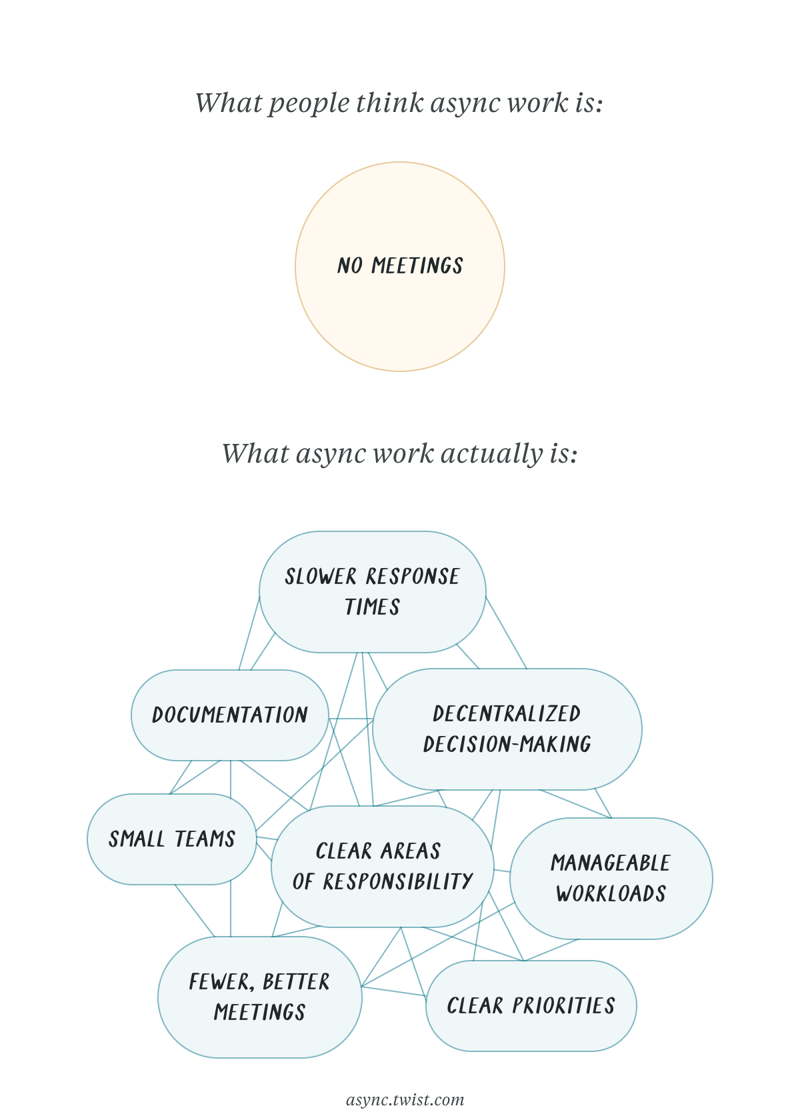
Reducing meetings is just one piece of creating an async-first culture.

She gives some examples of other pieces that are harder but even more important in having a lasting impact on engagement and productivity:

  • Decentralizing decision-making so people don’t have to wait for permission and deliberation before acting
  • Delineating clear areas of responsibility so people feel individual ownership to move work forward

You can read the post for the other examples, they’re all very good! As with most of these kinds of topics it’s really valuable to think about them not in isolation, but as a system. It’s not about whether meetings are good or bad, it’s about how meetings fit into the culture and system of planning and delivery that the organization operates in.

Becky’s illustration of what “async” really means is a perfect example of this:

Meetings for an effective engineering organization

It seems like the topic of meetings is on everyone’s minds again as we start the year. Will Larson has some good perspective from the engineering org viewpoint:

Some engineers develop a strong point of view that meetings are a waste of their time. There’s good reason for that perspective, as many meetings are quite bad, but it’s also a bit myopic: meetings can also be an exceptionally valuable part of a well-run organization. If you’re getting feedback that any given meeting isn’t helpful, then iterate on it, and consider pausing it for the time being. It may not be useful for your organization yet, but don’t give up on the idea of meetings. Good meetings are the heartbeat for your organization.

He goes on to recommend six core meetings for every organization to start with. The “weekly team meeting” is one I’ve become a fan of as well. Getting the entire team on a call every week has the potential for being a giant time-waster, so getting the purpose right and facilitating it tightly is essential here. For us, the purpose is:

  • See each other’s faces at least once a week. I wasn’t sure if the team would feel like this goal is a waste of time, but it absolutely is not. Since we’re all remote, “let’s just chat for a bit” is such a great way to start the week.
  • Discuss blockers/issues. This is not a status meeting where everyone goes around the room and tells us where they’re at. We have an agenda in Google Docs that anyone can add to. The goal is to bring up any issues that the team is struggling with so that we can all figure out the best way to help.
  • Company updates. This is also the opportunity for the leadership team to make sure the entire team has all the information and context they need to do their work effectively.

There’s one more thing about this that I highly recommend: every meeting is facilitated by a different team member. We have a schedule that we cycle through with a clear guide on what it means to facilitate—and of course, an option to opt out. This keeps the meetings interesting and everyone invested.


Previously, on meetings:

“Screen time” is dumb—5 questions for educational/technology expert and advocate Richard Culatta

This is an interesting interview with Richard Culatta, author of Digital for Good: Raising Kids to Thrive in an Online World. They discuss how to help kids bridge the gap between physical and digital spaces, how to model good technology behavior, and more. This is such a good point:

By focusing on screen time we miss the far more important concept that we should be teaching our kids; screen value. Some digital activities are just not a good use of a kid’s time (eg. playing a repetitive, luck-based game) while others provide much greater value (eg. editing a movie, creative writing, FaceTiming with a grandparent, etc.) And context is important to consider too. Digital activities that are appropriate on a long car-ride will likely be different than those on a beautiful spring day when friends are around, or the day before a large school project is due.

I’m going to go out on a limb here and say that is something that not only kids need to learn. We can all benefit from this lesson:

The most important lesson we can teach young kids is to recognize that some digital activities provide more value at some times than others. This means evaluating each digital activity on its own merit based on the circumstances.

We should probably also remember that controlling children’s behavior with screen time leads to more screen time:

Researchers investigated the impact of parenting practices on the amount of time young children spend in front of screens. They found a majority of parents use screen time to control behavior, especially on weekends. This results in children spending an average of 20 minutes more a day on weekends in front of a screen. Researchers say this is likely because using it as a reward or punishment heightens a child’s attraction to the activity.

The Death of Hybrid Work Is Greatly Exaggerated

I agree with Bruce Daisley in The Death of Hybrid Work Is Greatly Exaggerated:

The focus for organisations in 2023 shouldn’t be on mandating a return to the office, but on working out how to build strong cultures in a new, sustainable way. Some of that is about optimising the time that teams spend together, curating rather leaving it to chance. If we’re to get the best out of work culture then we all need to accept that this is the moment to reinvent the construction of it.

It’s a common criticism of remote work that it’s more difficult to collaborate remotely. But I think this is the conventional wisdom only because we try to recreate the office experience for remote work. Since offices rely on synchronous interactions, we use the same lens to try to make remote work effective, and that’s just not going to work.

If we optimize for asynchronous communication instead—which is what remote work is so good at—collaboration can be extremely effective. Perhaps even more effective than office collaboration, because everyone can provide thoughtful responses on whatever topic they are discussing on their own time. As Brian de Haaff points out in Remote Workers Are Outperforming Office Workers—Here’s Why:

Without being able to lean on physical proximity, remote workers must reach out to one another frequently and with purpose. This leads to stronger collaboration and camaraderie.

As counterintuitive as it sounds, this has been my experience as well. As long as we shift the way we think about collaboration away from the office mentality, and use the right tools, I don’t think remote collaboration is less effective than in-person work at all.

Things they didn't teach you about Software Engineering

Good post by Vadim Kravcenko on Things they didn’t teach you about Software Engineering:

Although it may sound surprising, the primary focus of a software engineer’s job is not writing code but rather creating value through the use of software that was written. […] Elegant code, best practices, smart solutions, design patterns — these are done for the sake of your fellow software engineers who will work on the codebase after you rather than helping you fulfill the purpose of bringing value.

And speaking of meetings:

It’s all interconnected, and the meetings are where the information is shared. As a software engineer, you are responsible for some part of this information sharing, so it would be irresponsible to hinder it. You might not like it, but the information must be shared for the system to remain efficient.

When meetings are outlawed, only outlaws will hold meetings

Here is a good articulation of why I wasn’t as enthusiastic about the Shopify meeting cancelation thing as most everyone else. Something felt… off? Here’s the Raw Signal team in When meetings are outlawed, only outlaws will hold meetings:

But the long-term fix for bad meetings isn’t no meetings, it’s competence. If you run a bad meeting, you need to fix the meeting or cancel it. But if you run a company full of bad meetings that need annual reboots, you need to fix your management team. Because while collaboration, alignment, decision making, and unit cohesion can all happen outside of meetings, well-run meetings are a very useful and effective place to accomplish those things. Taking that tool out of your management toolbox might be prudent if you don’t trust your managers to use it without hurting themselves or others. But it would be better if they were competent.

Also this:

Running an effective meeting means being opinionated about what it is and isn’t for, and fierce about not wasting the time of your invitees.

→ Context: Shopify CEO Tobi Lutke Tells Employees To Just Say No to Meetings.