Menu

Posts tagged “productivity”

Meetings are a point of escalation, not the starting point of a conversation

Ben Balter has a solid post on remote and async work, in which he makes the point that meetings are a point of escalation, not the starting point of a conversation:

A few minutes of reading or a few comments on an issue or Google Doc can often replace waiting days for mutual availability and a dedicated 30-minute block of time. In this sense, you can think of meetings as a point of escalation based on complexity, not as the default starting point for a workstream, initiative, or conversation.

Also see his excellent list of benefits of working asynchronously. Also also see Sisi Wei’s excellent guide on asynchronous participation in brainstorming, including this really great idea:

After the meeting, redesign that shared doc to become a worksheet for people participating on their own time. […]

The document should now read like it was designed for asynchronous participation to begin with. Instructions you may have given verbally – even helpful tips you realized and delivered impromptu – should now be captured as written instructions in the document.

Leadership tip: be a thermostat, not a thermometer

In Be a thermostat, not a thermometer Lara Hogan provides a helpful analogy for leaders on what to do when meetings go off the rails…

Once you’re able to start noticing when someone’s amygdala-hijacked, or simply that the vibes are off, you can reframe and use “be the thermostat, not the thermometer” for good. Since humans tend to mirror each other, you can intentionally change the energy in the room, setting the thermostat to a more comfortable temperature.

AI won’t free up our time to do more valuable and fun things at work and home

I enjoyed Bill Gates’s post The Age of AI has begun, right until he got to this bit:

When productivity goes up, society benefits because people are freed up to do other things, at work and at home.

The idea that increased productivity gives people more time to do other things that are more useful and fulfilling is a thoroughly-debunked theory. First, there’s the question of what we even mean by “productivity”, especially in the context of the Productivity Paradox:

The productivity paradox (also the Solow computer paradox) is the peculiar observation made in business process analysis that, as more investment is made in information technology, worker productivity may go down instead of up.

But even if we can get to a point where we agree on how to define the word, we have known for a long time that the only thing that increased productivity does is create more work:

The usual first response to encountering the Productivity Paradox is disbelief: “If I have to write a few emails so that I don’t have to use a carrier pigeon, sign me up!”

But in a bureaucracy, the story of those few emails usually doesn’t end there. So, you send your few emails, and then you soon get email replies and comments. Now, you have to write more emails in reply to those emails, which are then sent up the hierarchy and to a chain of full-time reviewers, who each make a comment to show that they are useful.

So when we get more productive the time we “save” on one type of task just gets filled with a different, not necessarily more valuable task. But what about “at home”, you ask? Nope. We have also known for a very long time that instead of giving us more time for hobbies and hanging out, technology is killing leisure time:

The very tools that were supposed to liberate us have bound us to our work (and schools) in ways that were inconceivable just a few years ago. Almost all of us have less leisure time than ever. We work harder, take fewer vacations for shorter periods of time, report more stress than almost any other demographic group and find the boundaries between work and play increasingly blurred. Computing and communications technologies are destroying the idea of privacy and leisure.

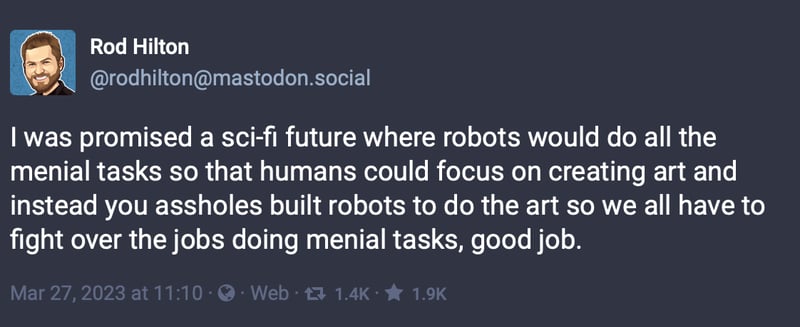
So anyway, Bill Gates wrote a pretty insightful take on AI, in my opinion. But the idea that generative AI will free up our time to do more valuable and fun things is not backed up by history at all. Or to put it slightly differently:

Link roundup for March 18, 2023

This feed of imagined alternate universe tech products is mind-bendingly wonderful.

Employees Are Feeding Sensitive Business Data to ChatGPT. Feels like this should be a bigger story. “Employees are submitting sensitive business data and privacy-protected information to large language models (LLMs) such as ChatGPT, raising concerns that AI services could be incorporating the data into their models, and that information could be retrieved at a later date if proper data security isn’t in place for the service.”

How companies can better understand neurodivergent employees. Good reminder: “If you use closed captioning, text messaging, or noise-canceling headphones, or have pushed a stroller or ridden a bike over the ramps at the end of sidewalks/curbs (see the curb cut effect), you’ve benefited from design that prioritized users who had these needs but are not the convenient ‘majority’ for whom many products are designed. Designing for difference enables innovation and productivity while setting up an enterprise to be future-fit and successful.”

I needed to hear this, so I’m sharing just in case you might need to hear it too: “When we have a lot on our plate, we tend to neglect the very things that equip us to handle having a lot on our plate. We leave aside exercise, which is important for physical and mental health. […] Leaving out our health to fend for last place in our list of priorities is bad enough. However, doing it when you most need your health to contend with a growing list of priorities is worse still.”

This latest Amazon forced “return to office” news is bleak. “The fact that Amazon’s S-Team did not blink, and refuses to soften the return to work policy signals that they either don’t expect much attrition, or have calculated with additional attrition. […] At the same time, looking at the market, it’s hard not to ask the question: if people want to leave, where will they leave to?”

Chat apps are no substitute for documentation. “Chat apps like Discord [and Slack] end up diluting the available knowledge because the content shared in them isn’t persistent, and the allure of an always-available answer breaks down when the person that could answer is no longer available.”

Modern Font Stacks. System font stack CSS organized by typeface classification for every modern OS. “No downloading, no layout shifts, no flashes — just instant renders.”

In The Name of The Father provides a fatherhood lens on the first season of The Last of Us that really resonated with me.

The new M83 album is out and it is, in my opinion, a return to form. On repeat over here.
Leaders, don’t be late for meetings

Some fairly standard advice here from Peter Yang on How to Run Meetings That Don’t Suck, but this point in particular is so important:

Try not to cancel or move 1-on-1s. If you’re a manager, it’s easy to move or cancel your 1-on-1s for other “important” meetings. This is disrespectful to your direct reports. Even if you see them everyday, nothing beats a private half-hour conversation where they can be open about real issues.

How we show up in meetings as leaders is very telling about how we view our team’s time. The most important rule is this: do not be late. I know this is hard to do in our culture of back-to-back meetings, but nothing says “I don’t respect your time” like consistently showing up 5 minutes late to meetings with no explanation. Here’s a quick tip: if you need a minute to go to the bathroom and/or get some more tea or whatever, make sure you join the meeting first and tell the person/people that you just got out of another meeting and you will be right back. Oh, and do not forget to mute when you leave…

Hypervigilance is not a sustainable lifestyle for leaders

In This will only take a minute the Raw Signal team shares some much-needed advice for leaders who feel like they never have time to think and reflect. This state of constant hypervigilance is not a sustainable lifestyle because:

On one level, you’re a human being. Regardless of your title or role, you are worthy of work that doesn’t wreck your health, or your happiness, or your ability to enjoy lunch away from your webcam. On another, if you’re a manager, you’re responsible for the work of a team of other human beings. If you don’t have the time to be thoughtful about your own work, the odds are very high that your team doesn’t either.

They go on to share some ideas for how to make this time to step back a priority, once you are “past the point where working a little bit more is going to clear your plate”.

The 90s, having time, and always rushing to the next thing

I’m sure every generation writes lots of articles like Freddie deBoer’s It’s So Sad When Old People Romanticize Their Heydays, Also the 90s Were Objectively the Best Time to Be Alive. But hear me out. This is the impassioned, forceful, yet balanced Gen X take I wish I had the skill and wherewithal to write. It is a balm to the nostalgic soul in a way that somehow doesn’t feel like cringey old-person fanfic.

Here he is on the experience of visiting a record store:

When you were there you were Doing Music. Now we’re never doing anything—we’re always getting through something to get to something else to get through, using various time-saving techniques that maximize the amount of time we have to get through things while keeping our attention divided into a thousand things we then get through. When you went to a record store you were intent on music, and sometimes, you’d care enough about a particular artist that you paid for their album, real money, so that the artist got a cut that was more than the .002 cents they get per stream now.

This reminds me of the question Alan Jacobs asks: What exactly are we’re rushing towards with all our 2x listening and cliff notes skim-reading?

My question about all this is: And then? You rush through the writing, the researching, the watching, the listening, you’re done with it, you get it behind you—and what is in front of you? Well, death, for one thing. For the main thing. 

But in the more immediate future: you’re zipping through all these experiences in order to do what, exactly? Listen to another song at double-speed? Produce a bullet-point outline of another post that AI can finish for you?

Maybe the 90s have a thing or two to teach us yet.

How to build human connections in an async workplace

This is a great post by Chase Warrington for the Twist Async newsletter on How to build human connections in an async workplace. They make this really important point about what human connection is actually about on a remote team:

I’ve come to realize that team culture and human connection is primarily built by how you work together—not how you socialize together. […]

The work we do is what actually brings us together. That’s ok (and frankly healthy) to admit. One of the biggest benefits of remote work is that it provides you the opportunity to spend more on the people and things you care about outside of work. Let’s not sabotage that with a bunch of forced and awkward social events for teammates to attend on top of their work duties.

I think we forget this too often. Doing a fun online social activity together doesn’t improve team culture if we haven’t also made sure that actually working together is safe, healthy, and enjoyable.

How the fediverse can help us collaborate better at work

Mehul Kar says he’s not super excited about the “fediverse” in the context of social media. However, he sees a huge need for The Fediverse At Work. The issue? The lack of integration across all the tools we use at work has become incredibly tedious and hard to keep track of:

Sometimes there are Figma design specs, with their own set of comments. And Loom walkthroughs, also with comments and likes. And any number of other things over time. The combinatorial complexity of these tools across these platforms (not to mention emails) can be quite messy to track. It’s really hard to remember where a conversation took place. Coworkers often repeat the same text in multiple places, prefixing with phrases like “Shared this in Notion comment also, but…” or “Just left a review, but high level: …”.

He believes that a decentralized platform for all these tools to effectively talk to each other would be hugely beneficial:

Maybe the protocols that make up the Fediverse can help. What if, instead of sharing a Github Pull Request URL in Slack, your Slack team channel could instead be subscribed to the Github repository. Maybe new Pull Requests are broadcasted to followers, and replies from Slack users to those posts are sent as comments to the Pull Request in addition to being threaded in Slack. Maybe the Notion document is treated the same way. Maybe the Loom walk through is a reply to a Slack thread, and comments on the video appear in Slack. Maybe the Slack thread is a series of comments displayed on a Figma design.

There are more examples in his post. I really hope we can get to this type of philosophy for our work tools. It does sound a little bit like the problem that Luro is trying to solve.

Link roundup for February 4, 2023

The Calculator Drawer is “a collection of emulated calculators, providing reference to how they worked and what the often unique interfaces would consist of.” (via Clive)

The Last Boeing 747 Leaves the Factory (NYT Gift Link). “The plane known as ‘Queen of the Skies’ helped make air travel more affordable, but it has been supplanted by smaller, more efficient aircraft.”

Here’s everything you ever wanted to read about the “This Is Fine” meme. The Meme That Defined a Decade (The Atlantic, possible soft paywall): “Memes are typically associated with creative adaptability, the image and text editable into nearly endless iterations. ‘This Is Fine,’ though, is a work of near-endless interpretability: It says so much, so economically. That elasticity has contributed to its persistence. The flame-licked dog, that avatar of learned helplessness, speaks not only to individual people—but also, it turns out, to the country.”

See also ‘This Is Fine’ creator explains the timelessness of his meme (The Verge), ‘This is fine’ creator reflects on 10 years of the comic meme (NPR), and the artist’s own reflection on the anniversary.

I adore the Barely Maps project—a collection of minimalist maps of places the author has visited. Here’s my local one:

I like this idea of “critical ignoring” as a way to be more intentional about our online time: “Critical ignoring is the ability to choose what to ignore and where to invest one’s limited attentional capacities.” See also The Sad, Beautiful Fact That We’re All Going To Miss Almost Everything.