Menu

Posts tagged “productivity”

Mankind's almost infinite appetite for distractions

I recently started reading Neil Postman’s Amusing Ourselves to Death (thanks to J.D. Bentley for the recommendation). It’s great so far, and I’m sure I’ll have lots more to say once I’ve made my way through it.

Postman juxtaposes George Orwell’s “Big Brother” prophecy from Nineteen Eighty-Four with Aldous Huxley’s very different view of the future as set out in his 1931 book Brave New World. With that as backdrop, it’s amazing to think that this section from Amusing Ourselves to Death was written in 1985:

Contrary to common belief even among the educated, Huxley and Orwell did not prophesy the same thing. Orwell warns that we will be overcome by an externally imposed oppression. But in Huxley’s vision, no Big Brother is required to deprive people of their autonomy, maturity and history. As he saw it, people will come to love their oppression, to adore the technologies that undo their capacities to think.

What Orwell feared were those who would ban books. What Huxley feared was that there would be no reason to ban a book, for there would be no one who wanted to read one. Orwell feared those who would deprive us of information. Huxley feared those who would give us so much that we would be reduced to passivity and egoism. Orwell feared that the truth would be concealed from us. Huxley feared the truth would be drowned in a sea of irrelevance. Orwell feared we would become a captive culture. Huxley feared we would become a trivial culture, preoccupied with some equivalent of the feelies, the orgy porgy, and the centrifugal bumblepuppy.

As Huxley remarked in Brave New World Revisited, the civil libertarians and rationalists who are ever on the alert to oppose tyranny “failed to take into account man’s almost infinite appetite for distractions.” In 1984, Huxley added, people are controlled by inflicting pain. In Brave New World, they are controlled by inflicting pleasure. In short, Orwell feared that what we hate will ruin us. Huxley feared that what we love will ruin us.

Sounds like it was written yesterday, doesn’t it…

The (non)value of a Twitter follow

Amber Naslund’s How Twitter Works Today… And How I’m Using It Now got me all riled up about something I didn’t even realise bothered me as much as it does. This is the part that really got to me:

Let me explain this very clearly: a Twitter follow is not a validation of your worth as a human, nor is it a stamp of approval from someone online that you’re awesome or not. If you even slightly see it that way, you might need to reset some priorities.

Twitter is simply a tool, a mechanism. Everyone uses it differently, and heavy users like me need to rejig the system once in a while so it continues to work and stay manageable. In short, the system of follows and lists and DM access and what is useful to me to pay attention to is not about you. In this case, it’s about me and what makes Twitter valuable for me personally.

You get to say the same thing about your experience, and you get to shape it according to your own needs. Hell, unfollow me and put me on a list (or don’t) if you want. Your Twitter is yours to shape, and you don’t owe me anything either. I’d wager that a good portion of the people I’m most interested in at a professional level don’t follow me back. And who cares?

I’ll be honest — the decision to follow someone on Twitter makes me really nervous. It feels like a huge commitment. Because if I realise a few days down the line that I’m not as interested in someone’s stream as I thought I would be, I find it very difficult to unfollow them — people take this stuff very personally. So when I find someone I might want to follow, I usually put them on a list first for a few weeks, and if I find myself clicking on a few of the links they tweet, I’ll go ahead and follow.

But it’s not a foolproof system, and every time I realise I actually don’t want to see this person’s tweets in my main timeline I feel trapped. I know I shouldn’t feel bad about unfollowing, but I do. The point Amber makes is so true, and bears repeating: “a Twitter follow is not a validation of your worth as a human, nor is it a stamp of approval from someone online that you’re awesome or not.”

The fact is that I use Twitter as a business tool, not so much as a way to communicate with friends. That means that I have very strict criteria for the kind of stuff I want to see in my timeline. I don’t want to see Foursquare checkins, I don’t want to see constant updates about a topic not related to my work, and I don’t want to see only tweets about a person’s product/app. And I’m sorry if that seems selfish, but to paraphrase what Amber says in her post: I get to choose what makes Twitter valuable for me, just like you get to do the same with your stream.

I like Chris Bowler’s distinction between the two main ways to use Twitter in his post The Purpose Varies:

One fact that I do my best to keep in mind is this: there are two very different ways to use Twitter. Option A is as a social tool to interact and joke around with others, to connect. Option B is to use it as a source of sharing information, usually in the form of links to content or pithy blurbs of opinion.

Some people like the service for one, but not the other. Some people manage to strike a lovely, harmonious balance between the two. The catch is that — in my opinion — we mostly want to follow folks who use the service in the same way we do.

I’m an Option B guy myself. I still love having conversations with people who use it more in the Option A way, but I’m not going to follow them. And one more time, with feeling, “a Twitter follow is not a validation of your worth as a human, nor is it a stamp of approval from someone online that you’re awesome or not.”

So let’s agree that we’re allowed to be selfish about how we use Twitter. I’ve learned from experience that I go insane with information overload if I follow more than 200 people, so I’m not going to break through that barrier. And you get to make your own rules, and follow and unfollow whoever you want. That is still, after all these years, the simple beauty of Twitter’s follower model.

So hey, let’s be selfish, and find the measure of our self-worth somewhere else.

How to do what you love, the right way

Every time I start a new job I take my dad to see my office. He loves seeing where I work, and I love showing him. It’s a thing. As much as I enjoy this unspoken ritual of ours, there’s always a predictable response from my dad that serves as a clear indicator of our large generation gap. At some point he’ll ask a question along the lines of, “So… no one has an office? You just sit out here in the open?” I’ve tried many times to explain the idea of co-location and collaborative work, but I don’t think it’s something that will ever compute for him.

This isn’t a criticism on how he’s used to doing things (especially if he’s reading this… Hi Dad!). But it shows how our generation’s career goals have changed from “I want the corner office!” to “I just want a space where I’m able to do good work.” We’ve mostly gotten over our obsession with the size and location of our physical workspaces. But we haven’t completely managed to let go of that corner office in our minds: the job title.

Even that’s starting to change, though. This tweet from Jack Dorsey has received over 1,700 retweets so far:

Titles, like “CEO”, get in the way of doing the right thing. Respect to the people who ignore titles, and fight like hell for what is right.

— Jack Dorsey (@jack) September 29, 2012

In episode 60 of Back to Work, Merlin Mann and Dan Benjamin discuss what they call “work as platform”. The basic idea is that we need to stop looking at work as a thing you do for a company. If you view your career like that, your success will always be linked to the success of the company, as well as your ability to survive within that particular culture. You will be at the mercy of people who are concerned about their own careers, not yours.

Instead, if you think about your work as platform, your attention starts to shift to using whatever job you are doing to develop your skills further, so that you’re never at the mercy of one company. Here’s Merlin, from about 31 minutes into that episode of Back to Work (edited down slightly):

If you think just in terms of jobs, you become a little bit short-sighted, because you tend to think in terms of, “What’s my next job?”, or “If I want good jobs in my career, what do I put on my resume?” So in terms of what you can do to make the kinds of things you want, and have the kind of career you like, I think it’s very interesting to think about what you do in terms of having a platform for what you do.

There’s always this thing about “doing what you love.” Well, doing what you love might not ever make you a nickel. And if doing what you love sucks, no one is ever going to see it, like it, and buy it, which is problematic. That’s not a branding problem, that’s a “you suck” problem. So the platform part is thinking about what you do not simply in terms of what your next job is — it’s a way of thinking about how all of the things that you do can and should and do feed into each other.

I think it’s worth giving yourself permission to take a dip into the douche-pool, and think a little bit about what platform thinking might mean to you. Because if you are just thinking about how unhappy you are with your job your horizons are going to become pretty short, and your options are going to be very limited.

So here’s how I want to pull this all together. Just like we’ve moved on from the idea that the big office is a big deal, we have to let go of the idea that a big enough title is equal to a successful career. Much more important is that we figure out what it is that we want to spend our time and attention on — and then working at our craft to make that our platform.

I was really inspired by Jason Santa Maria’s interview in The Great Discontent, in which he said the following:

One of my greatest fears is being at a big company and rising through the ranks to become a manager of people. That’s an art and there are people who are really good at energizing others and getting the best work out of them, but the thing I most enjoy is being hands-on and seeing something through to the end. I want to keep making things and not just talk about making them.

That resonates with me. It doesn’t have to resonate with you, and that’s the point. We don’t all have to follow the same path. You don’t have to run out and learn how to code. But be curious enough to find out if coding is your platform. Build your own platform, and make your own work. That’s what it means to “do what you love.”

Google wreaks havoc on our company's calendars

We run our company on Google Apps for Business, and we’ve never had any problems. Until now. On Friday morning we came in to work to find that all our calendars are completely, utterly messed up. We lost data, ownership changed randomly, and some of us lost access to our own calendars. We’re still coming to terms with what happened, and it’s hard to explain without getting into specific detail, so I’ll just give you taste of the damage. Sorry for all the names of people you don’t know, but it’s the only way I can keep this straight:

  • My work calendar disappeared from my account, and is now owned by Chris’s personal Google Apps account.
  • I now own the Boardroom calendar, which is a resource calendar.
  • Chris’s work account now owns his personal calendar.
  • Debré’s work calendar disappeared from her account, and is now owned by Philip’s work account.
  • Philip’s personal calendar disappeared from his account, and is now owned by Angela’s work account.
  • Some events have gone completely missing from calendars — they’re just not there any more. Those events also disappeared from our clients’ calendars, which is a huge embarrassment and inconvenience because we don’t know when we’re supposed to meet with who.

And on and on it goes. Google Apps for Business promises 24/7 customer support, with a guarantee that “We’re always available to help via phone or email.” We discovered this issue on Friday morning, so I called immediately. They opened a case, I sent some screen shots, and then we waited.

Later in the day I got an email saying that “Your case will now be further analyzed by the next tier of support.” And then they went dark. I kept sending more information as we found it, but nothing happened. I phoned again on Friday evening and Saturday morning, but by then, phone support couldn’t do anything because the case was transferred to a “calendar specialist”.

On Saturday evening I received an update from Google Apps Support:

I looked at the calendars you mentioned and see the strange names that you mentioned. However, determining exactly what happened will require some in depth logs analysis. This will take some time.

And after that — nothing. Now it’s Monday morning and our ability to run our business is crippled since we don’t have access to our meeting schedule. And since we know that some events have gone missing, we can’t even trust what remains.

On the Google Apps Calendar page it says this (my emphasis added):

Google Calendar is designed for security and reliability with features like encrypted connections to Google’s servers, simultaneous replicated storage for your calendar appointments, built-in disaster recovery and fine-grained sharing, which lets you share your calendar with people in and out of your organization.

So if there’s built-in disaster recovery, why can’t they just restore our calendars to the state it was in Thursday night? Why has it been three days and we’re not getting regular updates and progress reports? Why promise 24/7 customer support if you can’t deliver it? And yes, this includes both phone and email support of their “core services”, which includes Google Calendar.

I’m writing this to hopefully accomplish three things:

  • Get some more attention on the issue so that Google can fix it and let us get on with our business.
  • Ask if anyone has experienced this problem before — if so, please get in touch.
  • Warn you about something you most likely already know: your data is not safe anywhere.

That’s the story so far. Google, please help. We just want our calendars back, and we’d love to know what happened.

Update 12/10/2012: The Internet works! On Monday evening I received a call from a senior Google Calendar employee, and he spent 30 minutes on the phone with me to help troubleshoot and get to the bottom of the issue. Our calendars aren’t fixed yet, but I’m confident that Google is now on top of it and will give us regular updates on what’s going on. At this point it looks like a 3rd party application had a sync issue with GCal, and that instigated a weird chain reaction. I’ll update again with more information once it’s all been fixed.

Update 12/12/2012: We’re mostly back up and running. It sounds like BusyCal had a conniption during one of its regular syncs, and used an API call that created the whole mess. I’m told that the API call that was used doesn’t give them much logging, so we’re not able to figure out exactly what happened. That’s too bad, but at least we’re mostly restored (still some events missing, but we’ll live with that). They ended up undeleting all events that were deleted when the issue happened. I think we could have done that on Friday, and still not sure why it took so long to sort out, but since this post went out Google became really involved and responsive, so I’m happy with that. And that, as they say, is that.
Passion takes practice

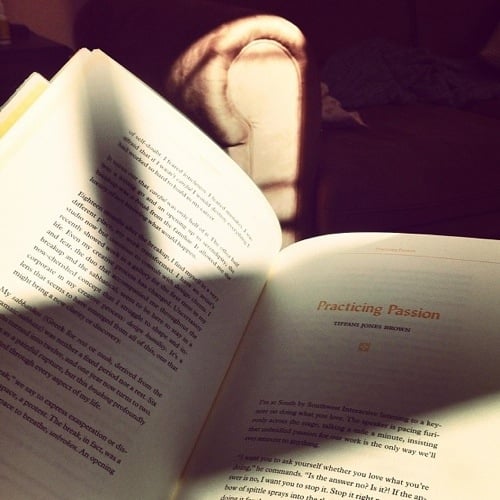
I’m slowly making my way through Issue #3 of The Manual. If you haven’t read these books, I highly recommend it — they’re wonderful essay collections. This morning I read Practicing Passion by Tiffani Jones Brown, in which she dissects the whole idea of following your passion and doing what you love. She starts with this observation:

Sure, I’d been excited to start my own business. And sure, I’d loved the idea of writing for a living. Yet banal and frustrating tasks — the kind you approach with a groan, not a fist-pump — make up much of my job. So do I feel over-the-moon about my work? I truly like it. I feel good when I get better at it. Passion overstates the point.

She then goes on to recommend a more tempered approach to the passion thing:

Instead of asking “what will make me feel passion?” we should ask, “how can I make passion happen?” The answer is to cultivate a way of living and working that makes passion more likely. Passion takes practice.

But the point that really resonated with me is the part where she talks about flow:

You can get into flow doing almost any activity, no matter how good you are at it, no matter how mundane the task. Only two things are required: the activity has to have a clear goal and a challenge. You need to be really plugged in and focused; what you’re doing must stretch your body or mind. You won’t achieve flow while multitasking or surfing the internet but you might, odd as it seems, while doing a content audit or cleaning up comps.

Those are good words to remember. Sometimes we do what we want to do. The rest of the time we do what we need to do to get the job done and get better at what we do. Anyway, I guess the point is, buy The Manual. It’s such a treat.

Practicing Passion

The Best vs. The Worst

A few weeks ago the Internet went nuts about a blog post by Dustin Curtis called The Best, in which he argued that it’s important to spend the time (and money) to find and purchase the absolute best of everything. The money quote:

If you’re an unreasonable person, trust me: the time it takes to find the best of something is completely worth it. It’s better to have a few fantastic things designed for you than to have many untrustworthy things poorly designed to please everyone.

The post got linked to by most of the sites I read, and I must have seen about 20 tweets about it in my stream.

I get the sentiment of going for the best, unwavering quality, and all that, but the post just didn’t sit right with me. I was going to write a response to it, but so far all I’ve been able to come up with is this montage from Arrested Development:

But yesterday, Moxie Marlinspike wrote a response that gets pretty close to the issues with Dustin’s philosophy. The Worst unfortunately steps into personal attacks, which is a real shame, because his argument is pretty solid, and would have been stronger without the snark. Anyway, the core of his message is this:

Hacker News could possibly be drawn to Dustin Curtis’ cutlery because it’s reminiscent of “simplify.” The makers of the cutlery took the concept to its core essentials, and nominally perfected them. But to me, “simplify” is about removing clutter — about de-emphasizing the things that are unimportant so that it’s easy to focus on the things that are. We shouldn’t be putting any emphasis on the things in our life, we should be trying to make them as insignificant as possible, so that we can focus on what’s important.

In a sense, the best gives a nod to this by suggesting that getting the very best of everything will somehow make those things invisible to us. That if we can blindly trust them, we won’t have to think about them. But the worst counters that if we’d like to de-emphasize things that we don’t want to be the focus of our life, we probably shouldn’t start by obsessing over them. That we don’t simplify by getting the very best of everything, we simplify by arranging our lives so that those things don’t matter one way or the other.

Of course, the right answer is most likely somewhere in the middle. To seek out quality without letting things own us. But it’s good for the Internet’s equilibrium to hear the complete opposite of Dustin’s argument.

For another perspective, consider Charles Faraone’s answer on Quora to the question What’s your favourite parable? Charles tells the story of a university professor who gave his students a large pot of coffee and an assortment of cups to choose from — some plain, others expensive and exquisite. Once all the students have chosen their cups, and only the plain and cheap ones were left behind, the professor commented:

While it is normal for you to want only the best for yourselves, that is the source of your problems and stress.

Be assured that the cup itself adds no quality to the coffee. In most cases it is just more expensive and in some cases even hides what we drink. What all of you really wanted was coffee, not the cup, but you consciously went for the best cups. And then you began eyeing each other’s cups.

Now consider this: Life is the coffee; the jobs, money and position in society are the cups. They are just tools to hold and contain Life, and the type of cup we have does not define, nor change the quality of life we live.

Sometimes, by concentrating only on the cup, we fail to enjoy the coffee. Savor the coffee, not the cups!

In other words, make the best coffee you can, and don’t worry about what you drink it in.

Read The Best, The Worst, and What’s your favourite parable?

Discovering meaning online: ditch abundance, embrace limitation

In Siamese Dream Frank Chimero addresses the differences between streaming music services (access to an unlimited number of songs) and purchasing music (ownership of a limited selection):

The way you navigate a place of abundance (streaming music) is fundamentally different than how you use a place with limitations (purchased music). In abundance, you’re looking to discover pre-existing value (“Knock my socks off!”), whereas with limitations, you’re looking to milk value (“I’ve got this thing. How can I learn to enjoy it?”).

He goes on to mention how this idea applies to most digital vs. physical environments:

Systems of abundance and limitation are not exclusive, even though we talk like they are. Digital services and technology rarely displace, but frequently add and augment. Your Twitter account didn’t replace your Facebook profile. You’re just splitting time and trying to keep both plates spinning. With digital, it is almost always AND instead of OR.

This is a huge part of our information overload problem. Imagine what would happen if you could only use one social network. Which one would you choose? What would you put there?1 We create these artificial rules about what is appropriate to share on which network, and it’s only going to get harder to keep the separations straight as more and more AND services pop up.

We spend so much time trying to figure out what each network is for, but they’re all for the same thing: human connection. We get fixated on the tools and the medium, and forget that it’s people all the way down. I’m slowly realising that the real power of any network is in the off-network experiences they enable. It’s about the point where a simple Twitter conversation moves to email and a strong friendship. It’s about the point where a discovery of mutual interests online leads to a coffee and an hour-long conversation.

This horse had been beaten to death, but I’ll say it one more time. It doesn’t matter what network(s) you use, how many followers you have2, what your Klout score is, or how Internet famous you are (or aren’t). What matters is the connections you make and the conversations you have. So what we really need is the courage to ditch AND (the place of abundance that’s about the dopamine rush of discovering new things all the time), and embrace OR (the place of limitation that’s about discovering value in the relationships that we already have).


  1. Does this hypothetical scenario make you break out in a cold sweat? Exactly… 

  2. For a bizarre look into the underbelly of follower-chasing, check out the #teamfollowback hashtag on Twitter. 

Family is not a side project

Chris Bowler took the wind out of my sails with Overcoming Project Guilt. It’s as if he’s been living in my head the past couple of weeks. With a newborn and a 3-year old, I’ve become increasingly nervous that I’m not doing enough to “contribute to society” by working on my side projects. Chris says that’s just crazy talk:

Please do not spend your time endlessly comparing your accomplishments or progress with those who have no family. You’re setting yourself up for guilt at best, and resenting your family at worst. […]

In all of this, you will have to decide where your priorities lie. Is launching a new application, store, blog more important than building up your children? Do you find yourself watching the clock between 5 and 8 PM, waiting for the kids to go to bed so you can get in a few more hours of sketching, coding or PhotoShop?

I know things will normalize eventually, and I’ll have time for all of that stuff again. But for now, I have to be ok with putting some things on the back burner.

You miss almost everything while you're offline, but that's ok

I often see posts from people who return from Internet sabbaticals proclaiming that they made an unexpected discovery — they didn’t really miss anything because nothing important happened while they were away. I don’t think that is an honest assessment of the offline experience. A more accurate description is that whenever you spend a significant amount of time offline, you miss almost everything — but that’s ok.

I just spent about 10 days with very minimal online interaction because we had a newborn in the hospital. I caught up on some reading today and realised that I missed a lot of great stuff. It made me anxious for a while — until I realised that the “I didn’t miss anything” crowd might just be a little bit caught up in their own reality distortion fields.

The secret to a healthy and balanced online life that doesn’t give you FOMO when you’re offline is not to deny that you’re going to miss a bunch of great stuff while you’re gone. The secret is to take a deep breath and realise that it’s ok to let the vast majority of information pass you by, as long as you really take in the things that matter. Don’t just retweet. Internalise. Write. Think. Figure out how the words apply to you. Make the time count, and then surrender the rest:

Surrender is the realization that you do not have time for everything that would be worth the time you invested in it if you had the time, and that this fact doesn’t have to threaten your sense that you are well-read. It is the recognition that well-read is not a destination; there is nowhere to get to, and if you assume there is somewhere to get to, you’d have to live a thousand years to even think about getting there, and by the time you got there, there would be a thousand years to catch up on.

Or as Chris Bowler so eloquently puts it:

If the quality is there, I’m thrilled to be weaned down on my quantity.

This is the only way I know how to make peace with the fact that everything happens while I’m offline.

We're stupid and we don't know it: a history

I’ve long been fascinated by the Dunning–Kruger effect and its distant cousin the Peter Principle. If you haven’t heard of these theories yet, I recommend you don’t read about it at bedtime if you value sleep. This is the kind of thing that keeps you up for days as you try to figure out how it applies to everything you’ve ever done.

Dunning-Kruger basically states that people who are incompetent don’t realise that they’re incompetent, because they lack the competence to figure it out. That’s really scary stuff.

Anyway, in June 2010 Errol Morris conducted an interview with David Dunning, and it’s a fascinating read. Among other things, Dunning gives more background about the research they did, and also goes into detail on the idea of “unknown unknowns”, that scary realm of not knowing what you don’t know. From The Anosognosic’s Dilemma: Something’s Wrong but You’ll Never Know What It Is:

Unknown unknown solutions haunt the mediocre without their knowledge. The average detective does not realize the clues he or she neglects. The mediocre doctor is not aware of the diagnostic possibilities or treatments never considered. The run-of-the-mill lawyer fails to recognize the winning legal argument that is out there. People fail to reach their potential as professionals, lovers, parents and people simply because they are not aware of the possible.

This is a five-part series, and I’ve only read part 1, but I’m really looking forward to digging into the rest of the series. If you have an interest in human behavior, and you’re not scared of freaking yourself out a bit, this is highly recommended reading.

(link via @berkun)