Menu

Posts tagged “productivity”

7 Essential Productivity Tools for Product Managers

As Product Managers our job is to gather information from a variety of different sources, make sense of it all, and then turn it into cohesive product visions and execution plans that end up growing the business exponentially (yes, we’re superheroes).  And we wouldn’t do it if we didn’t already love bringing order to chaos.  But sometimes we need a little help.  Below is a collection of software (mostly Mac-based) that I have found essential in my day-to-day PM work and helps me to always have a handle on what is going on in my projects.

I have broken these down into three categories:

  • Tools for project management. These are the programs that are always open on my Mac.  It starts with a high-level overview of all projects, and progressively gets into more detail and specifics.  I can’t imagine staying on top of all my parallel tasks without these.
  • Tools for wireframing. No designer wants a PM to tell them what a design should look like — and for good reason: it’s not our job.  But sometimes you want to put some of your design thoughts on paper, without being too prescriptive on the execution.  These tools help you do that.
  • Tools for collaboration. These are the tools that increase productivity by freeing documents from your hard drive and putting them in the cloud so you can work on them in collaboration with other stakeholders.

Tools for project management

1. OmniPlan ($150 from The Omni Group)

OmniPlan is the Mac version of Microsoft Project, except that it’s a lot faster to use so you don’t end of abandoning it in the middle of every project because of sheer frustration.  It lets you easily add projects and tasks, track progress, and add specific notes about each action if you need a little more detail.

2. OmniFocus ($80 from The Omni Group)

Describing OmniFocus as a fancy To-Do list (which it is) would be doing it a huge disservice.  It was designed from the ground up to make it easy to input thoughts very quickly (into the “Inbox” area), and then you can separate those thoughts into Goals vs. Tasks.  The tasks are then easily separated into Projects (which work like folders) and Contexts (which work more like tagging).  It is easy to switch views between Projects, Contexts, Flagged items, Urgent items, etc.  I basically start and end every day with OmniFocus.

One of the other huge advantages of using OmniFocus is the iPhone app.  It’s expensive ($20), but well worth it.  One complaint I do have is that it’s not as easy to sync as it should be, which is disappointing.  The only free way to sync OmniFocus Mac with the iPhone App is through sharing on a Wi-Fi network.  There is no central database that syncs automatically between devices.  But this is my only gripe with it.  As long as you have your iPhone on and connected to the same wireless network as the Mac, it works like a charm and cross-syncs beautifully.

3. Evernote (free for a basic account)

I was resistant to using Evernote at first, because I really didn’t know what I would use it for.  Now I’m not sure how I ever got anything done without it.  This is the ultimate cloud application.  It syncs seamlessly between the web site, other computers where you have it installed, and the iPhone app.

Yes, I know, it’s just software for taking notes.  But I use it in so many ways.   Meeting notes, web clippings (get the Firefox plugin!), photos of whiteboard drawings… the list goes on and on.  And the fact that it immediately syncs with your account means that your notes are accessible on all your devices, which really helps when you eventually sit down at your desk and have to make sense of all the stuff you put in there during the day.  Also, the price is right!

Tools for wireframing

4. OmniGraffle Pro ($200 from The Omni Group)

This is the Mac’s answer to Visio (except, you know, better again).  Whenever I start working on a new project, OmniGraffle is my tool of choice to diagram the existing flow and any proposed changes.  I also use this to provide a more visual representation of any data that we have on any of the flows/pages - analytics, CS, user research, etc.  This really helps to get all stakeholders on the same page so you can solve for the right problems.

5. Balsamiq Mockups ($79 for desktop version)

As I mentioned at the start of this post, PMs need to be careful about producing mockups.  But that’s what makes Balsamiq such a perfect piece of software.  It is an easy-to-use, low fidelity mockup and wireframing tool that allows you to get ideas on paper without any visual design elements.  This allows you and the designers to get on the same page without stepping on each others’ toes.  Here is a demo from YouTube:

<

p align=“center”>

Tools for collaboration

6. Google Docs (free)

I have been Microsoft Office free for a while now, and I haven’t missed any part of it.  Google Docs allow you to be truly collaborative on your documents.  You can start a document and other stakeholders can add to it, comment on it, change it, and it’s all saved in real-time.  One of the best features is that multiple users can edit at the same time.  This means that, for example, PMs, designers, and engineers can work on the same document, and come out of a meeting with a finalized spec.

One drawback is that there is very limited version control in Google Docs, so that would be the only word of caution - use file names wisely to provide your own form of version control.

7. Dropbox (free for 2GB of storage)

I haven’t met anyone who has used Dropbox and didn’t fall in love with it.  Dropbox is how you would design file storage if the personal computer didn’t start out with hard drives.  It allows you to store your files in the cloud and access it from any computer — and from your iPhone with the free app.

The iPhone app needs some improvement, particularly to allow you to add folders as favorites for offline viewing, but that is a small complaint.  Dropbox basically means that you can work from anywhere.

Now go and be productive

So that’s my list.  I’d love to hear what other PMs are using to stay on top of their projects, and what your experiences have been with using the software in this post.  Let’s go be (organized) superheroes now…
Email is dead. Long live email.

There has been growing discontent with email over the past year or so, but it appears that many people’s hatred for this particular form of communication has now finally started to boil over.  Several articles and blog posts over the past few weeks lamented the death and/or evilness of email in no uncertain terms.  In this post I go into a few highlights from said email hatemail, followed by some thoughts on why we shouldn’t be so fast to close down our email accounts.

The problem with email is…

First, a disclosure.  The excerpts below are just that: excerpts.  While I attempt to keep the context and the original intentions of the authors intact, I encourage you to read all these articles in their entirety.  They’re not only thoughtful and well-written, but they also lay a solid foundation for what I think is a very worthy and much-needed debate.

In the article Why Email No Longer Rules”¦, the Wall Street Journal announces that email is king no more:

But email was better suited to the way we used to use the Internet””logging off and on, checking our messages in bursts. Now, we are always connected, whether we are sitting at a desk or on a mobile phone. The always-on connection, in turn, has created a host of new ways to communicate that are much faster than email, and more fun.

Caught up in Google Wave frenzy, Techcrunch laments the following in Google Wave And The Dawn Of Passive-Aggressive Communication:

Google Wave is not just a service, it is perhaps the most complete example yet of a desire to shift the way we communicate once again.  For many of us, email is simply not cutting it the way that it used to. It’s a sedentary beast in a fast-moving web. It uses old principles for management, and this is leading to overload.

Sticking with Techcrunch, in Relevance Over Time, Nik Cubrilovic argues that email sacrifices relevance in order to present items in a chronological order:

Chronological order needs to be abandoned in favor of relevance. Without relevance, our ability to manage large sets of information is inefficient. The technology for relevance exist today, for eg. spam filters are able to tell us what we definitely don’t want to read. Real world information retrieval and organization is based on relevance, either what somebody else believes is relevant to us, or what we decide is relevant. Newspaper stories are not laid out in the order that events took place and libraries do not catalog their books in the order they were published.

Jeff Atwood, in a post entitled Email: The Variable Reinforcement Machine, explains why he think email kills productivity:

Oh, sure, we delude ourselves into thinking we’re being extra-productive by obsessively checking and responding to our email, but in reality we’re attending too frequently to our own desire for gratification and sabotaging our own productivity in the process.

Why email is essential in business communication

After reading each of these articles, the same question kept coming to mind: How do these authors use email? They certainly don’t use it the same way I do.  Because I simply cannot imagine replacing email with Twitter and Facebook - and even Google Wave.  As far as I can tell, here are the major complaints about email:

  1. Email is not real-time enough. I don’t understand this complaint at all.  How is Twitter more real-time than either sitting at your desk with your email client open, or checking your BlackBerry for new messages?  Yes, Google Wave lets you see people type in real-time, but do we really need that?
  2. Email is not dynamic enough. I don’t want email to be dynamic.  Email is a way to communicate static thoughts.  Tools like Google Docs, Dropbox, and Versionshelf are there for collaboration.  But email is a linear record of events and discussions, which is essential if we want to preserve any kind of sanity in business communication.
  3. Email is chronological, not relevant. This complaint perplexes me the most.  If email isn’t relevant, you may want to write different emails, or just spend a little time setting up a few filters to get rid of Hilton HHonors statements and other useless newsletters.  Chronology brings order.  Even though the most important things might not be at the top of your inbox,  timestamp is an important element in helping us separate the urgent from the important.
  4. Email reduces productivity. More than being on Twitter all day reduces productivity?  I’d like to see how productive people are who do business in 140 characters.

In short, I’m just not ready to give up email.  It serves as a very effective To Do list for me.  It allows for accurate and extensive documentation when needed, as well as quick decision-making with a variety of stakeholders.  Long live email.

How to increase the value you get out of social media

A common complaint about social networks is that they insulate us by only showing us information we’re already likely to agree with. This solidifies our existing confirmation biases and makes us less likely to see the value of other viewpoints. It’s a legitimate concern, but we only have ourselves to blame. The problem is that if we don’t follow enough people from different types of networks, we’re always going to see the same type of information over and over.  And in this fundamental point also lies the best way to get the biggest benefit from social media.  So stick with me as we discuss some sociology theory, which I promise will lead to some practical implications in the end.

First, a little background on Structural Hole Theory.

Structural Holes Defined

Ronald Burt’s theory of “structural holes’ is an important extension of social network theory, which argues that networks provide two types of benefits: information benefits and control benefits.

  • Information benefits refer to who knows about relevant information and how fast they find out about it. Actors with strong networks will generally know more about relevant subjects, and they will also know about it faster. According to Burt (1992), “players with a network optimally structured to provide these benefits enjoy higher rates of return to their investments, because such players know about, and have a hand in, more rewarding opportunities”.
  • Control benefits refer to the advantages of being an important player in a well-connected network. In a large network, central players have more bargaining power than other players, which also means that they can, to a large extent, control many of the information flows within the network.

People with a lot of followers on social media have a high degree of Control benefits — they are often extremely influential in their fields, and in unique positions to have control over certain conversations on the web. But being an influencer doesn’t guarantee that you will have strong Information benefits , because you tend to get the same news over and over again if you don’t do a bit of work on expanding your network in a very deliberate way.

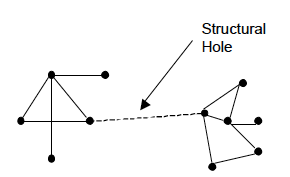
Burt’s theory of structural holes aims to enhance both these benefits to their full potential. A structural hole is “a separation between non-redundant contacts” (Burt, 1992). The holes between non-redundant contacts provide opportunities that can enhance both the control benefits and the information benefits of networks. The figure below shows a graphical representation of this definition.

The concept of non-redundant contacts is extremely important, and refers to contacts who give you access to networks you aren’t already part of. Now let’s look at how Mr. Scoble can increase the Information benefits he gets from Twitter.

Optimizing the benefits of networks

There are several ways to optimize structural holes in a network to ensure maximum information benefits:

  • The size of the network. The size of a network determines the amount of information that is shared within the network. A person has a much better chance to receive timely, relevant information in a big network than in a small one. The size of the network is, however, not dependant merely on the number of actors in the network, but the number of non-redundant actors. In other words, it’s not just about how many people you follow on Twitter, it’s also who you follow.  Pretty straight-forward, but let’s continue.
  • Efficient networks. Efficiency in a network is concerned with maximizing the number of non-redundant contacts in a network in order to maximize the number of structural holes per actor in the network. It is possible to eliminate redundant contacts by linking only with a primary actor in each redundant cluster. This saves time and effort that would normally have been spent on maintaining redundant contacts.  What this basically means is that if you follow people who all follow each other, your network isn’t very efficient and you need to get rid of some people.
  • Effective networks. Effectiveness in a network is concerned with “distinguishing primary from secondary contacts in order to focus resources on preserving primary contacts” (Burt, 1992:21). Building an effective network means building relationships with actors that lead to the maximum number of other secondary actors, while still being non-redundant.  This means that if 10 people give you access to the same network of information, only follow the most important one — their voice will be clearer and not drowned out by the others.
  • Weak ties. In his 1973 paper entitled “The strength of weak ties”, Mark Granovetter (Granovetter, 1973) developed his theory of weak ties. The theory states that because a person with strong ties in a network more or less knows what the other people in the network know (e.g. in close friendships or a board of directors), the effective spread of information relies on the weak ties between people in separate networks. “Weak ties are essential to the flow of information that integrates otherwise disconnected social clusters into a broader society” (Burt, 1992). This basically means that to get more out of Twitter, you need to figure out where your network is weak, and then follow those people who give you access to additional clusters. Building and maintaining weak ties over large structural holes enhances information benefits and creates even more efficient and effective networks.

So here’s the bottom line: to achieve networks rich in information benefits it is necessary to build large networks with non-redundant contacts and many weak ties over structural holes. Some of these information benefits are:

  • More contacts are included in the network, which implies that you have access to a larger volume of information.
  • Non-redundant contacts ensure that this vast amount of information is diverse and independent.
  • Linking with the primary actor in a cluster implies a connection with the central player in that cluster. This ensures that you will be one of the first people to be informed when new information becomes available.

How to get the most out of social media

If we apply these theories to Twitter and other social media networks, we quickly realize it is not the sheer number of “friends” in your network that count, it is the diversity of the people in your network that is most important. If you only have links to people in your immediate group of friends or colleagues, it will be difficult to get new information, since everyone will pretty much know the same things. This is not to say that you have to start following all those random spammers on Twitter, but it does mean that people with who you have “weak ties” will often provide you with new information and therefore more benefits than your “strong ties”.

So here’s how to make sure you get the most out of social media:

  • Identify the information networks you want to have access to (for me, it’s information about user experience design and product management).
  • Go through your following list and see where the overlap is — if there is a lot of resharing going on of the same people, follow the person who gets reshared the most.  This will reduce your Twitter stream but still get you the information you need (and faster than before).
  • Once you’ve reduced your following list, make your network as large as possible with the “weak ties” who will give you access to all the information you need.

These theories show that we can reduce the number of people we follow while actually getting more Information benefits from social media. We will get new information faster, we will get it only once or twice, and the information we get will be more diverse.

References

Burt, Ronald S. (1992). Structural Holes: The Social Structure of Competition. Cambridge: Harvard University Press. Granovetter, M. S. (1973). “The Strength of Weak Ties.” American Journal of Sociology 78: 1360-1380.