Menu

Posts tagged “productivity”

When only some workers in a company are remote

There are lots of great points in Chris Hardie’s Distributed vs. In-Person Teams, an article on the challenges and opportunities of remote work. But this part, in particular, stood out because I’ve experienced it myself:

Having some remote workers is harder than being fully local or fully distributed. […] This dual approach is probably a recipe for disaster when it comes to building shared vision and common culture in an organization. If there are team members who have a daily experience of being in the same space together and sharing all of the quirks and benefits of that, remote workers will almost always feel excluded in some way, culturally, logistically or both. When only part of the team is forced to consider the implications of having a distributed group, an unfair burden falls to the remote worker to keep their needs in front of everyone else. At best it adds a weird kind of tension to team relationships, and without incredible discipline and initiative, it probably won’t work in the long run.

This gets even worse when the remote workers are in different time zones. The remote workers are almost always the ones who have to give up their evenings to do Skype calls.

The downsides of tracking everything about ourselves

As is often the case with these things, I just noticed two articles that make very similar points about the quantified self movement. In Quantify Thyself LM Sacasas makes the point that we don’t know what we don’t measure:

Not only do we tend to pay more attention to what we can measure, we begin to care more about what can measure. Perhaps that is because measurement affords us a degree of ostensible control over whatever it is that we are able to measure. It makes self-improvement tangible and manageable, but it does so, in part, by a reduction of the self to those dimensions that register on whatever tool or device we happen to be using to take our measure.

In a similar vein, Anne Helen Petersen has a great piece on Buzzfeed called Big Mother Is Watching You: The Track-Everything Revolution Is Here Whether You Want It Or Not. Here’s the kicker:

But there’s something to be said for the allure and beauty of the mysteries not only of our confusing, previously unknowable bodies, but the intricacies of life. For the daily banalities of tuning the thermostat, or of knowing you had a good night’s sleep because you feel good, not because an app indicated as much. For the pleasure of running without knowing how fast or how long or how many calories but simply because your body could and did move, and that even without a digital trace, a GPS footprint, or way to leverage evidence thereof against friends and co-workers — it nonetheless felt something like being alive.

What makes online collaboration successful

Smarther Than You Think

I just finished Clive Thompson’s Smarter Than You Think: How Technology Is Changing Our Minds for the Better and really enjoyed it. So much of what we read about technology these days is doom and gloom that I wanted to spend time on something a little more positive. And turns out, there’s much to be positive about.

There are many stand-out moments in the book. One is the exploration of ambient awareness — how social media often makes our in-person connections stronger because we know so much about each other’s minutia that we can skip the small talk and jump straight to the important stuff when we see each other. But the part I want to elaborate on a little bit here is what historical events tell us about the important criteria to meet for collective thinking to be successful.

Clive points out four important aspects of successful online collaboration:

  1. Collective thinking requires a focused problem to solve. One disastrous story Clive tells is when the LA Times create a wiki page on the Iraq War and encouraged people to edit it. No focused outcome = a rapid decline into the bottom half of the internet. But give people a common problem to solve — like “Which tent hospitals in Cairo need help, and what do they need?”, and people start to shine together.
  2. Collective problem solving requires a mix of contributors. Specifically, it needs to have really big central contributors, and then a lot of people making small contributions to push the solution forward. As Clive puts it, “these hard-core and lightweight contributors form a symbiotic whole,” coming up with the best solution in the fastest possible way.
  3. Collective thinking requires a culture of “good faith collaboration”. Contributors need to struggle constantly to remain polite to each other. And it is a struggle, but a necessary one. As Anil Dash once said, if your website’s full of assholes, it’s your fault.
  4. To be really smart an online group can’t have too much contact with each other. This sounds counterintuitive, but the evidence supporting the point is pretty overwhelming. Clive goes over a few examples that shows that “traditional brainstorming simply doesn’t work as well as thinking alone, then pooling results.” This also explains why Design Studio is such an effective way to solve design problems. So one of the secrets of online collaboration is that it “inherently fits the model of people working together intimately but remotely,” as Clive puts it.

There’s much more to say about the book, but I think I’ll stop here and just encourage you again to read it. You’ll agree with a lot of it, disagree with some of it, and think about all of it for days after finishing it. That’s all we could ever ask of a book.

Product management and context-switching

In Avoiding product management whiplash Hemal Kuntawala describes the constant context-switching that PMs need to do as they move from strategy to execution and back:

Each phase of product development requires a different perspective, almost a different mindset. At one end of the scale you have a big-picture view of the world, like looking at the market you’re in and hypothesising new value propositions. At the other end you have nitty-gritty details like the pixels and font-sizes of your UI.

I like the gentle slopes of the sine wave he uses as illustration, although I think in reality the back-and-forth is a lot less gentle…

Using Mail.app as a replacement for Outlook for Mac

The biggest problem that many Mac users struggle with is that we work for organizations that use Exchange for email and calendar management. This means that, in most cases, we have to use Outlook for Mac if we want the majority of basic tasks to work. It’s an application that is so ugly and bug-ridden that most people look like this every time they open it:

Outlook

The problem is that traditionally it’s been pretty difficult to make OS X’s Mail.app play well enough with Exchange to be a viable replacement. For my personal use case there were a few things that always held me back:

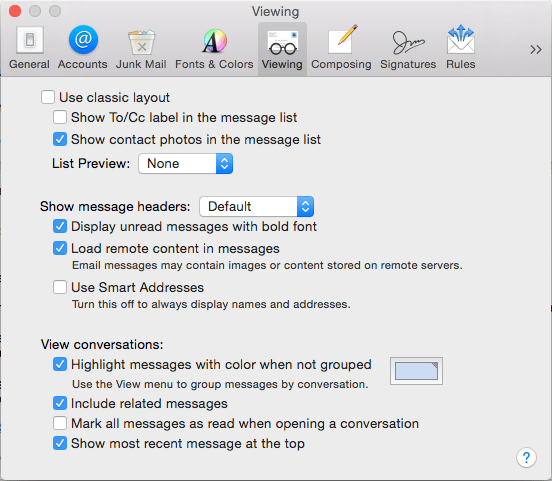
  • The default view settings are not conducive to effectively manage a lot of email.
  • No keyboard shortcuts to move messages into folders.
  • All other email programs display the default system font when it receives an email generated in Mail.app — in Office for Windows this is Times New Roman.

I think I’ve finally addressed these issues enough to make Mail.app my primary mail application and ditch the horrors of Outlook. But you’ll need a few settings and plugins to get that done.

View options

I like the simple, friendly list view that these options give me. Try it out:

View options

Shortcuts for moving messages

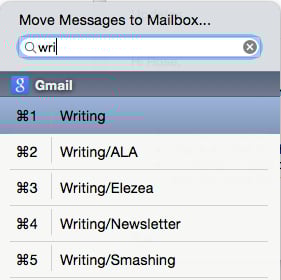
Mail Act-On 3 is an essential extension. It does a bunch of different things, but for the best feature is that you can map a key to moving messages to a different folder (I use “v” to match Gmail’s shortcuts), and then use type-ahead to pick the right folder:

Move messages

Changing the default font

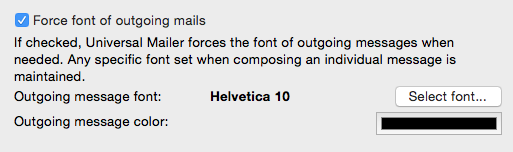
Universal Mailer is another powerful plugin that just makes Mail.app work better, but its best features is that you can set a system font that is respected by other email programs:

Force font

Unexpected bonus features

Switching to mail brings a bunch of great things with it that you don’t get in Outlook:

  • Smart folders that can bring a bunch of different emails together based on specific criteria you set.
  • Great integration with iOS, since it takes advantage of handoff.
  • Fast email that’s not ugly.

All I’m saying is, give it a try. Your eyes will thank you.

Do what you love?

My latest column for A List Apart is called How to Do What You Love, the Right Way, and it’s out today. It’s a response to that mantra we hear so often, and loosely based on a rant by Merlin Mann on one of his Back to Work podcasts. Here’s the gist:

Doing what you love doesn’t necessarily mean quitting your job and starting a coffee shop. Most often, it means building your own platform, and crafting your own work, one step at a time.

Single-purpose products

Craig Mod discusses single-purpose products in his product design essay There is much to learn from the paper towel:

All of these single-purpose tools or philosophies strive towards the same goal: whittle away the cruft around an idea to reveal its most base components, and in doing so, strengthen what is left.

The single-purpose lecture attendee is, in theory, a better student. The single-purpose-sized paper towel makes us happier, is gentler on the earth. Individual tools in unix are more efficient and easier to debug because of their specificity. Facebook Messenger on its own is easier to use to communicate without the deluge of Facebook notifications flying in our faces. And so on and so forth.

I’ve started using Craig’s solution for single-purpose Twitter notifications and single-purpose Facebook messages and it works really well.

Want to do something? Begin now.

Who doesn’t love Ira Glass? What a legend. His I’m Ira Glass, Host of This American Life, and This Is How I Work feature in LifeHacker is really good:

I’d just say to aspiring journalists or writers—who I meet a lot of—do it now. Don’t wait for permission to make something that’s interesting or amusing to you. Just do it now. Don’t wait. Find a story idea, start making it, give yourself a deadline, show it to people who’ll give you notes to make it better. Don’t wait till you’re older, or in some better job than you have now. Don’t wait for anything. Don’t wait till some magical story idea drops into your lap. That’s not where ideas come from. Go looking for an idea and it’ll show up. Begin now.

I also loved this response to the question What’s your best time-saving shortcut/life hack?:

I’ve got nothing. Reading other people’s answers to this question on your website today made me realize I live my life like an ape. I eat the same breakfast and lunch everyday, both at my desk. I employ no time-saving tricks at all.

So, I guess in related news, I bought making-it-right.com and I don’t know maybe it will become something, maybe not…

[Sponsor] Tower 2: the Git client for your Mac

Huge thanks to Tower 2 for sponsoring the site this week!

Version Control is an essential tool in today’s web and software world and a fundamental part of the workflow in teams large and small.

We believe that version control with Git should be easy. And why not beautiful?

It’s not about the command line or a Gui. It’s about how to be more productive, avoid mistakes and make your life easier.

With Tower 2, we’ve worked hard to make the best Git client even better. Completely redesigned and reengineered, Tower 2 comes with more than 50 additional features, a brand new design and an outstanding performance.

We believe we’ve made a tool that helps you to become a better professional.

Download the free trial today and see for yourself.

Tower 2

Sponsored via Syndicate Ads

Destroy email! No, don't!

In Doomed to Repeat It Paul Ford discusses our obsession with email and to-do list apps, and he makes an interesting point about this form of communication that we all love to hate:

Is there another form of communication besides email where the acknowledged goal is to hide all of the communication? Email has evolved into a weird medium of communication where the best thing you can do is destroy it quickly, as if every email were a rabid bat attacking your face. Yet even the tragically email-burdened still have a weird love for this particular rabid, face-attacking bat. People love to tweet about how overwhelming it all is. They write articles about email bankruptcy and proclaim their inbox zero status. Email is broken, everyone agrees, but it’s the devil we know. Besides, we’re just one app away from happiness. A tremendous amount of human energy goes into propping up the technological and cultural structure of email. It’s too big to fail.

There’s also these two little gems from the article:

Doing the work, responding to the emails—these all suck. But organizing it is sweet anticipatory pleasure.

Working is hard, but thinking about working is pretty fun. The result is the software industry.

And while we’re on the topic of email, here’s something else I’ve noticed recently:

“We’re implementing a new system to reduce our reliance on email.” “Cool, how will I know there’s an update for me?” “You’ll get an email.”

— Rian van der Merwe (@RianVDM) July 15, 2014